
NEWS
Komyshuvakha Deaths Rise as Patriot Magazines Run Dry
Rescuers still pull bodies from a Monday aid shelter in Komyshuvakha as Ukraine’s Patriot stocks sit empty and US-brokered talks close on a prisoner swap.

Police in Zaporizhzhia recovered two more bodies from a crushed school in Komyshuvakha on 12 November, the 11th day after Russian jets bombed a Monday aid line. Experts have named 48 of the dead. US-brokered talks in Abu Dhabi had just closed on a prisoner swap, with no ceasefire and no deal on land.
The bombs got through a sky Ukraine can no longer close. President Volodymyr Zelensky went to Berlin in the days after the strike to ask for Patriot interceptors. German stocks, his hosts said, are spent.
Two More Bodies on the Eleventh Day
Zaporizhzhia Oblast Police said the two bodies, and incomplete remains of other victims, came up after three days of empty searching. Investigators, forensic teams and State Emergency Service crews are still on the crater. Anti-drone units cover them from the air. Extra rescue groups have come in from Dnipropetrovsk, Ivano-Frankivsk and Kharkiv, with dog teams from Sumy, Cherkasy, Dnipropetrovsk and Donetsk.
THE TOLL ON 12 NOVEMBER
- Bodies by 7 November: Rescuers had pulled 55 people from the rubble, the State Emergency Service said.
- Named by 12 November: Experts have identified 48 of those killed, police said.
- Still missing: On 9 November police said 19 people could still be under the building; 30 of the 55 bodies had been identified by then.
- Among the dead: Four police officers and two State Emergency Service rescuers, Denys Konovalenko and Oleksiy Suschevskyi, both 44.
Police said officers are still trying to establish the fate of people listed as missing and to give families a burial. On 8 November a Russian drone hit emergency workers as they cleared debris and damaged their gear. The search has been a sieve through dust, smoke and charred fragments, not a simple lift of intact bodies.
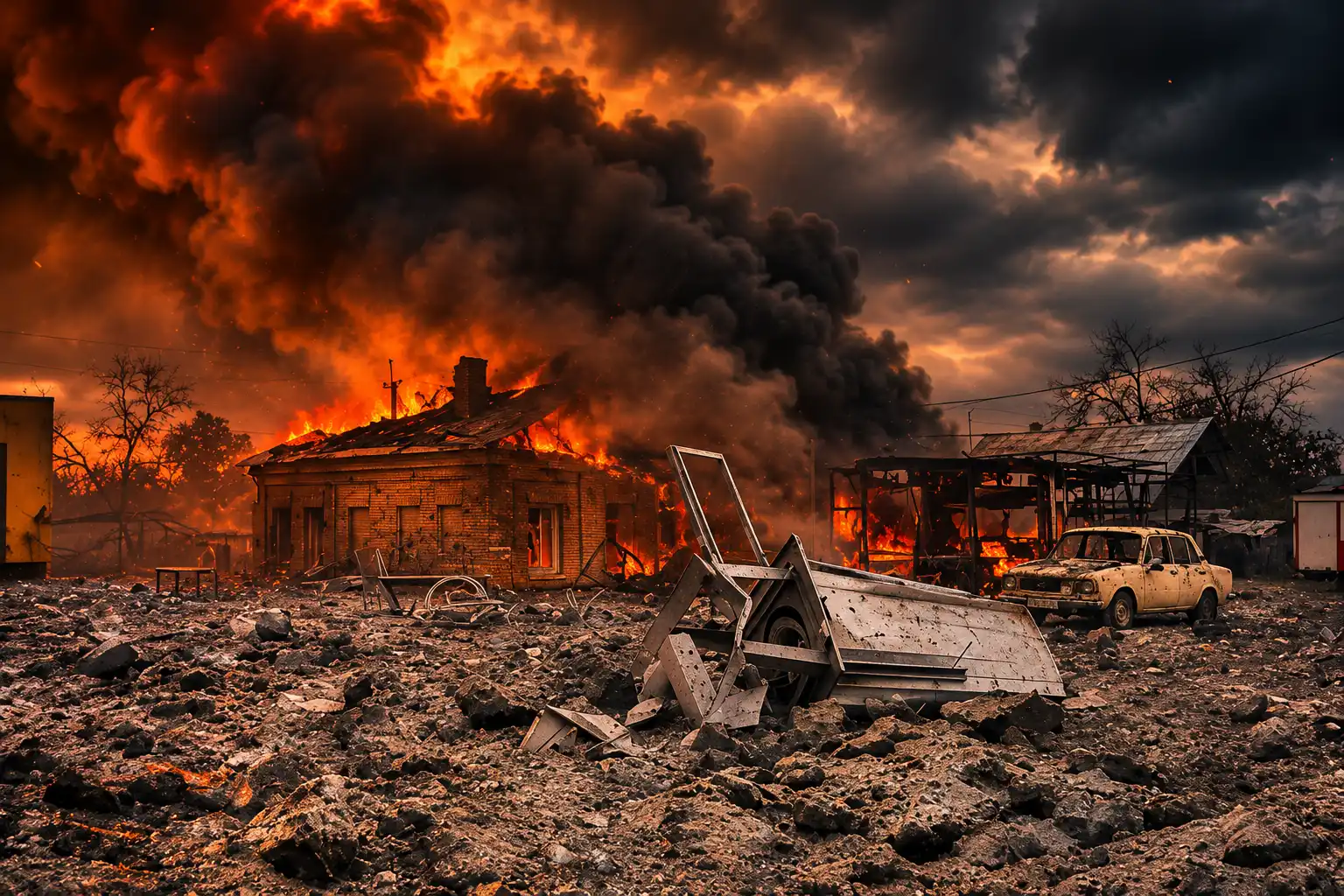
Nine Bombs Hit a Monday Aid Line
Komyshuvakha sits about 30 km south-east of the city of Zaporizhzhia, on the road net that feeds Ukraine’s positions on the approaches to the regional capital. The building was the local gymnasium. After students were gone it was used as a resilience centre and, every Monday, as a place to hand out bread and aid.
Ukraine’s Defence Intelligence, HUR, says the first wave was not the killing blow. two bombs then a FAB-3000 on the shelter is the sequence it published: two aerial bombs hit the gymnasium grounds, then a second strike put a 3,000 kg FAB-3000 directly onto the underground shelter where people were receiving help. Ukrainian officials said Russian aircraft dropped at least nine guided bombs on the settlement that morning.
THE MORNING THE SHELTER FELL
- 2 November, about 10 a.m.: Residents gather at the former school for the weekly aid handout.
- First wave: Two bombs hit the gymnasium grounds. Police and rescuers move in. People are pushed into the underground shelter.
- Second wave: A FAB-3000 strikes the shelter. The roof comes down. A fire starts below ground.
- Night of 2-3 November: More guided bombs and drones hit the village. Rescue crews keep leaving the crater to take cover.
- 3 November: HUR reports 31 dead, including four police officers and two rescuers, five wounded, and almost 50 missing.
- 7 November: The recovered-body count reaches 55. HUR names a Russian colonel and six pilots.
- 12 November: Two more bodies and incomplete remains come out of the rubble. Forty-eight of the dead have been identified.
Police body-camera footage from the first minutes shows officers going down into the basement with residents after the opening bombs. The cameras kept recording until the second wave. Illia Ponomarenko, a Ukrainian war correspondent, wrote that none of those officers made it out. Russia’s defence ministry said the raid targeted Ukrainian military units around Komyshuvakha and two other settlements and killed 25 servicemen. HUR and local authorities describe a school used for civilian aid. There are no major military or industrial plants in the settlement. Moscow’s line that the target was a drone hub still has defenders. The Monday aid schedule and the police cameras sit against that claim.
Zelensky called the strike one of the largest mass killings Russia has committed in this war. He later told an Ibero-American summit that nearly a hundred people in that one settlement might have died in a single day. “The Russians knew exactly what they were striking,” he said, asking partners not to stay silent.
Ukraine Names the Su-34 Crews
On 7 November, HUR named the colonel and six Su-34 crew it says planned and flew the raid. It put four Su-34 jets over the village and said a further crew is still being identified. The agency listed the raid as a war crime and tied the aircraft to tactical aviation group No. 5, drawn from the 11th mixed aviation regiment and the 559th bomber regiment.
THE CREWS HUR HAS NAMED
| Name | Rank and role |
|---|---|
| Fyodor Vladimirovich Zubakov | Colonel; head of the fire-engagement group, Dnepr Group of Forces headquarters; alleged planner |
| Sergei Yeliseyev | Captain; Su-34 aircrew |
| Dmitry Zverev | Captain; Su-34 aircrew |
| Rodion Plotnikov | Senior lieutenant; Su-34 aircrew |
| Nikita Ignatyev | Senior lieutenant; Su-34 aircrew |
| Maksim Sokolenko | Senior lieutenant; Su-34 aircrew |
| Vadim Perekhrest | Lieutenant; Su-34 aircrew |
A FAB-3000 is a three-tonne high-explosive bomb. Fitted with a glide kit it can be released tens of kilometres from the target, which is why a village this close to the line is reachable even when fighters stay back. HUR says the weapon used on the shelter held more than 1,000 kg of explosive. These bombs are not daily tools. Russia has used them on deep, hardened structures. An underground school-turned-aid-point is that kind of target if the aim is to collapse the basement, not to crater a field.
Why the Glide Bombs Keep Getting Through
Zelensky said in Berlin that the front line was stable and the air war was not, “particularly when it comes to our air defence capabilities and the protection of our civilian population.” The Komyshuvakha crater is what that sentence looks like on the ground. Guided bombs and ballistic missiles are cheap to throw at a Monday crowd if the other side is out of the missiles that stop them.
On the night of 7 November, five days after the school was hit, Zelensky said Russia fired 36 missiles on ballistic paths and Ukraine shot down four. He described a serious shortage of Patriot interceptors and said the United States was best placed to fill it. He has asked Washington for a winter package of 100 interceptors a month from existing stocks, and said he is ready to buy rather than wait on aid. On 30 October the United States approved a sale of 500 PAC-3 missiles. Zelensky called that a strong decision and warned that deliveries may begin only in a few years.
WHAT ZELENSKY ASKED AND WHAT ARRIVED
| Item | Figure |
|---|---|
| Ballistic missiles Ukraine faced, night of 7 November | 36 fired, 4 shot down, per Zelensky |
| Winter package Zelensky requested from stocks | 100 Patriot interceptors a month |
| US-approved PAC-3 sale, 30 October | 500 missiles; Zelensky said deliveries may take years |
| German stocks, 7 November | Defence Minister Boris Pistorius said Berlin cannot send more Patriots without opening gaps at home |
Pistorius said anything Germany gives now cannot be replaced for the time being, and that more is not possible. He told other allies to carry more of the air-defence load at the next Ramstein-format meeting in mid-November. Zelensky met him in Berlin on 4 November, two days after Komyshuvakha, to press for faster PAC-2 deliveries on a two-year German contract. European magazines are at a floor. New factory rounds are a 2027 problem. The FAB-3000 over Komyshuvakha was a 2 November problem.
A Hospice, a Hospital and a City Without Water
The same hours that buried the aid line also hit care for the dying, a hospital ward and the capital’s taps. These were not stray rounds on empty sheds. They were strikes on places civilians cannot move out of on a warning siren.
THE SAME HOURS, OTHER CITIES
- Dnipro hospice: A Russian missile wrecked a hospice. Mayor Borys Filatov said nearly 50 terminally ill patients were being moved, the oldest 90. The city had only just renovated the wards.
- Kharkiv hospital: Zelensky said 73 people were wounded, most of them elderly patients, when a hospital was hit.
- Kyiv water and metro: Kyivvodokanal said the water supply was cut off after attacks on the capital’s energy kit. The metro shut. Mayor Vitali Klitschko said the power situation was becoming very difficult.
- Donetsk region: Five more people were killed in aerial bomb and drone strikes, officials said.
I realise that I am violating ethics. I want as many people as possible to see these photos. Especially politicians and diplomats. Especially abroad. These are elderly, terminally ill people. This is a Russian missile.
Borys Filatov, mayor of Dnipro, on Telegram
Filatov posted pictures of elderly patients in beds under blown-out windows, with glass and rubble on the floors. In Dnipro, regional governor Oleksandr Hanzha said one person was killed and 17 wounded in the wider attack, with 20 apartment blocks damaged and more than 1,000 windows smashed. A water intake was hit, leaving the old part of Prydniprovsk dry. Russia has also struck energy kit in nine regions, cutting water and heat as the heating season starts.
Abu Dhabi Closed on a Prisoner Swap
While rescue dogs worked the Komyshuvakha crater, delegations from Ukraine, Russia and the United States sat in Abu Dhabi on 10 and 11 November. It was the first three-way meeting since February. Day one ran about four hours. Day two ran less than two. The only hard result both sides confirmed was a large prisoner exchange in principle. There was no ceasefire and no movement on territory.
Zelensky, who was not in the room, said negotiators had discussed a swap of 1,000 prisoners each, perhaps 1,500. Russian officials spoke of more than 1,000 from each side over two to three weeks. US envoy Jared Kushner said the numbers would be finalised on 12 November and called it the biggest humanitarian release of prisoners. He also said the talks had been tough after almost eight months apart. Russian delegation head Vladimir Medinsky said the core subject was the European security system, with understanding in some places and not in others. Ukrainian negotiator Rustem Umerov said large differences remain.
On 12 November, as police pulled two more bodies from the school, Kushner and fellow envoy Steve Witkoff were due in Moscow to see Vladimir Putin, then to meet Zelensky, who arrived in Ireland that day. Zelensky had already said in Berlin that he had not seen any sign Russia was serious about a ceasefire. Several rounds late last year produced nothing. In public, Russian officials have not stepped back from demands that amount to Ukrainian surrender. A prisoner swap is real for the people who come home. It does not put a Patriot round in a launcher, and it does not keep a Monday aid line from being a known, packed target.
Civilian Deaths Are Already at a Record Pace
Komyshuvakha is one crater in a year the UN mission is already calling the deadliest stretch of the full-scale war for civilians. The Human Rights Monitoring Mission in Ukraine verified 328 civilians killed in September 2026 and 2,105 injured, the highest September since the invasion began, and 85 per cent above September 2025. From January to September it verified 2,570 civilians killed and 15,211 injured, 59 per cent above the same stretch of 2025 and more than twice 2024.
SEPTEMBER’S CIVILIAN TOLL
- Long-range weapons: Missiles and drones caused 53 per cent of September’s civilian casualties (165 killed, 1,119 injured).
- Short-range drones: The second cause, 23 per cent (87 killed, 475 injured).
- Kyiv: 32 killed and 340 injured, with civilian casualties on 22 of 30 days, more often than in any previous month of the war.
- Where people died: Harm was recorded across 22 regions and Kyiv city; Kherson, Sumy and Zaporizhzhia were also hard hit.
A June UN Human Rights Office report on the last winter found that systematic strikes on energy kit drove a 40 per cent rise in civilian deaths and injuries in its reporting window, and counted 423 attacks on electricity facilities last winter, plus at least 74 on combined heat and power plants and other heating kit. The office said generation capacity cannot be fully restored before the next winter. Russia has now opened that campaign again. Glide bombs, the same family of weapon that opened the Komyshuvakha gymnasium, are a rising share of the harm near the line.
On 12 November the crater was still a worksite. Two more bodies. Forty-eight names. Nineteen people still unaccounted for under a school that had been handing out bread. In Moscow, American envoys were due to walk into a room with Putin carrying a prisoner list and no new interceptors for the sky that let the FAB-3000 in.

Airbnb Starts House Rules Reviews as Cities Rewrite Contracts

United’s Computers Failed the Day After Kirby Blamed ATC

Tyson Foods Guides Beef Losses Narrower as Chicken Cools

Saudi Arabia’s Leisure Tourism Falters as Pilgrims Still Come

Himesh Patel Confirms the X-Files Writers’ Room Is Open

AI Server Boards Put Everyday Circuit Materials on Allocation

Glacier Collapse Buried Nepal’s Hydropower Workers in Tunnels

Congo’s Bundibugyo Outbreak Outruns the Licensed Ebola Shots

Pennsylvania Measles Deaths Follow a Long Slide in Coverage

CISA’s Known Exploits Still Come From 2007-Era Bugs
-
 NEWS2 months ago
AI Server Boards Put Everyday Circuit Materials on Allocation
-
 NEWS3 months ago
Glacier Collapse Buried Nepal’s Hydropower Workers in Tunnels
-
 NEWS3 months ago
Congo’s Bundibugyo Outbreak Outruns the Licensed Ebola Shots
-
 NEWS3 months ago
Pennsylvania Measles Deaths Follow a Long Slide in Coverage
-
 NEWS3 months ago
CISA’s Known Exploits Still Come From 2007-Era Bugs
-

 NEWS3 months ago
Germany Can Miss Its 2026 Climate Cap Without Penalty
-

 NEWS3 months ago
Texas Judge Freezes the SEC Eligibility Ban for 41 Athletes
-

 BUSINESS3 months ago
Trump’s Venezuela Oil Deal Leaves the Barrels in the Ground