
NEWS
Congress Revives a Cloud Ban After Nvidia’s Spy Scandal
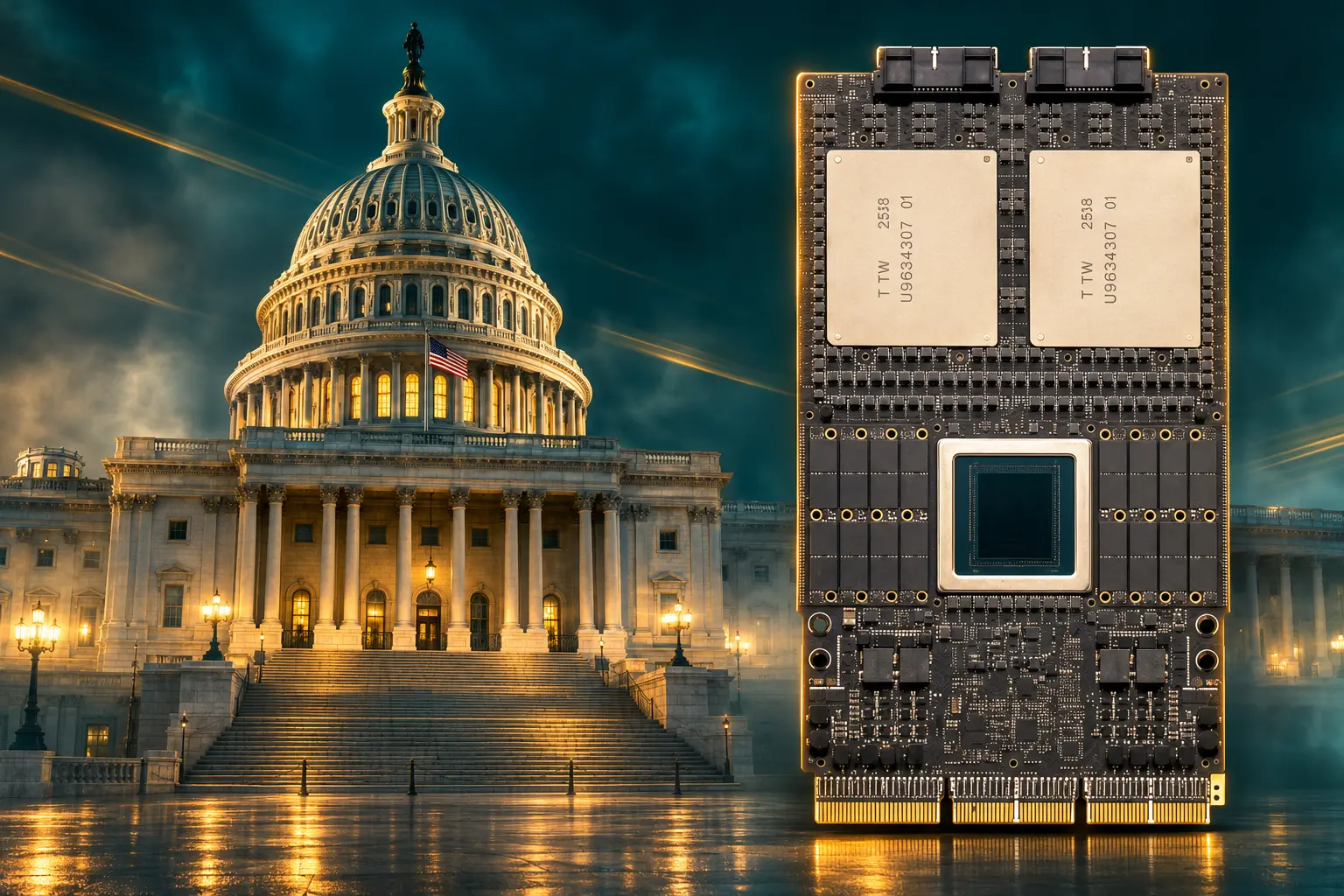
Congress is using the Nvidia spy scandal to revive a 369-22 bill treating cloud access to AI chips as an export.

The House passed a 369-22 bill in January to treat cloud access to AI chips as an export. That file has sat in the Senate since January 13, 2026. The Nvidia spy scandal has now put it back on the calendar, along with a demand that Jensen Huang testify.
Physical bans already stop many shipments to China. They do not stop a lab from renting the same chips in Malaysia, Singapore, or Virginia. That gap is what lawmakers are trying to close.
The House Already Voted 369 to 22
Rep. Michael Lawler, a New York Republican, introduced H.R. 2683 on April 7, 2025. The House passed it on January 12, 2026, by 369-22. The clerk recorded the vote as roll No. 13, on a motion to suspend the rules. The Senate received the bill the next day and sent it to Banking, Housing, and Urban Affairs. It has not come out.
The statute the bill would amend, the Export Control Reform Act of 2018, covers exports, reexports, and in-country transfers. For years that has meant a crate, a board, a serial number crossing a border. A login from Shanghai to a rack in Jakarta does not move the crate. The House-passed Remote Access Security Act would put that login on the same list, and let the Bureau of Industry and Security license it or punish it.
House Speaker Mike Johnson said on November 12, 2026, that there is growing consensus in Congress on limiting chip exports to China, and that he supports keeping powerful Nvidia parts out of Beijing’s reach. The consensus he described is not a new idea born of one affair. It is an old House vote looking for a Senate vehicle, with Huang’s fall as the shove.
A Singapore Firm Sat Between Nvidia and China
Huang resigned on November 12, 2026, as chief executive of the company he has led since 1993. He had already told staff he had been unfaithful to his wife. The relationship that blew up the week was with Alice Huang, an executive at Megaspeed, a Singapore company that buys Nvidia chips. The two Huangs are not related.
U.S. officials had treated Alice Huang as an intelligence target for months. The Justice and Commerce Departments opened a probe of her firm in 2024 as part of a wider look at shell companies suspected of diverting restricted Nvidia chips toward China. After intercepts were unmasked, Secretary of State Marco Rubio circulated a classified memo to a small group of senior officials, including the White House. President Donald Trump had been briefed and still, in December 2025, allowed licensed H200 sales into China.
The spy claim itself is not settled. Democratic Rep. Jim Himes, the ranking member of the House Intelligence Committee, said after a classified briefing that he still did not know the relationship between Alice Huang and the Chinese government, or what influence or information was traded. Other officials disagree on whether the Ministry of State Security recruited her to target Jensen Huang. Megaspeed’s role as a middleman is a separate, older complaint, and it is the one that maps onto the export bills.
WHAT WE KNOW
- The resignation: Huang left Nvidia on November 12, 2026, after admitting he had been unfaithful and after the board opened an independent inquiry into a reported foreign intelligence effort.
- The customer: Alice Huang worked at Megaspeed, a Singapore Nvidia customer that U.S. agencies have scrutinized for suspected diversion of advanced chips.
- The House ask: Reps. Brian Mast, John Moolenaar, and Rick Crawford first asked Huang on November 4, 2026, for a closed briefing, then sought a transcribed interview on December 1.
WHAT IS UNCONFIRMED
- The spy finding: U.S. intelligence has not, on the public record, closed the question of whether Alice Huang was an MSS officer or a businesswoman with risky ties.
- The leak path: No public charging document shows what, if any, Nvidia secrets or U.S. policy detail moved through the relationship.
- The Entity List delay: Treasury Secretary Scott Bessent says other cabinets wanted Megaspeed listed for months; Commerce has not put that delay in its own words.
Senators John Curtis, a Utah Republican, and Lisa Blunt Rochester, a Delaware Democrat, put the middleman problem in a November 13 letter to Commerce Secretary Howard Lutnick. They wrote that Inspur is on the Entity List, yet its U.S. subsidiary Aivres shipped at least $5.6 billion of advanced gear to Southeast Asia over two years, including more than $3 billion of computers with Blackwell chips, later used by firms such as Alibaba and ByteDance. They also wrote that the Carnegie Endowment for International Peace has documented at least 11 state-linked Chinese entities seeking chips through cloud services. If licenses are limited by geography, they warned, China will simply rent access to chips elsewhere.
What Remote Access Rules Would Change
The House text is short and mechanical. It defines remote access as a foreign person reaching a U.S.-controlled item through a network, including the internet or a cloud service, from somewhere other than where the item sits, when the commerce secretary finds a serious national-security or foreign-policy risk. It then writes “or remote access” through the licensing, penalty, and enforcement sections of the 2018 law, including “the provision thereof.”
Senators Dave McCormick, a Pennsylvania Republican, and Ron Wyden, an Oregon Democrat, filed a Senate companion, S.3519, on December 17, 2025, with Sens. Tom Cotton and Chris Coons. McCormick’s case is that the current statute has a hole, not a staffing problem.
Under current law, bad actors can train AI models by accessing advanced chips under the jurisdiction of the US, and the Bureau of Industry and Security has no authority to require a license.
Sen. Dave McCormick, press release on S.3519, December 17, 2025
Wyden said foreign countries should not be able to end-run export bans on American technology just by accessing servers over the internet. The McCormick-Wyden release gives a concrete case: a Chinese firm that wants to rent a cluster of controlled chips in an overseas data center could be told to get a license. It names three high-risk uses the sponsors want covered, including training models for weapons, automated cyber attacks, and tools for offensive cyber operations.
WHAT THE HOUSE TEXT ADDS
- The definition: Remote access includes a network or cloud login to a controlled item from a place other than where the hardware sits.
- The license: BIS could grant, condition, or deny that access the way it now treats a physical export.
- The penalty: Providing the access, not only shipping the box, could draw the same civil and criminal tools already in the 2018 act.
- The notice: Commerce would have to keep House Foreign Affairs and Senate Banking informed as it wrote the rules, including in a classified setting if needed.
That last point is why the scandal and the bill snapped together. If McCormick is right that BIS has no authority to require a license for a remote session, then listing Megaspeed after the fact still leaves a Chinese researcher one leased hour away from a Blackwell rack in a third country. Lawyers at Baker McKenzie have made the same statutory point to trade reporters: current law does not clearly let Commerce regulate remote computing access. The House already voted as if it agreed.
Three Chip Bills Sit in the Senate Defense Package
Hawks are not waiting on Banking. They are trying to hang chip curbs on the National Defense Authorization Act, the must-pass defense bill. Three measures are in the Senate’s NDAA management package: the Chip Security Act, the AI Overwatch Act, and the MATCH Act. RASA is the fourth vehicle, still on the Banking calendar, and some sponsors want it in the year-end bundle too.
Nvidia has been described by a former congressional staffer who dealt with the company as the biggest opponent of Chip Security and AI Overwatch. The Semiconductor Industry Association, whose members include Nvidia, wrote in March 2026 that the tracking mandates were new, untested, and potentially infeasible. Rep. Bill Foster, an Illinois Democrat and a Chip Security cosponsor, said Nvidia people told him the opposite in technical talks, in words he summed up as “yeah, of course we can do this,” with nothing in writing. Nvidia’s Fleet Intelligence software can already show which country a customer’s chips are in.
THE CHIP BILLS NOW IN PLAY
| Bill | What it would do | Where it stands |
|---|---|---|
| Remote Access Security Act (H.R. 2683) | Treat cloud or network access to controlled chips as an export | Passed House 369-22 on January 12, 2026; Senate Banking since January 13 |
| Chip Security Act | Require location checks on advanced AI processors after shipment | House Foreign Affairs 42-0 on March 26, 2026; in the Senate NDAA package |
| AI Overwatch Act | Give Congress a veto-style look at licenses for advanced chips to countries of concern | In the Senate NDAA package |
| MATCH Act | Push allies to tighten sales and servicing of chipmaking equipment bound for China | In the Senate NDAA package |
Moolenaar, who chairs the House Select Committee on China, said after Huang’s resignation that Nvidia must change its corporate practices and that Congress must pass bipartisan export-control legislation in the year-end defense bill. He took that case to Face the Nation on November 15.
Recent developments in the ongoing NVIDIA scandal have raised alarming national security concerns. Chairman @RepMoolenaar joins @FacetheNation to lay out why Congress must safeguard Americas AI dominance by codifying crucial export control legislation in the coming weeks. pic.twitter.com/RbxmXIIF8M
— Select Committee on China (@ChinaSelect) November 15, 2026
House Minority Leader Hakeem Jeffries is already pushing to use the defense bill for the Senate package. Senate Democratic Leader Chuck Schumer has called for a full accounting of what Trump knew about the alleged spying and how Huang shaped the administration’s decision to let Nvidia sell advanced chips to China for a cut of the proceeds. Those are votes that still have to be counted. None of the four bills is law.
Bessent Says Enforce the Rules You Have
The White House is not speaking with one voice. Bessent went on Fox News on November 15 and drew a line under the entire legislative surge.
I don’t think we need the legislation. We have all the rules we need, we just need them enforced.
Scott Bessent, Treasury secretary, on Fox News, November 15, 2026
He has spent the week blaming Lutnick’s department, not the statute book. On November 13 he said Treasury, War, the U.S. Trade Representative, and State had favored putting Megaspeed on the Entity List for months, but “Commerce has the pen.” He said Trump had been clear that China should not get Nvidia chips above the H100 class, and that leakage was frustrating. Senior White House officials have discussed whether Lutnick should be pushed out. A White House official said the same day that Trump maintains complete confidence in him.
Bessent’s enforcement point and McCormick’s authority point can both be true at once. Listing a Singapore reseller is an Entity List action under rules Commerce already runs. Licensing a remote hour on a U.S.-origin GPU in a Jakarta hall is the thing McCormick says those rules do not reach. The scandal mixed the two until they sounded like one demand.
WHERE EXPERTS DISAGREE
- Bessent: The tools exist; the failure was Commerce’s delay on Megaspeed and on diversion through Southeast Asian shells.
- McCormick and Wyden: BIS cannot require a remote-access license until Congress amends the 2018 act.
- Foster versus the industry group: Chip-location tracking is doable, in Foster’s private technical talks with Nvidia, and untested or potentially infeasible, in the Semiconductor Industry Association’s March letter.
Senator Richard Blumenthal was blunter still. “Lutnick must go,” he wrote, arguing that making powerful Nvidia chips available to China through an apparent spy undercut national security and economic competitiveness. Senator Chris Coons said Huang has spent years lobbying Trump to allow advanced AI chip sales to China, and that Congress needs answers about those ties and what the president knew. The personnel fight is loud. It does not pass RASA.
Licensed H200 Shipments Were Less Than 1 Percent
The legal sales channel into China is already tiny. Nvidia’s 10-Q for the quarter ended July 26, 2026, posted revenue of $96.2 billion, with Data Center revenue of $89.0 billion. Licensed H200 shipments to China-based customers, the company told investors, accounted for less than 1 percent of Data Center revenue in that quarter. Beijing, not only Washington, blocked the full licensed volume. Nvidia took a $0.4 billion charge tied to excess H200 inventory in the first half of its fiscal 2027.
The same filing books $7.88 billion to customers headquartered in China, including Hong Kong. That line is not the H200 license tally. Nvidia counts geography by the direct customer’s headquarters and warns that the end customer and the shipping location may differ. A Singapore or Malaysian buyer that then serves a Chinese lab does not land on the China row. That is why a crackdown on remote access and on Southeast Asian resellers can hit a much larger flow than the licensed H200 trickle.
NVIDIA’S CHINA CHANNELS IN THE JULY QUARTER
- Company revenue: $96.2 billion for the quarter ended July 26, 2026.
- Data Center: $89.0 billion, the base for the H200 license share.
- Licensed H200 to China: less than 1 percent of Data Center revenue, with PRC limits on the permitted volume.
- China-headquartered customers: $7.88 billion, a headquarters count, not a map of end use.
Nvidia also flagged the Senate file by name. The 10-Q says Congress is considering the Remote Access Security Act, which could prohibit cloud services to China-parented firms, and that new restrictions on cloud providers and OEMs could have a material impact on the business. That sentence was in the filing in August, months before Huang resigned.
The licensed H200 path itself is the other fight Wyden wants on paper. In a November 12 letter with Rep. Richard Neal, he described a December 2025 deal: Taiwan-made H200s would enter the United States for a security review, Trump would collect a 25 percent tariff on H200 chips under Section 232, and Commerce would then license them onward to Chinese buyers. Wyden called that an unconstitutional export tax. He wrote that Commerce had approved sales to cutout companies with no physical presence at listed addresses, and that a Megaspeed inquiry was halted after outreach from Nvidia. He asked Lutnick to preserve the Section 232 semiconductor file, Nvidia license records, and communications with Huang. He also wrote that Huang and Nvidia had directed at least $26 million toward Trump’s personal priorities, including the White House ballroom. Those are allegations in a records letter, not findings.
Huang Faces a December Calendar of Hearings
Huang has agreed to brief the House panels, according to Moolenaar, without a subpoena. Senate Banking Chairman Tim Scott still put a date on a public hearing and warned he could compel testimony if Huang stayed away. Lutnick, Scott wrote, should appear a week later on Commerce’s handling of Nvidia and of reports that raise national-security concerns. The department has said Lutnick proactively agreed to appear.
Nvidia named chief financial officer Colette M. Kress interim CEO and hired Wachtell, Lipton, Rosen & Katz to run the board’s inquiry. Bessent said the board should go outside the company for a permanent chief, that the culture needed a dramatic shake-up, and that he wanted answers in the next 10 days from the board and outside counsel on whether Nvidia pressed “seemingly illicit” sales through Singapore shells to goose earnings. He asked whether the failure was low-level, in the middle, or in the C-suite.
THE PATH TO THE DECEMBER HEARINGS
- April 7, 2025: Lawler introduces the Remote Access Security Act in the House.
- December 17, 2025: McCormick and Wyden file the Senate companion.
- December 2025: Trump permits licensed H200 sales to China under the Section 232 tariff route.
- January 12, 2026: The House passes H.R. 2683 by 369-22; the Senate receives it January 13.
- November 4, 2026: Mast, Moolenaar, and Crawford ask Huang for a closed briefing on Nvidia’s espionage protocols.
- November 12, 2026: Huang resigns. Scott asks him to testify December 3 and Lutnick on December 10. The House trio resets its ask to a transcribed interview on December 1.
- November 15, 2026: Bessent says the country does not need new chip-export laws and gives Nvidia’s board 10 days to answer on compliance.
Scott has asked Huang to appear on December 3 and Lutnick on December 10. The House committees want Huang in a closed room on December 1. H.R. 2683 remains with the Senate Banking Committee, where it has sat since January 13, 2026.

Airbnb Starts House Rules Reviews as Cities Rewrite Contracts

United’s Computers Failed the Day After Kirby Blamed ATC

Tyson Foods Guides Beef Losses Narrower as Chicken Cools

Saudi Arabia’s Leisure Tourism Falters as Pilgrims Still Come

Himesh Patel Confirms the X-Files Writers’ Room Is Open

AI Server Boards Put Everyday Circuit Materials on Allocation

Glacier Collapse Buried Nepal’s Hydropower Workers in Tunnels

Congo’s Bundibugyo Outbreak Outruns the Licensed Ebola Shots

Pennsylvania Measles Deaths Follow a Long Slide in Coverage

CISA’s Known Exploits Still Come From 2007-Era Bugs
-
 NEWS2 months ago
AI Server Boards Put Everyday Circuit Materials on Allocation
-
 NEWS3 months ago
Glacier Collapse Buried Nepal’s Hydropower Workers in Tunnels
-
 NEWS3 months ago
Congo’s Bundibugyo Outbreak Outruns the Licensed Ebola Shots
-
 NEWS3 months ago
Pennsylvania Measles Deaths Follow a Long Slide in Coverage
-
 NEWS3 months ago
CISA’s Known Exploits Still Come From 2007-Era Bugs
-

 NEWS3 months ago
Germany Can Miss Its 2026 Climate Cap Without Penalty
-

 NEWS3 months ago
Texas Judge Freezes the SEC Eligibility Ban for 41 Athletes
-
 GAMING2 months ago
Xbox Disc-to-Digital Turns Delisted Games Into Traveling Licenses