
BUSINESS
Japan’s Economy Contracts as Energy Imports Force a Bind
Japan’s economy shrank 0.1% annualized in Q3 as energy imports cut growth, even as the Bank of Japan still looks set to hike.

Japan’s economy shrank at a 0.1% annualized rate in the third quarter, the Cabinet Office said Monday, the first drop in four quarters.
Household spending fell and a jump in energy imports erased a rebound in business investment. The same price shock that pushed inflation back through the Bank of Japan’s 2% target is now the force cutting growth, with a rate decision due in December.
Japan’s First Contraction in Four Quarters
Real output edged down 0.02% from April-June, according to the Cabinet Office’s first preliminary GDP estimates, or 0.1% at a yearly pace. Economists had penciled in 0.1% quarterly growth and 0.3% annualized. The second quarter was left at 0.4% quarter on quarter and revised to 1.7% annualized.
On a year-earlier basis the economy still grew 1.1%. Nominal GDP, which includes prices, rose 0.4% on the quarter, or 1.6% annualized. The GDP deflator cooled to 2.4% year on year from 2.6%.
real GDP in chained yen stood at 599,455.9 billion yen, down from 599,598.8 billion in the prior quarter. Private consumption, about 55% of output, fell 0.3% after a flat 0.0% reading in April-June and subtracted 0.1 percentage point from growth. Business investment rose 1.6%, adding 0.3 point, after a 0.9% drop the quarter before.
Domestic demand as a whole added 0.6 point. Net exports subtracted the same amount. The two lines cancelled, and the economy slipped just below zero.
THE Q3 DEMAND BREAK
| Item | Q3 change | Contribution | Q2 |
|---|---|---|---|
| Real GDP | -0.02% q/q, -0.1% annualized | – | +0.4% q/q, +1.7% annualized |
| Private consumption | -0.3% | -0.1 pt | 0.0% |
| Business investment | +1.6% | +0.3 pt | -0.9% |
| Public investment | -1.1% | -0.1 pt | -0.5% |
| Private inventories | – | +0.0 pt | +0.3 pt |
| Domestic demand | – | +0.6 pt | -0.1 pt |
| Net exports | – | -0.6 pt | +0.5 pt |
Housing investment fell 1.1%. Government consumption was down 0.03%. A Cabinet Office quarterly demand breakdown is now on the official dashboard. To hit the government’s 0.9% real-growth forecast for fiscal 2026, which runs to March 2027, output needs to rise 0.09% a quarter, or 0.4% annualized, from here.
A 2.5% Jump in Imports Cut Growth
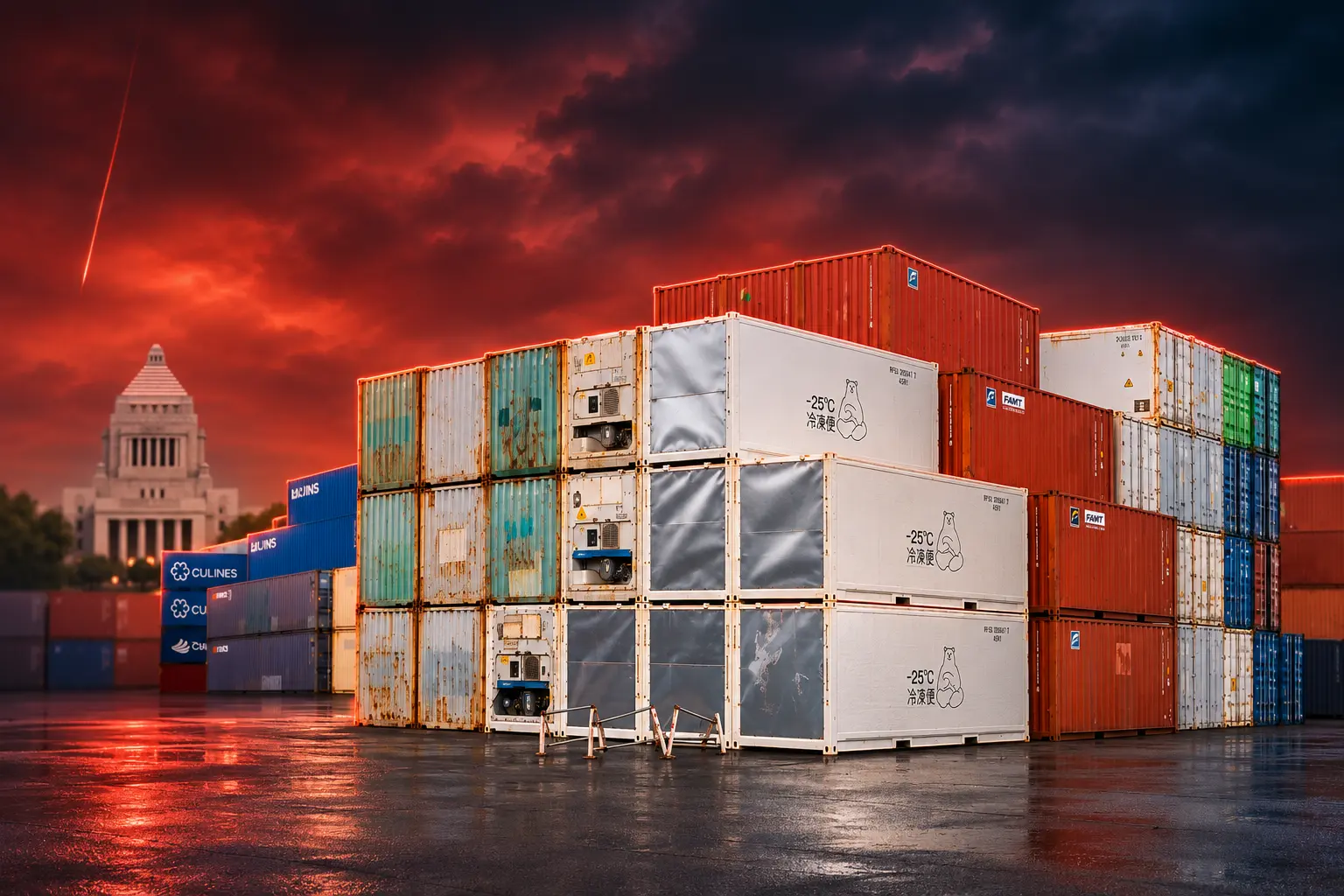
Exports slipped 0.2%. Imports rose 2.5%. In the national accounts, imports are subtracted, so the restocking of costly crude and fuel is what produced that -0.6 point external drag. Japan took about 94% of its crude from the Middle East in 2025, and most of those barrels moved through the Strait of Hormuz.
US-Israeli strikes on Iran began on February 28 and disrupted normal traffic through the strait. Japan’s crude imports fell to about 850,000 barrels a day in April, nearly two thirds below a year earlier and the lowest since records began in 1979. Tokyo released 80 million barrels from government stocks, the largest drawdown on record, and went into the crisis with reserves equal to about 254 days of use.
Refiners then paid more to bring oil from farther away. By September the United Arab Emirates supplied 48.5% of Japan’s crude, much of it loaded outside Hormuz, and the United States supplied 27.5%, according to Trade Ministry figures. The Middle East’s share was still 68.4%. Masato Kamiya, managing director of Inpex’s Abu Dhabi business, put the structural problem in one line.
“Japan doesn’t have any natural resources in crude oil,” Kamiya said, adding that the Middle East is still a core area for the company.
Longer voyages and costlier barrels show up as higher imports in GDP even when the volume of oil Japan burns has not fully recovered. That is an arithmetic hit to growth, and it is also the channel that is pushing consumer prices back through the central bank’s target.
Households Lost the Power-Bill Shield in September
Electricity and city-gas subsidies that had been lowering bills by about ¥800 to ¥900 a month expired in September. The power subsidy had been ¥3.50 per kilowatt-hour. The gas subsidy had been ¥14 per cubic meter. Japan had spent 5.6 trillion yen ($35.6 billion) on gas and utility aid since 2023.
October usage, billed in November, then hit record standard rates at all 10 major power companies. Tokyo Electric Power Company’s typical household bill rose ¥1,286 to ¥9,561. Okinawa Electric Power’s rose ¥1,578 to ¥10,752. Tokyo Gas’s standard bill rose ¥744 to ¥6,488. Those increases landed in the same quarter as a 7.1-magnitude earthquake in Kumamoto Prefecture in late July, long rains, and a hangover from air-conditioner and car buying that had been pulled into April-June ahead of tax changes and stricter energy-efficiency rules due in April 2027.
Real employee compensation, a measure of pay after prices, rose only 0.3% on the quarter after 1.1% in April-June. Toothbrushes, shampoo and other high-frequency purchases were among the items households cut, Cabinet Office officials said in the briefing on the report.
THE ENERGY BILL CALENDAR
- September 2026: Household electricity and gas subsidies expire.
- October 2026: All 10 major power companies post record standard household rates for October usage.
- October 29, 2026: Prime Minister Sanae Takaichi says winter power and gas aid will return in December.
- November 13, 2026: The Cabinet approves 651.8 billion yen from reserve funds for winter energy support.
- December 2026: Winter electricity and gas aid starts, and the gasoline reference price steps up ¥5 a liter.
Gasoline is still being held near ¥170 a liter with a separate subsidy that Takaichi said was costing more than ¥10 billion a day. That program is being tapered, not rebuilt. The power-bill holiday is the one coming back.
Why the Bank of Japan Still Looks Set to Hike
The policy rate is 1.25%, a 31-year high after a 7-2 vote at the September 17-18 meeting. The board held that rate on October 29-30 and said underlying inflation had reached 2% for the first time in 13 years. Core consumer prices, which exclude fresh food, rose 2.1% in September, the highest reading this year. The index that also strips out energy rose 2.4%.
Governor Kazuo Ueda has already drawn a line under overshooting. “Underlying inflation is already roughly around 2%, and we cannot tolerate it any further going forward,” he said in Bangkok earlier this fall. At an IMF seminar on November 6 he said energy-related prices were beginning to hit consumer inflation, with faster gains seen into early next year, and he flagged “some upside risks.”
LSEG put a 75.6% chance on a 25 basis-point increase at the next gathering after Monday’s data. Overnight-index swaps had been even firmer late last week. Seisaku Kameda, the bank’s former top economist, said he still expects the rate to go to 1.5% in December and toward a 2% terminal rate next year, arguing that company profits can absorb it and that a planned sales-tax cut on food will support spending.
Krishna Bhimavarapu, APAC economist at State Street Investment Management, read the report as a warning on demand, not a free pass on prices.
Today’s GDP data is hardly a green light for the BOJ to hike in December.
Krishna Bhimavarapu, APAC Economist, State Street Investment Management
He pointed to real final sales of domestic product, which strip private inventories out of GDP, falling 2.1% annualized, the largest decline outside the Covid-19 pandemic and the first quarter of 2022. “Looks to be a loss of momentum,” he said.
WHERE EXPERTS DISAGREE
- State Street: Bhimavarapu treats the 2.1% drop in real final sales as a loss of underlying demand that argues against a December increase.
- Capital Economics: Marcel Thieliant, head of Asia Pacific, says the stagnation will not stop a hike and that the bank will have to tighten more than his shop had built in because inflation is about to surge.
- Former BOJ staff: Kameda still maps a path to 1.5% in December and 2% next year unless the AI investment boom collapses.
Thieliant’s own note on Monday said the bank will probably worry more about faster wage growth than about last quarter’s stall. Capital Economics had already raised its inflation call, saying its measure of core producer-goods inflation in October was close to the multi-decade high of late 2022 and that consumer inflation would reach 4% next year. Staff estimates of the nominal neutral rate still span 1.1% to 2.5%, which is why the terminal-rate debate will not end with one 25 basis-point step.
The board’s next decision is the December 17 and 18 meeting. Ueda is scheduled to speak to business leaders in Nagoya on November 30, the last set-piece appearance before that vote.
Business Spending Rose as Underlying Demand Fell
The split inside the report is blunt. Firms spent. Households did not. Capital expenditure’s 1.6% rise was the first in three quarters and tracked orders for labor-saving gear, data-center construction, and AI-related equipment, a Cabinet Office official said. Memory-chip demand and a chronic labor shortage are the domestic reasons companies are still writing checks.
That capex line is what kept domestic demand positive even as consumption and public works went the other way. Public investment fell 1.1%. Private inventories added nothing. Once inventories are set aside, Bhimavarapu’s final-sales gauge is the one that looks like a stall, not a rounding error.
A small headline miss can still be revised. The second estimate is due in December, and consumption and capex are the items that often move. The first print is still the one the Bank of Japan takes into Nagoya and then into the December meeting, and it shows a corporate investment cycle running ahead of a household sector that has just been handed higher power bills.
Takaichi Puts Winter Energy Aid Back On
The political response is to put a floor back under winter bills while pulling back the open-ended gasoline scheme. Takaichi told reporters the winter electricity and gas subsidies will run from December through February and should cut the burden on a typical household by about ¥7,000 over the three months, a month earlier than last winter’s program.
WINTER AID ON THE TABLE
- Power rates: The subsidy is ¥1 per kilowatt-hour in December and ¥4.5 in January and February.
- Household relief: A typical home is expected to save about ¥7,000 across those three months, against about ¥5,000 of relief in the July-September round.
- Gasoline taper: The reference retail price, now about ¥170 a liter, is to rise ¥5 each month from December.
- Reserve funds: The November 13 Cabinet decision commits 651.8 billion yen, including 521.8 billion yen for electricity and city gas and 130 billion yen for LP gas and kerosene via local governments.
Takaichi said the government would look at March after checking the weather and energy prices. The gasoline fund had already been burning cash fast enough that she had ordered Industry Minister Ryosei Akazawa to review it in late October. Restarting power-bill aid eases the consumer squeeze that just showed up in GDP. It also puts a fiscal thumb on the same energy prices the Bank of Japan is trying to keep from overshooting 2%.
The Yen Held Near 160 After the Miss
The Nikkei 225 fell 0.62% after the data. The yield on the 10-year Japanese government bond was at 2.885%. The yen weakened a little, trading at 159.76 per dollar, still close to the 160 level that has repeatedly drawn warnings from Finance Minister Satsuki Katayama.
MONDAY MARKET SNAPSHOT
- Nikkei 225: Down 0.62% after the GDP release.
- 10-year JGB: Yield at 2.885%.
- Dollar-yen: 159.76, a marginal move weaker.
- December hike odds: 75.6% for a 25 basis-point rise, per LSEG.
A weaker yen makes the next oil cargo more expensive in local currency, which is how an import shock feeds back into CPI. Hiking can support the yen. It also lands on households that already cut spending when the power-bill shield came off. That is the bind inside a 0.1% contraction: the price victory and the growth miss are the same energy bill.
Ueda speaks in Nagoya on November 30. The board then meets on December 17 and 18 with inflation above target, final sales down 2.1% at a yearly pace, and winter subsidies moving back onto electricity bills.

Airbnb Starts House Rules Reviews as Cities Rewrite Contracts

United’s Computers Failed the Day After Kirby Blamed ATC

Tyson Foods Guides Beef Losses Narrower as Chicken Cools

Saudi Arabia’s Leisure Tourism Falters as Pilgrims Still Come

Himesh Patel Confirms the X-Files Writers’ Room Is Open

AI Server Boards Put Everyday Circuit Materials on Allocation

Glacier Collapse Buried Nepal’s Hydropower Workers in Tunnels

Congo’s Bundibugyo Outbreak Outruns the Licensed Ebola Shots

Pennsylvania Measles Deaths Follow a Long Slide in Coverage

CISA’s Known Exploits Still Come From 2007-Era Bugs
-
 NEWS2 months ago
AI Server Boards Put Everyday Circuit Materials on Allocation
-
 NEWS3 months ago
Glacier Collapse Buried Nepal’s Hydropower Workers in Tunnels
-
 NEWS3 months ago
Congo’s Bundibugyo Outbreak Outruns the Licensed Ebola Shots
-
 NEWS3 months ago
Pennsylvania Measles Deaths Follow a Long Slide in Coverage
-
 NEWS3 months ago
CISA’s Known Exploits Still Come From 2007-Era Bugs
-

 NEWS3 months ago
Germany Can Miss Its 2026 Climate Cap Without Penalty
-

 NEWS3 months ago
Texas Judge Freezes the SEC Eligibility Ban for 41 Athletes
-

 GAMING2 months ago
Xbox Disc-to-Digital Turns Delisted Games Into Traveling Licenses