
NEWS
Congo’s Bundibugyo Outbreak Outruns the Licensed Ebola Shots
The DRC Bundibugyo Ebola outbreak has 6,100 cases across 60 zones, and licensed vaccines still target a different virus.

The Democratic Republic of the Congo has recorded 6,100 confirmed Bundibugyo Ebola cases and 2,950 deaths, with 60 health zones now affected. Those figures, published by the European Centre for Disease Prevention and Control from data through 30 August, put this wave second only to the 2014 to 2016 West Africa epidemic on the all-time list.
The licensed shots and antibody drugs built after that disaster still target Zaire ebolavirus. Responders here are left with contact tracing, isolation and an off-label vaccine whose effect on Bundibugyo has not been proved in people.
Congo’s Fastest Ebola Wave Has Already Beaten Its Own Record
ECDC’s weekday tracker, updated on 1 September, lists 6,100 confirmed cases as of 30 August, including 2,950 deaths, 1,383 recoveries and 814 patients in isolation. Fifty-nine new confirmed cases and 39 deaths were added in a single reporting day, from Ituri, North Kivu, Haut-Uélé and Bas-Uélé.
The DRC Ministry of Public Health declared the outbreak on 15 May. CDC epidemiologists, writing in a 1 September field note, said about 5,000 confirmed cases had piled up in 100 days and called the rise unmatched against earlier Ebola outbreaks. West Africa’s epidemic still stands larger, with more than 28,000 cases and more than 11,000 deaths across two years.
Ituri remains the centre of the fire, with 5,016 cases and 2,274 deaths in 28 of 36 health zones. North Kivu has fewer cases and a much higher death rate. The ministry has named Biena and Manguredjipa among the newest North Kivu zones drawn in, part of a map that now covers 60 of 151 zones in the six affected provinces.
CONFIRMED CASES BY PROVINCE
| Province | Confirmed cases | Deaths | Health zones hit |
|---|---|---|---|
| Ituri | 5,016 | 2,274 | 28 of 36 |
| North Kivu | 836 | 566 | 15 of 34 |
| Haut-Uélé | 222 | 97 | 6 of 13 |
| Tshopo | 19 | 9 | 7 of 23 |
| Bas-Uélé | 4 | 3 | 3 of 11 |
| South Kivu | 3 | 1 | 1 of 34 |
ECDC notes that Congolese case and death totals are still being reviewed and aligned. Uganda reported 20 confirmed cases and two deaths, discharged its last patient on 16 July, and closed its outbreak on 26 August after 42 days with no new confirmed infection. A U.S. humanitarian worker who had been in the DRC tested positive in July and was treated outside the region.
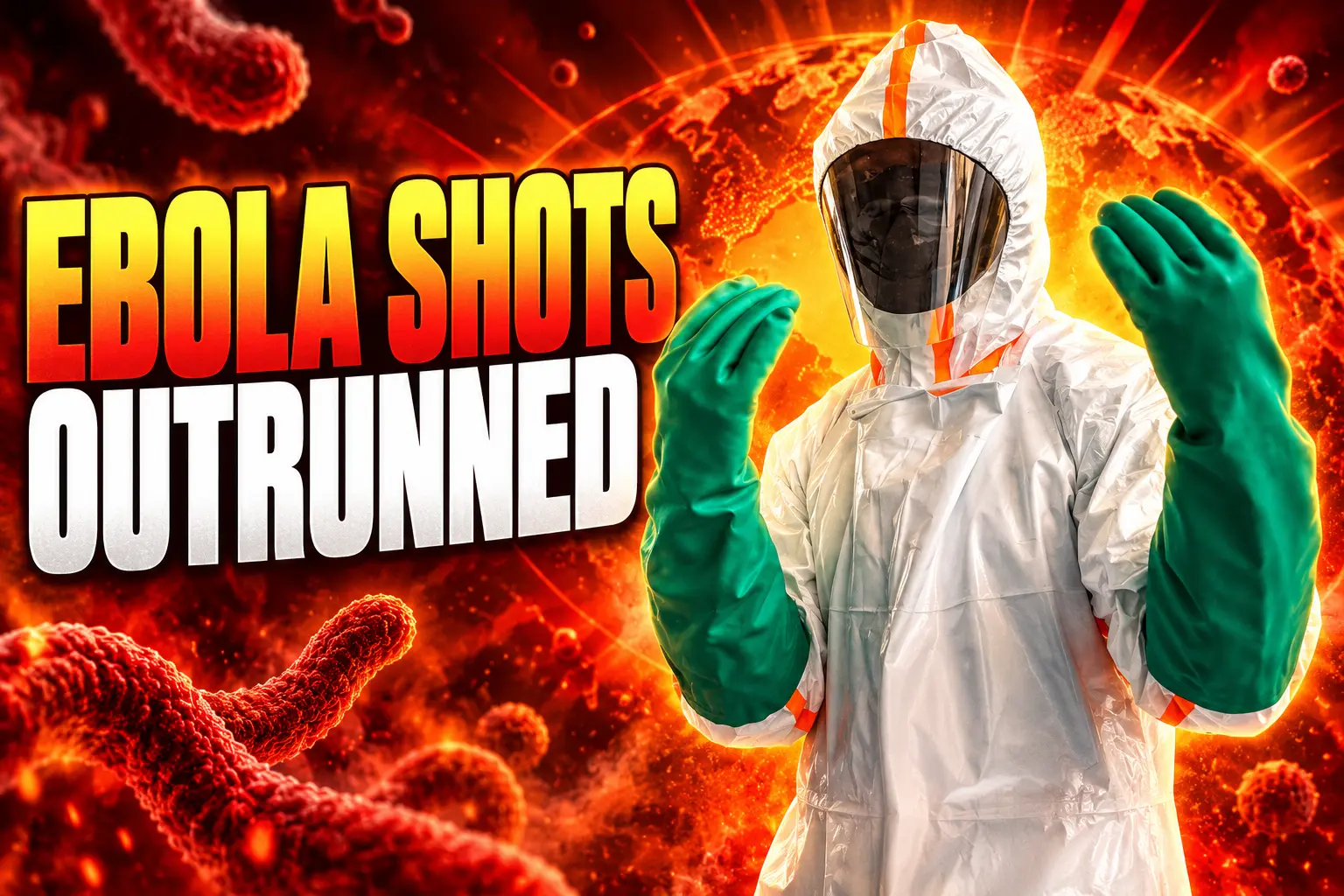
Licensed Shots Were Built for a Different Virus
Bundibugyo virus is a close relative of Zaire ebolavirus, not the same species. A comment in npj Vaccines, published 22 August, walks through how almost all licensed products were aimed at Zaire because that species had caused the largest share of past outbreaks and deaths.
Ervebo, Merck’s single-dose rVSV shot, is the main tool used to ring-vaccinate around Zaire cases. Zabdeno/Mvabea, the Johnson & Johnson prime-boost, also carries a Zaire glycoprotein and needs eight weeks between doses, which limits it in a fast outbreak. The approved antibody drugs Inmazeb and Ebanga were built for Zaire as well.
The same paper states that no licensed vaccines or treatments exist for Bundibugyo or Sudan virus disease. After 2014, money and factories followed the species that had just torn through Guinea, Liberia and Sierra Leone. Cross-protection studies in a handful of monkeys were never turned into human trials for Bundibugyo, and that gap is now the operating condition of this response.
UN Secretary-General António Guterres wrote on 28 August that this is the fastest-spreading Ebola epidemic ever recorded, growing faster and wider than the effort to contain it. “We know how to contain Ebola and save lives. The world must urgently step up action to get it under control,” he said. The products that made that claim feel solid after 2018 and 2021 are the Zaire products.
Why Most New Cases Sit Outside Known Chains
Without a matching shot, the old methods have to do the work: find the sick, list their contacts, isolate them, test alerts fast, and bury the dead without spreading the virus. CDC staff pulling daily ministry situation reports found those checks still short of the levels that have ended past outbreaks.
In the 21 days from 31 July to 21 August, teams listed an average of 10.6 contacts per confirmed case, against a target of at least 20. Only 15 to 20 percent of new cases had already been listed as contacts, against a target of more than 90 percent, so most infections are appearing outside known chains. Contact-tracing completeness sat at 82 percent, against a target above 95 percent.
WHERE THE RESPONSE IS MISSING ITS TARGETS
| Check | Target | Latest reading |
|---|---|---|
| Contacts listed per case | 20 or more | 10.6 |
| New cases already known as contacts | More than 90% | 15% to 20% |
| Alerts tested in the lab | More than 90% | 72% |
| Tests that come back positive | 0% | 24% |
| Confirmed deaths outside a treatment unit | 0% | 59% |
| Affected zones with a safe-burial team | 100% | 49% |
More than half of confirmed deaths, 59%, are happening outside an Ebola treatment unit, which CDC authors read as a mix of too few beds, fear of the units, and chains nobody has mapped. National bed occupancy averaged 64 percent, under the 80 percent ceiling, but some wards were filled to 140% and could not isolate every infected person. Only 72 percent of validated alerts were tested. Test positivity was 24 percent, a figure that would be near zero if the net were tight. Armed conflict, weak clinics, and a mobile, displaced population in eastern Congo keep pulling those numbers off target.
North Kivu’s Death Rate and the Beni Ward
North Kivu has 836 confirmed cases and 566 deaths, a death rate near 68 percent, far above the national 48 percent. Beni, one of the hardest-hit cities there, has recorded 122 confirmed cases and 87 deaths since mid-May. Médecins Sans Frontières said on 28 August that it had opened a new treatment centre in Beni to speed care in that pocket.
The aid group already had about 1,400 staff on the outbreak and was running six treatment centres with 400 beds, about one third of all Ebola beds in the response. By 21 August its teams had admitted more than 2,000 patients, including more than 800 with confirmed Ebola disease, across Ituri, North Kivu, South Kivu, Tshopo and Haut-Uélé.
Dr Javid Abdelmoneim, MSF’s international president, warned that extra beds will not close this outbreak on their own.
This epidemic continues to spread, moving faster than the response can keep up. Treatment centres remain essential for saving lives, but this response needs more than extra beds.
Dr Javid Abdelmoneim, International President, Médecins Sans Frontières, 21 August statement
Albert Stern, an MSF emergency coordinator, said early diagnosis and treatment from the first symptoms raise the chance of survival and cut spread inside families. In Beni the group has also kept general clinics open for malaria and other ordinary illness, trying to stop rumours about Ebola wards from driving people away from care. Researchers tracing deaths in the gold-mining town of Mongbwalu, where the outbreak is believed to have smouldered before the 15 May declaration, say a tighter hold there would have been much easier. Manuel Albela, an MSF epidemiologist who has worked in Mongbwalu, said containing it in that town would have made control far simpler.
An Off-Label Vaccine Reaches the Front Line
On 20 August the International Coordinating Group on Vaccine Provision told Kinshasa it would release 70,000 Ervebo doses from the stockpile. Twenty thousand are for a Phase 3 trial on Bundibugyo. Fifty thousand are for frontline and health workers, in line with current SAGE advice. Gavi funds the stockpile. WHO, the Red Cross, MSF and UNICEF sit on the group that releases it.
Ervebo is licensed and WHO-prequalified only for Zaire ebolavirus. MSD holds no safety or efficacy data on Bundibugyo, and WHO says any off-label use is a decision for health authorities. From 2021 through July 2026 the same stockpile had already sent more than 56,000 Ervebo doses to the DRC for Zaire outbreaks. Those shipments matched the licence. This one does not.
The Democratic Republic of the Congo (#DRC) will receive Ervebo vaccines from the global Ebola virus disease vaccine stockpile for use in the current Bundibugyo virus disease outbreak.
The Ervebo vaccine is licensed and recommended for use in outbreaks of Ebola virus (previously… pic.twitter.com/LKg3GlAaO9
— World Health Organization (WHO) (@WHO) August 20, 2026
WHERE EXPERTS DISAGREE
- WHO in May: A technical group advised against using Ervebo for Bundibugyo patients, citing weak evidence of cross-protection.
- WHO on 31 July: The same advisory group reversed after new lab work showed some, weaker, antibody response to the Bundibugyo glycoprotein, and it backed a Phase 3 trial in this outbreak.
- Africa CDC on 14 August: Its Emergency Consultative Group said there is still no reliable evidence of clinical efficacy, yet it backed a ring-vaccination trial for contacts and compassionate use for frontline workers under a study protocol.
That split is the operational fact on the ground. Doses are moving because something has to be offered to health workers walking into 60 zones. They are also moving because nobody can yet say the shot will stop this virus in people. Informed consent, WHO said, has to spell out that limit.
Two Earlier Bundibugyo Outbreaks Stayed Small
This is only the third known Bundibugyo outbreak. The first Bundibugyo outbreak in 2007 hit the Bundibugyo district of Uganda: 131 cases and 42 deaths, a death rate of about 32 percent. A second wave in 2012, in what was then Province Orientale in the DRC, recorded 62 cases and 34 deaths, about 55 percent, with heavy spread inside clinics.
Those two flares never forced a dedicated vaccine program. Zaire kept returning, including the 2018 to 2020 North Kivu epidemic that had been the DRC’s largest until this year, and the factories stayed on Zaire. The 2026 wave has already gone far past both earlier Bundibugyo counts and past every previous Congolese Ebola outbreak on case volume.
Incubation still runs 2 to 21 days. Spread still moves through body fluids. Safe burials still matter, which is why CDC flagged that fewer than half of affected zones had a trained burial team. The biology did not change. The map did, and the product shelf did not move with it.
The PARTNERS Trial Is Running Ahead of the Shots
Treatment research has moved faster than vaccination. The PARTNERS trial, testing the monoclonal antibody MBP134 and the antiviral remdesivir in people with Bundibugyo disease, enrolled its 200th patient 14 weeks after the outbreak was declared, the quickest randomised Ebola treatment trial on both launch and recruiting pace, according to the International Pandemic Preparedness Secretariat’s Day 100 review on 25 August. First enrolment was in Bunia. The target is still hundreds more patients. Two hundred enrolments sit against 6,100 confirmed infections.
Bundibugyo-specific shots are further back. WHO’s priority list has been IAVI’s rVSV-BDBV candidate, Oxford’s ChAdOx1-BDBV shot with the Serum Institute of India, and Moderna’s mRNA-1469.
SHOTS AND DRUGS STILL IN TESTING
- MBP134 plus remdesivir: Already in a field trial in Ituri, with 200 patients enrolled by late August.
- Ervebo (Zaire licence): 20,000 doses assigned to a Phase 3 Bundibugyo trial; 50,000 assigned to health workers.
- Oxford ChAdOx1-BDBV: First human trial opened in July, still a safety study, not a ring-vaccination tool.
- Moderna mRNA-1469: First people dosed on 4 August at three sites in Canada, backed by CEPI, months from any field use.
IAVI’s rVSV-BDBV shot, the closest copy of the Ervebo design rebuilt around the Bundibugyo glycoprotein, was still estimated at seven to nine months from human efficacy trials when WHO ranked it. Carmen Pérez Casas, who leads pandemic preparedness at Unitaid, said only a short list of treatment candidates is ready for trials, and that if those fail there are no spare options sitting behind them.
On 25 August the outbreak clock hit 100 days from the 17 May PHEIC. The PARTNERS trial had 200 people on drugs. Canada had started dosing an mRNA candidate. Congo had 60 health zones on the board, a tracing net that still misses about four new cases in five, and a vaccine built for a different virus moving into arms because the matching one was never made.
Disclaimer: This article is news reporting and analysis of an ongoing Ebola outbreak, written for general information only. It is not medical advice, a diagnosis, a treatment plan, or guidance on vaccination or travel. Anyone who may have been exposed, who has symptoms, or who is making personal health decisions should speak with a qualified physician or with the public health authority where they live before acting. Case counts, deaths, zone lists, trial enrolments and vaccine advice are those published by the agencies named above as of 2 September 2026 and can change as the outbreak and the studies move.

Amazon’s Apple Prime Deals Mostly Undo the June Hikes

The Atlantic’s First Hurricane Is Aimed at Soaked Gulf Soil

Iran’s Hormuz Attacks Target the Route That Restored Crude

S&P 500 Clears 7,800 as AI Chips Outrun Yields

Russia’s No-Plague Finding Leaves a Siberian Death Unexplained

Glacier Collapse Buried Nepal’s Hydropower Workers in Tunnels

Congo’s Bundibugyo Outbreak Outruns the Licensed Ebola Shots

AI Server Boards Put Everyday Circuit Materials on Allocation

Germany Can Miss Its 2026 Climate Cap Without Penalty

CISA’s Known Exploits Still Come From 2007-Era Bugs
-
 NEWS1 month ago
Glacier Collapse Buried Nepal’s Hydropower Workers in Tunnels
-
 NEWS1 month ago
AI Server Boards Put Everyday Circuit Materials on Allocation
-
 NEWS1 month ago
Germany Can Miss Its 2026 Climate Cap Without Penalty
-
 NEWS1 month ago
CISA’s Known Exploits Still Come From 2007-Era Bugs
-

 BUSINESS1 month ago
Trump’s Venezuela Oil Deal Leaves the Barrels in the Ground
-

 NEWS1 month ago
A Cow Rumen Enzyme Dissolves Superbug Biofilms on Gauze
-

 NEWS1 month ago
Texas Judge Freezes the SEC Eligibility Ban for 41 Athletes
-

 NEWS1 month ago
Pennsylvania Measles Deaths Follow a Long Slide in Coverage