
BUSINESS
US Caps Jet-Part Licenses to Keep COMAC From Stockpiling
Washington is slowing airplane-part licenses and capping COMAC volumes so China cannot stockpile Western jet systems while rare earth talks slip to January.

The Commerce Department has slowed airplane-part licenses to China and capped volumes for COMAC, people familiar with the process said. The aim is to stop the state planemaker from stockpiling Western parts while rare earth talks continue.
A draft circulating among officials would make landing gear easier to restrict and would add a license for aviation hydraulic fluid from U.S. firms such as ExxonMobil. Commerce and the White House did not comment. Neither did the Chinese embassy in Washington.
Commerce Slows Licenses to Stop a COMAC Stockpile
The pressure is a paperwork squeeze, and it is already in use. People familiar with the licensing said the slowdown took several forms through late September, after U.S. and Chinese officials met in New York and Washington on rare earths, farm trade, and advanced AI. Two of them said Commerce is ready to raise the pressure if the White House asks.
HOW THE SQUEEZE WORKS
- Slower licenses: Approvals for airplane parts bound for China have been dragged out in recent weeks rather than denied in public.
- COMAC caps: The number of parts licensed for the state planemaker has been limited so the company cannot build a deep buffer.
- Landing gear draft: Officials have looked at a rule that would make it easier to hold back landing gear and other aircraft parts.
- Hydraulic fluid: That draft included a new license for aviation hydraulic fluid shipped by U.S. suppliers, including ExxonMobil.
Chinese airlines still fly Boeing and Airbus jets that need those same U.S. shops for upkeep. COMAC needs them to raise output of the C919, the narrowbody Beijing built to challenge that pair. A hard cutoff would hit U.S. exporters and Chinese fleets at once. A drip hits the production calendar first.
WHAT WE KNOW
- The method: Licensing has been slowed and COMAC volumes have been capped, according to people familiar with the process.
- The target: Officials want to keep the planemaker from stockpiling parts it still cannot make at home.
- The clock: After Xi Jinping’s visit, the two sides extended their trade truce from November 10, 2026, to January 10, 2027.
WHAT IS UNCONFIRMED
- The draft: No public text has been issued on landing gear or hydraulic fluid, and it is unclear whether the rule will be published.
- The 200-jet spares: China has asked for several years of parts for Boeing jets bought last spring; people familiar with the talks said Washington has not given that guarantee.
- Denial versus delay: Commerce has not said whether applications are being refused or only slowed.
Aerospace has mostly escaped the tariff fights that hit other trades. Parts and materials have not. Producers of thermal coating sprays used on jet engines have already faced delays tied to Chinese controls on rare earths. Certified hardware is a slower substitute than a tariff, which is why a license queue can move a factory even when no ban is on the books.
Why the C919 Cannot Replace US Parts Quickly
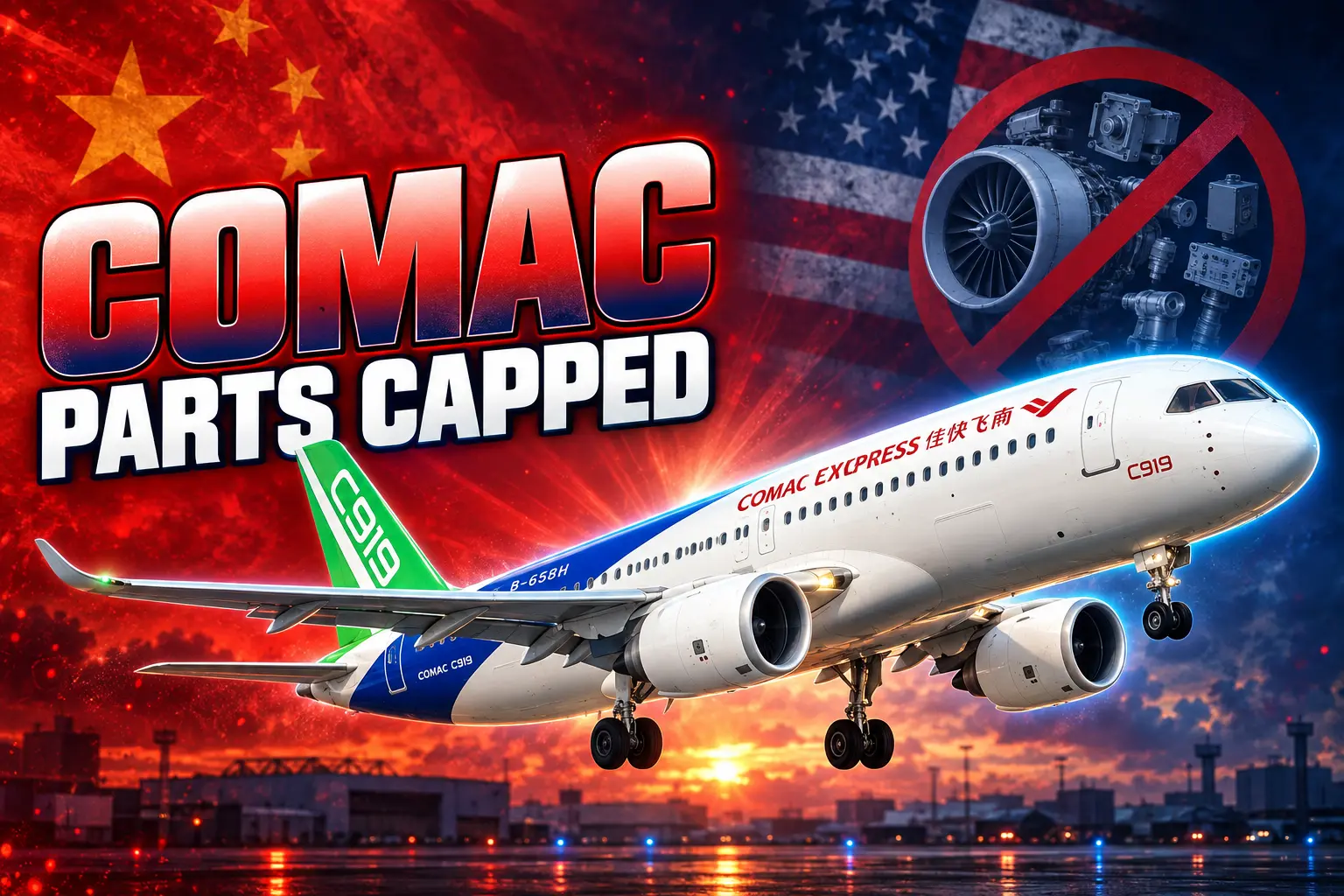
The C919 is assembled in China. Its flight-critical kit is not. Safran, which shares CFM International with GE Aerospace on a 50/50 basis, still lists the LEAP-1C as the only Western propulsion system on the jet, and it also supplies nacelles, FADEC engine controls, wiring, and cabin gear. The LEAP line is sold as using 15% less fuel than the engines it replaced. China is developing the AECC CJ-1000A as a stand-in. That engine is still in testing.
A Center for Strategic and International Studies compilation of Airframer data listed 48 U.S. names among major C919 suppliers, against 26 in Europe, 6 in Asia-Pacific, and 14 in China. Richard Aboulafia, managing director of AeroDynamic Advisory, has said Washington could stop the line if it cut those Western boxes. Dan Taylor, head of consulting at IBA, has noted that the LEAP core module is built in Ohio, so a U.S. hold can stall engines even when final assembly sits in France.
WESTERN SYSTEMS STILL ON THE C919
| System | Supplier | Home base |
|---|---|---|
| LEAP-1C engines | CFM International (GE and Safran) | United States and France |
| Fly-by-wire and APU | Honeywell Aerospace | United States |
| Hydraulic systems | Parker Hannifin, with an AVIC joint venture | United States and China |
| Landing gear | Liebherr LAMC Aviation (Changsha) | Germany and China |
| Wheels, tires, carbon brakes | Honeywell Aerospace | United States |
| High-lift system | Moog | United States |
Collins Aerospace, a unit of RTX, supplies weather radar, ice protection, and other cockpit and cabin kit. Crane Aerospace handles brake control. Those boxes are certified into the type. Swapping them means new tests, new paper, and new risk, which is why a delayed license is not a delayed crate of steel.
China’s industry ministry said 41 C919s had been delivered as of July 20, 2026, with flight time past 130,000 hours. By September 18, industry officials put safe running time above 150,000 hours and passenger totals above 8 million. The factory rate is another story. COMAC delivered 1 jet in 2022, 2 in 2023, 13 in 2024, and 15 in 2025. ADS, the UK aerospace trade body, counted 10 COMAC deliveries from January through August 2026. China Southern then took another C919 on September 24. At a March supplier meeting the planemaker had set 45 deliveries for 2026, then 55 in 2027 and 80 in 2028. Compiled airline and air-show notices put confirmed orders around 1,150. The airframe can share a size class with an A320 and still not leave the hall at anything like that rate.
Landing Gear and Hydraulic Fluid Are in the Draft
The next turn of the screw is aimed at systems that do not make speeches. Landing gear on the C919 comes from a Liebherr-AVIC joint venture in Changsha. Wheels, carbon brakes, and the brake-control package still trace to Honeywell and Crane. Parker’s hydraulic gear is assembled with AVIC. Fluid is the consumable that makes those actuators move, and U.S. firms including ExxonMobil are the names in the draft license.
That mix is why a rule written around “landing gear and other aircraft parts” can bite without a single U.S. strut leaving Ohio. Content, software, and aftermarket kits still run through U.S. licenses. Hydraulic fluid is even simpler. It is a U.S. shipment with a U.S. seller, and a new license is a tap Commerce can close without redesigning a jet.
Last spring Commerce already sent letters to hydraulic-fluid makers saying the product needed a new export license. That demand did not last. The new draft puts the same idea back on paper, this time beside landing gear. Until a rule is published, the live tools remain the slow queue and the COMAC volume cap.
China Never Turned the Rare Earth Spigot Back On
The aviation drip is the reply to a minerals drip that never fully opened again. After almost halting rare earth supply in April 2025, Beijing let more material out later that year and into 2026, yet a Council on Foreign Relations report by Joris Teer found that China kept rare earth shipments below earlier volumes even after the Busan meeting. The April 4, 2025, rare-earth controls were not reversed, nor were older limits on gallium, germanium, and other inputs.
For 17 of the 34 materials the European Union lists as critical, China holds at least a 70% share of global mining or refining. License paperwork has been used to collect data on defense buyers, to refuse military end users, and to cut Japan’s supply of several rare earths and gallium after Prime Minister Sanae Takaichi said Japan could help defend Taiwan. Anyone who raises the cost of a fight over the island pays in factories.
THE MINERALS STILL UNDER LICENSE
- April 4, 2025, rules: The heavy-rare-earth controls from that date were never taken off the books.
- October 9, 2025, package: Broader licensing, including on some foreign-made goods with traces of Chinese rare earths, was postponed rather than dropped.
- General licenses: Fewer were issued than Western governments said they had been promised, and the material that did move came with extra questions.
The White House fact sheet on the Busan deal claimed a de facto removal of controls imposed since 2023. Export volumes did not return to those earlier levels. That gap is the opening Commerce is now using on jet parts.
Boeing’s 200 Jets Come With a Spare-Parts Fight
The other hostage is already on order. China confirmed on May 20, 2026, that it would buy 200 Boeing jets after President Donald Trump’s trip to Beijing, the planemaker’s first large Chinese deal in nearly a decade. Trump told reporters the package was “over 200 planes for Boeing, with a promise of 750 planes.” Boeing chief executive Kelly Ortberg called the 200 jets an “initial tranche.” China’s commerce ministry said the United States would give supply guarantees for aircraft engine parts and components.
People familiar with the later talks said Beijing then asked for several years of spare parts for those 200 jets, and that Washington has been slow to lock that in because the parts are leverage. Planes are not usually sold with parts guarantees. Chinese carriers want a buffer after last year’s on-off licenses. U.S. officials want a chip left on the table through January.
Consistent with US export requirements, Boeing is committed to supporting Chinese airlines with the parts and services they need as we have done for decades.
Boeing spokesperson
Chris Raymond, chief executive of Boeing Global Services, said in June that China could get aftermarket support “if it’s a part that we’re allowed to sell globally,” and that Boeing already keeps a parts warehouse in the country. That clause is the whole fight. Global catalogs do not override a Commerce license.
The On-Off Switch From Last Spring
This is not a new invention. Commerce used the same switch in 2025, then flipped it back once minerals talks moved. GE Aerospace later confirmed the freeze had blocked Leap-1C engines for the C919 and CF34 engines for the smaller C909, because the hot section still ships from the United States to France. Honeywell navigation kits and other COMAC parts were caught in the same net. The 2025 round also hit ethane and chip-design software. It lasted only a few weeks.
THE LICENSE WAR SINCE 2025
- April 4, 2025: China tightens rare-earth export licenses and later squeezes magnets and other inputs.
- Late May 2025: Commerce suspends licenses for GE engines, Honeywell navigation systems, and other COMAC parts, and tells hydraulic-fluid makers a new license applies.
- July 3, 2025: Commerce tells GE it can restart Leap-1C shipments for the C919 and CF34 shipments for the C909.
- October 9, 2025: Beijing announces broader rare-earth rules, then postpones them as part of the Busan truce.
- October 2025: Trump says the United States could put export controls on Boeing plane parts if China keeps squeezing minerals.
- May 20, 2026: China confirms a 200-jet Boeing buy and asks for engine-part supply guarantees.
- September 24, 2026: Trump and Xi meet in Washington and push the trade truce to January 10, 2027.
- October 1, 2026: People familiar with Commerce licensing describe a new slowdown, COMAC volume caps, and a draft covering landing gear and hydraulic fluid.
After last year’s freeze, a Chinese embassy spokesperson accused the United States of abusing export controls. The embassy did not repeat that line when asked about the new slowdown. The pattern is the message. Licenses go on, licenses come off, and the queue itself is the penalty.
Talks Now Run to January Without a Minerals Deal
The September meetings produced a shorter truce, not a minerals settlement. Negotiators now have until January 10, 2027, to deal with rare earths, farm trade, and the harder technology files. The October 9, 2025, rare-earth package is still on a delay, not in the shredder. Commerce, meanwhile, has already started treating airplane parts the way Beijing treats oxides and magnets: licensed, counted, and easy to slow.
COMAC cannot wait that calendar out with a warehouse if the licenses are capped. It also cannot swap a LEAP core, a Honeywell flight computer, or a Parker hydraulic pack on a political timetable. Domestic stand-ins are being qualified, including the CJ-1000A, but they are not on the line that has to meet a 45-jet plan. The C919s already in service will keep flying on Western boxes, and those boxes will keep needing U.S. paper.
The draft on landing gear and hydraulic fluid has not been issued. The 200-jet spare-parts guarantee has not been signed. What is already running is the slower queue, and it is aimed at a factory that was already missing its own targets before the latest turn of the tap.

Amazon’s Apple Prime Deals Mostly Undo the June Hikes

The Atlantic’s First Hurricane Is Aimed at Soaked Gulf Soil

Iran’s Hormuz Attacks Target the Route That Restored Crude

S&P 500 Clears 7,800 as AI Chips Outrun Yields

Russia’s No-Plague Finding Leaves a Siberian Death Unexplained

AI Server Boards Put Everyday Circuit Materials on Allocation

Glacier Collapse Buried Nepal’s Hydropower Workers in Tunnels

Congo’s Bundibugyo Outbreak Outruns the Licensed Ebola Shots

Germany Can Miss Its 2026 Climate Cap Without Penalty

CISA’s Known Exploits Still Come From 2007-Era Bugs
-
 NEWS1 month ago
AI Server Boards Put Everyday Circuit Materials on Allocation
-
 NEWS2 months ago
Glacier Collapse Buried Nepal’s Hydropower Workers in Tunnels
-
 NEWS2 months ago
Congo’s Bundibugyo Outbreak Outruns the Licensed Ebola Shots
-
 NEWS2 months ago
Germany Can Miss Its 2026 Climate Cap Without Penalty
-
 NEWS2 months ago
CISA’s Known Exploits Still Come From 2007-Era Bugs
-

 NEWS2 months ago
Pennsylvania Measles Deaths Follow a Long Slide in Coverage
-

 BUSINESS2 months ago
Trump’s Venezuela Oil Deal Leaves the Barrels in the Ground
-

 NEWS2 months ago
A Cow Rumen Enzyme Dissolves Superbug Biofilms on Gauze