
NEWS
Rain Drops 10.6 Kilograms of PFAS on Port Phillip Bay
Eight PFAS turned up in Melbourne rain below drinking limits, yet the same study puts about 10.6 kilograms a year straight onto Port Phillip Bay.

RMIT University and EPA Victoria found eight PFAS compounds in Melbourne rain collected between 2024 and 2025. Levels sat in nanograms per litre, and the two best-known compounds, PFOS and PFOA, were below current Australian drinking water limits.
The same figures give the city a second number that tank ads will not print. Rain might deliver about 10.6 kilograms of PFAS (23.4 pounds) straight onto Port Phillip Bay each year.
Samples From Three Storms Held Eight PFAS
The work is the first Australian study of PFAS in rainwater, released by RMIT on 10 September 2026. Doctoral student Nav Singh led the writing. Professor Oliver Jones, from RMIT’s School of Science, led the lab group. EPA Victoria joined for the air-mass modelling.
PFAS are a large family of human-made chemicals, thousands of individual compounds used in firefighting foams, food packaging, textiles, cosmetics and non-stick cookware. They hitch to dust and tiny water droplets, travel, then fall again with rain. Jones has long been asked why the chemicals turn up far from factories and firegrounds. Rain is one answer that had not been measured here.
The project also tested a method built for very low levels in small samples. The team collected rain on three occasions, screened 30 PFAS compounds, and found eight. Jones said the hits were generally measured in nanograms per litre, which is one part per trillion.
WHAT THE THREE STORMS SHOWED
- Screen: 30 PFAS compounds were tested in rain collected on three occasions between 2024 and 2025.
- Detections: Eight compounds were found, at levels Jones described as very low.
- Best-known pair: PFOS and PFOA sat below current Australian drinking water guideline values.
- Jones’s line: All the concentrations the team found were well below the NHMRC drinking water guidelines for PFAS.
Jones said finding PFAS in rain is not surprising given how widespread the chemicals are. Detecting a chemical, he added, does not by itself mean there is a health risk.
The more useful question isn’t whether a chemical is toxic, but whether it’s present at a concentration that could actually cause harm. Dose and exposure matter.
Oliver Jones, Professor, RMIT School of Science
EPA Victoria Deputy Chief Environmental Scientist Caroline Martino said the study gives the regulator a clearer view of how PFAS moves, and that peer-reviewed measurements are what risk work should rest on. Singh called the work a contribution to a live environmental problem. RMIT posted a short explainer with Jones walking through the result.
A Direct 10.6 Kilogram Load on Port Phillip Bay
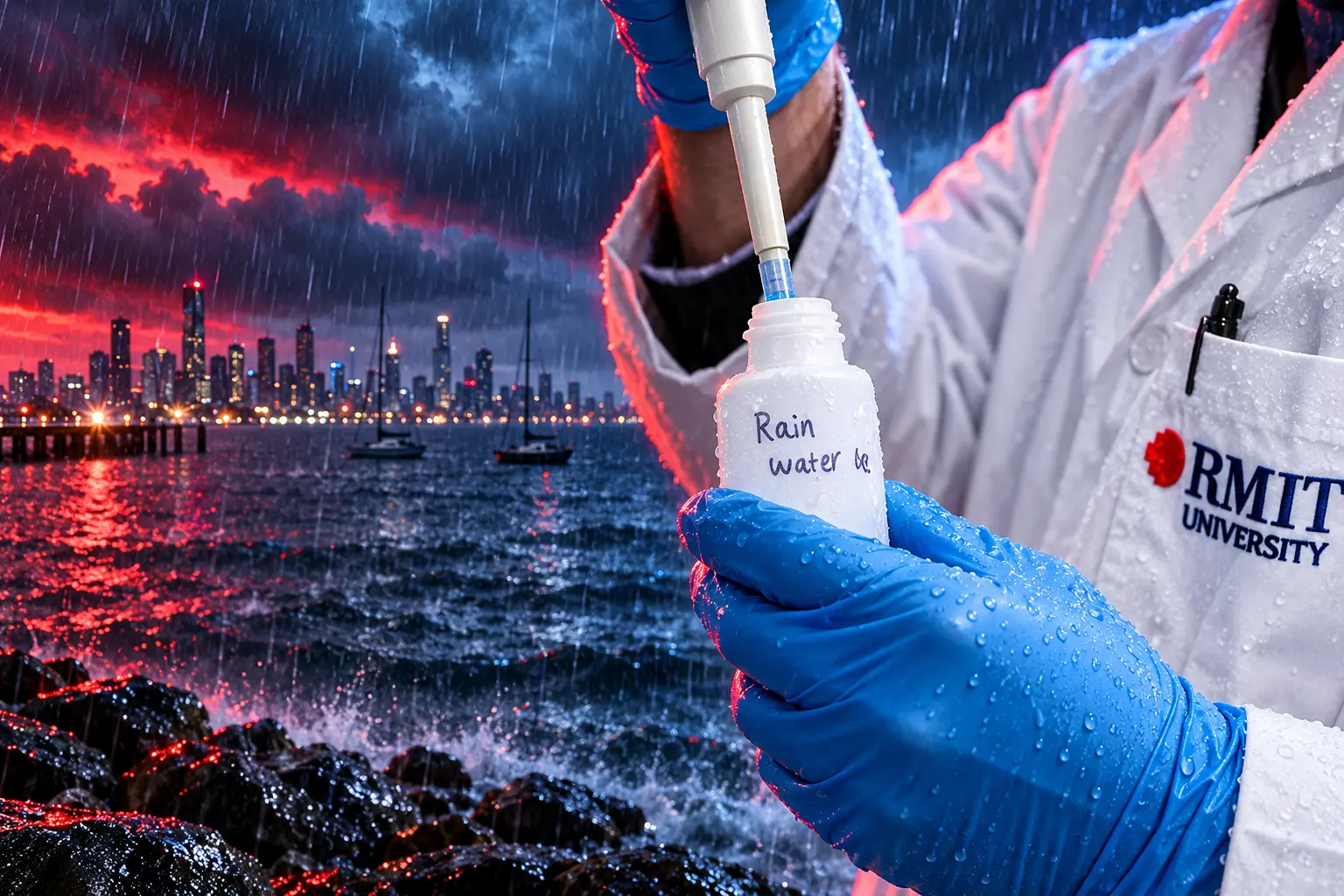
Using Melbourne rainfall and the levels in those storms, the team estimated that rain might deliver about 10.6 kilograms of PFAS directly to Port Phillip Bay each year. That is the same load written as about 5.5 grams per square kilometre across the bay’s 1,930 km² surface. It is PFAS falling on the water, not PFAS washed off streets and into creeks.
A separate EPA Victoria and RMIT river study, on a much wider chemical list, had already put 57.4 kilograms a year from urban rivers into the same bay. That figure is a sum of 52 PFAS in grab samples from major rivers and creeks. Mean Σ52PFAS in those grabs was 76.4 ng/L. The authors also found surface-water flows exported more than twice the Σ19PFAS load of wastewater discharges. Rain’s 10.6 kilograms cannot be added to 57.4 kilograms as if both counted the same compounds. They do not.
TWO MEASURED INPUTS TO PORT PHILLIP BAY
| Pathway | Annual load | What was counted |
|---|---|---|
| Rain falling on the bay | about 10.6 kg | 8 PFAS in Melbourne rain, this study |
| Rivers and creeks | 57.4 kg | 52 PFAS in grab samples feeding the bay |
| Wastewater | less than half the river figure, on a 19-PFAS subset | compared in the river study, not in the rain paper |
Port Phillip Bay is a large, shallow, semi-enclosed water body. Its catchments cover almost 10,000 km² of rural and urban land. Water in most of the bay turns over on a roughly yearly cycle, except in the south near Bass Strait. Direct rain is a small pipe beside the rivers on these numbers, and it is a pipe that Australian PFAS budgets had not quantified from local storms.
Jones said rainfall could sit alongside wastewater, urban runoff and landfill as a pathway into waterways. That is the second-order reading of a paper sold, in the first line, as reassurance for people who drink tank water.
Land Air Carried More PFAS Than Ocean Air
EPA Victoria supplied atmospheric modelling for the air that fed each storm. Rain linked to air that had travelled over land held higher PFAS levels than rain linked to air that had travelled over the ocean. Urban and industrial ground, on that split, looks like a source of airborne PFAS that later falls somewhere else.
Jones has put the same idea in plainer words. Sometimes there is an obvious source. Sometimes the chemicals appear in a remote spot with no industry next door. Atmospheric transport, he said, is a movement path that has not been fully counted. PFAS leave the city on dust and droplets, then come back down in the weather.
Contaminated-land work in Victoria has for years treated PFAS as a point-source problem around airports, firegrounds and a handful of industrial precincts. EPA science summaries already show PFOS turning up in urban fresh water more often than in farm or remote sites. Rain now belongs in those site models even when no foam store sits on the boundary. The finding that land-origin air is dirtier than ocean-origin air is the mechanism, not a vibe.
The presence of PFAS in rain was the expected result for anyone who has watched overseas precipitation studies. North American storm totals in a 2024 review of five papers sat between 2.28 and 92.42 ng/L, with higher hits near local sources. Melbourne’s result sits in that same nanogram band. The local value is the bay load and the land-versus-ocean split, not the fact of a detection.
How Australia’s PFAS Drinking Water Limits Work
Jones compared the rain with the National Health and Medical Research Council’s health-based guideline values for four PFAS, published on 25 June 2025. Those values are built for lifetime daily drinking, not for a weekend of tank water after one storm. They replaced older, higher figures and split PFOS from PFHxS for the first time.
THE JUNE 2025 DRINKING WATER LIMITS
| Compound | Limit from 25 June 2025 | Previous national value |
|---|---|---|
| PFOS | 8 ng/L | 70 ng/L, shared with PFHxS |
| PFOA | 200 ng/L | 560 ng/L |
| PFHxS | 30 ng/L | no separate value |
| PFBS | 1,000 ng/L | no national value |
Public consultation had put PFOS at 4 ng/L. The Water Quality Advisory Committee then chose a different benchmark-dose model and the final figure was rounded to 8 ng/L. Jones said the two headline compounds in the Melbourne rain, PFOS and PFOA, were below those current values, which should give some reassurance to people who use rainwater as drinking water. He did not publish a compound-by-compound table in the university release, and the journal page stays behind a login, so the other six detections are counted, not named, here.
NHMRC is also clear that tap water is a small slice of a person’s PFAS intake. In areas with low contamination, drinking water has been put at about 2 to 3 percent of total exposure. Up to 90 percent in Australia is believed to come from food and household products. A below-guideline rain result does not empty the rest of that ledger.
The south-eastern Australian rainwater PFAS measurements appear in Environmental Toxicology and Chemistry (DOI: 10.1093/etojnl/vgag204), under the title “Concentrations of per- and polyfluoroalkyl substances in the rainwater of South-Eastern Australia.”
Melbourne Catchments Stay Below 2 ng/L
People on mains water in Greater Melbourne are not drinking these three storms. Melbourne Water’s 2024 to 2026 program reports no PFAS detected in catchment source water at the four named compounds, with PFOS, PFHxS, PFOA and PFBS all <2 ng/L. The utility says that water is considered safe to drink from a PFAS perspective. Tests go to an independent NATA-accredited lab and can report down to 2 ng/L.
SEVEN CATCHMENT SITES ON THE 2024 TO 2026 PROGRAM
- Yarra Ranges: two sites in the protected ranges catchments.
- Tarago: two sites in that catchment.
- Maroondah: one site near the Maroondah catchment.
- Mid-Yarra: one site in the mid-Yarra catchment.
- Yan Yean: one site near the Yan Yean catchment.
Sampling ran fortnightly in 2024 and 2025 and monthly in 2026. Melbourne Water first tested harvested catchment water for PFAS in 2010, when methods could only report down to 5 to 30 ng/L. Between 2010-11 and 2014-17 it ran over 1,100 tests; more than 99 percent sat below those early reporting limits, and any hits stayed under the draft guideline values of the time.
Tank water is a different legal object. NHMRC says the owner of a private tank, bore or well is responsible for testing it. State agencies can advise. They do not run the tap.
A Misleading Name for a Persistent Chemical Family
Jones is trying to retire a slogan while he publishes a detection. PFAS are often called forever chemicals, he said, but that phrase suggests they never break down, which is not the case. He prefers highly persistent, or lingering, chemicals that can remain in the environment for a long time. The behaviour still has to be mapped. The nickname does not do that job.
PFAS are often called ‘forever chemicals’, but that term can be misleading because it suggests they never break down, which isn’t actually the case. A more accurate description is that they are highly persistent, or ‘lingering’, chemicals that can remain in the environment for a long time, which is why understanding their behaviour is so important.
Oliver Jones, Professor, RMIT School of Science, university release
On 14 September 2026 he posted the same core numbers from his own account: 30 PFAS tested, eight found, all at ng/L levels, with a link to the journal article.
Last week we published Australian measurements of #PFAS in rain. We tested for 30 PFAS and found eight of them, all at ng/L concentrations.
Read more at https://t.co/3gyrMVoAyh
and see the @ResearchRMIT video at https://t.co/k3xXBqKI2x#ozchem #chemistry #pollution
— ⏣ Prof. Oliver Jones (@Dr_Oli_Jones) September 14, 2026
He wants the same measurements in more Australian rainfall, not a one-city snapshot from three storms. The open questions he listed are how much is there, where it came from, and what the pattern says about movement. Melbourne now has a first answer on the first of those, a land-versus-ocean clue on the second, and a 10.6 kilogram line on a bay that already takes a larger, differently counted load from its rivers.
Frequently Asked Questions
Who has to test a rainwater tank for PFAS in Australia?
The property owner. NHMRC says private tanks, bores and wells are unregulated sources, and it is up to the owner to test and to talk with the state environment agency, local health authority or drinking water regulator if the supply might not be safe. Mains customers sit under the Australian Drinking Water Guidelines and their retail utility’s testing; tank drinkers do not.
How much of a person’s PFAS intake usually comes from drinking water?
About 2 to 3 percent of total PFAS exposure in areas with low contamination, according to NHMRC. Up to 90 percent in Australia is believed to come from food and household products, which is why a below-guideline rain result does not settle a person’s overall intake.
Which health effects sit behind Australia’s PFAS water limits?
NHMRC used potential bone marrow effects for PFOS, potential carcinogenicity for PFOA, and potential thyroid effects for PFHxS and PFBS, drawn from animal studies. It did not set a health-based guideline value for GenX chemicals, saying suitable studies were lacking.
What does 1 ng/L equal in everyday volume?
Melbourne Water describes 1 ng/L as one drop of water in 20 Olympic-sized swimming pools. Jones used the other standard gloss, one part per trillion, for the same unit.
Can states ignore the new PFAS drinking water values?
NHMRC writes the guidelines. Each state and territory decides when to adopt them, and suppliers are not legally required to meet the new figures until that happens. NHMRC also says there is no immediate health risk from short periods at the old, higher values, and that most supplies already sit below the new ones.
Three Melbourne storms put eight PFAS compounds in the rain at nanograms per litre, below the drinking-water limits Jones used as his yardstick. They also put about 10.6 kilograms a year on Port Phillip Bay, with dirtier air after it has crossed land. That is the number the bay did not have, and it is smaller than the 57.4 kilogram river load counted on a wider list.
Disclaimer: This article is news reporting on a published environmental chemistry study and on public drinking-water guidance. It is for information only and is not medical, environmental-health or water-treatment advice, and it is not a recommendation to drink, avoid, filter or test any particular supply. Anyone who uses a private tank, bore or well, or who has a health concern about PFAS, should speak with a doctor and with their state environment protection agency or drinking-water regulator before changing how they use water. Figures, detections and guideline values reflect the RMIT and EPA Victoria paper, NHMRC guidance and Melbourne Water testing as cited, and those numbers can be revised as new samples and reviews appear.

Amazon’s Apple Prime Deals Mostly Undo the June Hikes

The Atlantic’s First Hurricane Is Aimed at Soaked Gulf Soil

Iran’s Hormuz Attacks Target the Route That Restored Crude

S&P 500 Clears 7,800 as AI Chips Outrun Yields

Russia’s No-Plague Finding Leaves a Siberian Death Unexplained

AI Server Boards Put Everyday Circuit Materials on Allocation

Glacier Collapse Buried Nepal’s Hydropower Workers in Tunnels

Congo’s Bundibugyo Outbreak Outruns the Licensed Ebola Shots

Germany Can Miss Its 2026 Climate Cap Without Penalty

CISA’s Known Exploits Still Come From 2007-Era Bugs
-
 NEWS1 month ago
AI Server Boards Put Everyday Circuit Materials on Allocation
-
 NEWS2 months ago
Glacier Collapse Buried Nepal’s Hydropower Workers in Tunnels
-
 NEWS2 months ago
Congo’s Bundibugyo Outbreak Outruns the Licensed Ebola Shots
-
 NEWS2 months ago
Germany Can Miss Its 2026 Climate Cap Without Penalty
-
 NEWS2 months ago
CISA’s Known Exploits Still Come From 2007-Era Bugs
-

 NEWS2 months ago
Pennsylvania Measles Deaths Follow a Long Slide in Coverage
-

 BUSINESS2 months ago
Trump’s Venezuela Oil Deal Leaves the Barrels in the Ground
-

 NEWS2 months ago
A Cow Rumen Enzyme Dissolves Superbug Biofilms on Gauze