
BUSINESS
Trump’s Venezuela Oil Deal Leaves the Barrels in the Ground
Trump billed 65 billion Venezuelan barrels as a free historic deal, but the extra-heavy crude still needs $100 billion and an unnamed driller.

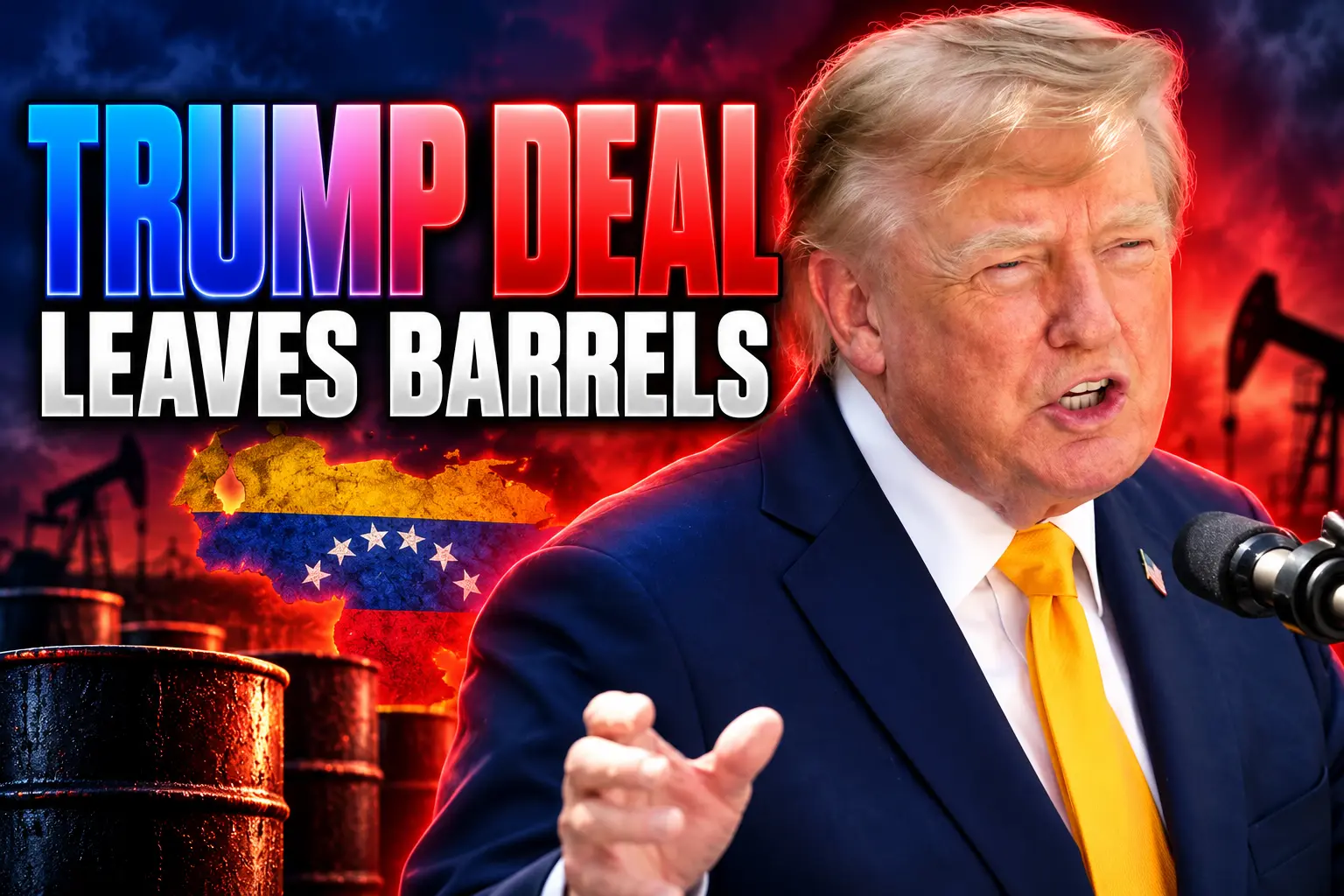
President Donald Trump said Friday the United States had locked in majority control of more than 65 billion barrels of Venezuelan oil. He called the pact the biggest oil deal in world history and said American taxpayers would pay nothing for the reserves.
Venezuela’s acting president, Delcy Rodriguez, confirmed 17 fields, more than $100 billion of private investment, and more than $209 billion in taxes for the state. Drivers still paid a national average of $4.09 a gallon on Friday, and the Strategic Petroleum Reserve held 289.7 million barrels last week.
Trump Claims Majority Control of 65 Billion Barrels
Trump posted the announcement on Truth Social on Friday evening. “The United States of America has just entered into an Agreement with the Country of Venezuela on, THE BIGGEST OIL DEAL IN WORLD HISTORY!” he wrote, saying Secretary of State Marco Rubio and Defense Secretary Pete Hegseth had worked with Rodriguez “through a partnership with private business.”
He said that partnership had “secured majority US control of more than 65 BILLION BARRELS of proven Oil Reserves in Venezuela, at no cost to the American Taxpayer.” The same post said the transaction “MORE THAN DOUBLES American Oil Reserves,” would raise supply, and “will substantially lower Gas Prices for all Americans, long into the future.”
Rubio, who led the talks, called the pact “a huge win for both the American and Venezuelan people” and said it would bring about $100 billion in private investment, secure “low-cost oil in our Hemisphere,” and lower prices at home.
This deal is a huge win for both the American and Venezuelan people.
It demonstrates how President Trump's bold foreign policy is driving America First wins: securing stable reserves and low-cost oil in our Hemisphere and lowering gas prices here at home.
For the Venezuelan… https://t.co/SMSRYGWmVb
— Secretary Marco Rubio (@SecRubio) August 28, 2026
U.S. officials speaking without authorization described a new private company in which Washington would hold a 55 percent effective share, through equity plus the right to buy crude at cost, and said Rodriguez had granted 100-year rights to the fields. They said the unnamed operator had not been disclosed. Those terms did not appear in the Caracas statement.
Seventeen Fields and a $209 Billion Tax Promise
Xinhua, citing Rodriguez’s statement on Friday, said the agreement would promote investment in “the recovery and reconstruction of strategic infrastructure” for Venezuela’s oil industry and would raise output with private operators. Caracas put the same 65 billion barrel figure on 17 “strategic fields,” paired with “an investment of more than 100 billion U.S. dollars, and more than 209 billion dollars in taxes for the State.”
Rodriguez thanked Trump and Rubio and said the pact would have a major effect on “the rebirth of our nation,” language she also used on Telegram. The U.S. version counts majority control. The Venezuelan version counts private capital and a tax haul. Both rest on barrels that have to be produced.
THE DEAL ON PAPER
| Item | Figure | Who stated it |
|---|---|---|
| Fields to develop | 17 strategic fields | Rodriguez statement, Aug. 28 |
| Claimed oil | 65 billion barrels of proven potential | Trump and Rodriguez |
| Private investment | More than $100 billion | Rodriguez; Rubio said “almost $100 billion” |
| Taxes for Venezuela | More than $209 billion | Rodriguez statement |
| U.S. cash for the reserves | None, per Trump | Truth Social, Aug. 28 |
| Reported U.S. share | 55 percent of a new private company | Anonymous U.S. official |
| Reported term | 100-year concession | Anonymous U.S. official |
Sixty-five billion barrels is about one fifth of Venezuela’s proved stock, which OPEC’s 2026 yearbook places near 303 billion barrels, the largest total on earth. It is also a slice, not a cargo. No field list, no operator name, and no production timetable went out with the Friday posts.
Most of the Oil Is Extra-Heavy Orinoco Crude
Venezuela’s endowment is not light shale. An August paper from Orlando A. Ochoa, a visiting fellow at the Oxford Institute for Energy Studies, using PDVSA planning figures dated July 17, puts national proved crude at 303.010 billion barrels. Of that, 260.8 billion is extra-heavy, almost all of it in the eastern basin that holds the Orinoco Belt.
That belt is a wide sheet of extra-heavy crude, much of it 8 to 12 degrees API, that does not flow like West Texas oil. It needs diluent, heat, or both, plus a lot of electricity, before it can move to a port or a refiner. Ochoa’s paper maps extra-heavy crude in the Orinoco Belt as the long-term prize and the slow one.
HOW THE ORINOCO RESOURCE SPLITS
- Cold production: About 71 billion barrels can be produced without heavy heating, the cheaper first slice.
- Mixed recovery: About 147 billion barrels need a blend of cold and thermal methods.
- Hard thermal oil: About 44 billion barrels need intensive heating and upgrading.
- Power limit: Ochoa calls reliable electricity the Achilles’ heel of any fast ramp.
A return toward 3.3 million barrels a day over 10 to 12 years is “technically plausible,” he wrote, if politics, fiscal terms, private capital, pipes, power, and diluent all hold. It is a ceiling, not a forecast. Venezuela lifted about 1.12 million barrels a day in July, per OPEC secondary sources. Output peaked near 3.75 million barrels a day in 1970 and near 3.5 million in 1997, before Hugo Chavez’s nationalizations and years of sanctions and under-spending.
Who Writes the $100 Billion Check?
Private companies do, if anyone does. Trump’s “no cost to the American Taxpayer” line is the point of the structure: Washington claims a stake, Caracas claims tax, and the cash for wells, pipes, upgraders, and power plants is supposed to come from a private operator that Friday’s statements would not name. Chevron is still the only U.S. major with a live permit in the country. ExxonMobil chief executive Darren Woods told Trump in January that Venezuela was uninvestable without deep legal change, a rebuff that drew a public scolding and no check.
Francisco Monaldi, director of the Latin American Energy Program at Rice University’s Baker Institute, has spent the year putting numbers on that hesitation. In January he told interviewers a climb back to historic output would take about $10 billion a year for a decade. Some analysts put a full return near 3 million barrels a day above $180 billion over 15 years. After Friday’s announcement he told the Washington Post the same core worry in one line.
I think oil companies in the end will be pretty hesitant.
Francisco Monaldi, director of the Latin American Energy Program at Rice University, Washington Post
The hesitation has a file history. Chavez seized foreign-run projects in 2007, including Exxon and ConocoPhillips assets, and those firms took billions in losses. Exxon’s old Cerro Negro complex was found in ruins this year, and restarting it is expected to cost billions. Idle Orinoco plants have been stripped for parts. The Amuay and Cardon plants in the Paraguana complex, which process extra-heavy crude before export, have been running at less than a fifth of capacity, with a refit bill of $500 million to $1 billion.
Ochoa’s paper adds a legal snag that sits poorly next to a 100-year lease. The January 2026 hydrocarbons reform, which Rodriguez used to open the door to private operators, still contains uncompensated reversion clauses in Articles 35(4) and 43. Those clauses, he argues, recreate the old “horizon problem”: a firm asked to spend on thermal recovery and power plants cannot be sure it will own the asset at the end. That is a strange companion to a century-long concession.
Boards can do the arithmetic at today’s prices. West Texas Intermediate settled at $84.81 a barrel on August 27, per EIA figures drawn from the day’s close, and extra-heavy crude has often needed high prices plus a light tax take to work. Monaldi has also argued that some published breakeven figures bake in old 50 percent royalty loads and should not be used as a veto. None of that names the operator. Until a company puts its letterhead on the 17 fields, the 65 billion barrels are a concession, not supply.
The Strategic Reserve Hit 289.7 Million Barrels
The political need for a barrel headline is not mysterious. The EIA’s Weekly Petroleum Status Report for the week ending August 21 put the Strategic Petroleum Reserve at 289.7 million barrels, down 3.7 million from the week before and the lowest since November 1982, when the caverns held 288.2 million. Before the Iran war began on February 28, the stockpile held 415.4 million barrels. About 125.7 million barrels have come out since then.
A June note from the U.S. Government Accountability Office counted a planned 172 million-barrel Iran-war release among the draws, on top of earlier sales after Russia’s invasion of Ukraine. The caverns can hold about 714 million barrels. They are now about 41 percent full, with 98.7 million barrels of sweet crude and 191 million of sour. Commercial crude, which is a different pile, stood at 428.9 million barrels the same week.
BARRELS ON PAPER AND BARRELS IN TANKS
| Stock | Barrels | What it measures |
|---|---|---|
| U.S. SPR, week ending Aug. 21 | 289.7 million | Crude in Gulf Coast salt caverns |
| U.S. proved reserves, year-end 2024 | 46.0 billion | Oil EIA says can be recovered under current conditions |
| Friday’s deal acreage | 65 billion | Claimed proven potential in 17 Venezuelan fields |
| U.S. proved plus the deal | 111 billion | Arithmetic Trump used for “more than doubles” |
| Venezuela proved, OPEC | About 303 billion | Largest national total, mostly extra-heavy |
| World proved, end-2025 | 1,572 billion | OPEC Annual Statistical Bulletin 2026 |
The doubling claim is real as math. The EIA’s last full survey counted 46.0 billion barrels of proved crude and lease condensate in the United States at year-end 2024, down 1 percent from 46.4 billion. Add 65 billion and the sum is 111 billion, which is more than double 46. OPEC’s yearbook puts 1,572 billion barrels of proven crude in the world at the end of 2025, so 111 billion would be about 7 percent of that total, in the same band as the United Arab Emirates. Proved reserves, in EIA’s own definition, are volumes recoverable “under existing economic and operating conditions.” A 100-year claim on extra-heavy fields that lack power, diluent, and an operator does not meet that test today.
AAA said Friday’s $4.09 national average was a cent below the prior week and that every day this August had sat above $4, on track for the most expensive August on record, beating 2022. A year earlier the average was $3.21. Diesel averaged $5.61. Those are the prices the Truth Social post said the deal would bring down “long into the future.” They are also the prices drivers paid the morning after.
Rodriguez Traded Access for Future Tax Revenue
The bargain is clearer from Caracas than from Washington. Rodriguez keeps the state in the tax stream, invites private operators onto 17 fields, and sells the pact as reconstruction money after the January 3 raid that seized Nicolas Maduro and his wife and flew them to New York. U.S. forces left her in place as interim president. On January 29 she backed a partial hydrocarbons reform to let private firms take a larger role, the same law Ochoa now flags for its reversion clauses.
FROM THE RAID TO THE ANNOUNCEMENT
- January 3, 2026: U.S. forces seize Maduro in a large-scale strike and take him to New York.
- January 29, 2026: Rodriguez announces a partial hydrocarbons-law reform to widen private oil work.
- March 2026: The Treasury issues licenses that let U.S. firms operate in Venezuela, according to contemporaneous official accounts.
- April 2026: The Office of Foreign Assets Control takes Rodriguez off its sanctions list, the same accounts said.
- August 28, 2026: Trump and Rodriguez announce the 17-field, 65 billion barrel agreement.
For Rodriguez, $209 billion in future taxes is the domestic sell. For Trump, majority control at no Treasury cost is the domestic sell, aimed at a public that has watched the Iran war pinch the Strait of Hormuz and drain the caverns. Gulf Coast refiners still want heavy sour barrels of the kind Venezuela used to send in volumes above 1 million barrels a day in the late 1990s. The hardware that made those barrels, from Lake Maracaibo’s leaking lines to stripped Orinoco upgraders, is the part of the deal that does not fit in a social post.
A 100-Year Lease Will Not Cut Pump Prices Now
A century-long concession can outlast several presidents. It cannot refill a salt cavern next week or change a $4.09 gallon this month. The next EIA weekly report will still count oil in Texas and Louisiana, not oil in the Faja. The unnamed private company, if it appears, will face extra-heavy wells, a weak power grid, a law that still threatens uncompensated reversion, and boards that remember 2007.
Caracas has a tax promise of more than $209 billion and a reconstruction pitch. Washington has a majority claim on 65 billion barrels and a talking point that American reserves have more than doubled. The barrels are in the ground, most of them extra-heavy, and the $100 billion check still has no signer on it.

Amazon’s Apple Prime Deals Mostly Undo the June Hikes

The Atlantic’s First Hurricane Is Aimed at Soaked Gulf Soil

Iran’s Hormuz Attacks Target the Route That Restored Crude

S&P 500 Clears 7,800 as AI Chips Outrun Yields

Russia’s No-Plague Finding Leaves a Siberian Death Unexplained

Glacier Collapse Buried Nepal’s Hydropower Workers in Tunnels

Congo’s Bundibugyo Outbreak Outruns the Licensed Ebola Shots

AI Server Boards Put Everyday Circuit Materials on Allocation

Germany Can Miss Its 2026 Climate Cap Without Penalty

CISA’s Known Exploits Still Come From 2007-Era Bugs
-
 NEWS1 month ago
Glacier Collapse Buried Nepal’s Hydropower Workers in Tunnels
-
 NEWS1 month ago
Congo’s Bundibugyo Outbreak Outruns the Licensed Ebola Shots
-
 NEWS1 month ago
AI Server Boards Put Everyday Circuit Materials on Allocation
-
 NEWS1 month ago
Germany Can Miss Its 2026 Climate Cap Without Penalty
-
 NEWS1 month ago
CISA’s Known Exploits Still Come From 2007-Era Bugs
-

 NEWS1 month ago
A Cow Rumen Enzyme Dissolves Superbug Biofilms on Gauze
-

 NEWS1 month ago
Pennsylvania Measles Deaths Follow a Long Slide in Coverage
-

 NEWS1 month ago
Texas Judge Freezes the SEC Eligibility Ban for 41 Athletes