
NEWS
Pennsylvania Measles Deaths Follow a Long Slide in Coverage
Pennsylvania’s measles-associated deaths, NICU lockdowns, and a disputed death count follow Lancaster kindergarten coverage of 87.6%.

The Pennsylvania Department of Health confirmed two measles-associated deaths in Pennsylvania on Aug. 25, the first in 35 years, and by Aug. 31 the count of confirmed infections had reached 497 across 34 counties.
Both people who died were unvaccinated residents of Lancaster County. A county coroner says an infant among the cases died of a lacerated spleen, and federal officials have not added either death to the national measles tally.
Two Deaths, Two Investigations, and a Climbing Case Count
Health Secretary Dr. Debra Bogen said both deaths were in unvaccinated Lancaster County residents and that the department would release no further identifying details. The department uses “measles-associated” when laboratory or epidemiologic evidence of measles is present, even if a coroner has not listed measles as the immediate cause of death. Gov. Josh Shapiro, speaking the same day, called the losses the first measles-associated deaths in Pennsylvania since 1991 and said he hoped they would be the last.
Because measles was largely eliminated in the Commonwealth for more than three decades, people are not familiar with this disease and don’t fully understand the potential severity of the illness.
Dr. Debra Bogen, Pennsylvania secretary of health
Bogen also said none of the state’s confirmed measles cases had been in people who had received both recommended doses of the MMR shot. The department’s general measles brief puts the hospital rate near 20 percent and the death rate at one to three patients per 1,000 cases. The virus can hang in air and on surfaces for up to two hours, and symptoms can start 7 to 21 days after contact.
An Aug. 31 department update listed 497 confirmed cases, 34 counties, 87 hospitalizations, and the same two measles-associated deaths. About half of the state’s cases have been in Lancaster County through the summer. Two days earlier, a formal release had put the total at 460 cases in 31 counties with 83 people in the hospital. The live tracker at pa.gov/measles is refreshed Monday, Wednesday, and Friday afternoons.
The Department of Health confirmed two measles-associated deaths in Lancaster County — the first measles‑related deaths in the state in 35 years. To respect their families’ privacy, no additional details will be released.
So far this year, Pennsylvania has seen 393 measles cases… pic.twitter.com/mGV0TrWE0I
— PA Department of Health (@PAHealthDept) August 26, 2026
Shapiro’s office said staff had given more than 4,100 MMR doses at 91 pop-up clinics since the outbreak began in April, with 40 more clinics planned. Two doses of MMR, the department says, provide 97 percent protection against measles.
HOW THE OUTBREAK REACHED HOSPITALS
- April 2026: Cases are first identified in Lancaster County, and pop-up MMR clinics follow.
- July 14, 2026: The health department launches a public measles dashboard with county, age, and hospital figures.
- August 3, 2026: Parents get a new state tool with vaccination rates by school for kindergarten, seventh grade, and 12th grade.
- August 12-13, 2026: A visitor with high suspicion of measles is on the Geisinger Medical Center campus in the emergency waiting room, pediatric emergency department, atrium, fluoroscopy, and the second floor of Janet Weis Children’s Hospital.
- August 14-17, 2026: A later visitor who tests positive is in the Danville NICU and Ronald McDonald House Danville from 5 p.m. Friday to 6:30 p.m. Monday.
- August 17, 2026: Penn State’s Golisano Children’s Hospital warns that someone later found to have measles spent two and a half hours in the main lobby.
- August 25, 2026: The state confirms two measles-associated deaths, both unvaccinated Lancaster County residents.
- August 31, 2026: The department’s update reaches 497 cases, 34 counties, and 87 hospitalizations. Lancaster County Coroner Dr. Stephen Diamantoni says his office has a new report of another child who died with measles.
UPMC Children’s Hospital’s emergency department was also named in recent exposure notices from the Allegheny County Health Department. Dr. Jeffrey Martin, who practices at Lancaster General Health, asked people who think they might have measles to call ahead before they walk into a clinic, urgent care, or hospital, so staff can isolate them before they sit in a waiting room.
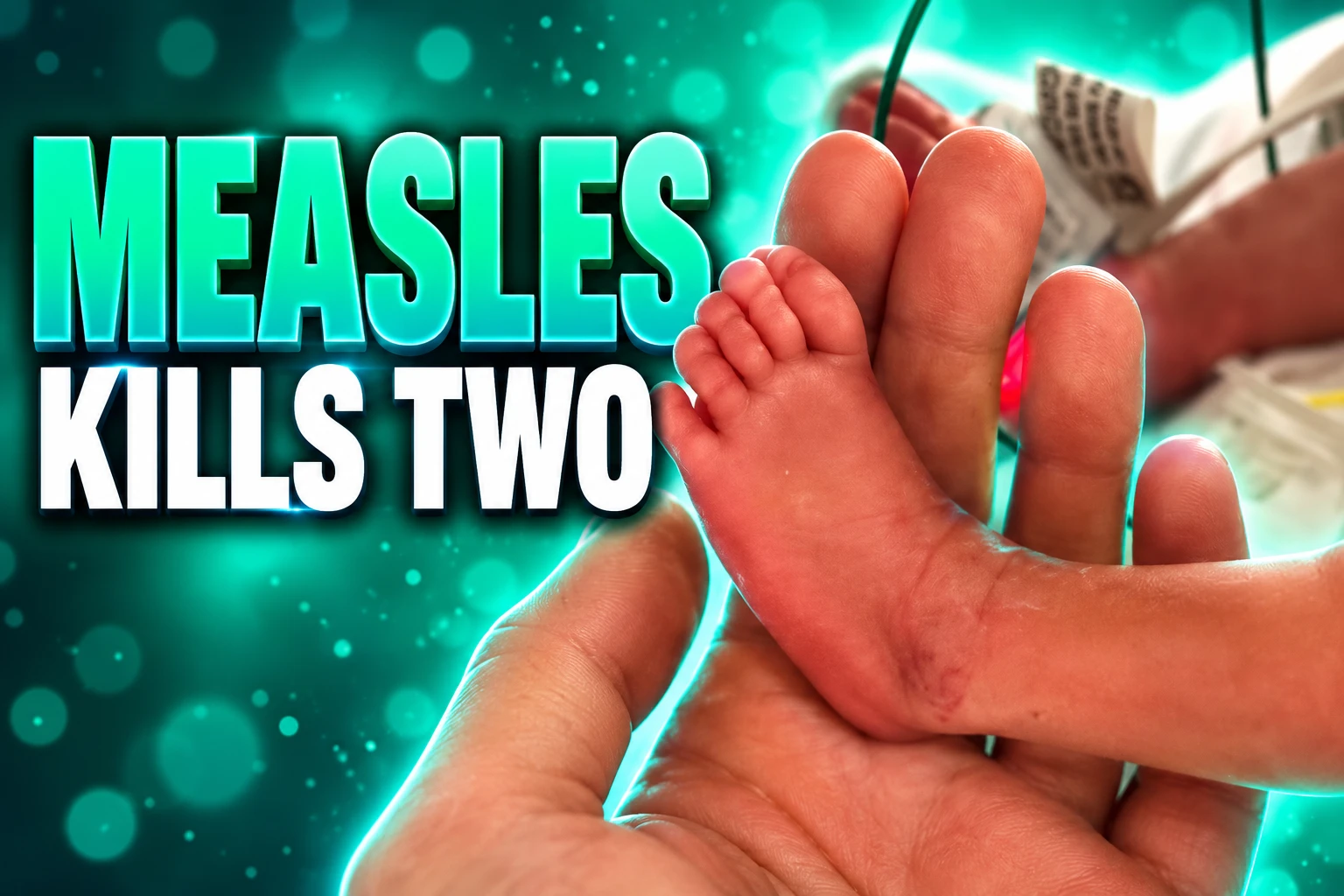
Measles in the NICU After a Weekend Visit
Geisinger Medical Center in Danville sits north of Lancaster County. On Aug. 21 the system said a visitor who later tested positive for measles had been on campus from 5 p.m. on Friday, Aug. 14, to 6:30 p.m. on Monday, Aug. 17, and that a review found the person had gone only to the NICU and Ronald McDonald House Danville. Anyone in those rooms in that window was told to watch for symptoms.
The adult developed a fever and a rash on Aug. 17 and tested positive the next day, according to the physician who later called Brittany Nicole Sponenberg about her son. Geisinger then limited NICU visits to parents or legal guardians with no measles signs or symptoms. Entrance screening, aligned with CDC and state guidance, had already started on Monday, Aug. 17. Surgical masks are strongly encouraged before anyone steps onto the unit. The new visitor rule applies only to the Danville NICU.
Our teams established entrance screenings to best protect our patients, visitors and staff as measles cases are rising in the area. However, the screening process relies on accurate and complete information being shared at the time of entry.
Dr. Michael Fitzpatrick, Geisinger Central Region chief medical officer
Fitzpatrick said the hospital did not change the rule lightly and that parents still need to be at the bedside. He also said people born before 1957, people who have had measles, and people with two MMR doses are generally at low risk, while unvaccinated and immunocompromised patients are not. A separate Geisinger notice had already covered the Aug. 12-13 campus walk-through, a different window from the NICU visit.
Sponenberg has said she does not understand why the hospital does not require visitors to show vaccination records. Pediatric infectious-disease doctors note that hospitals almost never bar a parent from a child’s bedside. If a parent had an illness the building could not contain, the usual step would be to move parent and child into an isolation room with its own airflow and bathroom, and to send meals in so no one walks the halls.
The People Who Cannot Opt Out
Sponenberg’s son had been in the Danville NICU for almost two months with underdeveloped lungs and gut. She said she sat silent on the phone while a doctor explained the measles exposure, then learned the hospital had waited three days, after the baby had already been moved to a hospital closer to home. “And he told me all of that, and I’m like, are you kidding me right now?” she said.
The doctor called the baby’s chance of getting measles low, she said, but ordered extra medicine by injection in the top of each thigh and a transfer into an isolation room with special air circulation. He will not be fully clear of the risk for 28 days after the exposure. “He’s already had to overcome so many battles already. This was not a battle I wanted to add to us having to overcome,” Sponenberg said. Other parents in the unit were furious, she added, and some of the smallest babies could not handle the noise from the pressure-controlled rooms.
Dr. Buddy Creech, a pediatric infectious disease specialist at Vanderbilt University, said premature infants are open to infection for several reasons. They are born before antibodies move from mother to baby late in pregnancy. They often depend on medical devices, and in the earliest infants the skin is not yet a solid barrier. Children under 5 who get measles are more likely than older kids to develop pneumonia and brain swelling.
The same math reaches people who leave the hospital every day. Kimberly Reichenbach, 50, of Leola, retired from work as a corrections officer after severe asthma and other health problems. For the past few years she has driven Amish customers on errands, a common workaround in a community that avoids some modern machines. She quit last week of August after she and her partner, who has type 1 diabetes, separately drove clients who were sick or had been exposed.
At the end of one trip, a woman said she was grateful to restock her pantry because her whole family had measles and she wanted food in the house before she got too sick to get out of bed. Another client, a bakery worker, got into the car coughing and sneezing and called it a cold. Reichenbach went home and canceled everybody. “It’s a tough place to be immune-compromised,” she said. “If I get sick, who’s going to take care my family?” Her doctor later told her that she and her boyfriend, who are immunized, would probably be fine after their exposures, but advised her not to visit her young niece and nephew. “They’re babies. They’re toddlers. I wasn’t going to risk it,” she said.
Amish and Mennonite families do not all reject vaccines, but their coverage runs lower than the county as a whole, and they share cars, bakeries, hospital lobbies, and ride drivers with neighbors who cannot take that chance. Reichenbach said her Amish neighbors tend to brush off their own symptoms and have told her they do not like to take medicine to ease them. The people absorbing the extra shots, the isolation rooms, and the lost work are often the ones who never filed an exemption.
Lancaster’s Kindergarten Rate Fell to 87.6 Percent
Measles needs about 95% coverage to stop jumping from person to person. Lancaster County’s 2025-26 kindergarten measles vaccination rate is 87.6 percent, 7.4 points under that line. Seventh graders sit at 83.3 percent, 11.7 points under. Twelfth graders, at 94.9 percent, come closest. Pennsylvania’s statewide kindergarten two-dose MMR rate for the same year was 93.2 percent, down from 93.7 percent.
Those county averages hide a split. Public schools in Lancaster County, in the 2024-25 figures, sat at 95 percent MMR overall, with the weakest public campus in that set, Adamstown Elementary in the Cocalico district, at 86 percent. In August the state posted school-level vaccination rates online for kindergarten, seventh grade, and 12th grade. Statewide, more than half of reporting schools met the 95 percent kindergarten MMR mark, and more than 200 schools reported 100 percent.
MEASLES SHOT RATES AGAINST THE 95% LINE
| Group | Rate | Gap vs 95% |
|---|---|---|
| U.S. kindergartners, MMR, 2025-26 | 92.4% | 2.6 points under |
| Pennsylvania kindergartners, two-dose MMR | 93.2% | 1.8 points under |
| Lancaster County kindergartners, measles | 87.6% | 7.4 points under |
| Lancaster County seventh graders, MMR | 83.3% | 11.7 points under |
| Lancaster County 12th graders, MMR | 94.9% | 0.1 points under |
| Ephrata Mennonite School kindergartners | 33.3% | 61.7 points under |
A county can look nearly protected on a 12th-grade average and still have kindergarten rooms where two-thirds of the children have no measles shots. That is the pattern the new school tool was built to show parents before the 2026-27 year began, with some Lancaster campuses already back in class the week of Aug. 18.
Some Schools Sit Far Below the County Average
Private Christian and Mennonite campuses, and homeschool groups, pull the county numbers down. Ephrata Mennonite School, with about 370 students, reported a 33.3 percent kindergarten measles vaccination rate for last year and 95.8 percent among 12th graders. Two of its students were sickened in the spring. Other 2024-25 figures show how wide the pockets are.
SCHOOL POCKETS UNDER THE COUNTY AVERAGE
- Weavertown Mennonite: Kindergartners had a 25 percent MMR rate, the lowest private-school group in that year’s county set.
- Homeschool average: Lancaster County homeschoolers sat at 49 percent MMR across the measured grades.
- Pequea Valley homeschool: Seventh graders in that district’s homeschool group were at 15 percent, the lowest homeschool cell reported.
- Eastern Lancaster homeschool: Twelfth graders in that district reached 77 percent, the high end of the homeschool range.
- Full coverage campuses: Lancaster Catholic 12th graders, Lancaster Country Day at several grades, Lancaster Mennonite kindergartners, Linden Hall 12th graders, and St. John Neumann seventh graders were listed at 100 percent.
The same county contains classrooms at 100 percent and classrooms at 25 percent. Measles does not average them. It burns through the open pocket and then uses shared places, a hospital lobby, a bakery ride, a Ronald McDonald House, to reach people who were never in that classroom.
What Herd Immunity Required All Along
The United States declared measles eliminated in 2000 because coverage stayed high enough that importations died out. That floor was 95 percent. During the 2025-26 school year, U.S. kindergarten MMR coverage was 92.4 percent, and kindergarten exemptions rose to 4.2% from 3.6 percent the year before, about 155,000 children exempt from one or more shots. About 280,000 kindergartners started school without documentation that they had finished the two-dose MMR series. Exemptions rose in 41 states and Washington, D.C., and 24 states reported exemption rates above 5 percent.
THE NATIONAL MEASLES LEDGER
- 2026 cases: The CDC counted 2,903 confirmed measles cases as of Aug. 27, in 47 jurisdictions, plus 16 cases in international visitors.
- Last year: All of 2025 produced 2,289 cases and three deaths, so 2026 is already 614 cases above that full-year total with four months left.
- Who is sick: 94 percent of 2026 cases are unvaccinated or of unknown status; 3 percent had one MMR dose and 3 percent had two. Ages run 541 under 5 (19 percent), 1,351 ages 5-19 (47 percent), and 1,001 ages 20 and up (34 percent).
- Hospital care: 223 of the 2,903 cases (8 percent) were hospitalized. The CDC’s 2026 death total is listed as zero while it reviews Pennsylvania’s two reports.
Dr. Andrew D. Racine, president of the American Academy of Pediatrics, said more than a quarter of a million children started kindergarten last year without protection from the MMR vaccine, and that even a small drop can open outbreaks because measles needs coverage over 95 percent. In August, President Trump signed an executive order directing the U.S. Department of Health and Human Services to find a way to split the MMR shot into three separate vaccines. “I think you’re going to see a very big difference in the rates of autism,” Trump said when he signed it. Dozens of studies have looked for a link between vaccines and autism and have not found one.
Health Secretary Robert F. Kennedy Jr. has questioned the Pennsylvania deaths in public remarks, saying county officials told him they could not find measles deaths and that the state’s announcement felt like old political theater. The louder public argument has fastened onto that autopsy, which is a real dispute, and treated it as a substitute for the coverage numbers. Those numbers were already under the line before anyone argued about a spleen.
CDC Has Not Counted Pennsylvania’s Two Deaths
Lancaster County Coroner Dr. Stephen Diamantoni has said his office investigated a newborn boy who died Aug. 14 at a birthing center in Christiana Borough. Tissue sent for PCR testing confirmed measles, he said, but the forensic pathologist found a lacerated spleen and massive blood loss, with no enlargement or inflammation that would tie the rupture to measles. “At the time of the autopsy, we did obtain some tissue from the newborn and sent it for PCR testing that did confirm the presence of measles. But measles was not the cause of death,” Diamantoni said. County Commissioner Josh Parsons, after speaking with him, said the office had one patient who died with measles, not of measles. Diamantoni has also said he had no file on the state’s second measles-associated death. On Aug. 31 he told local stations his office had just received a report of another child who died with measles and that the cause could take weeks.
Shapiro has refused to litigate the coroner’s comments as a conspiracy fight. “Those two deaths were measles related,” he said. “What does not serve the public interest right now is getting into a back and forth with people online who are spewing irresponsible conspiracy theories.” The CDC’s own measles page states that its weekly update will not include the two Pennsylvania deaths while the agency reviews the circumstances and causes. For 2026, the federal death total remains zero. For 2025, it remains three.
WHERE EXPERTS DISAGREE
- Pennsylvania DOH: Two unvaccinated Lancaster County residents died in measles-associated cases, the first such deaths in the state in 35 years, announced Aug. 25 and still listed on the state dashboard.
- Lancaster County coroner: The infant his office autopsied had measles on PCR but died of a traumatic spleen rupture; measles was not the cause, and he has not identified the state’s second death in his files.
- CDC: The two reports are under review and are not in the national death count as of the Aug. 27 update, which still shows zero U.S. measles deaths for 2026.
A ruptured spleen is rare in a newborn, and Diamantoni has said the investigation into what tore it remains open. Physicians who treat measles note that the infection can enlarge a spleen and thin its capsule, which is why the state’s “measles-associated” label and the coroner’s “not the cause” finding can sit on the same chart. That fight will not rewrite the 497 infections, the 87 hospital stays, or the Danville NICU rule that now lets in only a parent without a fever.
Sponenberg’s son still has to clear a 28-day clock that started in a unit built to keep the smallest patients alive. Reichenbach is not driving. The state’s dashboard, updated three times a week, still lists two measles-associated deaths. The CDC’s page still lists zero. Geisinger’s NICU still screens the door.
Disclaimer: This article is news reporting and analysis of a measles outbreak, hospital exposure notices, and vaccination coverage data. It is for information only and is not medical advice, a diagnosis, or a recommendation that any person receive or refuse a vaccine or any other treatment. Readers with questions about measles exposure, isolation, pregnancy, a premature infant, or vaccination should speak with a licensed physician, pediatrician, or their local health department before making a health decision. Case counts, death classifications, hospital visitor rules, and school rates reflect the public sources named here and can change as investigations and dashboards are updated.

Amazon’s Apple Prime Deals Mostly Undo the June Hikes

The Atlantic’s First Hurricane Is Aimed at Soaked Gulf Soil

Iran’s Hormuz Attacks Target the Route That Restored Crude

S&P 500 Clears 7,800 as AI Chips Outrun Yields

Russia’s No-Plague Finding Leaves a Siberian Death Unexplained

Glacier Collapse Buried Nepal’s Hydropower Workers in Tunnels

Congo’s Bundibugyo Outbreak Outruns the Licensed Ebola Shots

AI Server Boards Put Everyday Circuit Materials on Allocation

Germany Can Miss Its 2026 Climate Cap Without Penalty

CISA’s Known Exploits Still Come From 2007-Era Bugs
-
 NEWS1 month ago
Glacier Collapse Buried Nepal’s Hydropower Workers in Tunnels
-
 NEWS1 month ago
Congo’s Bundibugyo Outbreak Outruns the Licensed Ebola Shots
-
 NEWS1 month ago
AI Server Boards Put Everyday Circuit Materials on Allocation
-
 NEWS1 month ago
Germany Can Miss Its 2026 Climate Cap Without Penalty
-
 NEWS1 month ago
CISA’s Known Exploits Still Come From 2007-Era Bugs
-

 BUSINESS1 month ago
Trump’s Venezuela Oil Deal Leaves the Barrels in the Ground
-

 NEWS2 months ago
A Cow Rumen Enzyme Dissolves Superbug Biofilms on Gauze
-

 NEWS1 month ago
Texas Judge Freezes the SEC Eligibility Ban for 41 Athletes