
LIFESTYLE
A San Francisco Floating Home Lists for $1.749 Million
Tyson Graham’s Mission Creek floating home, bought for $225,000 on a handshake, is listed at $1,749,000 as a 5.7-acre park prepares to break ground beside the dock.

Tyson Graham listed his Mission Creek floating home for $1,749,000 on September 18, 2026, one of 20 such homes permitted in San Francisco. He paid $225,000 for it in 2002, on a handshake with the last owner.
The creek that once took industrial waste now sits between Oracle Park, Chase Center, and a 5.7-acre park set to start construction in late 2026 or early 2027. The house he built from a 40-foot boat is on the open market, which almost never happens here.
What $1,749,000 Buys on Mission Creek
The home at 300 Channel Street No. 14 is 1,980 square feet, with three bedrooms, three baths, and two of those baths en suite, and it is offered at $1,749,000. Erik Throm of City Real Estate holds the listing, MLS 426147746. That works out to $883 a square foot, filed as a condominium even though the structure sits on water the Port of San Francisco owns.
THE HOME ON BERTH 14
- The layout: A split-level main floor puts the living room above the dining room and galley kitchen, divided by a floor-to-ceiling steel-trimmed window.
- The primary suite: Wide-plank wood runs floor to ceiling, with a balcony, a water-facing sitting room, a walk-in closet, and a private bath.
- The extras: A winding steel staircase reaches a small office, a second bedroom has its own bath, two parking spaces come with the sale, and a 40-foot pleasure-boat berth is optional.
- The motion: The whole community rises and falls with the tide, climbing as much as 8 feet in a day, so the floors list as you stand in the bedroom.
The upper level has its own entrance, a leftover from Graham’s first plan to run the top floor as a separate apartment. The kitchen wraps a custom wood counter into a curving breakfast bar. A small deck takes lounge chairs at water level. Open houses ran September 27 from 1 to 3 p.m. and September 29 from 9 to 11 a.m.
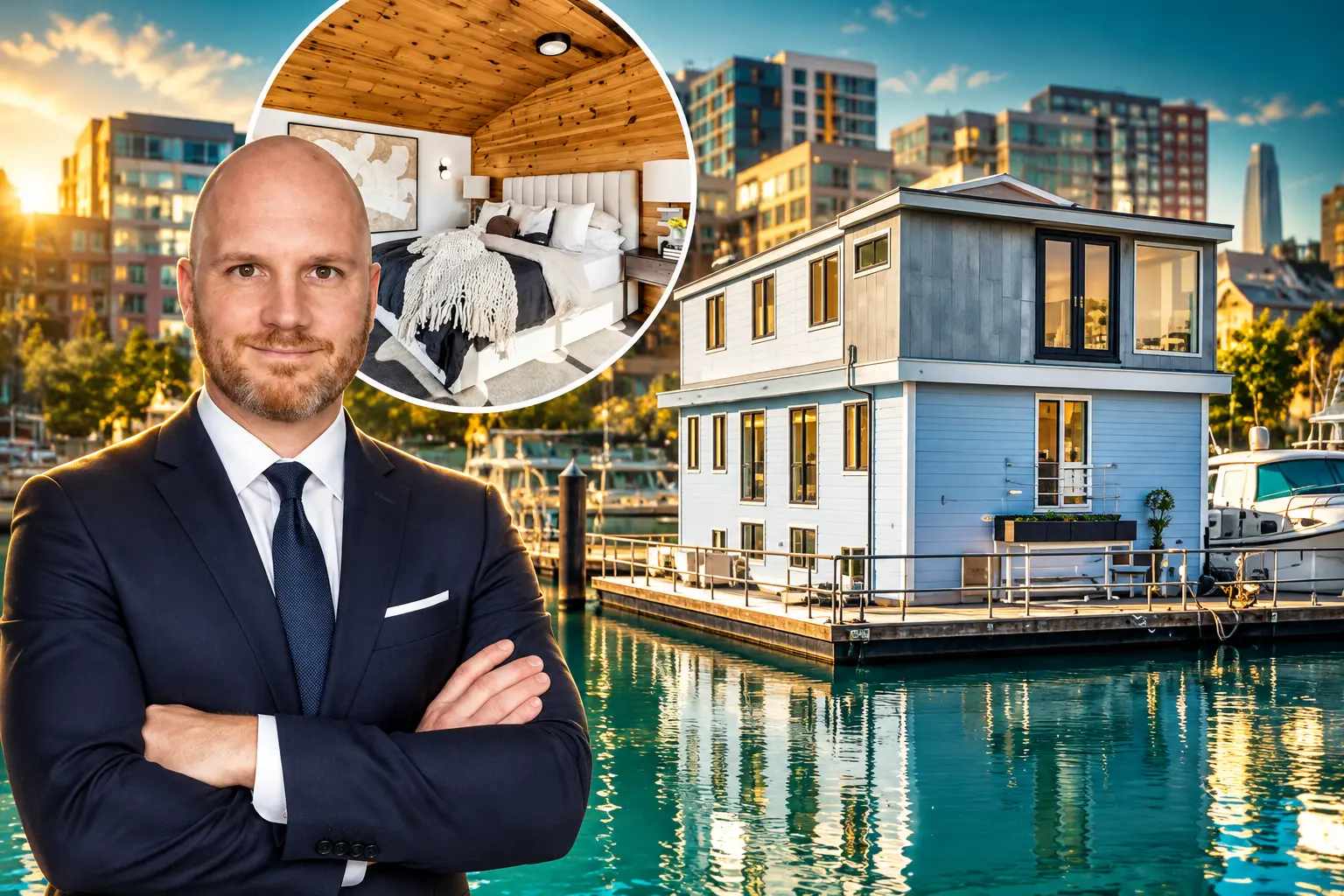
He Built It From a 40-Foot Jewel Box
Graham, a Chicago native who still calls himself the new guy after buying in 2002, did not purchase the house that is for sale. He bought a 40-foot boat in a 40-foot slip.
It had a deck in the front. A deck in the back, and it was a little jewel box. I don’t think it was 300 square feet.
Tyson Graham, owner, 300 Channel Street No. 14
He built the present home himself in 2003, a rite of passage on this dock, and has redone almost every part of it since. One design goal was two units, with the upstairs as an apartment and the downstairs as his own quarters. The top floor is now a primary suite. He says upkeep is not less than a house on land, and not more, if you stay on it.
He has lived in San Francisco on and off since the 1990s and retired before this listing. More of his time now goes to a ranch in Sonoma County. Sea lions used to visit the creek; he says he rarely sees them, and that many birds left during years of construction nearby and have not come back.
Only Three Have Sold on the Open Market
Most Mission Creek homes move inside families or through people already tied to the dock. Throm and official records say only three have sold on the public market. Graham’s 2002 deal was a handshake. The last closed comparable that is easy to pin down is berth 55, which sold for $1,687,500 on August 27, 2019, after listing at $1,800,000 on June 20 and sitting 66 days.
THE MISSION CREEK PRICE CARD
| Home | Year | Size | Price |
|---|---|---|---|
| 300 Channel No. 14, Graham purchase | 2002 | About 300 sq ft boat | $225,000 |
| 300 Channel Unit 55, closed sale | 2019 | 2,192 sq ft, 2 bed, 2 bath | $1,687,500 |
| 300 Channel No. 14, current ask | 2026 | 1,980 sq ft, 3 bed, 3 bath | $1,749,000 |
The 2019 sale was $770 a square foot for a larger two-bedroom. Graham is asking more money for fewer square feet and an extra bedroom, at 7.8 times what he paid in 2002. He is considering seller financing and doubts he will need it. Regular mortgages are hard to get on a house that floats, so the buyer will likely need cash or terms he writes himself.
The Water Belongs to the Port
A buyer owns the structure. The berth is a lease. The Port of San Francisco owns the property, and the Mission Creek Harbor Association holds a ground lease that runs through 2055, 29 years past this listing. Bob Isaacson, a longtime resident, has said the homes have no motors and are not seaworthy, so the harbor has to work or the houses have nowhere to be.
WHAT THE CHECK DOES NOT BUY
- The slip: Monthly extras run about $1,183 for berthing, a capital assessment, and internet, plus water and electricity.
- The pleasure berth: An adjacent 40-foot slip can come with the sale at $423 a month for the slip.
- The tax file: Agents selling these berths have treated the home as personal property on the unsecured roll, not a standard land lot.
- The clock: After 2055 the association and the Port have to make a new deal, including whatever the water does as the bay rises.
Mission Creek Harbor describes itself as a community of mariners, floating-home dwellers, and gardeners that has been on this channel for 60 years. Huffaker Park, about one acre of paths, lawn, and picnic tables named for the woman who kept the boats from being towed, sits along the shore. Herons, cormorants, bat rays, and fish still use the creek. Swimming is not advised; sewer overflows still hit the channel in heavy storms.
Ruth Huffaker Told City Hall No
The harbor’s own history dates the community to 1959, when houseboats were moved from Islais Creek onto Channel Street. Early residents were artists, tradespeople, and fishing-boat owners who could live with a working waterway people called a dump. In 1969 the Burton Act moved the port from the state to the city with a grandfather clause: if the occupants were forced out, the city had to offer comparable berths.
HOW THE CREEK STAYED PUT
- 1959: Houseboats relocate from Islais Creek to Channel Street, later capped at 20 floating-home berths and 35 other slips, 55 in all.
- 1969: The Burton Act’s grandfather clause requires comparable berths if the city moves the occupants.
- 1974: The Port sends word that the pier will be torn down; Ruth Huffaker organizes, and the San Francisco Progress prints her line that you can beat City Hall.
- July 1976: Boat owners, the Port, the Bay Conservation and Development Commission, and the Army Corps of Engineers reach an agreement; the Port builds new berths from salvage for about $170,000.
- November 1977: The Mission Creek Harbor Association takes over management of the harbor.
Philip De Andrade, who later led the association, liked an old line about staying happy by staying hidden. Corinne Woods, another of the creek’s organizers, said the old sailors did not want anything to do with the city. Betty Boatright helped win the long lease. The hideout strategy worked until Mission Bay filled in around them: the Giants’ ballpark, UCSF, condo walls on the north bank, then Chase Center. In 2019, when berth 55 went public, De Andrade warned that selling to the highest bidder could drain the habit of neighbors raising a sunk boat together.
Mission Creek Park Comes to the Dock
The listing leans on a park that does not exist yet. San Francisco Recreation and Park, which will own and run the finished ground, says the Mission Creek Park South extension on Parcels P2 and P8 will add 5.7 additional acres of new open space west of the Mission Creek Park Pavilion. Construction is set to begin in late 2026 or early 2027, with an 18-month job, funded through the Office of Community Investment and Infrastructure and built with the Mission Bay Development Group.
The new park’s shoreline is adjacent to the houseboat community. It is meant to weave bike and pedestrian routes under Interstate 280 along Mission Bay Drive and Channel Street, with native plants, stormwater gardens, informal gathering space, public art, and a larger community garden. The garden the harbor has kept since the 1980s is already moving to an adjacent parcel to make room. For a buyer, that is a new front yard with a construction calendar. For the people already on the dock, it is the last empty edge of their creek turning into a city amenity.
Volunteer Days, Cash and a Closed Rental Door
The association limits rentals and second-home use, so a buyer has to spend real time on site. Residents take part in volunteer work days twice a year. Graham wants the next owner to understand that before writing the check.
This whole place is about the community. This is something to be preserved.
Tyson Graham, owner, 300 Channel Street No. 14
Preservation now has a number on it. A handshake for a 40-foot jewel box in 2002 has become a cash listing at $1,749,000, with a 3D walkthrough and a dedicated website, in a neighborhood whose old rule was to stay off the market. The next owner gets a house Graham built, two parking spots, and a shot at a 40-foot slip. They do not get the water, they do not get a quiet pass on work days, and they do not get a lease past 2055. They get a berth in a 20-home harbor that spent 50 years beating the city so it could remain a family, then watched the city arrive anyway.
Disclaimer: This article is news reporting on an active real-estate listing and is for information only. It is not an appraisal, a solicitation, or investment, legal, or lending advice, and it is not a recommendation to buy or sell this home or any other property. Anyone considering a floating-home purchase should consult a licensed California real-estate attorney, a lender who handles unusual collateral, and an independent marine surveyor before acting. Asking prices, monthly fees, association rules, lease terms, and listing status can change without notice.

Nintendo Pulls SmileBASIC After the First Switch 2 Jailbreak

Arkane Lyon’s Union Holds the Clock Microsoft Cannot Skip

Airbnb Bans Guest Chores as Homes Turn Into Hotels

Riyadh Downs a Houthi Missile After Weeks of Capital Strikes

Ariana Madix’s Empty Los Angeles House Fits a Bravo Pattern

AI Server Boards Put Everyday Circuit Materials on Allocation

Glacier Collapse Buried Nepal’s Hydropower Workers in Tunnels

Congo’s Bundibugyo Outbreak Outruns the Licensed Ebola Shots

Pennsylvania Measles Deaths Follow a Long Slide in Coverage

Germany Can Miss Its 2026 Climate Cap Without Penalty
-
 NEWS2 months ago
AI Server Boards Put Everyday Circuit Materials on Allocation
-
 NEWS2 months ago
Glacier Collapse Buried Nepal’s Hydropower Workers in Tunnels
-
 NEWS2 months ago
Congo’s Bundibugyo Outbreak Outruns the Licensed Ebola Shots
-
 NEWS2 months ago
Pennsylvania Measles Deaths Follow a Long Slide in Coverage
-
 NEWS2 months ago
Germany Can Miss Its 2026 Climate Cap Without Penalty
-

 NEWS2 months ago
CISA’s Known Exploits Still Come From 2007-Era Bugs
-

 NEWS2 months ago
Texas Judge Freezes the SEC Eligibility Ban for 41 Athletes
-

 BUSINESS2 months ago
Trump’s Venezuela Oil Deal Leaves the Barrels in the Ground