
BUSINESS
Riyadh Downs a Houthi Missile After Weeks of Capital Strikes
Saudi batteries destroyed a Houthi ballistic missile aimed at Riyadh, another night in a campaign that already killed 12 at the capital’s airport.

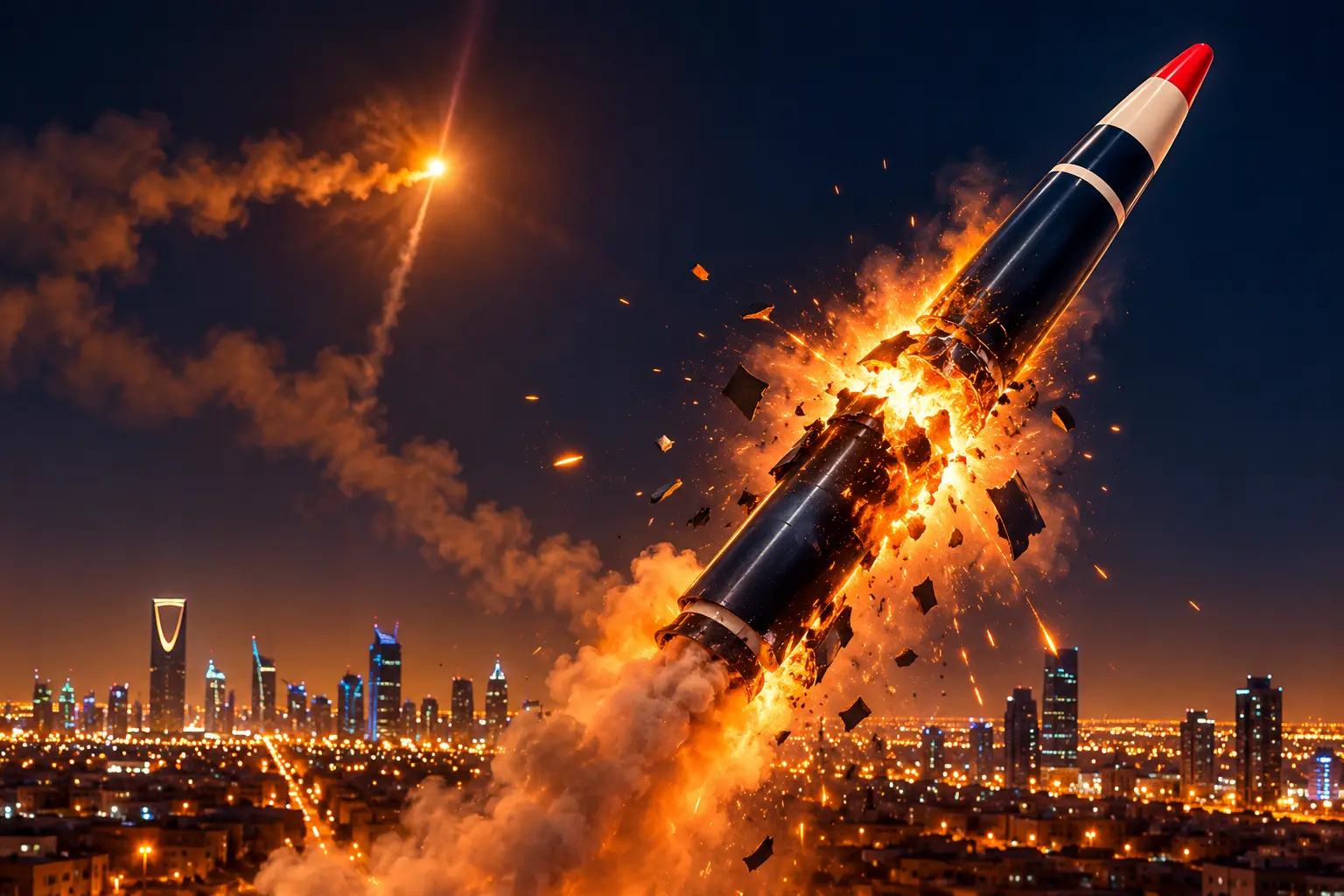
Saudi air defenses destroyed a Houthi ballistic missile headed for Riyadh on October 24, the coalition said, after sirens sounded in the capital, Najran and Wadi al-Dawasir. It was another night in a campaign that has already killed 12 people at the capital’s airport.
The intercept will read as a clean defensive win. The harder fact is that ballistic shots at Riyadh have become a regular cost of the Iran war’s southern front, and oil already moved on that risk.
What Happened Over Riyadh on October 24?
Coalition air defenses intercepted and destroyed a ballistic missile launched toward Riyadh, Maj. Gen. Turki al-Maliki said on the coalition account. Saudi civil defence had already pushed emergency alerts through the National Early Warning Platform in the capital, in Najran near the Yemeni border, and in Wadi al-Dawasir. It later said the danger had passed in all three places and told residents to keep following instructions, stay off the street and not film. The emergency number it posted was 911.
The coalition also said it had intercepted and destroyed a drone over the Eastern Province earlier in the night. Houthi-aligned media, for their part, reported air strikes on the al-Salem, Ketaf and al-Baqa districts of Saada governorate, the northern Yemeni stronghold that has long housed the group’s missile force. No official Saudi statement listed dead or wounded from the Riyadh missile on October 24.
THE NIGHT OF OCTOBER 24
- Eastern Province: The coalition said air defenses brought down a drone before the capital alerts went out.
- Three-city warning: Civil defence posted danger alerts for Riyadh, Najran and Wadi al-Dawasir.
- The intercept: Al-Maliki said batteries destroyed a Houthi ballistic missile headed for Riyadh.
- All-clear: Civil defence said the danger had passed and told people not to gather or take pictures.
The coalition’s own notice of the intercept sat on its official account within minutes of the all-clear.
التحالف:
الدفاع الجوي اعترض ودمر صاروخ باليستي أطلقته الميليشيا الحوثية الإرهابية باتجاه الرياض. pic.twitter.com/KKTkdEWLYZ
— المتحدث الرسمي باسم قوات التحالف (@CJFCSpox) October 24, 2026
Civil defence repeated the all-clear in English and Arabic and again told people to stay off their cameras.
تنبيه زال الخطر عن مدينة الرياض، لسلامتك الاستمرار في اتباع تعليمات #الدفاع_المدني وتجنب التجمهر والتصوير نهائيًا. في حالة الطوارئ اتصل بالرقم (911).
Alert: The danger has passed in Riyadh City. For your safety, continue following #CivilDefense instructions and avoid gathering… pic.twitter.com/uJFN1JmVOa
— الدفاع المدني السعودي (@SaudiDCD) October 24, 2026
A single ballistic kill is the version of this war Riyadh can put on a graphic. It does not describe the raid pattern that has already gotten through.
Twelve People Died at King Khalid Airport
On October 10 the General Authority of Civil Aviation said a strike on King Khalid International Airport killed 12 people and wounded 309, some of them in critical condition. The dead included four Saudi citizens, two Bangladeshis, and one person each from the United States, Jordan, Palestine, Syria, Sudan and Egypt. Operations at the airport, which serves a city of 8 million, were suspended and flights diverted.
THE OCTOBER 10 AIRPORT TOLL
- Dead: 12 people, including four Saudis and eight foreign nationals, according to the civil aviation authority.
- Wounded: 309 people, with some listed in critical condition and treated in several hospitals.
- Where it hit: A complex housing terminals 3 and 4 for domestic flights, which then had to be evacuated.
A passenger at gate 403 said they saw gate 401 hit and injured people in front of them, then everyone running. The Saturday strike was the third assault on the same airport that week. The civil aviation authority had already said Thursday’s attacks killed three Saudi citizens, among them Saudia Capt. Hamoud Ali Alkalthami, and damaged a Saudia aircraft on the ground.
Early accounts of the October 10 raid described drones going in first, then cruise and ballistic missiles behind them, a mix that can soak radars and force commanders to spend premium interceptors on the wrong tracks. Investigators were left asking why warning came so late on a shot that had hundreds of kilometres of flight time. Saturday’s isolated ballistic intercept does not answer that problem.
Missiles Have Come at the Capital All Month
Coalition figures put Houthi fire at the kingdom in October, through October 23, at at least 14 ballistic missiles and more than 60 armed drones. Saturday’s Riyadh missile and the Eastern Province drone sit on top of that tally. Riyadh, Khamis Mushait, Najran and the Eastern Province have all been named as aiming points. A cruise missile toward the Madinah region on October 15 was also reported intercepted.
HOW THE CAPITAL CAME BACK UNDER FIRE
- July 2026: Fighting in Yemen flares and a United Nations-brokered ceasefire that had largely held since 2022 unravels.
- September 8, 2026: Houthis launch a major wave at Jizan, Abha, Khamis Mushait and Najran.
- September 19, 2026: The first air-raid alerts of this round sound in Riyadh; black smoke is seen from a fuel tank at King Khalid International Airport after a barrage the Houthis said was aimed at “sensitive sites.”
- September 24, 2026: The coalition says it intercepts six Houthi ballistic missiles.
- October 10, 2026: The civil aviation authority records 12 dead and 309 wounded at the capital’s airport.
- October 23, 2026: Al-Maliki says a ballistic missile toward Riyadh is destroyed around 4 a.m., after two drones toward the south around 1 a.m.; Khamis Mushait is also named as a ballistic target.
- October 24, 2026: Batteries destroy another ballistic missile toward Riyadh and a drone in the Eastern Province; civil defence then lifts alerts in three cities.
Aviation analytics firm Cirium put cancellations across all Saudi airports at 46.4% during the mid-October wave, as carriers pulled flying and the kingdom’s main international gateway kept taking raids. The sirens on October 24 were not a return of the war to Riyadh. They were the war staying there.
Why Are the Houthis Firing at Riyadh Again?
The Houthis are using the same lever they used from 2015 through 2022: range the Saudi capital, oil plants and airports until Riyadh’s cost of backing Yemen’s internationally recognised government exceeds its appetite for the fight. International Crisis Group’s September alert said the group’s lightning advance along the Red Sea coast had dealt a major setback to that government and that cross-border fire, including at Riyadh, could deepen if territorial gains and pressure on shipping looked like a way to extract concessions.
That advance also put Houthi forces closer to Bab al-Mandab, the southern gate of the Red Sea, so Saudi ships now face trouble on two chokepoints at once, Hormuz in the northeast and the Red Sea in the southwest. The United Kingdom on September 22 and France on September 24 announced defensive military support for the kingdom. Military chiefs from Saudi Arabia, Pakistan and Türkiye, partners in a new trilateral defence pact, met in Riyadh on September 25.
Washington has been more cautious. U.S. officials met Houthi representatives in Oman in mid-September, and the group restated a 2025 ceasefire with the United States even as it opened a new account with Saudi cities. The October 10 airport dead made that split harder to keep. Riyadh wants the United States in against the Houthis directly. Saturday’s intercept will not settle that argument, because the argument is about the shots that land, not the ones that do not.
A 2022 Truce Bought the Capital Four Quiet Years
Riyadh has seen this movie. On June 24, 2018, Houthi forces launched two Burkan-2H ballistic missiles toward the capital; then-Colonel Turki al-Maliki said Patriots intercepted them over residential areas and that fragments in Riyadh’s diplomatic quarter were found near the U.S. mission and a school. Burkan-2H shots at King Khalid International Airport in November 2017 and at the Yamama palace district that December had already put the capital on the map of a Yemen war Saudi Arabia had tried to keep next door.
ACLED’s study of the cross-border air war found that between 2015 and the truce of April 2, 2022, the Houthis carried out nearly 1,000 rocket and missile attacks and more than 350 distinct drone attacks into Saudi and Emirati territory. Guided weapons rose from 15% of the yearly rocket and missile total in 2015 to 89% in 2022. The last major gasp in that data set was a large combined raid on March 25, 2022, aimed at oil plants and energy sites from Asir to the Eastern Province. A few days later the United Nations truce took effect.
Cross-border fire at Saudi cities largely stopped after that truce. The quiet lasted long enough for Riyadh to treat Yemen as a file to freeze, not a capital-range air war. Fighting inside Yemen and then across the border came back in July 2026, once the wider U.S.-Israeli war with Iran, which began on February 28, had already opened Hormuz as a shooting gallery. The batteries that worked on October 24 are the same family of systems that failed to keep terminals 3 and 4 intact on October 10. Four years of quiet did not retire the missiles. It stored them.
Rubio Says Interceptors Are the Scarce Weapon
Saudi Arabia went into this round with Patriot batteries, including PAC-3, and Terminal High Altitude Area Defense for the high-altitude ballistic layer, plus fighters that can hunt drones. The architecture was built for a different raid rate than a nightly mix of ballistic missiles, cruise missiles and low drones. Volume is what empties the magazine. Each intercept that works still spends a round that takes months to replace, and the United States is trying to feed Israel, Ukraine-era stocks, its own ships and Gulf partners from the same plants.
Secretary of State Marco Rubio put the squeeze in public after talking with Riyadh about resupply.
I also talked to Saudi Arabia today; they’d like interceptors. Israel would like interceptors. We would like interceptors. Every country in the world would like interceptors.
Marco Rubio, U.S. secretary of state
He called interceptors probably the most in-demand product in the defence field. That is the second-order bill for a night like October 24. The graphic shows a missile destroyed. The ledger shows another high-end round gone, and a Houthi launch crew that can reload a cheaper ballistic or a drone for the next alert. Britain’s decision to send Typhoon jets to help defend Saudi cities and plants is a way to plug gaps without waiting on those rounds. It is not the same as filling the tubes.
Oil Traders Price a Second Chokepoint
Brent futures gained 3.1% on October 23 to settle at $116.72 a barrel, the highest settlement since April 29. U.S. West Texas Intermediate added 3.8% to $103.27. Brent was up 6.2% on the week, the third week of gains, as traders weighed a possible new round of U.S. strikes on Iran and kept one eye on Houthi fire at Saudi airports and oil sites. Aramco’s Dhahran headquarters and Red Sea outlets at Yanbu have already been named as aiming points in this campaign, which is how a missile war in Yemen shows up in the barrel.
PRESSURE ON OIL AND THE KINGDOM
| Pressure point | Figure |
|---|---|
| Brent settlement, October 23 | $116.72 a barrel, up 3.1% |
| Hormuz-area ship attacks in October | 28, per the Washington Institute |
| Ship attacks since February 28 | 113, per the Washington Institute |
| Houthi ballistic launches at Saudi Arabia in October, through October 23 | at least 14, per the coalition |
| Armed drones at Saudi Arabia in October, through October 23 | more than 60, per the coalition |
Noam Raydan, a senior fellow at the Washington Institute for Near East Policy who keeps the institute’s record of shipping attacks mapped since 2017, said October had seen the highest number of ship attacks on record. She has counted 28 confirmed and reported attacks in the Strait of Hormuz and nearby waters in October and 113 since the U.S.-Israeli war with Iran began on February 28. A review of International Maritime Organization listings put damaged very large crude carriers at more than 30, including 11 in October, about 3.5% of a fleet that exceeds 900 ships. Each of those ships can carry about 2 million barrels.
Kpler put the seven-day average of Hormuz clearances at 12,653 kbd, about 74% of a 17,147 kbd pre-war baseline. Flows have recovered from the worst weeks of the war, but they have not recovered the old price, because freight and war risk now sit inside the delivered barrel. A missile that dies over Riyadh still tells a trader that Saudi export gear and the Red Sea option off the East-West pipeline are inside the same war as Hormuz. That is the price of a “successful” intercept.
Ground Fighting in Taiz Feeds the Air War
Saudi-backed Yemeni government fighters were photographed on October 21 riding in the back of a truck during battles against the Houthis at the Jabal Han front west of Taiz. Yemeni forces said they had conducted nearly 1,400 attacks on Houthi positions over the previous 24 hours and claimed to have put 620 fighters out of the fight. Those numbers are a warring party’s claim, not a verified body count, but they describe the tempo on the ground that the missile shots are meant to influence.
The Houthis answer ground losses the way they did in the last war, by ranging airports, oil plants and the Saudi capital so that the fighting in Taiz and on the Red Sea coast is felt in Riyadh’s sirens and in the barrel. Coalition aircraft, in turn, keep hitting launch country in Saada. Saturday’s sequence, a drone in the east, a ballistic missile toward the capital, alerts in three cities, an all-clear, and a warning not to film the sky, is what that loop looks like when the batteries work.
Civil defence left residents with a simple instruction after the all-clear: follow the rules, do not gather, do not point a camera at the intercept. The missile did not land. The campaign that sent it is still in range of the airport that already buried 12 people this month.

Nintendo Pulls SmileBASIC After the First Switch 2 Jailbreak

Arkane Lyon’s Union Holds the Clock Microsoft Cannot Skip

Airbnb Bans Guest Chores as Homes Turn Into Hotels

Riyadh Downs a Houthi Missile After Weeks of Capital Strikes

Ariana Madix’s Empty Los Angeles House Fits a Bravo Pattern

AI Server Boards Put Everyday Circuit Materials on Allocation

Glacier Collapse Buried Nepal’s Hydropower Workers in Tunnels

Congo’s Bundibugyo Outbreak Outruns the Licensed Ebola Shots

Pennsylvania Measles Deaths Follow a Long Slide in Coverage

Germany Can Miss Its 2026 Climate Cap Without Penalty
-
 NEWS2 months ago
AI Server Boards Put Everyday Circuit Materials on Allocation
-
 NEWS2 months ago
Glacier Collapse Buried Nepal’s Hydropower Workers in Tunnels
-
 NEWS2 months ago
Congo’s Bundibugyo Outbreak Outruns the Licensed Ebola Shots
-
 NEWS2 months ago
Pennsylvania Measles Deaths Follow a Long Slide in Coverage
-
 NEWS2 months ago
Germany Can Miss Its 2026 Climate Cap Without Penalty
-

 NEWS2 months ago
Texas Judge Freezes the SEC Eligibility Ban for 41 Athletes
-

 NEWS2 months ago
CISA’s Known Exploits Still Come From 2007-Era Bugs
-

 BUSINESS2 months ago
Trump’s Venezuela Oil Deal Leaves the Barrels in the Ground