
NEWS
AI Server Boards Put Everyday Circuit Materials on Allocation
AI server boards are pulling glass cloth onto allocation, so standard FR-4 for cars and factory controllers now waits in the same queue.

Würth Elektronik and STARTEAM GLOBAL say AI server boards now use three to five times higher layer counts than ordinary designs. Their August 18 analysis warns that AI data centers are absorbing high-grade laminates and leaving less capacity for industrial and automotive boards.
Demand is expected to stay high at least through the end of 2026. The tighter bind is further upstream, in the glass looms that used to weave ordinary FR-4 cloth.
Würth and STARTEAM Call Time on Freely Available Boards
Manuel Mairhofer, a member of the Würth Elektronik management board, is not describing a short spike in copper-clad laminate. He is describing a market that has already stopped treating base materials as something you can order next week.
Through our close collaboration with customers, material suppliers, and technology partners, we gain early insights into changes in material availability, manufacturing capacities, and the stability of global supply chains. This transparency enables us to respond proactively to emerging developments and provide the best possible support to our customers.
Manuel Mairhofer, Member of the Management Board, Würth Elektronik GmbH & Co. KG
Daniel Jacob, CEO of STARTEAM GLOBAL, said the pair’s supplier net is how they see the squeeze early. The release is blunter than the quotes. Production slots at many makers are already booked for the long term, so short-term demand swings have nowhere to go. Free stock is giving way to allocation. Firms without long-term supplier ties, a usable forecast, or a second qualified material can lose supply outright, not just pay more.
The shortage is not one resin or one foil grade. Würth names copper-clad laminates, copper foils, prepregs (especially PP1080 and PP2116), high-performance resin, and tungsten carbide for drilling and routing. For fiberglass fabrics, the same note says experts do not expect a real easing before 2028.
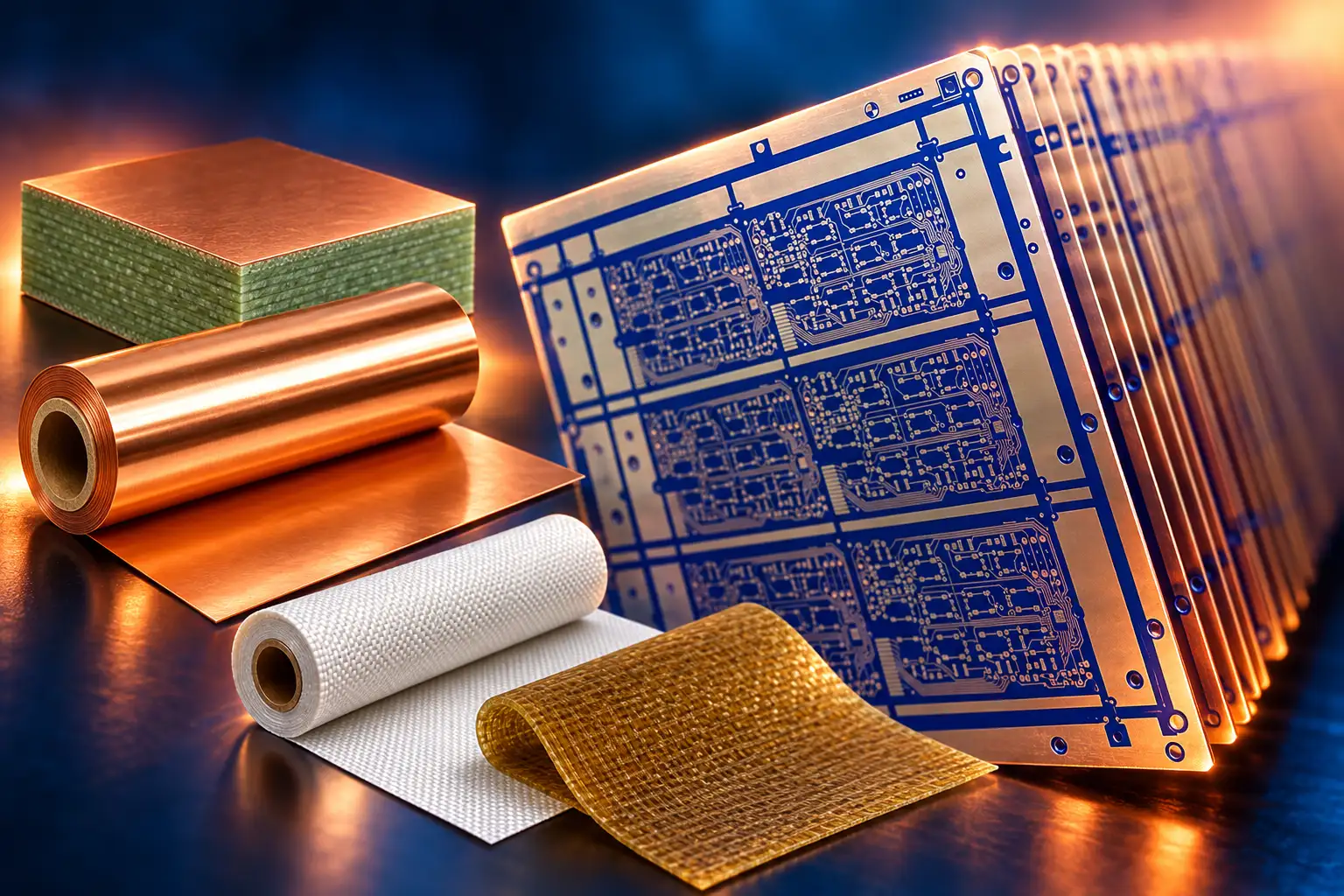
Ordinary FR-4 Is No Longer a Three-Day Item
High-speed laminates went first. Standard FR-4 has followed, which is the part of the stack that still fills car controllers, factory drives, and a lot of industrial electronics that never touch a GPU rack.
Raymond Goh, COO at Norwegian PCB supplier Confidee, wrote in March that FR-4 from Shengyi and Nanya had moved from about three days to about four weeks, while advanced high-Tg, low-Dk grades were out as far as 140 days. By August 19 he had dropped the idea that this was still an advanced-materials problem.
What began as isolated shortages affecting advanced, high-frequency laminates has evolved into a broader structural shift impacting the availability of standard FR-4, thicker copper-clad laminates, and conventional PCB materials.
Raymond Goh, COO, Confidee market update
Some laminate suppliers now confirm prices only on delivery. Refuse the new number and the allocation goes to the next buyer in line. Goh’s line for the rest of 2026 and into 2027 is that the shift is structural. Offers that promise a much shorter wait than the market, he wrote, should be treated with care.
BOARD GRADES AND WAIT TIMES
| Board grade | Earlier wait | Wait in 2026 | Typical buyer |
|---|---|---|---|
| Standard FR-4 | About 3 days at China mills, early 2026 | About 4 weeks by March, still extending | Industrial, auto, consumer |
| Advanced high-frequency laminates | A few weeks | Up to 140 days | AI servers, high-speed networking |
| Finished PCB prices | Open quotes | Up to 40 percent higher in early 2026, per in4ma | Across the board, steepest on high-layer work |
Korea Customs Service recorded copper-clad laminate imports at $20,728 per ton in March 2026, up 74.5 percent from a year earlier, the first time that series had cleared $20,000. That is an import unit value, not a shop-floor quote, but it matches what buyers already feel on the invoice.
The Looms That Used to Weave Everyday Cloth
A copper-clad laminate is glass cloth, resin, and copper foil pressed into a sheet. AI servers need more of all three, and they need a different glass. High-speed traces want flatter, lower-loss fabric. Teng Yan, who writes on AI supply chains as @tengyanAI, put it simply: “the next strangest AI bottleneck might be fiberglass.”
The second-order hit is what happens to the looms. Capacity can be sold once. When a weaver points a machine at low-Dk or T-glass for an AI stack, that machine is no longer making the 7628 and 1080 styles that sit inside ordinary FR-4. UK fabricator Garner Osborne Circuits, in its Q3 2026 supply note, said thin 1080 glass styles being deprioritised in favour of AI-focused K-fabric, with output cuts of 30 percent or more expected across 2026.
WHY EVERYDAY CLOTH GETS SCARCER
- Loom mix: Fine 1080, 106 and 104 styles are being pulled toward high-layer AI boards, so standard e-glass metres fall even when yarn output rises.
- Output cut: Garner Osborne expects reductions of 30 percent or more across 2026 as thin styles lose loom time to AI fabric.
- T-glass choke: TrendForce puts the Nittobo hold on specialty T-glass at about 90 percent, with 60 to 70 percent of NER-glass, and new Nittobo capacity only from mid-2027.
- Relief date: Würth’s joint note still dates any real easing in fiberglass fabrics after 2028, which is later than the yarn lines now starting up.
Qiu, a senior analyst at the Taiwan Institute of Economic Research, said the upgrade pace on AI boards has already outrun the build-out of supply. Last year’s step was M6 toward M7, with a little M8. This year the move is M7 toward M8, with M9 showing up. High-end copper-clad laminate, Qiu said, sells at about two to eight times the average selling price of mid and low grades, so mills have a clear reason to feed the AI queue first.
Low-CTE glass, used in BT and ABF substrates, went short in late 2025 and is still short. Qiu expects Nittobo’s extra Low-CTE output in 2027 to help only after those lines actually run. Low-Dk2 cloth for M8-and-up laminates is the next pinch as GB300-class hardware ramps.
How Automotive Boards Lost Their Place in Line
in4ma market research, working with EMSNOW, frames the money that reroutes those looms. Four U.S. cloud groups have guided to about $700 billion to $725 billion of 2026 capital spending, against about $410 billion in 2025. AI server boards want 20-plus layers, M8 and M9 low-loss laminates, and ABF substrates, on the same material streams that car, factory, and consumer boards still use. When that much cash shows up in one year, spare capacity follows it.
Some PCB makers, in4ma found, have already told existing customers they will no longer ship standard boards and will take only AI server work. That is a hard stop for a factory-automation run that still needs eight-layer FR-4, not a polite stretch in lead time.
Wus Printed Circuit’s first-half numbers show the split inside one large China-listed board maker. Data-communications PCB revenue was 11.33 billion yuan, up 73.46 percent. Boards with 32 layers and above were up 190.83 percent. Smart-auto revenue rose 1.11 percent, and that line’s gross margin fell 6.22 points. The AI stack is getting the cloth, the press time, and the margin. The car stack is getting the leftover slot.
Zhen Ding Technology put a 34-layer AI server board on the floor at SEMICON Taiwan on September 2, using ultra and extreme low-loss material at M8, VIPPO, backdrills, and high aspect-ratio plating. That is what “three to five times” looks like as a physical stack: more lamination cycles, more drill time, more of the thin cloth that used to be ordinary inventory.
Tungsten Carbide Joins the Same Queue
A thicker, harder board does not only eat laminate. It eats tools. Würth listed tungsten carbide for drilling and routing in the same breath as prepreg and foil, because a high-layer AI panel is a different job for the bit than a standard multilayer.
MATERIALS ALREADY ON ALLOCATION
- Prepreg: PP1080 and PP2116 are the styles Würth flags, the thin bonding sheets that hold a high-layer stack together.
- Copper foil: Very-low-profile and high-speed foils are short, and foil plants are steering output toward those grades.
- Resin: in4ma notes SABIC accounts for about 70 percent of global high-purity PPE resin, so a disruption at one petrochemical source moves laminate cost at once.
- Carbide drills: Topoint, a Taiwan drill maker, has been lifting monthly output toward 45 million bits by the end of 2026, which is a response to wear and layer count, not a sign the tool aisle is loose.
China still supplies most of the world’s tungsten, and it added APT and tungsten carbide to export controls in 2025. U.S. cutting-tool shops spent 2026 asking Washington for a more stable carbide flow, because allocation has reached the powder that makes the bits, not only the bits themselves. A board that cannot be drilled is a board that does not ship, even if the laminate finally arrives.
New Glass Capacity Still Lands After 2027
Yarn is not cloth, and cloth is not a qualified laminate. That lag is why new furnaces do not clear the queue this autumn.
THE 2026 ALLOCATION CALENDAR
- March 2026: Confidee records FR-4 waits stretching from about three days to about four weeks, and advanced laminates out to 140 days.
- July 6, 2026: Kingboard Laminates tells customers that FR-4 above 1.3 mm rises 15 percent and prepreg rises 15 percent, after a run of earlier letters.
- August 18, 2026: Würth Elektronik and STARTEAM GLOBAL publish the joint note that industrial and auto boards are losing laminate capacity to AI servers.
- August 19, 2026: Goh writes that the FR-4 spillover is structural into 2027, with some prices only firm at delivery.
- September 2, 2026: Zhen Ding shows a 34-layer AI server board at SEMICON Taiwan.
- September 7, 2026: Kingboard ignites a 70,000-tonne electronic-grade glass-fibre yarn line at Shaoguan, with an adjacent 108 million-metre fabric project due in the third quarter.
Jeff Pu, a long-time tech equity analyst, wrote in August that the E-glass gap is still about 15 percent, that the industry needs about 3,000 new weaving machines, and that Toyota’s annual output is about 2,000 units with the Toyota loom book running into 2028. That equipment math is why Würth’s 2028 fiberglass date still holds even as Kingboard lights a furnace. Jushi and others are adding electronic yarn too. The machines that weave the thin styles, and the months it takes to qualify a new cloth into a server stack, do not move on a furnace’s first-fire day.
Prepay, or Wait Behind the Data Centers
in4ma says suppliers are asking for partial or full prepayment along the chain, both to stop speculative over-ordering and to lock cash while lead times stretch. Data-center buyers can fund that. A mid-size industrial OEM working off a 12-week MRP run cannot, and that is how allocation becomes a credit test as much as a materials test.
Qiu’s other point is copper. Part of the laminate bill is still the metal, and upstream mills have been able to pass that cost because the AI buyer will pay it. Kingboard’s July 6 letter put another 15 percent on thick FR-4 and on prepreg. Those hikes now show up on boards that never go into a training cluster.
Europe is a thin place to wait this out. Goh has said the region is down to a single laminate maker, with FR-4 that once took a few days in China now quoted in weeks and sometimes months. Würth’s warning is aimed at the industrial customer who used to treat a multilayer board as a commodity. That customer is now competing with a hyperscaler for the same glass, the same foil, and the same press time.
Kingboard’s new yarn line is already running. The looms that turn that yarn into everyday cloth are still booked into 2028, and so is the queue for ordinary boards.

Amazon’s Apple Prime Deals Mostly Undo the June Hikes

The Atlantic’s First Hurricane Is Aimed at Soaked Gulf Soil

Iran’s Hormuz Attacks Target the Route That Restored Crude

S&P 500 Clears 7,800 as AI Chips Outrun Yields

Russia’s No-Plague Finding Leaves a Siberian Death Unexplained

AI Server Boards Put Everyday Circuit Materials on Allocation

Glacier Collapse Buried Nepal’s Hydropower Workers in Tunnels

Congo’s Bundibugyo Outbreak Outruns the Licensed Ebola Shots

Germany Can Miss Its 2026 Climate Cap Without Penalty

CISA’s Known Exploits Still Come From 2007-Era Bugs
-
 NEWS2 months ago
Glacier Collapse Buried Nepal’s Hydropower Workers in Tunnels
-
 NEWS2 months ago
Congo’s Bundibugyo Outbreak Outruns the Licensed Ebola Shots
-
 NEWS2 months ago
Germany Can Miss Its 2026 Climate Cap Without Penalty
-
 NEWS2 months ago
CISA’s Known Exploits Still Come From 2007-Era Bugs
-

 NEWS2 months ago
Pennsylvania Measles Deaths Follow a Long Slide in Coverage
-

 BUSINESS2 months ago
Trump’s Venezuela Oil Deal Leaves the Barrels in the Ground
-

 NEWS2 months ago
A Cow Rumen Enzyme Dissolves Superbug Biofilms on Gauze
-

 NEWS1 month ago
Pig Kidneys Got Two Men to Human Transplants After Failing