
NEWS
Kulbergs Leads Latvia’s Election With a Fragile Coalition
Andris Kulbergs leads Latvia’s Saeima vote at 14.4 percent, but the 5 percent cutoff may wipe out the partners he needs to govern without Šlesers.

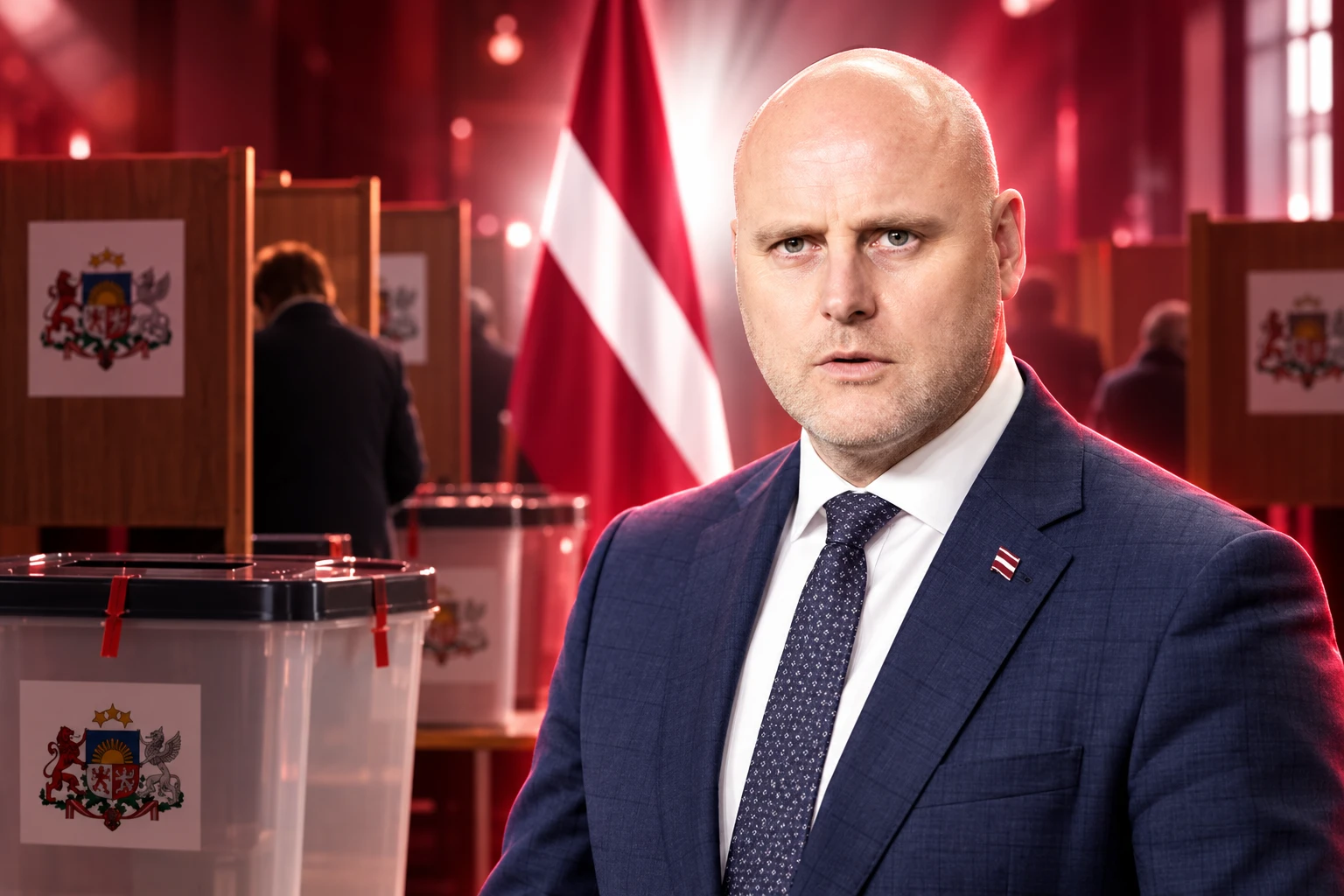
Andris Kulbergs’ United List led Latvia’s Saturday parliamentary election with 14.4 percent in the final SKDS poll, far short of a Saeima majority. The 47-year-old prime minister, a former racing driver given the job in May, asked voters for four years to pair a stronger economy with stronger defence. The harder number on the ballot is 5 percent, the cutoff that could wipe out the very parties he needs beside him.
Polling stations opened at 8 a.m. and close at 8 p.m. Fourteen lists are competing for 100 seats. A majority is 51. First figures are due within hours of closing, with a clearer picture after midnight.
Fourteen Lists Are Fighting for 100 Seats
The Central Election Commission put the electorate at 1,557,615 people in a country of 1.9 million. Fourteen tickets fielded 1,428 candidates, about 14.3 names per seat, down from the 2022 field. All 933 stations opened without a reported hitch, and President Edgars Rinkēvičs voted with the rest of the country.
THE SATURDAY ELECTORATE
- Eligible voters: 1,557,615 people are on the roll for the 15th Saeima.
- The house: 100 seats, with 51 needed to form a majority government.
- The field: 14 lists and 1,428 candidates, or about 14.3 names per seat.
- The clock: 933 stations, open from 8 a.m. to 8 p.m., with the new Saeima due to sit on November 3.
By noon, including ballots already in safekeeping, turnout stood at 25.44 percent, a little over 396,000 people, ahead of 23.57 percent at the same point in 2022 and 22.25 percent in 2018. More than 11 percent had already voted during the working week, so Saturday’s queues are a poor guide to the final share. Latgale, the eastern district that borders Russia, was the slowest of the five regions at noon.
SKDS, polling more than 2,000 citizens for Latvian Television between September 4 and 16, still had United List in front. It also had 18.7 percent undecided and 14.9 percent saying they would not vote at all. That idle pool is large enough to move parties across the cutoff overnight.
SKDS SEPTEMBER SHARE, ALL RESPONDENTS
| Party | September SKDS | 5% line | Now in government |
|---|---|---|---|
| United List (AS) | 14.4% | Clear | Yes, PM’s party |
| Sovereign Power / Young Latvians | 9.4% | Clear | No |
| Latvia First | 9.2% | Clear | No |
| The Progressives | 6.2% | Clear | Left in May |
| National Alliance | 5.6% | Clear | Yes |
| Union of Greens and Farmers | 4.8% | Under | Yes |
| New Unity | 4.3% | Under | Yes |
| For Stability! | 2.8% | Under | No |
SKDS still ran a seat model in which seven lists cross the line once the undecided are allocated. Among all adults, only five sit safely above it. New Unity, the party of several past prime ministers and of European Commissioner Valdis Dombrovskis, is the starkest case: 18.97 percent in 2022, 4.3 percent in this survey.
Two Ukrainian Drones Brought Down a Government
Kulbergs did not win this job at a general election. He inherited it after two stray airframes turned a long coalition quarrel into a collapse, five months before the statutory poll.
In the early hours of May 7, Latvia’s Defence Ministry said three drones crossed from Russia. Two came down on Latvian ground. One hit empty fuel tanks at a depot in Rēzekne, near the eastern border. No one was hurt. Sirens sounded after the strike. Nothing was shot down. Kyiv said the aircraft were Ukrainian machines bound for Russia and blamed Russian jamming for the diversion. Officials in Riga adopted that account.
FROM THE DEPOT TO THE BALLOT
- May 7, 2026: Three drones enter from Russia; two crash in Latvia and one strikes empty tanks in Rēzekne.
- May 10, 2026: Defence Minister Andris Sprūds, of the Progressives, resigns after Prime Minister Evika Siliņa demands it.
- May 14, 2026: The Progressives pull out. Siliņa resigns, ending a three-party cabinet already strained on other fights.
- May 28, 2026: The Saeima confirms Kulbergs as prime minister by 66 votes in a four-party deal of United List, New Unity, the National Alliance and the Union of Greens and Farmers.
- October 3, 2026: That same cabinet asks voters for a full term, with German fighters on a Latvian runway for the day.
The drones were not a Russian strike package. They were still enough to end a government, because they landed on a promise of safe skies that the air-defence record could not keep. Siliņa’s New Unity had been the 2022 winner of a rally around the flag. By May it was the party that had failed a visible test. Kulbergs, until then a relatively obscure opposition figure, got a five-month audition.
United List Surged While Its Partners Slipped
SKDS tracked the personal bounce with ugly precision for everyone else in the room. United List stood at 6.8 percent in May, rose to 12.2 percent in July and 15.2 percent in August, then eased to 14.4 percent in September. That is still a strong first place in a splintered field, and a lift from the 11.01 percent the list took in 2022.
The three partners who voted him in moved the other way for most of the summer. The National Alliance recovered to 5.6 percent in September, a 1.1-point gain, and sits a few tenths above the cutoff. The Union of Greens and Farmers climbed two points to 4.8 percent and remains under it. New Unity is at 4.3 percent. The Progressives, who walked out in May, fell 2.6 points to 6.2 percent, the sharpest drop in the September wave, and still look likely to return.
THE FOUR PARTIES IN THE MAY DEAL
- United List: Regionalist grouping of the Green Party, the Association of Regions and the Liepāja Party; 14.4 percent and the only coalition force in clear first.
- National Alliance: National conservatives still in cabinet, 5.6 percent, the one partner comfortably, if narrowly, over the line in this survey.
- Greens and Farmers: Agrarian conservatives at 4.8 percent, up two points in September and still short of 5 percent among all respondents.
- New Unity: The 2022 winner at 18.97 percent, now 4.3 percent, with Arvils Ašeradens, a former finance minister, as its prime ministerial candidate.
Ašeradens called the slide “the political pendulum which shifts from one way to the other.” Inflation, trouble around the national airline airBaltic, and migration pressure from Belarus have given that pendulum plenty to work with. Una Bergmane, a Latvian political scientist at the University of Helsinki, put Kulbergs in a comfortable bind: he holds the most powerful office in the country and has not been there long enough for the job to sour. The cost of that bounce is that voters collapsed toward one man and left his usable majority on the knife edge.
Who Still Has to Clear 5 Percent?
Latvia’s rule is brutal in a small, split electorate. A party needs 5 percent of votes cast, not 5 percent of the roll. Votes dumped on lists that finish at 4.8 percent do not transfer. They vanish. In a 100-seat house that can be the difference between a four-party national-security cabinet and a hunt for new friends.
If New Unity and the Greens and Farmers both make it, Kulbergs can try to rebuild something close to the 66-vote bloc he holds now, perhaps with the National Alliance still in the room. If one of them falls out, the arithmetic opens toward parties he has spent the campaign treating as a problem. If both fall out, the first-place finish becomes a trap. The Progressives are available on paper and hostile in recent memory. Sovereign Power is polling second and wants to stop help for Ukraine. Latvia First is polling third and is run by a businessman Kulbergs says he does not trust.
That is the second count, and it will start while the first one is still being read aloud. Foreign coverage of Saturday has treated the Russian threat as the plot. The plot inside the numbers is a personal surge that ate the centre he needs.
Šlesers Waits With the Arithmetic
Ainārs Šlesers, the Latvia First leader and a former transport minister, does not need a miracle to enter the next Saeima. SKDS had him at 9.2 percent. He has spent years arguing that ports, rail and eastbound cargo still matter to a thin economy, and he told national television that transit of Russian grain should be allowed even after Riga tightened the screws. He says he supports Ukraine’s path into the European Union. He also says relations with Russia will have to be rebuilt after the war.
Kulbergs shut the door, then left it on a chain. In early September he dismissed a deal with Šlesers, saying “as it is given now: no,” because he does not trust the people around him. In July he had been looser.
I have to see what chess pieces I will get to make a coalition.
Andris Kulbergs, Prime Minister of Latvia, July 2026
Bergmane sees a path if the Greens and Farmers survive: a temptation to add Šlesers rather than sit short. Šlesers himself has drawn other red lines, ruling out deals with New Unity, the Progressives and Sovereign Power. The last of those is personal as well as political. Politicians who left his orbit in 2022 after refusing to condemn Russia’s invasion went on to build Sovereign Power.
Jūlija Stepanenko, that alliance’s leader, would not say whether she supports sanctions on Russia. “Our voters want peace,” she said. The ticket pledges to stop help for Ukraine’s war. Kulbergs has called Sovereign Power a threat to security and democracy and ruled it out. He has not been as absolute, over a full summer, about Latvia First.
Arnis Kaktiņš, the SKDS pollster, said Russian-speakers largely stayed home in 2022, embarrassed by the war. If they turn out this time, he said, lists with a softer line on Moscow will do well. Campaign posters in Riga put Kulbergs’ face under the line “Kulbergs is the solution.” The solution still has to add to 51.
German Jets Cover a Quiet Intelligence File
The security theatre around the vote is real, and it is also narrower than the hybrid-war framing implies. Defence Minister Raivis Melnis asked allies to thicken air cover for the election period after months of unmanned flights along the eastern flank, including a shoot-down over Balvi district in August. NATO answered with a short, dated reinforcement, not a new permanent base.
four German Air Force Eurofighter jets from Tactical Air Wing 74 at Neuburg moved to Lielvārde Military Base for the days around the poll. Italy, flying from Šiauliai in Lithuania, took extra tasks over Latvia. Turkish F-16s at Ämari in Estonia were told to contribute in parallel with their existing NATO job. Berlin described a week-long Luftwaffe Eurofighter detachment in the mid double digits of personnel, under enhanced Air Policing North.
The drone-related incidents on NATO’s eastern flank in recent months have once again demonstrated that we must be prepared to respond rapidly to any threat. Germany, Italy and Türkiye’s response to Latvia’s request is a tangible demonstration of Allied solidarity and strengthens our ability to protect Latvia’s airspace. This is particularly important at a time when parliamentary elections will be taking place in Latvia. Every person in Latvia has the right to participate safely in free and fair elections, and it is our duty to protect that right.
Raivis Melnis, Minister of Defence of Latvia, Ministry of Defence statement, September 17, 2026
The Latvian State Security Service, in a September 28 note, struck a colder tone than the runway photos. It said it had found no significant and systematic attempts by Russia or other hostile states to swing the Saeima result toward any party or candidate. It is assessing separate efforts to spread election disinformation. It has not ruled out provocations by Russia or Belarus on voting day, or attempts at vote buying. Anxiety about hybrid attacks is a campaign fact. Proven interference in this race, as of that assessment, is not.
WHAT WE KNOW
- The air cover: Four German Eurofighters at Lielvārde, with Italian and Turkish aircraft adding tasks for the election window.
- The spies’ line: The State Security Service, on September 28, reported no significant, systematic foreign effort to swing the result.
- The drones in May: Ukrainian airframes, in the official account, diverted after crossing from Russia and hitting empty tanks in Rēzekne.
WHAT IS UNCONFIRMED
- The cutoff: Whether New Unity at 4.3 percent and the Greens and Farmers at 4.8 percent clear 5 percent once real ballots replace a survey.
- The turnout mix: How much of the late vote comes from Latgale and from Russian-speaking cities that stayed home in 2022.
- The cabinet: Which of Šlesers, the Progressives, or a rebuilt four-party bloc Kulbergs can actually count to 51.
Kulbergs voted in Riga and kept the pitch he has used all summer. “I hope we get a good result. This would give us an opportunity to make changes, put Latvia on the right track for defense and economy,” he said. “A strong economy can only bring strong defense, so that is the mission for the next four years if I’m given the right to lead the country. Our party is ready to make changes.”
In Daugavpils the War Feels Far Away
The split he is trying to govern sits in plain view 230 kilometres from the capital. Daugavpils has about 94,000 people, 24 kilometres from Lithuania and 33 kilometres from Belarus. Ethnic Russians make up about half the city and about a third of Riga. In interviews there before the vote, a music teacher who gave only her first name, Andzela, said she lost her job after failing a Latvian language exam and wanted the next Saeima to drop the requirement. Local journalist Inna Plavoka summarised the pitch that lands: save the Russian language, skip Latvian, go east again for cheaper fuel and food, and spend money on pensioners here rather than on Ukraine.
Olga Petkeviča, a Daugavpils politician who joined Latvia First, said she wants the party to become a kingmaker and pull Riga toward a more practical relationship with Russia. “I am not saying Ukraine is bad or Russia is good. I look at our lives and we are not well. Yes, they have war over there, but we live worse here,” she said. Back in Riga, Ruta Slavinska, a 60-year-old finance director, called the threat simpler: a threat to Latvia’s freedom.
Kulbergs put that divide on the record himself.
The Ukraine war has divided our society. A lot of people do not share the same outlook. A pretty large part of society does not perceive Russia as a threat, they do not understand why the government is investing big money in defence. They are mistaken.
Andris Kulbergs, Prime Minister of Latvia, in Riga, October 1, 2026
Saturday’s vote will not settle that argument. It will decide how many seats the people who already agree with him can actually occupy, and whether he has to pick up Šlesers to keep the rest of the programme. Stations close at 8 p.m. The 15th Saeima is due to convene on November 3.

Amazon’s Apple Prime Deals Mostly Undo the June Hikes

The Atlantic’s First Hurricane Is Aimed at Soaked Gulf Soil

Iran’s Hormuz Attacks Target the Route That Restored Crude

S&P 500 Clears 7,800 as AI Chips Outrun Yields

Russia’s No-Plague Finding Leaves a Siberian Death Unexplained

AI Server Boards Put Everyday Circuit Materials on Allocation

Glacier Collapse Buried Nepal’s Hydropower Workers in Tunnels

Congo’s Bundibugyo Outbreak Outruns the Licensed Ebola Shots

Pennsylvania Measles Deaths Follow a Long Slide in Coverage

Germany Can Miss Its 2026 Climate Cap Without Penalty
-
 NEWS2 months ago
AI Server Boards Put Everyday Circuit Materials on Allocation
-
 NEWS2 months ago
Glacier Collapse Buried Nepal’s Hydropower Workers in Tunnels
-
 NEWS2 months ago
Congo’s Bundibugyo Outbreak Outruns the Licensed Ebola Shots
-
 NEWS2 months ago
Pennsylvania Measles Deaths Follow a Long Slide in Coverage
-
 NEWS2 months ago
Germany Can Miss Its 2026 Climate Cap Without Penalty
-
 NEWS2 months ago
CISA’s Known Exploits Still Come From 2007-Era Bugs
-

 NEWS2 months ago
Texas Judge Freezes the SEC Eligibility Ban for 41 Athletes
-
 BUSINESS2 months ago
Trump’s Venezuela Oil Deal Leaves the Barrels in the Ground