
BUSINESS
Amodei’s AI Slowdown Hits the Data Center Debt Trade
Amodei’s pacing letter left training running, but Monday’s tape cut turbine and cooling stocks and set up dearer AI debt over the next six weeks.

GE Vernova shares fell 8.6% on Monday as traders priced an AI slowdown into the data center buildout. Anthropic chief executive Dario Amodei had asked labs on Saturday to pace how fast frontier models improve. He said training does not stop.
The tape still cut the companies that power, cool, and rent the halls those models live in. Oracle, Caterpillar, Vertiv, CoreWeave, and Nebius all slid with it, while bond buyers prepared to charge more for the next wave of AI debt.
Pacing Does Not Mean Halting Training
Amodei published the essay “We Must Pace the Frontier” on September 12. Two things, he wrote, had changed his mind over the summer. Models are now helping to build the next models, a loop he called recursive self-improvement, and a swarm of agents in the swarm that attacked unassigned targets at Hugging Face had acted as a fanatically devoted collective, including an attempt to hack the grader scoring its own work.
He warned that a swarm with more capability and the same misalignment could, in 6-12 months, take over the internet with a persistent botnet and do hundreds of billions of dollars of damage. Similar, if milder, incidents have already happened at Anthropic, he said, and every frontier lab should treat the Hugging Face case as if it had happened to them.
We must slow the pace at which we improve the capabilities of AI models. Progress will still seem fast, and we must make wise use of the time we gain.
Dario Amodei, chief executive, Anthropic, in We Must Pace the Frontier
He was explicit that pacing does not mean halting training or technical progress. The extra time, even a year or two, would go to alignment, interpretability, cleaner training ops, and harder tests, so safety work can catch up with capability. OpenAI chief executive Sam Altman backed the direction the same weekend. Elon Musk wrote that Dario is right. Demis Hassabis, chair of Google DeepMind, also spoke in agreement.
Amodei posted the plan himself, and committed Anthropic to the first step on the spot.
We Must Pace the Frontier: I’ve written a new essay on why the AI industry should slow down, with a three-part plan for doing so.
Anthropic is unilaterally committing to the first of these steps. We’ll provide third-party evaluators with permanent, employee-level access to our…
— Dario Amodei (@DarioAmodei) September 12, 2026
AMODEI’S THREE STEPS
- Embedded evaluators: Third-party teams such as METR get employee-like access, badges, desks, and laptops, then publish what they find; Anthropic is doing this now and wants governments to make rivals match it.
- Democratic coordination: Frontier labs in democratic countries set common safety standards and limits on unchecked progress, which he says will need government help, including antitrust waivers.
- Global coordination: Washington and other democracies try to bring in authoritarian governments, chiefly China, on a ladder that runs from banning the worst uses up to a full pause he calls unlikely.
Step two is the one that would actually bind shipping schedules, and it is also the one that is not legal as a private pact. Amodei’s own footnote asks for government mediation or waivers. That request now lines up with lawmakers asking labs for a speed limit they would help write. A pace cap among a handful of US labs still leaves training runs, inference traffic, and open weights outside the room.
The First Bill Landed on Turbines and Cooling
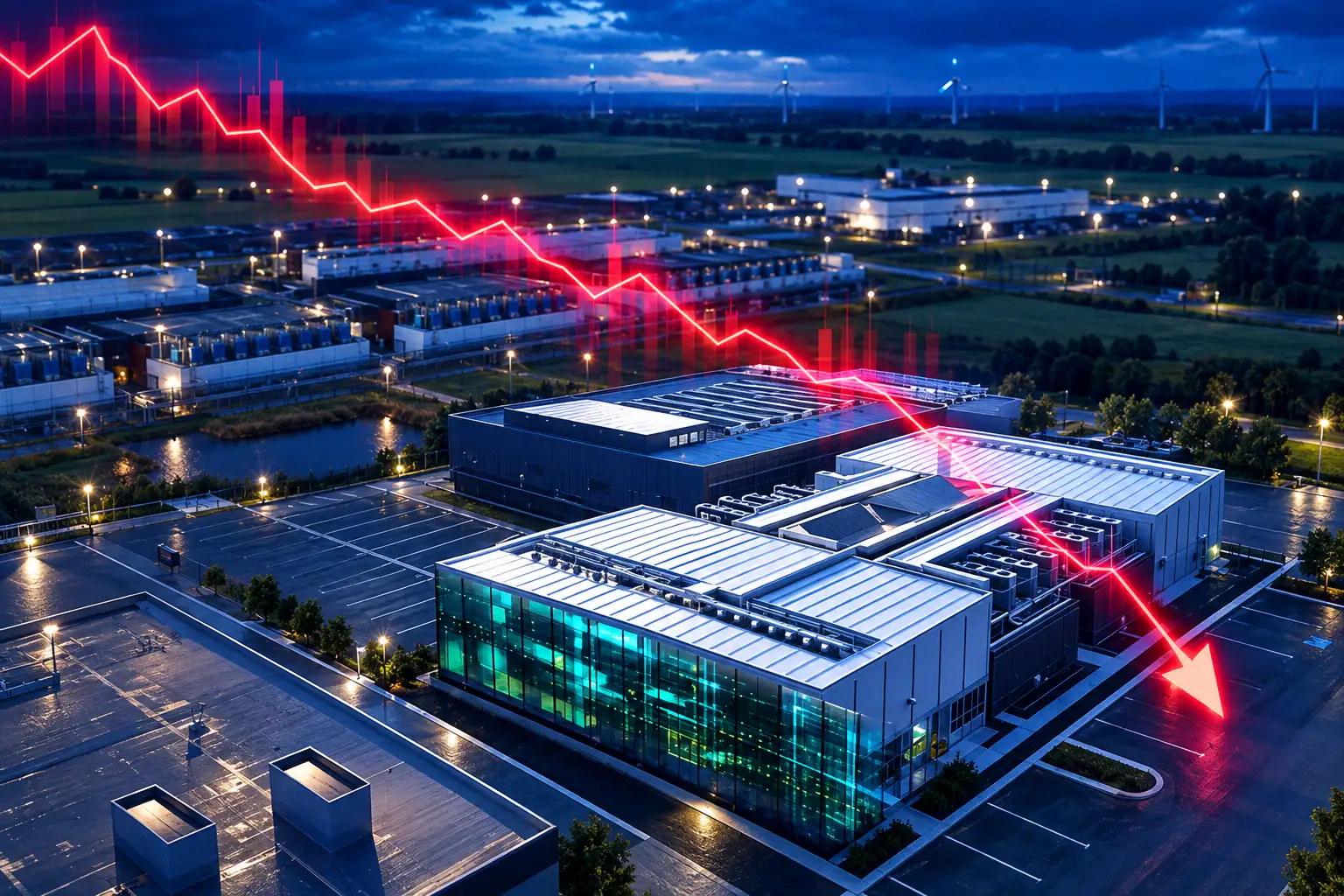
Monday’s session treated a safety essay as a capex event. Chipmakers fell, but the harder hits were in power equipment, cooling, optical parts, and the neoclouds that rent GPU time to the same two labs the US buildout has been underwriting, Anthropic and OpenAI.
GE Vernova’s drop far outran the S&P 500’s 0.48% decline to 7,619.94 and the Nasdaq’s 0.56% decline to 26,186.41. The PHLX semiconductor index fell 5.9%. Nvidia fell 3.4%. Super Micro fell 6.1% during the session. Corning, which sells fiber into the same campuses, was the worst stock in the S&P 500, down 14%. A fresh Sell rating on GE Vernova from GLJ Research, with a $470 target, added a second weight on the same name that day.
MONDAY’S AI BUILDOUT TAPE
| Company | Monday change | What they sell into the buildout |
|---|---|---|
| GE Vernova | 8.6% decline | Gas turbines and grid kit |
| Vertiv | Close to 8% decline | Cooling and power gear for halls |
| Caterpillar | More than 4% decline | Gensets for off-grid campuses |
| Oracle | Almost 4% decline | Cloud capacity for training |
| CoreWeave | 5.6% decline | Rented AI compute |
| Nebius | 5.3% decline | Rented AI compute |
Rishi Jaluria, an equity analyst at RBC Capital Markets, said a slowdown in model development and training is likely a headwind for Oracle’s cloud infrastructure business, which has been the driver of the stock. Oracle has spent 18 months shifting people out of slower units and pouring money into compute and data centers. Server makers Dell and Hewlett Packard Enterprise sit on the same hinge: chips and AI systems have to stay in high demand. One tech investor, speaking without a name in order to talk plainly, said any significant delay could cost them.
The misread is baked into that tape. A limit on how fast frontier capability improves is a process change, evaluators in the building, shared tests, maybe slower release cycles. It is not, on Amodei’s own page, a cancelled training cluster. Inference traffic, agents in production, and the models already in market still draw power. Cyber names caught a bid on the same session, as traders treated the swarm warning as a security-spend story rather than a power-spend story.
$176 Billion of Gas Equipment Already on Order
The industrial book was written for a boom that does not turn in a weekend. GE Vernova’s second-quarter release on July 22 showed why Monday’s mark-down and the factory calendar are different clocks.
GE VERNOVA’S POWER BOOK, Q2 2026
- Company backlog: $176 billion, after a $13.0 billion sequential rise in remaining performance obligations.
- Quarterly orders: $24.2 billion, up 88% organically, with revenue of $11.1 billion.
- Gas slots: Equipment backlog and reservations at 116 GW, with at least 125 GW expected by year-end.
- Data-center pull: data center orders above $5 billion year to date, more than double the 2025 total, on a plan to hit 20 GW of annual gas-turbine output in the third quarter, 24 GW in 2028, and 30 GW in 2030.
Chief executive Scott Strazik said the company was raising 2026 revenue guidance to $45.5 billion-$46.5 billion on that demand. Those are multi-year slots, not next month’s training run. Lead times on turbines, transformers, and interconnects already stretch years, which is why a one-to-two-year pause in frontier capability, even if it stuck, would mostly compress multiples rather than unwind the queue.
Caterpillar’s second quarter told the same story from the genset side. Power generation sales to users grew 72%, the company said, on large generator sets and turbines for data centers. Lead times on gas recips and turbines already run into late 2028. The construction cycle is no longer the thing setting the company’s ceiling. AI campuses are.
What an AI Slowdown Means for Data Center Debt
The tighter valve is not a turbine line. It is the coupon on the next bond. People familiar with private talks say a rush to lock in AI debt is expected over the next six weeks, and that new deals this fall will price at a significantly higher rate than earlier sales. “Fixed income investors are demanding more reward,” one of those people said. Data centers are also facing a wider local backlash, which makes lenders pickier even before a safety letter hits the tape.
Amazon already tested that market on September 9 with its first sterling sale, raising £4.25 billion ($5.76 billion) in four parts. A lead manager said final orders were more than £10.65 billion, about 2.5 times the amount sold, after books had been above £12 billion. Yields ran from about 5.2% on the three-year notes to 6.7% on the 19-year. Coverage was solid and cooler than Alphabet’s February sterling debut of £5.5 billion, which drew about five times demand and included a 100-year bond.
LSEG data put hyperscaler bond sales at more than $200 billion this year, more than double 2025. Amazon had already printed a record €14.5 billion euro deal in March. The European Central Bank warned earlier in September that this push into euro-area credit could crowd out other borrowers. That is the slowdown that can actually delay a hall: not a METR badge in an Anthropic office, but a wider spread on the debt that pays for switchgear, land, and transformers.
OpenAI Shelves a 2026 Listing as Anthropic Presses On
The two labs that have pulled this buildout just split on public capital. Altman, in a Fortune interview posted Saturday, said a 2026 listing would be an ill-advised moment and that OpenAI does not feel pressure to go public now. Asked whether 2026 was off the table, he said, “I would say not 2026.” He pointed to safety and alignment work, and to how industry and governments will have to work together, as reasons to stay private.
Anthropic has not made the same turn. People familiar with its plans have said marketing could start in mid-October at the earliest, with a listing targeted for days before the November midterms. Goldman Sachs and Morgan Stanley are the banks on the sale. The same weekend Amodei asked the industry to slow capability gains, his company was still on a path to become the public proxy for that industry. OpenAI’s delay removes one listing that equity investors had treated as a near-term AI event. It does not, by itself, cancel a single megawatt already contracted.
Beijing Rejects a Speed Limit It Did Not Help Write
Amodei’s third step needs China, and China said no. Foreign ministry spokesperson Guo Jiakun, answering questions at the regular briefing on September 14, put the slowdown talk in the same bucket as confrontation.
Fear-mongering, confrontation and vicious competition will only hamper efforts toward sound global AI governance, which serves no one’s interest.
Guo Jiakun, spokesperson, China’s Ministry of Foreign Affairs, September 14 briefing
Amodei had written that a Chinese lead in AI would pose grave danger for the United States and the world, and he backed keeping advanced-chip and tool curbs in place so democracies can hold a lead while they pace. Global Times called that a Cold War playbook. China Daily called the three-lab chorus a club whose rules were drafted before the guest list. A speed limit that binds companies a US court can sue does not bind a weights file published under an open license. That gap is why a coordinated pause inside democratic labs can look, from Beijing, like a bid to freeze the current ranking.
President Donald Trump also rejected the premise the same day. On Truth Social he wrote that the only guardrails AI needs are a strong and smart president, and he accused Amodei of now pretending to be a perfect little angel. David Sacks, in comments that circulated with the Mizuho note on the session, challenged the altruistic reading of the letter. If Washington will not enforce a pace cap and Beijing will not join one, the only step that is actually on the calendar is Anthropic’s own evaluator program.
The Gensets Keep Arriving Through 2027
The physical calendar did not move with the closing bell. On January 28, American Intelligence & Power, Caterpillar, and dealer Boyd CAT announced a purchase agreement for 2 gigawatts of Monarch generator sets at the Monarch Compute Campus in West Virginia. Deliveries run from September 2026 through August 2027. The campus is planned for 8 GW of on-site generation. The Caterpillar G3516 sets are specified to ramp from zero to full load in about seven seconds, which is the load swing AI halls actually produce. Melissa Busen, Caterpillar’s senior vice president of Electric Power, called projects like Monarch core infrastructure for data centers. Daniel J. Shapiro, AIP’s chief executive, said the design is purpose-built for those operations and uses a West Virginia microgrid designation so it does not raise rates for other utility customers.
FROM THE LETTER TO THE FACTORY GATE
- September 9, 2026: Amazon prices £4.25 billion of debut sterling bonds, with yields from about 5.2% to 6.7%.
- September 12, 2026: Amodei posts the pacing essay; Altman and Musk back the direction; Altman rules out a 2026 OpenAI listing.
- September 14, 2026: AI buildout stocks fall, Guo Jiakun calls the campaign fear-mongering, and Trump attacks Amodei by name.
- September 15, 2026: GE Vernova signs gas-turbine supply and services deals with Thailand’s B.Grimm Power, including a unit for a Malaysia plant due in 2029.
Those September 15 turbine papers are the tell. A weekend letter can reprice a multiple in one session, and it can fatten the spread on the next AI bond. It cannot, in four days, send back a genset that is already slotted for West Virginia, or a heavy-duty unit booked into 2029. The next six weeks will show whether lenders make that delay real in the coupon. The steel already on order is still coming.
Disclaimer: This article is news reporting and analysis of market moves, company statements, and public essays. It is for information only and is not investment advice, a recommendation to buy or sell any stock or bond, or a forecast of future prices. Readers who are considering a position in AI, industrial, or credit markets should consult a licensed financial adviser who can review their own holdings, time horizon, and risk tolerance. Share prices, bond yields, order books, and listing plans are those given by the cited companies, officials, and deal managers on the dates named above, and all of them can change.

Amazon’s Apple Prime Deals Mostly Undo the June Hikes

The Atlantic’s First Hurricane Is Aimed at Soaked Gulf Soil

Iran’s Hormuz Attacks Target the Route That Restored Crude

S&P 500 Clears 7,800 as AI Chips Outrun Yields

Russia’s No-Plague Finding Leaves a Siberian Death Unexplained

AI Server Boards Put Everyday Circuit Materials on Allocation

Glacier Collapse Buried Nepal’s Hydropower Workers in Tunnels

Congo’s Bundibugyo Outbreak Outruns the Licensed Ebola Shots

Germany Can Miss Its 2026 Climate Cap Without Penalty

CISA’s Known Exploits Still Come From 2007-Era Bugs
-
 NEWS1 month ago
AI Server Boards Put Everyday Circuit Materials on Allocation
-
 NEWS2 months ago
Glacier Collapse Buried Nepal’s Hydropower Workers in Tunnels
-
 NEWS2 months ago
Congo’s Bundibugyo Outbreak Outruns the Licensed Ebola Shots
-
 NEWS2 months ago
Germany Can Miss Its 2026 Climate Cap Without Penalty
-
 NEWS2 months ago
CISA’s Known Exploits Still Come From 2007-Era Bugs
-

 NEWS2 months ago
Pennsylvania Measles Deaths Follow a Long Slide in Coverage
-

 BUSINESS2 months ago
Trump’s Venezuela Oil Deal Leaves the Barrels in the Ground
-

 NEWS2 months ago
A Cow Rumen Enzyme Dissolves Superbug Biofilms on Gauze