
NEWS
Webb’s Archive Already Held 51 Eridani b
FLIP, a physics model of JWST’s NIRCam, recovered 51 Eridani b at 4.3 microns and may loosen the picometer stability bill for the next flagship.

Software that models James Webb’s NIRCam camera has recovered 51 Eridani b in a 2024 image at 4.3 microns, a wavelength where standard processing saw nothing. The method, Physics-based Learning for Imaging Planets (FLIP), is described in a paper published November 4 in Nature. Across test frames it reached sensitivity 2 to 15 times superior to the usual pipeline, and it did that on data already on disk.
The planet is not a new world. It is a proof that leftover starlight, not empty sky, was the limit in those frames, which is a different problem from launching a more stable telescope.
51 Eridani b Was Already in the 2024 Frames
NASA lists 51 Eridani b as a gas giant whose mass is 2 Jupiters around an F-type star, announced in 2015 after the Gemini Planet Imager recorded it. The same system sits about 97 light-years away. A NIRCam coronagraph frame from February 20, 2024, already showed the planet at 4.1 microns, on an orbit NASA places 890 million miles from its star, comparable to Saturn’s path around the Sun.
William Balmer and colleagues, writing in 2025, detected that 4.1-micron signal and reported no detection at longer wavelengths. Carbon dioxide in the atmosphere eats light near 4.3 microns, so the planet goes fainter in the F430M filter, which is also the band astronomers want for composition. In the original reduction, KLIP left a dashed circle on a blank patch. FLIP, run on the same pixels, returns a point source at signal-to-noise 6.3 at the predicted spot. That is the first image of 51 Eridani b at 4.3 microns.
THE 51 ERIDANI FILE
- 2015: Bruce Macintosh and the Gemini Planet Imager team announce 51 Eridani b, a young giant with methane and water in the near infrared.
- February 20, 2024: JWST program 1194 records the system with NIRCam’s bar coronagraph in the narrow position.
- March 17, 2025: Balmer’s team publishes a 4.1-micron detection and a non-detection at longer wavelengths, and NASA releases the F410M image.
- November 4, 2026: Rodrigo Ferrer-Chavez, Jason Wang, Katie Bouman and colleagues publish FLIP in Nature (volume 659, pages 58 to 62) and report the F430M recovery.
Jason Wang, an assistant professor of physics and astronomy at Northwestern and senior author, called the missed 4.3-micron signal science left on the table because the tools were not good enough. The telescope had done its job in 2024. The starlight model had not.
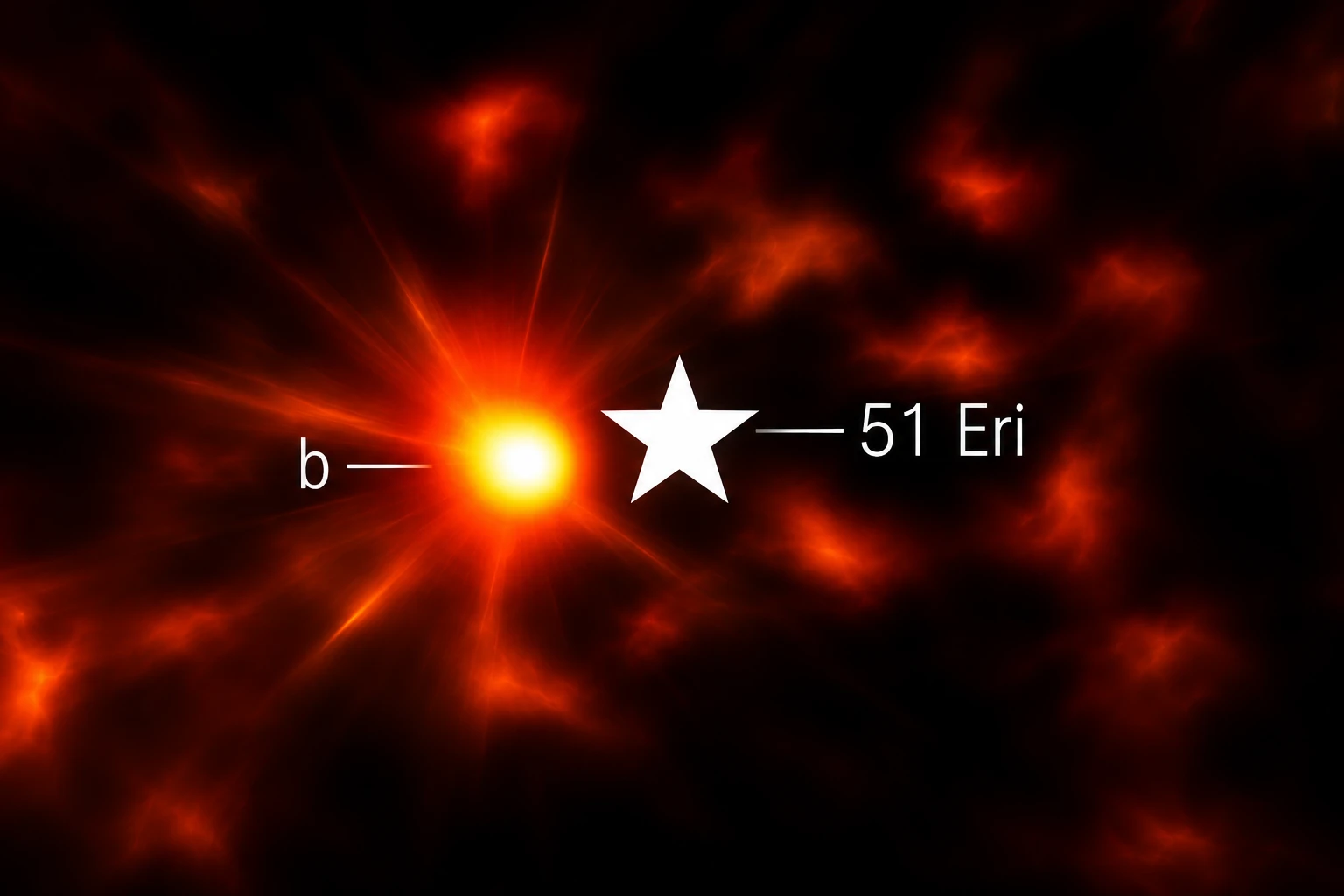
FLIP Fits a Telescope Model, Then Erases the Star
For about 20 years, the working fix has been to photograph a different star and subtract that glare from the science frame. Wang said the reference never matches, because no telescope sits still. Thermal drifts, pointing errors and cryocooler vibration change how starlight smears across the detector between visits. Even a nanometer-class shift rewrites the pattern, and whatever glare remains can hide a planet.
FLIP does not borrow another star’s halo as the last word. It starts from STPSF, the Space Telescope Science Institute package that builds simulated point spread functions for JWST from optical-path maps. Marshall D. Perrin, who developed STPSF and is a co-author, already had the best public description of the optics. The team rebuilt that physical model in PyTorch so automatic differentiation could tune millions of parameters, including wavefront aberrations, the star’s position and flux, and the detector’s pixel response.
HOW THE TWIN IS FIT
- Pre-calibrate: A reference NIRCam frame, the same kind KLIP would use, pulls the model close to a real point-spread function.
- Tune on science: Gradient descent then adjusts a smaller set of knobs on the actual target image, so the twin can follow drifts the reference star never saw.
- Guard the planet: Fake planets are injected and tracked; the fit stops when their signal-to-noise peaks, which is how the team limits overfitting a real companion into the star model.
- Subtract: The fitted starlight is removed. An end-to-end pass takes about 35 minutes on an NVIDIA A30 graphics card.
Ferrer-Chavez, a Northwestern astronomy graduate student in Wang’s group and the lead author, had first tried to train machine-learning models to predict the glare. That failed. The published method uses the same optimizers those models train with, pointed at a physics simulation rather than at a guess. Wang said they did not use AI, because the optics are already known. Katie Bouman, a Caltech professor of computing and mathematical sciences and a co-author, put the same point in instrument language.
What’s exciting is that we’re showing how computation can help overcome limitations of the telescope itself.
Katie Bouman, professor of computing and mathematical sciences, Caltech, Nature paper
Co-authors also include William T. Freeman and Brandon Y. Feng at MIT and Laurent Pueyo at the Space Telescope Science Institute. The work was supported by STScI award JWST-AR-07942, Sloan Foundation award FG-2025-24976, and NSF award PHY-2525568.
How Much Fainter Can Webb See Now?
FLIP was run on published NIRCam coronagraph data for three stars: HIP 65426 and 51 Eridani, both with known planets, and TYC 5899, a search target with no known companion and large aberration drifts between the reference and science visits. HIP 65426 and TYC 5899 used the F444W filter with the round 335R mask. 51 Eridani used F410M and F430M with the bar mask in the narrow position. The comparison is against the KLIP reductions those papers already published, not against a homemade baseline.
FLIP VERSUS KLIP ON THE SAME FRAMES
| Target | Filter | Result versus KLIP |
|---|---|---|
| HIP 65426 b | F444W | 1.6 times higher SNR |
| 51 Eridani b | F410M | 2.1 times higher SNR |
| 51 Eridani b | F430M | SNR 6.3 (prior non-detection); 4 times better at the planet; 5 times at 0.5 arcsec; 2.5 times at 1 arcsec |
| TYC 5899 (injected planets) | F444W | 15 times better at 0.5 arcsec; 5 times at 1 arcsec |
The abstract’s sensitivity 2 to 15 times superior span is that table, not a single magic factor. The 15-times jump is the search-like case, TYC 5899, where fake planets were injected because no real companion is known, and where the reference star was taken months apart. That is also where a new planet, if one is sitting close in, would have been easiest to lose. The paper’s own stability estimate for KLIP, built from pointing errors and optical-path drifts, sits within a factor of two of the real KLIP curves. FLIP falls below that wall in most of the tests.
Carbon Dioxide Made 4.3 Microns the Hard Filter
Young giant planets, even the brightest ones, are about 100,000 times fainter than their stars in the near infrared, the figure the paper uses for that class. Ferrer-Chavez said planets are a million times fainter, which matches the older Gemini discovery image of this same companion. Earth-like worlds around Sun-like stars are a different problem, at about 10 billion to one. The 51 Eridani recovery lives in the giant-planet class, at a wavelength where the planet is extra dim on purpose.
Balmer’s 2025 non-detection at the longer NIRCam wavelengths was already being read as a carbon-dioxide clue, because a cold, metal-rich atmosphere should bite into 4.3 microns. FLIP does not rewrite that chemistry. It supplies a 6.3-sigma image in the band that had been a blank, so photometry there can start. The authors leave that atmospheric fit as later work. The immediate fact is narrower: the scientifically useful filter was the one the old pipeline could not finish.
We showed that we can actually recover a planet that people previously couldn’t see. This is real data in a real scenario. It was science left on the table because we didn’t have the right tools to analyze the data in the most optimal way.
Jason Wang, assistant professor of physics and astronomy, Northwestern University
Gains are largest at 0.5 arcsec, closer to the star, which is the region where a smaller or colder companion would vanish first. A method that only helps in the wide, easy field would not move the archive much. This one helps where the glare is worst.
The Picometer Budget FLIP Wants to Relax
Wang has said JWST is optically stable to the nanometer level and that this is still the limit for imaging. NASA’s Habitable Worlds Observatory studies treat that gap as an engineering mountain. A Lockheed Martin pathfinder write-up on NASA’s Technical Reports Server asks for wavefront stability on the order of 10 picometers over long times, raw contrast better than 10-10, and contrast stability of 10-12, on a 6-meter-class off-axis telescope with 19 segments. The FLIP paper says that is 100 to 1,000 times more stable than JWST, the range you get if a nanometer-class observatory has to be held at a few picometers.
The HWO technology office describes companions tens of billions of times fainter than their stars and starlight suppression near 10 billion to one, with deformable mirrors in closed loop and post-processing as part of the design, not a patch. Tolerable motion is on the order of picometers, about 1/50th the size of a hydrogen atom. Ferrer-Chavez said imaging something about 10 billion times fainter, sitting right next to the star, is brutal both as an image-cleaning job and as a telescope-building job.
HWO STABILITY ASK
- Wavefront hold: About 10 picometers over long science visits, in the pathfinder error budget.
- Raw contrast: Better than 10-10, so one planet photon survives among 10 billion star photons the coronagraph tries to kill.
- Contrast stability: 10-12 in the same NASA pathfinder write-up.
- Relative to JWST: 100 to 1,000 times more stable, per the FLIP paper, if the current observatory is held at nanometers.
If a physics fit can take JWST below its stability limit, some of that picometer bill might move from hardware into processing. The paper is careful: only if the same idea extends to HWO contrast. Roman’s coronagraph and ground telescopes are named as the next testbeds. The archive argument does not wait on that. Every NIRCam coronagraph visit already taken can be run again, including frames that were written off as non-detections at the interesting wavelengths.
Photon Noise Is the Floor FLIP Has Not Hit
FLIP has not reached the Poisson, or photon-noise, limit in any of the tested observations, even though it sits closer to that floor than KLIP. The detector model is simple enough for most NIRCam coronagraph frames and is not yet built for the brightest stars or the deepest stacks. The fit can cancel the phase drifts and star-coronagraph misalignments that wreck a reference subtraction, but the authors say it is not yet calibrated to hand back accurate numbers for those instabilities. On TYC 5899, a bright nearby star remains in the frame and comes out distorted. Supplementary notes flag compute cost and larger data volumes as unfinished work.
WHAT WE KNOW
- The 4.3-micron image: 51 Eridani b is a 6.3-sigma point source in F430M after FLIP, where the published KLIP analysis had a non-detection.
- The gain range: On these NIRCam sets the method is 2 to 15 times more sensitive than the published KLIP reductions, with the top end from injected planets around TYC 5899.
- The first: The authors say this is the first time differentiable, model-based starlight subtraction has beaten standard tools on real on-sky coronagraph data.
WHAT IS UNCONFIRMED
- Archive yield: No census exists yet of how many other NIRCam coronagraph targets hide similar signals.
- HWO relief: Whether the same model can be pushed to 10-10 contrast, and how many picometers that would actually buy engineers, is untested.
- Photometry: The new F430M flux has not been turned into a carbon-dioxide abundance in this paper.
Ferrer-Chavez said the tool can hunt planets that were missed in the JWST archive and planets people tried to image but could not detect at the time. That is the near-term use. The farther claim, that future flagships can be built a little less perfect because the software will finish the subtraction, still has to survive Roman and a harder contrast.
Frequently Asked Questions
Is 51 Eridani b a Newly Discovered Planet?
No. It was the first planet found by the Gemini Planet Imager, announced in 2015 by Macintosh and colleagues, with a near-infrared spectrum that already showed methane and water. FLIP’s result is a first image at 4.3 microns in JWST data, not a first detection of the object.
What Is KLIP in Exoplanet Imaging?
KLIP, Karhunen-Loève Image Projection, is the standard starlight-subtraction algorithm published by Soummer and colleagues in 2012. It builds an empirical glare model from a library of other stars, other times, or other wavelengths, then subtracts that library from the science frame. FLIP still uses a reference frame to pre-calibrate, then replaces the last subtraction step with a physical model of the telescope.
Does FLIP Use Artificial Intelligence to Find Planets?
No neural network is classifying pixels as planets. Automatic differentiation and an Adam optimizer, the same numerical machinery used to train many AI models, adjust a STPSF-based optical model until it matches the image. An earlier student project that tried to predict glare with machine learning did not work and was dropped.
Can James Webb Photograph an Earth-Like Planet With FLIP?
Not on the evidence in this paper. Direct images of Earth analogs around Sun-like stars are the job description for the Habitable Worlds Observatory, which is being scoped at 10-10 contrast and picometer holds, 100 to 1,000 times more stable than JWST. FLIP still sits above the photon-noise floor on today’s NIRCam frames.
Which Other Telescopes Could Run FLIP?
The paper names the Nancy Grace Roman Space Telescope, the Habitable Worlds Observatory, the Lazuli Space Telescope, and ground-based instruments as targets for the same physics-plus-autodiff approach, because the method is not tied to NIRCam’s hardware. STPSF already includes a preliminary Roman coronagraph model, which is why that observatory is the obvious next software port.
The F430M photometry is still sitting in that 2024 cube, waiting on an atmosphere fit the authors did not attempt here. Roman’s coronagraph is the first place they say the same twin has to prove it can work when the contrast demand is no longer a young giant’s.

Airbnb Starts House Rules Reviews as Cities Rewrite Contracts

United’s Computers Failed the Day After Kirby Blamed ATC

Tyson Foods Guides Beef Losses Narrower as Chicken Cools

Saudi Arabia’s Leisure Tourism Falters as Pilgrims Still Come

Himesh Patel Confirms the X-Files Writers’ Room Is Open

AI Server Boards Put Everyday Circuit Materials on Allocation

Glacier Collapse Buried Nepal’s Hydropower Workers in Tunnels

Congo’s Bundibugyo Outbreak Outruns the Licensed Ebola Shots

Pennsylvania Measles Deaths Follow a Long Slide in Coverage

CISA’s Known Exploits Still Come From 2007-Era Bugs
-
 NEWS2 months ago
AI Server Boards Put Everyday Circuit Materials on Allocation
-
 NEWS3 months ago
Glacier Collapse Buried Nepal’s Hydropower Workers in Tunnels
-
 NEWS3 months ago
Congo’s Bundibugyo Outbreak Outruns the Licensed Ebola Shots
-
 NEWS3 months ago
Pennsylvania Measles Deaths Follow a Long Slide in Coverage
-
 NEWS3 months ago
CISA’s Known Exploits Still Come From 2007-Era Bugs
-

 NEWS3 months ago
Texas Judge Freezes the SEC Eligibility Ban for 41 Athletes
-

 NEWS3 months ago
Germany Can Miss Its 2026 Climate Cap Without Penalty
-

 NEWS2 months ago
Pig Kidneys Got Two Men to Human Transplants After Failing