
NEWS
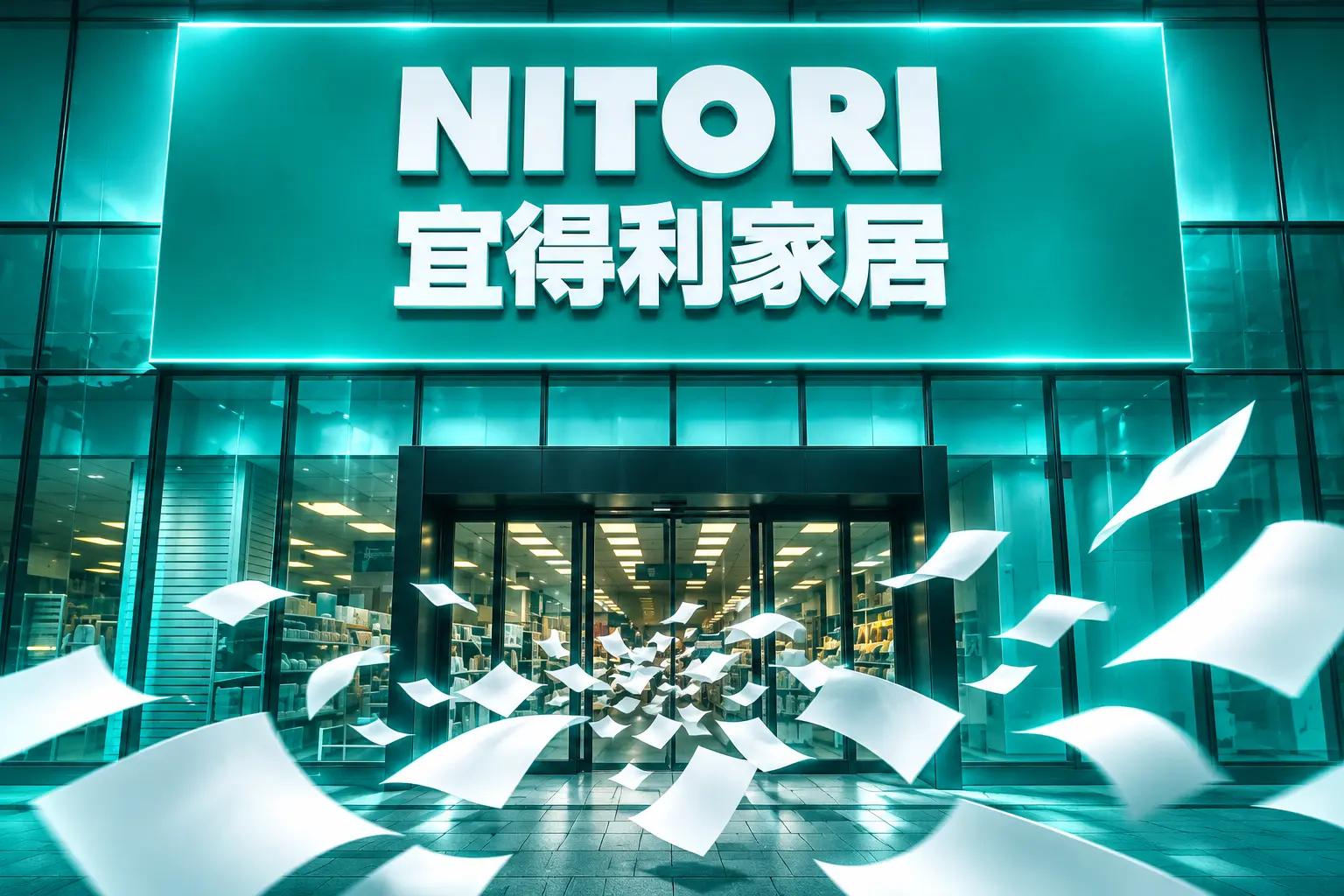
Nitori’s Contact File Walks Out With 37.62 Million Records
Nitori may have lost 37.62 million customer records without cards or passwords, leaving a contact file built for phishing while it calls the earnings hit limited.

Nitori Holdings said on November 9, 2026, that up to 37.62 million customer records may have left its servers after a break-in found on November 6. Login passwords and credit card data are not on the list. Names, addresses, phone numbers, dates of birth, membership numbers and order data are.
The furniture chain also told investors that, on what it knows now, the hit to group results looks limited. That is the split the rest of this leak sits on.
A 37.62 Million Ceiling on Customer Records
The possible personal-information leak notice is an apology, not a finished count. Nitori Holdings Co., Ltd., listed in Tokyo and Sapporo as 9843, said a third party got into systems it manages, and that personal information held on its servers may have gone outside. It called 37.62 million a maximum, and said log work and data matching could still change the figure.
The filing is signed by Toshiyuki Shirai, representative director and chief operating officer. It counts records, not people, and it does not say how many unique customers sit behind the ceiling.
Nitori is Japan’s largest home-furnishings retailer. The group ended March 31, 2026 with 1,069 stores, 860 of them in Japan and 209 overseas, on its FY2025 store and sales figures. Group revenue for that year was ¥912.2 billion (about $5.72 billion), with operating profit of ¥125.5 billion and 19,432 employees.
THE FIGURES NITORI HAS PUT ON THE RECORD
- Record ceiling: Up to 37.62 million records of personal information on company servers may have gone to an outside party.
- Find date: The company confirmed the break-in on November 6, 2026, blocked the access, and went public on November 9.
- Held back: Login passwords and credit card information are not in the information that may have gone out.
- Earnings line: On current information, Nitori expects the impact on group results to be limited.
That last line is for shareholders. The fields in the dump are for everyone else.
What Left the Servers, Field by Field
Nitori split the possible leak into three groups. The mix of fields, it said, varies from customer to customer. The list is already enough to write a message that looks like it came from the shop that sold you a sofa.
WHAT NITORI LISTED AS POSSIBLY EXPOSED
| Group | Fields named in the notice | Passwords and cards |
|---|---|---|
| Individual members and Nitori Group buyers | Membership number, name, furigana (phonetic reading), email, address, phone, date of birth, gender | Not included |
| Corporate members | Membership number, company name, department, representative’s name, company address and phone, contact person’s name, email and phone | Not included |
| Order data | Purchases through Nitori Net and official Nitori shops on e-commerce malls | Not included |
Furigana is the reading of a Japanese name. Paired with an address, a phone number and a date of birth, it is how a stranger proves they “already know you.” Order data does the rest. A fake delay notice can name the customer, the delivery address, and the idea of a recent purchase without ever needing a card number that a bank would cancel the next morning.
Nitori said it will never ask by email or telephone for passwords, credit card numbers, personal identification numbers, or similar secrets. That warning only has to exist because the rest of the file makes a fake Nitori message cheap to write.
Investigators Are Tracing a Mid-October Window
The company found the break-in on November 6, 2026, blocked it at once, and brought in outside specialists. Later log work pointed to possible third-party access before that date, in mid to late October. How the attacker got in, how long they stayed, and whether any second wave of harm has started are still open.
THE DAYS NITORI HAS PINNED DOWN
- Mid to late October 2026: Possible third-party access, found only after the November 6 review of logs. Details still under inquiry.
- November 6, 2026: Nitori confirms unauthorized access to systems it manages, blocks it, and starts work with outside specialists.
- November 9, 2026: Public notice of a possible leak of up to 37.62 million records, three days after the find.
- November 12, 2026: Some customers said the promised apology notice had reached them by post.
The gap between a possible mid-October entry and a November 6 find is the part of this incident that does not shrink just because cards never moved. A contact file can be copied in quiet. Ransomware crews usually want a conversation. This filing names no group, no demand, and no proof that anyone has tried to sell the data back.
WHAT WE KNOW
- The find: Nitori confirmed unauthorized access on November 6, 2026, and says the attacker’s access has been blocked.
- The ceiling: Up to 37.62 million records may have gone out; the number can still change.
- The carve-out: Login passwords and credit card information are not in the affected set.
- The filings: The company is reporting and consulting with Japan’s Personal Information Protection Commission, the police, and other authorities.
WHAT IS UNCONFIRMED
- The actor: No group has been named, and the notice does not describe a ransom note.
- The take: Nitori still describes a possibility, not a finished proof that every listed record left the building.
- The people: There is no public count of unique customers behind the 37.62 million records.
- Follow-on harm: Secondary damage, including fraud that uses the file, is still being checked.
Nitori said it has dealt with the weak spots it found and finished upgrades to monitoring. Cause, route, and range remain under review with the outside team.
Office Buyers, Mall Orders and One Server Pile
The dump is not only a consumer membership list. Corporate members had company names, departments, representatives, company addresses and phones, and the names, emails and phones of the people who actually place the orders. That is a map of who buys furniture for an office, and who to call if you want to pretend you are the vendor.
Mall orders sit in the same notice. Nitori said order data from Nitori Net and from official Nitori shops on e-commerce marketplaces may be in the set. It did not name the malls. Anyone who bought a Nitori product on a third-party site, and never opened a Nitori app, can still be in the file.
The company will write to affected customers by email or post, in sequence. Until that letter arrives, the only public test is whether you ever bought from the group, joined as a member, or checked out through an official Nitori shop on a mall.
2,094 Reports and a 260 Million Running Count
This Nitori file did not land in a quiet year. Japan’s Personal Information Protection Commission, briefing on reports from April 1 through October 16, 2026, put unauthorized-access cases at 2,094 and the people covered, counted with duplicates and with cases of possible leakage, at about 260 million. October 1 through 16 alone brought 830 reports, about 2.7 times September’s 303. The prior fiscal year had 1,256 such reports in twelve months.
Nitori said it is reporting and consulting with that commission, which sets how companies must report a data leak, and with the police. The 37.62 million figure is large. It is not the largest number a Japanese organization has put on a 2026 notice.
LARGE 2026 DISCLOSURES NITORI NOW SITS AMONG
| Organization | Ceiling given | Company’s own status | What the notice emphasized |
|---|---|---|---|
| Arara Message (email delivery) | 81.33 million email addresses | Taken | Addresses and member details copied from shared sending systems |
| Sagawa Express | 53.23 million records | Possible | Names, addresses and phones from 100 days of waybills, with duplicates |
| Yumil Link (Cuenote email) | 47.86 million records | Taken | Addresses and related data from client systems |
| Nitori Holdings | 37.62 million records | Possible | Member, buyer, corporate-contact and order fields; no passwords or cards |
| MUJI (Ryohin Keikaku) | 27.26 million | Possible | App and store members; a smaller slice also has names, addresses and phones |
| Iris Plaza (Iris Ohyama) | 7.7 million people | Possible | Members and guest buyers in an external cloud shop |
Capcom separately put 11.77 million CAPCOM ID accounts in a notice of their own, mostly emails and login records. The point of stacking Nitori against the mail vendors is not a league table. Arara and Yumil are address pipes. Nitori’s listed fields are a household file: who you are, where you live, how to reach you, when you were born, and what you ordered from a shop most Japanese homes already know.
MUJI’s app dump, disclosed in late October with later updates, hit another default household brand in the same stretch. Two membership systems that sit in ordinary kitchens were opened in the same season. A false claim that Nitori also lost My Number data has been circulating with those headlines. My Number is not on the company’s list.
Do Not Open the Email That Knows Your Name
Nitori’s own customer note is already a fraud briefing. It said leaked personal information could be misused for fake emails, phishing, odd phone calls, or other impersonation, and it named the costumes those messages will wear: the company, a delivery firm, an e-commerce mall.
The personal information that may have been disclosed could potentially be misused for fraudulent emails, phishing scams, suspicious telephone calls, or other forms of impersonation.
Nitori Holdings, November 9, 2026 notice
WHAT THE COMPANY ASKED CUSTOMERS TO DO
- Treat the costume: Be careful with messages that claim to be from Nitori, a delivery company, a marketplace, or anyone tied to the leak.
- Leave the link: Do not open links or attachments in mail you do not recognize or were not expecting.
- No secrets by phone: Nitori says it will not ask by email or telephone for passwords, card numbers, or PINs.
- Use the real desk: Do not reply to a number or address printed on a suspect message. Use the official inquiry route instead.
The customer desk is 0120-209-993, 10:00 a.m. to 8:00 p.m., including weekends and public holidays, plus a form on Nitori Net. By November 12, 2026, some customers said a printed apology had already arrived. That is the letter the November 9 notice promised. It is also a reminder that criminals now have a window in which a “Nitori leak help” call can sound timely.
The Information-technology Promotion Agency, Japan’s public IT-security body, had already stood up an advice line for leaked personal data on November 2, 2026, at 03-5978-7509 on weekdays from 10:00 a.m. to 5:00 p.m., for people trying to cut the follow-on risk from this year’s dumps.
The Filing Calls the Earnings Hit Limited
In the English November 9 disclosure filing, Nitori said it is still reviewing the effect of the measures it will take, then added that, on information now in hand, the impact on consolidated financial results is expected to be limited. It gave no yen figure for response costs, customer contact, or any later claim.
That is a defensible line for a retailer that kept card numbers and login passwords out of the described set, blocked the access it found, and still books more than ¥900 billion a year. It does not put the contact file back on the server. A name, a furigana reading, a home address, a phone number, a date of birth, a membership number and an order record are the parts of a Japanese household that a phishing desk actually uses.
Nitori is still working with outside specialists on cause, route, range and second-order harm, and it said it will issue another notice if something new has to be disclosed. By November 12 the first apology letters were already in the post. The 37.62 million-record ceiling had not been moved.

Airbnb Starts House Rules Reviews as Cities Rewrite Contracts

United’s Computers Failed the Day After Kirby Blamed ATC

Tyson Foods Guides Beef Losses Narrower as Chicken Cools

Saudi Arabia’s Leisure Tourism Falters as Pilgrims Still Come

Himesh Patel Confirms the X-Files Writers’ Room Is Open

AI Server Boards Put Everyday Circuit Materials on Allocation

Glacier Collapse Buried Nepal’s Hydropower Workers in Tunnels

Congo’s Bundibugyo Outbreak Outruns the Licensed Ebola Shots

Pennsylvania Measles Deaths Follow a Long Slide in Coverage

CISA’s Known Exploits Still Come From 2007-Era Bugs
-
 NEWS2 months ago
AI Server Boards Put Everyday Circuit Materials on Allocation
-
 NEWS3 months ago
Glacier Collapse Buried Nepal’s Hydropower Workers in Tunnels
-
 NEWS3 months ago
Congo’s Bundibugyo Outbreak Outruns the Licensed Ebola Shots
-
 NEWS3 months ago
Pennsylvania Measles Deaths Follow a Long Slide in Coverage
-
 NEWS3 months ago
CISA’s Known Exploits Still Come From 2007-Era Bugs
-

 NEWS3 months ago
Texas Judge Freezes the SEC Eligibility Ban for 41 Athletes
-

 NEWS3 months ago
Germany Can Miss Its 2026 Climate Cap Without Penalty
-

 NEWS3 months ago
FDA Approves XFG COVID-19 Vaccines Without a CDC Vote