
NEWS
Chicago’s $10 Billion Bears Bid Needs Suburban Land First
Capri’s $10 billion Bronzeville plan would raze apartments and buy Arlington Heights land, five days before a Springfield vote the Bears have not endorsed.

Capri Investment Group and GRIT Chicago unveiled a $10 billion Bears stadium plan in Bronzeville on Nov. 12. The 100-acre pitch pairs a 75,000-seat dome on the old Michael Reese Hospital grounds with an offer to buy the team’s Arlington Heights land.
The Bears declined to comment. They are still finishing due diligence on two Hammond, Indiana, sites under a state law signed in February, and they already own the suburban tract the developers say they would purchase.
A $10 Billion Dome Arrives Five Days Before Springfield
Quintin E. Primo III, founder and executive chairman of Capri Investment Group, laid out the $10 billion Bronzeville housing and sports plan on Nov. 12 at Olivet Baptist Church, five days before Illinois lawmakers return to Springfield on Nov. 17. Capri has joined GRIT Chicago, the Farpoint Development-led group that already controls the former hospital plot, and Golub & Co. is putting the adjacent Prairie Shores apartments into the same map.
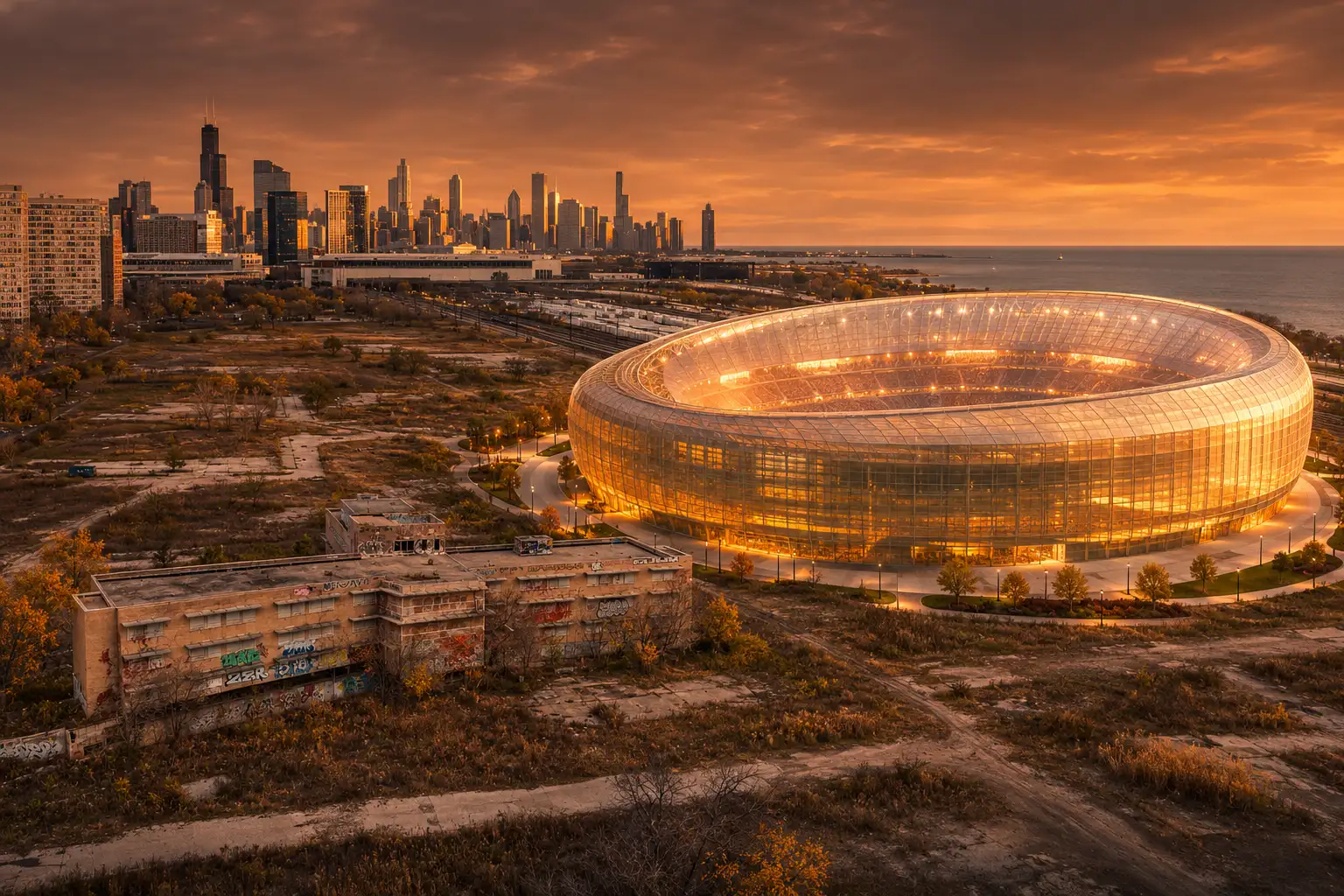
The assembled district would run about 100 acres. A glassy dome, shown in renderings by Studio Inference, would sit at the widest part of a trapezoid-shaped site west of DuSable Lake Shore Drive, about 1.5 miles south of Soldier Field. The stadium would be publicly owned. Financing, still preliminary, mixes private capital, money from the Bears, possible Illinois Sports Facilities Authority bonds, tax-increment financing, and state funds for roads and utilities.
WHAT THE $10 BILLION DISTRICT PUTS ON PAPER
- Homes: More than 5,000 units on the site and nearby, including at least 1,000 affordable or senior homes, plus student housing still in early talks with Illinois Tech and Lake Meadows.
- Hotels and park: About 2,000 hotel rooms and a 28-acre public park that the developers say could also handle tailgating.
- Transit: A proposed 29th Street Metra stop and a new CTA Green Line station, plus air rights over the McCormick Place marshaling yard.
- Jobs and tax take: The group estimates 60,000 construction-related jobs, about $14 billion in regional activity during the build, and about $135 million a year in tax revenue from homes, hotels, shops, and offices.
Primo told the church crowd a modern dome in Bronzeville would outperform Arlington Heights or northwest Indiana, which he called remote next to the economic core of the Midwest. “There should be absolutely no reasons why the Bears and the NFL should not seriously consider Bronzeville Lakefront as the best site for their new home,” he said.
There should be absolutely no reasons why the Bears and the NFL should not seriously consider Bronzeville Lakefront as the best site for their new home.
Quintin E. Primo III, founder and executive chairman, Capri Investment Group, at Olivet Baptist Church
Zeb McLaurin, CEO of McLaurin Development Partners and a GRIT member, would not say whether the group had met the Bears or Mayor Brandon Johnson. He said the team would leave “no stone unturned” in selling the site. A Bears spokesperson declined to comment. A Johnson spokesperson said the mayor will hear from developers who have a record in Chicago, and that any plan still has to face scrutiny and community support.
The first test of a new city site is not the quality of the drawings. It is whether Halas Hall asked for the meeting. This pitch did not clear that bar in public, and social feeds filled the gap with renderings anyway, which is how a hospital plot the club already passed on started looking like a live option overnight.
Making the Site Fit Means Tearing Down Homes
The Bears dismissed the 48.6-acre Michael Reese site years ago as too narrow, with safety worries about putting a stadium over an active rail line. Kevin Warren, the team’s president and CEO, also flagged the need to move McCormick Place truck yards. GRIT’s answer is to grow the map: Prairie Shores to the west, air rights over the marshaling yard to the east, and the dome on the widest remaining ground.
Prairie Shores is a five-building complex along King Drive between 26th and 31st streets. Golub bought it with Farpoint for about $180 million in 2019 and finished a remodel in 2022. Phase 1 of the new plan would tear down as many as 1,000 apartments there and build about 1,500 replacements, a 1.5-to-1 swap, with new homes finished before old ones come down. Developers also promise five years of rent protection, priority access for people who have to move, extra help for long-term residents, a resident committee, and an independent monitor. They said those rules still have to be written into enforceable deals.
I want to be very clear that before you can remove, tear down Prairie Shores, you have to put the units up first. You need to have 1,000 units up before you can take one unit down or have one family displaced.
Lamont Robinson, 4th Ward alderman, to reporters
Robinson, whose ward includes the hospital grounds, scheduled a town hall for 4:30 to 6 p.m. on Nov. 13 at Prairie Shores. He backs the larger project if current residents are not pushed out, and he has said success should be measured by who keeps a home and who shares in the jobs. The Metropolitan Pier and Exposition Authority, which owns McCormick Place, said the Bronzeville idea is in early stages and that it has made no commitments on air rights or a 300,000-square-foot expansion of convention space.
That is the trade inside the city-save pitch. The land becomes wide enough for a dome only if occupied towers come down and a rail yard the Bears already treated as a safety problem is bridged in the air. Jim Wales, president of South Loop Neighbors, said his group is generally supportive after meeting a developer about a month ago, and he wants transit planned as a whole rather than stop by stop.
Indiana Already Has a Stadium Law on the Books
While Chicago groups hold church press conferences, Indiana is working from a statute. Gov. Mike Braun signed Indiana’s stadium authority law on Feb. 26, 2026, hours after the Senate concurred 45-4. The House had passed Senate Bill 27 on Feb. 24 by 95-4. The enrolled act is Public Law 44. It creates the Northwest Indiana Stadium Authority to buy land, issue bonds, and own a public stadium in Hammond.
The state’s fiscal note on the enrolled bill lets the city impose a 12% Hammond admissions tax on tickets, and it amends Lake and Porter County food-and-beverage and innkeeper taxes to feed the same board. That is a finished tax machine, not a concept board.
On June 5, after the Illinois House left Springfield without voting on its own stadium bill, Bears chairman George H. McCaskey and Warren said the board had voted to advance the Hammond project, with the exact site still to be picked. In August, Warren called Hammond the club’s “sole focus,” said Lost Marsh had been deemed viable, and said the team was then testing Wolf Lake Terminal, a second site that might be used with the first. By early November the club’s public line was that it was “finalizing due diligence details across two sites in the Wolf Lake area.”
Braun has started talking like a man with other uses for the money. He said Indiana assembled the Hammond deal in good faith, that Hoosier taxpayers were protected, and that it is nearly time for the state to shift energy and resources to the next opportunity. Hammond Mayor Thomas McDermott Jr. has said the Bears already have the property-tax certainty they wanted, and that closing the deal is now the job.
326 Acres the Club Already Owns
The Bears closed on 326 acres in Arlington Heights on Feb. 15, 2023, paying $197 million for the old Arlington Park racetrack. The club said then that closing did not guarantee a stadium, and that it would not seek taxpayer money for the building itself, but that it would need property-tax certainty and help with roads and other public work. That ask never went away. It is the same certainty Indiana wrote into law in February.
Primo called ownership of that suburban tract “the key impediment to the team staying Downtown and fairly considering Bronzeville,” and said Capri and its investors are prepared to buy the land to clear the conflict. That is a city pitch that starts with a suburban closing. It also assumes the Bears want to sell a site they spent years and $197 million to control.
Gov. JB Pritzker has said the Illinois bill under discussion would let the Bears choose Chicago or Arlington Heights, because they are a private company and the state’s aim is to keep them in Illinois. NFL Commissioner Roger Goodell joined McCaskey and Warren in meetings with Illinois leaders in early November. The league’s interest, on the public record, is a timely Illinois option, not a Bronzeville site plan.
THREE STADIUM TRACKS NOW ON THE TABLE
| Track | Who holds the land | Bears’ posture | Legal footing |
|---|---|---|---|
| Bronzeville Lakefront | Capri, GRIT Chicago, Golub | No comment; Reese previously dismissed | Unsolicited; city infrastructure plan due Dec. 14 |
| Arlington Heights | Bears, 326 acres | Illinois site the club already bought | Needs a state stadium-authority bill |
| Hammond | Two Wolf Lake-area sites | Board voted June 5 to advance | Stadium authority law signed Feb. 26 |
Pritzker’s site-agnostic bill, if it passes, would still let the club pick the racetrack it already owns. The Bronzeville buyout only matters if the Bears both want out of Arlington Heights and want into a district that does not yet have air rights, tenant deals, or a letter from Halas Hall.
South Works and Rate Field Are in the Same Queue
Bronzeville is not the only unsolicited map. Related Midwest, which controls the former U.S. Steel South Works mill on the Southeast Side and is already building a quantum campus there, floated a lakefront dome in early November. Curt Bailey, the firm’s president, has described a partnership around a stadium rather than a land sale, and he said the idea had been shown to the Bears and to lawmakers heading into veto session.
A separate Rate Field concept in Bridgeport was drawn up without the team. Sterling Bay’s Andy Gloor made an informal pitch to Warren; the Bears declined to pursue it. City developers have stacked public stadium ideas since Mayor Johnson took office. This $10 billion version is the latest, not the first, and it has the same missing piece as the others: a club that is still sampling soil in Indiana and sitting on 326 acres in the suburbs.
A March 2025 Reese pitch put a $3.2 billion dome on the same hospital grounds. Scott Goodman, principal of Farpoint Development, said then that he had not met the Bears and had not locked up about $600 million in state money just to ready the dirt. Thursday’s version is bigger, wider, and still waiting on the same tenant.
What Springfield Can Pass in Six Days
The fall veto session is six sitting days, Nov. 17 to 19 and Dec. 1 to 3. Pritzker wants the stadium-authority bill ready for hearings in the first block and a vote in the second. The last day on the calendar is Dec. 3. In the spring the Senate passed a version in the closing hours and the House adjourned without a vote; four days later, on June 5, the Bears board pointed the project at Hammond.
The Illinois model under discussion looks a lot like Indiana’s already-passed one: a public authority owns the building, the team finances construction, property tax falls away, and public money concentrates on roads and other work around the site. That structure can cover Arlington Heights or a city plot. It does not pick Bronzeville. It does not force a sale of the racetrack. It does not move McCormick Place trucks.
THE YEAR THAT PUT TWO STATES ON THE CLOCK
- Feb. 15, 2023: The Bears close on 326 acres at Arlington Park for $197 million.
- Feb. 26, 2026: Braun signs Senate Bill 27, creating a Hammond stadium authority as Public Law 44.
- June 5, 2026: After Illinois fails to finish a bill, the Bears board votes to advance Hammond, site still unset.
- Nov. 12, 2026: Capri and GRIT unveil the $10 billion Bronzeville Lakefront plan at Olivet Baptist Church.
- Nov. 17 to 19 and Dec. 1 to 3, 2026: Illinois veto session; Pritzker wants hearings, then a vote.
- Dec. 14, 2026: GRIT’s updated infrastructure plan is due to the city, with or without the Bears.
WHAT WE KNOW
- The pitch: A $10 billion, 100-acre, 75,000-seat Bronzeville plan was announced Nov. 12 and is not endorsed by the Bears.
- The housing swap: Up to 1,000 Prairie Shores apartments would come down in Phase 1, with about 1,500 replacements and a town hall set for Nov. 13.
- The other state: Indiana’s stadium authority law is on the books, and the Bears say they are finishing due diligence on two Wolf Lake-area sites.
WHAT IS UNCONFIRMED
- The meetings: Whether Capri or GRIT has briefed the Bears or City Hall on the new maps.
- The air rights: Whether MPEA will grant use of the marshaling yard the dome needs to clear the old rail objection.
- The vote: Whether both Illinois chambers will pass a stadium-authority bill before Dec. 3, and which site the club would then pick.
A veto-session bill still has to survive members who already walked away once this year. Pritzker has said he will not dump the cost on statewide taxpayers. The Bears, in a statement after the early November meetings, said they expect productive talks with leadership in both states and have a duty to explore every option, including a project that “will attract global events and deliver jobs and economic growth to all of Chicagoland.”
The Dec. 14 Filing Does Not Need the Bears
Michael Reese Hospital closed in 2008. The city once bought the land for an Olympic Village after Chicago lost the 2016 Games to Rio, and the plot has sat in planning limbo since. Robinson said he cannot leave it dormant for another 20 years, that the ward needs housing and tax base, and that the Bears should at least look because they say they are still looking. If the club refuses a second look, he said the same boards can be shown to other teams.
GRIT has until Dec. 14 to file an updated infrastructure plan as part of the existing Bronzeville Lakefront process, a city deadline that was coming whether or not a football tenant appeared. McLaurin said the Springfield calendar made it the right week to put new drawings out. That is the other clock inside Thursday’s event: a redevelopment filing dressed in navy and orange, timed to six legislative days and a Dec. 14 date that does not care if Warren ever walks the site.
The Bears can keep testing soil in Hammond, and they can keep the 326 acres they already paid for, while that city paper gets stamped. Robinson’s version of the next month is simpler than a stadium tour. The hospital plot has to move.

Airbnb Starts House Rules Reviews as Cities Rewrite Contracts

United’s Computers Failed the Day After Kirby Blamed ATC

Tyson Foods Guides Beef Losses Narrower as Chicken Cools

Saudi Arabia’s Leisure Tourism Falters as Pilgrims Still Come

Himesh Patel Confirms the X-Files Writers’ Room Is Open

AI Server Boards Put Everyday Circuit Materials on Allocation

Glacier Collapse Buried Nepal’s Hydropower Workers in Tunnels

Congo’s Bundibugyo Outbreak Outruns the Licensed Ebola Shots

Pennsylvania Measles Deaths Follow a Long Slide in Coverage

CISA’s Known Exploits Still Come From 2007-Era Bugs
-
 NEWS2 months ago
AI Server Boards Put Everyday Circuit Materials on Allocation
-
 NEWS3 months ago
Glacier Collapse Buried Nepal’s Hydropower Workers in Tunnels
-
 NEWS3 months ago
Congo’s Bundibugyo Outbreak Outruns the Licensed Ebola Shots
-
 NEWS3 months ago
Pennsylvania Measles Deaths Follow a Long Slide in Coverage
-
 NEWS3 months ago
CISA’s Known Exploits Still Come From 2007-Era Bugs
-

 NEWS3 months ago
Texas Judge Freezes the SEC Eligibility Ban for 41 Athletes
-

 NEWS3 months ago
Germany Can Miss Its 2026 Climate Cap Without Penalty
-

 NEWS2 months ago
Pig Kidneys Got Two Men to Human Transplants After Failing