
NEWS
Most New Ebola Cases in Congo Miss the Contact Lists
Africa CDC says most new Bundibugyo Ebola cases in Congo never appear on contact lists, so the outbreak has spread to East, Central and West Africa.

Jean Kaseya said Sunday that more than 80 percent of new Ebola cases in the Democratic Republic of the Congo now appear outside contact lists. The Africa CDC director-general warned the Bundibugyo outbreak is still not under control six months after it was declared on 15 May.
US CDC figures as of 12 November put the toll at 11,285 confirmed cases and 5,509 confirmed deaths, the second-largest Ebola outbreak on record. Kenya and Nigeria stopped imported chains by following every name. Congo is losing the names.
Most New Cases Never Appear on a Contact List
Kaseya told a briefing on 15 November that the outbreak is still serious. More than 80 percent of new infections, he said, emerge among people who were never on a monitoring list. Over 65 percent of deaths have occurred in the community, outside health centres. Africa CDC, in a joint statement the same day, put community deaths at two-thirds of confirmed fatalities and said infections are still being found too late.
Those two measures describe different failures. The World Health Organization, using data as of 3 November, found an average of 86 percent of known contacts seen daily, below the 95 percent bar used to break chains. Teams can follow people they already know. They cannot follow people who never entered the register.
THE TRACING GAP
- New cases: Kaseya said more than 80 percent now appear outside contact lists.
- Known contacts: WHO put daily follow-up at 86 percent as of 3 November, under a 95 percent target.
- Place of death: Africa CDC said two-thirds of confirmed deaths still occur in the community.
- Weekly pace: The joint statement said 400 to 500 new cases continue each week across 67 health zones in eight provinces.
That weekly range is why Kaseya’s warning still holds even where the first hotspots have cooled. A tracing system that sees most of its own list, and misses most new patients, will keep drawing a map of yesterday’s outbreak.
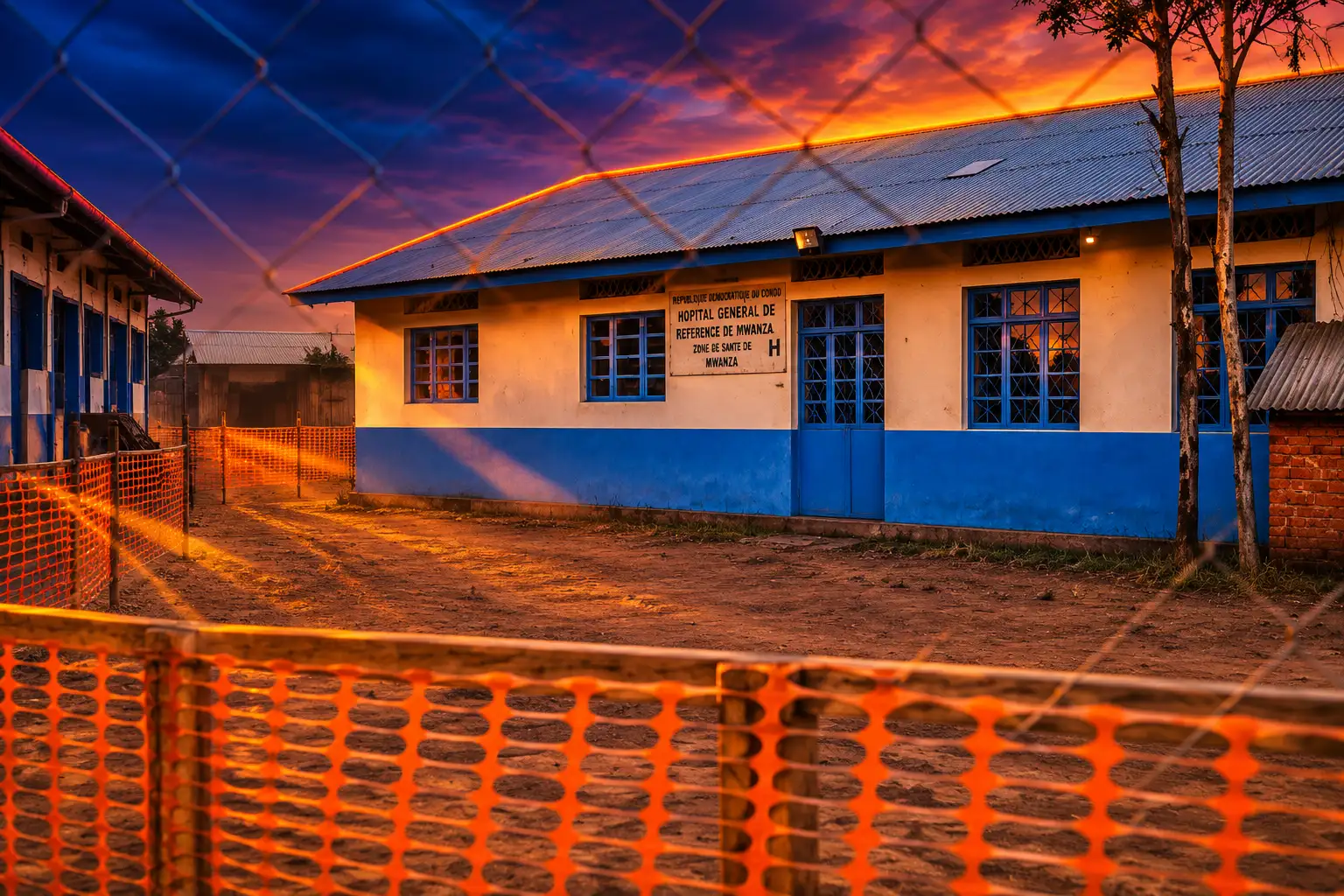
An Armed Raid Erased More Than 1,000 Names
Africa CDC said delays in paying frontline health workers and responders create tension and slow the work. Kaseya said Kinshasa is trying to digitise the payroll for staff who had not been paid for months. Unpaid tracers do not walk the extra kilometre. Families who do not trust the clinic keep the sick at home, which is where two-thirds of confirmed deaths now occur.
Insecurity does the rest. The joint statement said there have been over 80 attacks on health care since the outbreak was declared. A raid in Cantine-Aloya killed 66 civilians, including three health workers, and looted three health facilities. More than 1,000 contacts were lost to follow-up, and three confirmed cases remain unaccounted for. A second attack on the town was reported early on 11 November.
Donor-fatigue arguments treat the cash as the whole story. They skip what a single raid does to a register: a thousand names drop off, and the next generation of cases is born off the list.
HOW THE OUTBREAK LEFT THE FIRST MAP
- 15 May 2026: Congo and Uganda declare a Bundibugyo outbreak after cases surface in Ituri, and WHO later treats it as a public health emergency of international concern.
- 20 October 2026: Nigeria reports one imported case in Abuja, and Kenya records the last case in its Nairobi cluster.
- 23 October 2026: The Tumaini vaccine trial enrols its first participants in Bunia.
- 4 November 2026: WHO advisers recommend adding two Bundibugyo-specific vaccine candidates to that trial.
- 11 November 2026: A second attack is reported on Cantine-Aloya after a raid that had already wiped more than 1,000 contacts off follow-up.
- 13 November 2026: Nigeria’s Centre for Disease Control says all 62 identified contacts have finished 21-day monitoring with no spread from the index case.
- 15 November 2026: Kaseya says the outbreak is still not under control, six months after the declaration.
WHO advised against travel or trade bans. The risk it flagged is not a closed border. It is a chain that starts in a village the lists never held.
Kenya and Nigeria Stopped Chains That Congo Could Not
The same virus has behaved like two different diseases, depending on whether contacts were actually followed. Kenya’s nine confirmed cases, including two deaths, all sit in one cluster around a traveller who arrived from Congo through Uganda on 6 October and died in isolation in Nairobi. WHO said the eight later infections were four family members and four health workers, and that every one of them was already under quarantine when symptoms began. There has been no new Kenyan case since 20 October, and no sign of spread outside that group.
Nigeria reported one laboratory-confirmed imported case in Abuja on 20 October. The patient was later evacuated to Geneva. On 13 November the Nigeria Centre for Disease Control said the 21-day watch for all 62 identified contacts was complete, with no transmission from the index case. The agency kept its emergency centre on high alert because Congo is still seeding travellers, not because Abuja had lost the chain.
Uganda, which declared alongside Congo, has been controlled since August. France’s single patient was also closed out in August. A UK health worker was evacuated from Congo to London on 5 November for specialist care. Those moves are medevacs of known patients, not new African epicentres.
CONFIRMED CASES BY COUNTRY
| Country | Confirmed cases | Confirmed deaths | Status as of mid-November |
|---|---|---|---|
| DR Congo | 11,254 | 5,505 | Community transmission in eight provinces |
| Kenya | 9 | 2 | Single Nairobi cluster, no new case since 20 October |
| Uganda | 20 | 2 | Controlled since August (plus one probable case and one probable death) |
| Nigeria | 1 | 0 | 62 contacts finished 21-day follow-up, no spread |
| France | 1 | 0 | Controlled since August |
The US CDC’s 12 November total of 11,285 confirmed cases and 5,509 confirmed deaths is the sum of that table. Crude case fatality on those figures is 48.8 percent. Kaseya said cases have now been reported in East, Central and West Africa, the widest geographic spread of any Ebola outbreak on the continent. The extra countries are not where the dying is. They are where a missed contact in Congo becomes someone else’s problem.
Bundibugyo Still Has No Licensed Vaccine
The strain is Bundibugyo virus, first identified in western Uganda in 2007. WHO puts case fatality from the two earlier outbreaks at 30 percent in 2007 and 50 percent in 2012. CEPI, which is funding new shots, states there are no licensed vaccines for Bundibugyo virus and no licensed treatments. Ervebo and the licensed antibody drugs were built for Zaire ebolavirus, a different species. Incubation runs from two to 21 days. People are not infectious until they feel sick, which is why a list that starts late is already behind.
If we don’t stop this outbreak now, it would be the worst Ebola outbreak that the world will have.
Jean Kaseya, director-general, Africa CDC, 15 November briefing
The 2014-2016 West African epidemic still stands larger, with more than 28,600 infections and more than 11,000 deaths. This one is already Congo’s largest of any Ebola species, and the US CDC says it is the 17th Ebola outbreak in the country. It passed 1,000 confirmed cases within 40 days of response activation. The 2018 Congo outbreak took about 235 days to cross the same line.
On 23 October the Tumaini trial, a Phase 2/3 ring-vaccination study led by Congo’s Institut National de Recherche Biomédicale with the University of Antwerp, enrolled its first participants in Bunia. On 4 November, WHO expert groups recommended two new candidate vaccines to join that trial after national approvals: ChAdOx1, from the University of Oxford and the Serum Institute of India, and Moderna’s mRNA-1469. WHO said it was the first time shots designed for Bundibugyo virus would be tested during an outbreak of that virus, with results expected in early 2027.
Tedros Adhanom Ghebreyesus, the WHO director-general, wrote on 15 November that transmission is slowing in several early epicentres and that the Tumaini trial and new vaccine candidates are advancing. He also said around 3,000 people have recovered and gone home, matching Africa CDC’s figure, and asked for a halt in fighting so health workers can reach every affected area.
Six months ago, I declared the Bundibugyo virus #Ebola outbreak in the #DRC a Public Health Emergency of International Concern. Since then, over 11,000 cases and 5400 deaths have been recorded across eight provinces, making this the largest and deadliest Ebola outbreak in the… pic.twitter.com/v1TncZkxJs
— Tedros Adhanom Ghebreyesus (@DrTedros) November 15, 2026
A trial that reports in 2027 cannot close a contact list in November. The licensed tools that ended Zaire outbreaks in Congo are not on the shelf for this species.
Africa CDC Can See Only $820 Million of Donor Cash
Kaseya called coordination between Congo and donors a collective failure, then said he was not pointing fingers. On 15 November he laid out a three-layer ledger. Donors have pledged around $2.9 billion. Around $1.2 billion has been disbursed or is being disbursed. Africa CDC has visibility over approximately $820 million, including money already spent and balances still on hand.
WHERE THE MONEY STANDS
- Pledged: About $2.9 billion from donors, Kaseya said on 15 November.
- Moving: About $1.2 billion already disbursed or in the process of being disbursed.
- Visible: About $820 million that Africa CDC can actually trace on the ground.
- Earlier gap: In October, Congolese authorities had sight of $260 million out of about $960 million then said to have been disbursed, leaving about $700 million unexplained to Kinshasa.
Kaseya said partners do not have to hand their cash to the government. They do have to share the information so plans line up. He said unused balances would be the subject of a meeting in the coming days between the government and partners. Fast, flexible funding must be sustained through 2027, the joint UN and Africa CDC statement said, if the fragile gains are to hold.
Money that cannot be seen cannot be steered toward the unpaid tracer in a health zone that just lost a thousand names.
Early Epicentres Slow as the Map Keeps Growing
The joint statement said most of the early epicentres have been brought under control, including Mongbwalu, Nyankunde, Nizi, Rwampara and Butembo. In Bunia, still a large focus, new cases have halved and treatment centres report low occupancy. Diagnostic labs have grown from two to more than two dozen. Close to 2,000 treatment beds now sit in 104 treatment and transit centres. Over 17,000 community health workers and 46,000 community actors have been trained. Almost 90 percent of registered deaths now receive a safe burial.
EARLY FOCI THAT HAVE COOLED
- Mongbwalu, Nyankunde, Nizi, Rwampara, Butembo: Rapid transmission halted, Africa CDC said on 15 November.
- Bunia: New cases halved, with low occupancy in treatment centres, though transmission continues.
- South Kivu: US CDC says no confirmed case since 29 May.
- Bas-Uele and Sud-Ubangi: WHO recorded no new cases in the 21 days to 3 November.
The map still widens. Confirmed cases have been found in 67 health zones across eight of Congo’s 26 provinces: Ituri, North Kivu, South Kivu, Tshopo, Haut-Uele, Bas-Uele, South Ubangi and North Ubangi. As of 3 November, WHO said 51 of those 67 zones had at least one new case in the preceding 21 days. Ituri remained the heaviest burden, with 7,485 confirmed cases and 3,532 deaths, and 28 of 36 health zones touched. North Kivu had 2,593 cases and 1,422 deaths, the highest provincial case fatality ratio at 54.8 percent, and the highest seven-day count, 232 cases. In those 21 days WHO counted 1,463 new confirmed cases, 710 of them in Ituri and 640 in North Kivu.
Seven in 10 Infected Children Under Five Have Died
Children account for more than a quarter of confirmed cases and one third of deaths, Africa CDC said. Seven in 10 children under five with confirmed Ebola have died. WHO said the high share of community deaths, especially among young children, shows how late detection still is. Of 512 deaths it tallied from 21 October to 3 November, 335 were in the community and 177 in treatment centres.
Kaseya said Sunday that if this outbreak is not stopped now, it would be the worst Ebola outbreak the world will have. The 2014-2016 counts are still higher. The weekly range is not. Until the lists include the people the virus has already met, 400 to 500 new cases will keep arriving each week from health zones the first map never named.
Disclaimer: This article is news reporting on a public health emergency and is for information only. It does not constitute medical advice, a diagnosis, or guidance on treatment, vaccination, isolation, or travel. Anyone who needs personal medical or travel advice should consult a qualified physician or an official public health authority in their country. Case counts, death totals, trial status, pay arrangements, and funding figures reflect the official sources named above and can change as ministries and agencies issue new updates.

Airbnb Starts House Rules Reviews as Cities Rewrite Contracts

United’s Computers Failed the Day After Kirby Blamed ATC

Tyson Foods Guides Beef Losses Narrower as Chicken Cools

Saudi Arabia’s Leisure Tourism Falters as Pilgrims Still Come

Himesh Patel Confirms the X-Files Writers’ Room Is Open

AI Server Boards Put Everyday Circuit Materials on Allocation

Glacier Collapse Buried Nepal’s Hydropower Workers in Tunnels

Congo’s Bundibugyo Outbreak Outruns the Licensed Ebola Shots

Pennsylvania Measles Deaths Follow a Long Slide in Coverage

CISA’s Known Exploits Still Come From 2007-Era Bugs
-
 NEWS2 months ago
AI Server Boards Put Everyday Circuit Materials on Allocation
-
 NEWS3 months ago
Glacier Collapse Buried Nepal’s Hydropower Workers in Tunnels
-
 NEWS3 months ago
Congo’s Bundibugyo Outbreak Outruns the Licensed Ebola Shots
-
 NEWS3 months ago
Pennsylvania Measles Deaths Follow a Long Slide in Coverage
-
 NEWS3 months ago
CISA’s Known Exploits Still Come From 2007-Era Bugs
-

 NEWS3 months ago
Germany Can Miss Its 2026 Climate Cap Without Penalty
-

 NEWS3 months ago
Texas Judge Freezes the SEC Eligibility Ban for 41 Athletes
-

 GAMING2 months ago
Xbox Disc-to-Digital Turns Delisted Games Into Traveling Licenses