
NEWS
Amazon’s Biggest Leo Rocket Fails on Its First Flight
ULA’s Vulcan failed 10 minutes after liftoff, losing 40 Amazon Leo satellites and grounding the rocket booked for half the constellation.

United Launch Alliance’s Vulcan rocket failed 10 minutes after liftoff on November 15, destroying 40 Amazon Leo satellites and parking the vehicle booked for half the constellation. The 214-foot stack left Space Launch Complex 41 at Cape Canaveral at 12:40 p.m. ET and never delivered its payload to orbit.
ULA, the Boeing and Lockheed Martin launch company, called it an anomaly and the first total loss of one of its rockets since the firm was formed in 2006. The 40 spacecraft are replaceable. The launch slots are not.
Vulcan Was Booked to Carry Half of Amazon Leo
Amazon designed Leo, the network once called Project Kuiper, to fly on four families of rockets so a single grounding could not freeze the build. Vulcan was the heavy end of that plan. Amazon said the rocket would loft more than 1,500 first-generation Leo satellites across 38 missions, close to half of the 3,232-spacecraft fleet the FCC licensed, and more than any other vehicle in the program.
Melissa Wuerl, director of launch systems for Amazon Leo, called Vulcan the primary workhorse for the next several years. “Vulcan will launch close to half our first-generation constellation, making it our primary workhorse over the next several years, and we’re looking forward to kicking off the sprint with our partners at ULA,” she said before the flight.
Sunday was LV-01, the first of those 38 missions, and the largest Leo payload Amazon had stacked to date. The company had already finished its 1,000th satellite in early September and said hundreds more were flight-ready. LV-02 was being built in a second hangar so it could fly within weeks of a clean LV-01. That second rocket is now waiting on an investigation with no public timeline.
AMAZON LEO’S LAUNCH BOOK
| Rocket | Flights booked | Satellites delivered | Status after November 15 |
|---|---|---|---|
| Atlas V | 8 Leo missions | 224 | Campaign complete |
| Ariane 6 | 24 | 100 on 3 flights | Next window November 23 |
| Falcon 9 | 13 | 72 on 3 flights | Still flying |
| Vulcan | 38 | 0 | Failed; under investigation |
| New Glenn | 24 | 0 | Grounded since May 28 |
The catalog math is blunt. KeepTrack’s launch history counts 224 satellites on eight Atlas flights, 100 on three Ariane 6 missions, and 72 on three Falcon 9s, which is 396 production satellites launched through July 2. A working Vulcan would have taken that launched tally to 436. Atlas V is done with Leo. Vulcan and New Glenn, which together account for 62 of the remaining 93 contracted flights, are both on the ground.
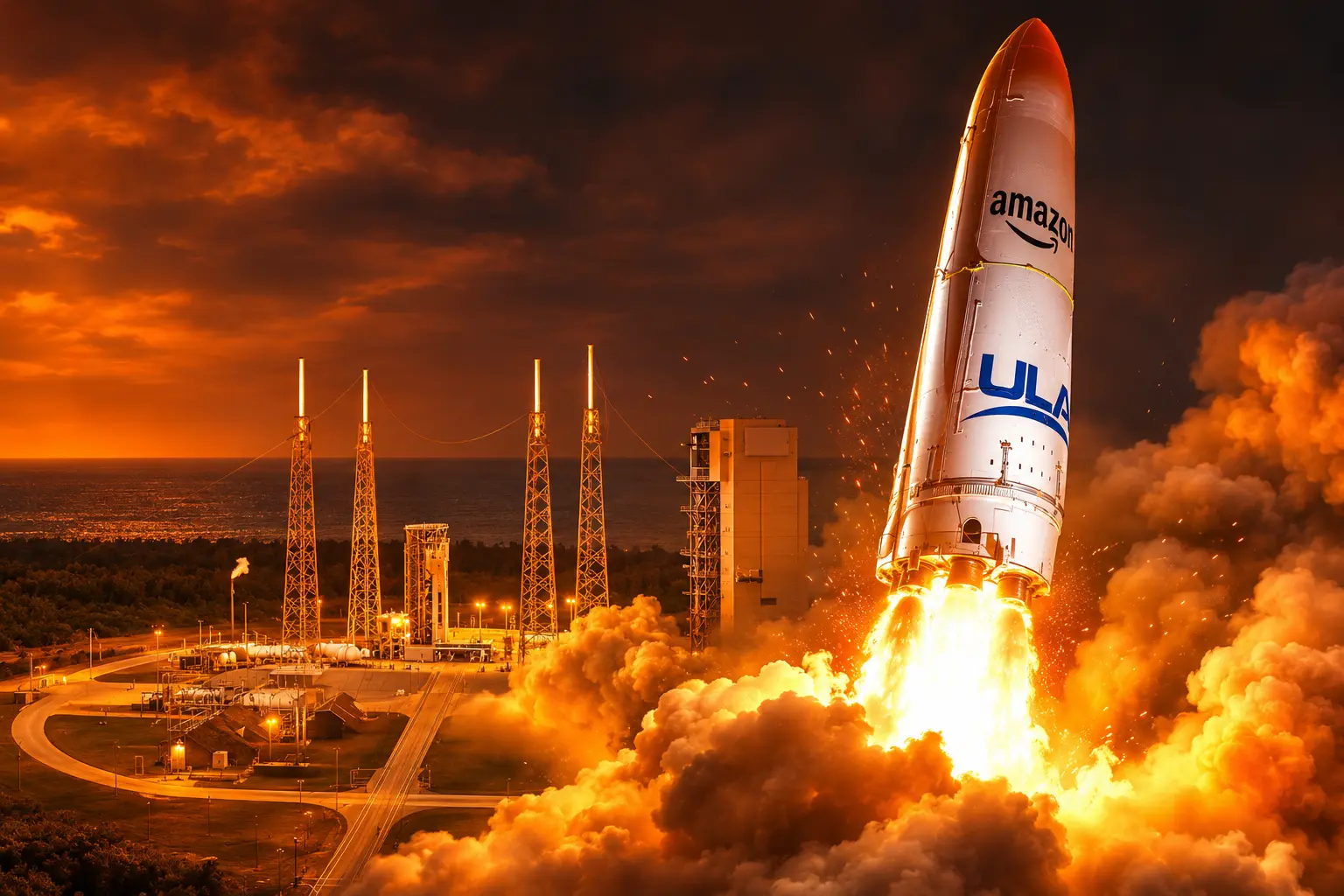
What Happened 10 Minutes After Liftoff
The solids and the first-stage climb looked healthy from the ground. A Friday try had died when a gaseous nitrogen plant that feeds several pads lost power, and a Saturday window fell to a network fault between the rocket and the ground. On Sunday, controllers held at T-minus 20 seconds over a technical issue on the vehicle, then recycled to the end of a 12:11 to 12:40 p.m. ET window and sent it.
Six Northrop Grumman GEM 63XL boosters and two Blue Origin BE-4 main engines made 3.8 million pounds of thrust. The solids burned out and fell away about 1 minute 40 seconds after liftoff, which matched the plan. The BE-4s then appeared to burn longer than ULA’s pre-launch timeline, and first-stage separation looked late. After that, the hydrogen-fueled Centaur upper stage was supposed to fire for 12 minutes and 15 seconds. ULA later said the failure came 10 minutes into the flight, during that upper-stage window, and that the Amazon mission did not reach orbit.
The company still has not named a failed part. The first stage running long could mean it was underperforming and had to make up energy. The 10-minute mark sits after staging, which points at Centaur, or at a first-stage problem that only showed up once the upper stage took over. Until telemetry is briefed, both readings are open.
ULA posted its finding about 50 minutes after liftoff.
Based on data received by our Launch Director, we confirm that the Vulcan vehicle launched from Space Launch Complex 41 suffered an anomaly 10 minutes into the flight and failed to deliver the Amazon mission to orbit.
Every flight generates data, and every flight teaches us…
— ULA (@ulalaunch) November 15, 2026
“Today, we did not meet that standard,” the company said, after writing that it exists to provide assured access to space and holds itself to mission success. It promised customers visibility into the inquiry and said it would return to flight as quickly as possible.
Amazon Leo answered in kind, treating LV-01 as a first flight with known risk.
There is risk with any launch, and that’s especially true for inaugural missions like LV-01. ULA has been a trusted partner for Amazon, and we believe they’ll learn from this mission and deliver on their long-term plans for Vulcan.
Full statement from @ulalaunch below. https://t.co/lS2GEioSak
— Amazon Leo (@AmazonLeo) November 15, 2026
“There is risk with any launch, and that’s especially true for inaugural missions like LV-01,” the unit said. “ULA has been a trusted partner for Amazon, and we believe they’ll learn from this mission and deliver on their long-term plans for Vulcan.”
Nine Months of Nozzle Work Met a New Fault
This was only the fifth Vulcan flight, and the first in nine months. The grounded stretch was not about Centaur. It was about the strap-on motors ULA spent the year trying to fix, the same motors that looked ordinary on Sunday.
VULCAN’S FIVE FLIGHTS
- January 2024: Cert-1, the debut, reaches orbit and starts the Space Force certification clock.
- October 4, 2024: Cert-2 loses a GEM 63XL nozzle about 37 seconds after liftoff; the rocket still makes orbit.
- August 12, 2025: USSF-106, the first national security flight after certification on March 26, 2025, flies clean.
- February 12, 2026: USSF-87 suffers a nozzle burn-through about 20 seconds after liftoff; the payloads still reach the planned orbit, and the Space Force then freezes further Vulcan military launches.
- November 15, 2026: LV-01, six boosters and a shortened Centaur, fails 10 minutes in and loses 40 Amazon satellites.
Two of the first four flights had nozzle trouble. ULA CEO Mark Peller said before Sunday that the team had identified three credible causes and taken steps against all of them, and that Sunday’s motors carried the redesigned nozzles. Those motors did their job. The failure sat later in the stack.
Sunday also debuted hardware Amazon wanted for cadence. It was the first Vulcan in the six-booster layout, and the first with a shorter Centaur V built for low orbit, with tanks trimmed so more mass could go to satellites. John Gedmark, chief executive of the satellite firm Astranis, noted that if the fault traces to those tank changes, a return on the standard Centaur could come faster, and that a problem common to every Centaur V would travel much further, including onto NASA’s later Artemis flights that plan to use the stage.
Peller also said Blue Origin had fitted a “retrofit kit” on the BE-4s for this mission after the valve work that followed New Glenn’s pad accident. Those engines have a clean flight record so far. ULA has not said they were at fault on Sunday, and has not cleared them either.
New Glenn Has Been Silent Since May
The other American heavy rocket on Amazon’s sheet has not flown since spring. On May 28, Blue Origin lost a fully stacked New Glenn during a hotfire test at Launch Complex 36, days before a planned loft of 48 Leo satellites that were never on the vehicle. CEO Dave Limp said early analysis pointed to the aft section of the first stage. Later company updates traced the start of the event to a main oxygen valve on one of the seven BE-4s.
The blast took out the lightning tower, the transporter-erector, and the hydraulic cylinders. The tank farm, integration building, and water tower survived. Limp told staff in June the firm would skip a like-for-like pad rebuild and go to a crane-based raise so it could fly again before the end of 2026. By early November that target had moved to January 2027.
Amazon’s original New Glenn buy was 12 flights with options; the working book is now 24. None of those have flown. The same engine family sits on Vulcan’s first stage. A BE-4 finding on Sunday would tie the two groundings together. A Centaur finding would not. That is why the unanswered 10-minute mark matters to more than one pad.
How Far Amazon Leo Still Has to Go
Amazon is not short of metal. It is short of working heavy rockets, and it is already late on the license that lets the network keep its spectrum standing. The FCC’s 2020 grant, trimmed in 2024, requires 3,232 first-generation satellites. Half of that, 1,616 satellites by July 30, 2026, was the interim mark. Amazon missed it by a wide margin and had told the bureau in January it would likely reach only about 700, roughly 21 percent of the licensed fleet.
THE LICENSE CLOCK AMAZON IS ON
- Gen1 license: 3,232 satellites, with a final deadline of July 30, 2029 that the FCC did not move.
- Missed mark: 1,616 operational satellites were due by July 30, 2026; Amazon entered that date with a few hundred in space and no launches after July 2.
- The waiver: On June 5, 2026, in order DA 26-553, the Space Bureau waived the 50 percent cut that would have shrunk the license to whatever was already flying, and it still made Amazon forfeit the surety bond tied to the miss.
- The penalty: Satellites launched after July 30, 2026 lose processing-round spectrum priority until Amazon hits 50 percent or until March 30, 2028, whichever comes first, with an earlier out on October 30, 2027 if it certifies the satellites are built and the launches are booked.
KeepTrack’s October catalog put 11,131 Starlink satellites in orbit against Amazon’s few hundred. That gap is the product of cadence, and cadence is what Sunday took away. Amazon still talks about an initial service rollout in late 2026, starting at high latitudes. The next Vulcan cannot help that date until ULA says what broke.
Space Force Stopped Waiting in February
National security cargo was already off Vulcan. After the February 12 nozzle event, Brig. Gen. Eric Zarybnisky, the Space Force’s portfolio acquisition executive for space access, said the service would not fly more NSSL missions on the rocket until that fault was closed. “Until this anomaly is solved we will not be launching Vulcan missions,” he said.
The hold turned a two-provider military launch setup into a one-provider line. Space Systems Command moved time-sensitive payloads onto SpaceX, including GPS III-8, the last GPS III satellite, which flew on a Falcon 9 on April 21 after being pulled off Vulcan. Other missile-warning and tracking missions followed onto Falcon 9 and Falcon Heavy. Sunday’s commercial flight was supposed to give the service fresh data on the redesigned nozzles. It instead produced a total loss on a different part of the vehicle, which does not shorten a military return.
ULA’s pitch for two decades was that it did not lose missions. The nozzles were the known worry, and they were the thing the company spent nine months and a full-scale hot fire in Utah trying to bury. The failure on the fifth flight landed somewhere the pre-launch briefings were not aimed.
Kourou Still Has a Rocket on the Calendar
The hedge is not fully dead. Ariane 6 has already put 100 Leo satellites up in three flights from French Guiana, and Amazon raised that contract from 18 to 24 missions on September 9. The next European flight, LE-04, is listed no earlier than November 23 from Kourou with 36 satellites. Falcon 9 still has 10 Leo missions on the book after three flights that delivered 72 spacecraft. Those two vehicles are the only contracted paths that are actually flying.
WHAT CAN STILL FLY LEO SATELLITES
- Ariane 6: 21 missions left on a 24-flight buy, with LE-04 aimed at November 23 and 36 satellites.
- Falcon 9: 10 missions left on a 13-flight buy, the only American rocket on the Leo sheet that is launching now.
- New Glenn: 24 missions, none flown, next attempt slipped to January 2027 after the May 28 pad loss.
- Vulcan: 38 missions, none successful, LV-02 already in VIF-G until the inquiry clears a return.
Two-thirds of the remaining contracted flights, 62 of 93, sit on the two rockets that cannot currently leave the Cape. Ariane 6 and Falcon 9 cannot absorb 1,500 spacecraft on their leftover manifests. That is the second hit, after the 40 lost on Sunday: the workhorse Amazon funded new buildings to fly in weeks, including VIF-A and a dedicated mobile launch platform, is now in the same state New Glenn has been in since May.
NASA Administrator Jared Isaacman offered help within the hour, which is the other customer sitting behind this investigation.
Appreciate you quickly keeping the public and your partners informed. The team at @NASA is available to assist in all matters related to the investigation and remediation effort. Artemis, Moon Base, and the nation need ULA. We are in your corner and here to help.
Jared Isaacman, NASA Administrator, on X
In the second vertical integration building at the Cape, LV-02 is already stacked for a flight that was supposed to come weeks after a nominal LV-01. It will stay there until ULA can say what happened 10 minutes after the first one left the pad.

Airbnb Starts House Rules Reviews as Cities Rewrite Contracts

United’s Computers Failed the Day After Kirby Blamed ATC

Tyson Foods Guides Beef Losses Narrower as Chicken Cools

Saudi Arabia’s Leisure Tourism Falters as Pilgrims Still Come

Himesh Patel Confirms the X-Files Writers’ Room Is Open

AI Server Boards Put Everyday Circuit Materials on Allocation

Glacier Collapse Buried Nepal’s Hydropower Workers in Tunnels

Congo’s Bundibugyo Outbreak Outruns the Licensed Ebola Shots

Pennsylvania Measles Deaths Follow a Long Slide in Coverage

CISA’s Known Exploits Still Come From 2007-Era Bugs
-
 NEWS2 months ago
AI Server Boards Put Everyday Circuit Materials on Allocation
-
 NEWS3 months ago
Glacier Collapse Buried Nepal’s Hydropower Workers in Tunnels
-
 NEWS3 months ago
Congo’s Bundibugyo Outbreak Outruns the Licensed Ebola Shots
-
 NEWS3 months ago
Pennsylvania Measles Deaths Follow a Long Slide in Coverage
-
 NEWS3 months ago
CISA’s Known Exploits Still Come From 2007-Era Bugs
-

 NEWS3 months ago
Germany Can Miss Its 2026 Climate Cap Without Penalty
-

 NEWS3 months ago
Texas Judge Freezes the SEC Eligibility Ban for 41 Athletes
-
 GAMING2 months ago
Xbox Disc-to-Digital Turns Delisted Games Into Traveling Licenses