
BUSINESS
Tyson Foods Guides Beef Losses Narrower as Chicken Cools
Tyson Foods is guiding beef from a $654 million loss toward breakeven in fiscal 2027, while chicken, pork and group sales take the actual cut.

Tyson Foods is guiding its beef unit from a $654 million adjusted operating loss toward a range of a $300 million loss to $100 million of profit in fiscal 2027. Chicken and pork are the lines actually cut. Group sales are guided down 3.5% to 5.5% as the company runs fewer cattle through a smaller plant net.
The Springdale, Arkansas, meat company reported the year ended Oct. 3, 2026, on Nov. 16 and posted adjusted operating income of $1.977 billion, down 14% from $2.287 billion. Adjusted earnings per share were $3.44, down 17% from $4.12. Shares still rose about 9% that session, because the beef range is a narrower hole than last year’s, even as the rest of the stack is guided softer.
Tyson Is Guiding Beef Toward a Smaller Loss
Beef lost $654 million on an adjusted basis in fiscal 2026, after a $275 million loss the year before, on adjusted sales of $21.277 billion. Adjusted volumes fell 12.2%. Average prices rose 10.0%, which was not enough to cover what Tyson paid for scarce cattle.
The fourth quarter was the ugly end of that year. Adjusted beef sales were $4.910 billion. The segment lost $171 million, against a $52 million loss a year earlier, and the quarter included an $80 million noncash write-down on live cattle after prices fell following Tyson’s purchases, chief operating officer Wes Morris said on the call.
For fiscal 2027, Tyson put beef at a $300 million adjusted loss at worst and $100 million of operating income at best. That worst case is still $354 million narrower than fiscal 2026. Morris called the drag a cattle-cycle problem, not a brand problem, and said there are early signs industry economics are improving.
Jeff Schomburger, who became president and chief executive at the start of October after Donnie King, told analysts the year came in where Tyson said it would in September, with the shape a little better in beef and a little lighter in chicken. His written results comment did not mention beef. He pointed to a diversified multiprotein model, brands, innovation and returns.
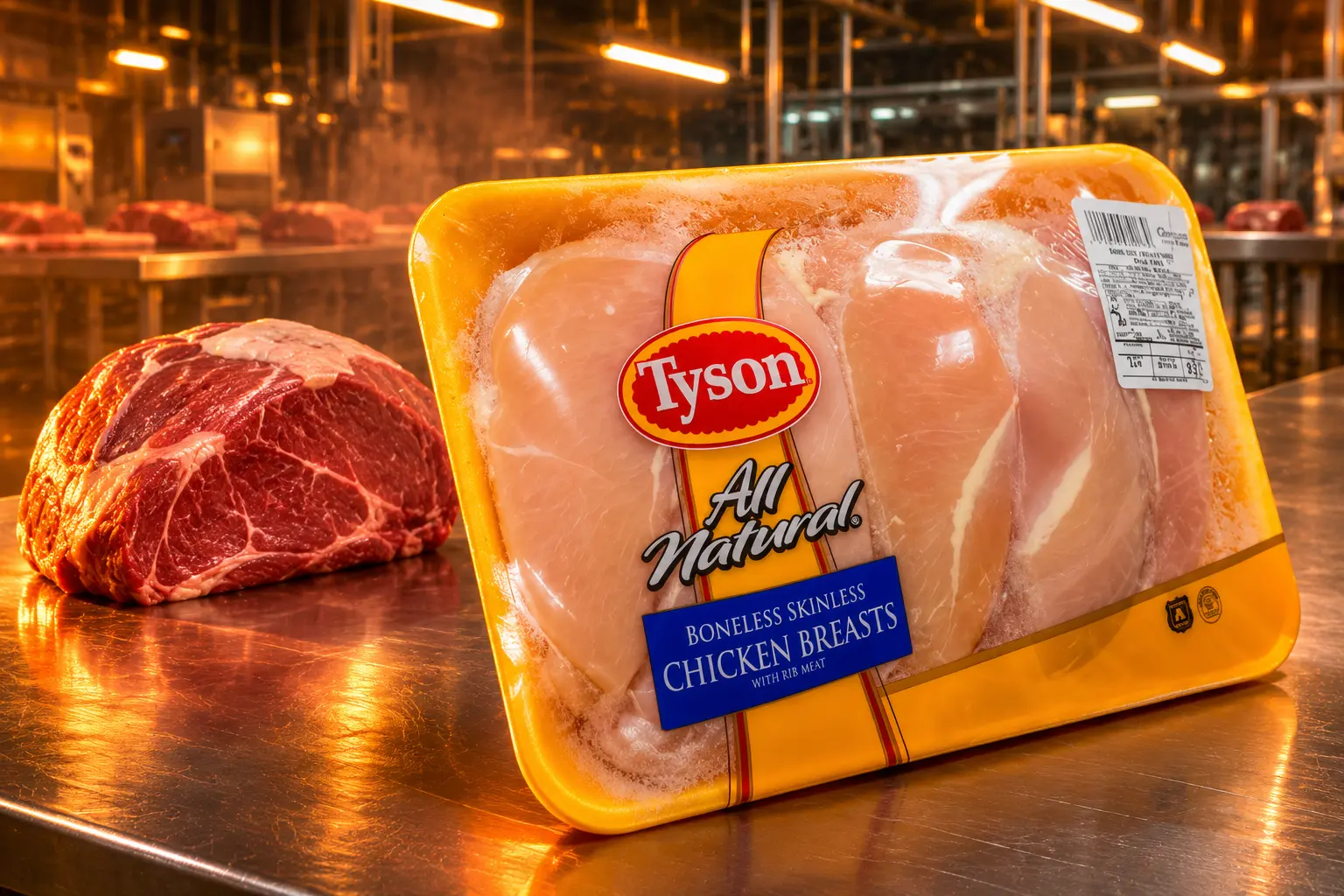
An 86-Million-Head Problem for Packers
Packers lose money when there are too few cattle, because they bid against each other for the animals and cannot always recoup the cost in boxed beef. That is the bind Tyson spent fiscal 2026 in, and USDA’s head counts still read tight even after a summer of slightly higher replacement heifers.
THE JANUARY 2026 CATTLE COUNT
- All cattle: The USDA counted 86.2 million head of cattle and calves on U.S. farms as of Jan. 1, 2026, slightly below 86.5 million a year earlier.
- Beef cows: The beef-cow herd was 27.6 million head, down 1%.
- Heifers kept back: Beef replacement heifers rose 1% to 4.71 million head, a thin start to any rebuild.
- Calf crop: The 2025 calf crop was 32.9 million head, down 2%.
The July 1, 2026, count always runs higher because calves are on the ground by then, and it should not be read as a six-month rebound. USDA put the midyear herd at 94.2 million head, only slightly above 94.0 million a year earlier. It also put 28.5 million beef cows on July 1, still down 1%, while beef replacement heifers rose 3% to 3.80 million. The 2026 calf crop was estimated at 32.5 million head, down 2% again.
Feedlots then printed a hole that will show up in early 2027 slaughter. Cattle on feed in lots of 1,000 head or more totaled 11.37 million on Oct. 1, 2026, down 0.4%. September placements were 1.777 million head, down 12.1%, the lowest for that month since 1996. For Tyson’s own fiscal 2027, USDA projects U.S. beef production down about 2%, pork about flat and chicken up about 1%.
Joslin Closed so Amarillo Could Run Two Shifts
Tyson stopped waiting for the herd. On Aug. 13, 2026, it said it would anchor beef around three central plants, Dakota City, Nebraska; Holcomb, Kansas; and Amarillo, Texas, in what it called one of the most historic cattle shortages the country has ever experienced. Capacity, it said, would move to those sites so harvest could stay similar on a tighter, more modern net.
THE BEEF NETWORK AFTER AUGUST
- Joslin, Illinois: The beef plant closed, a site of about 3,000 head a day that employed about 2,500 people.
- Eagle Mountain, Utah: The case-ready plant closed; Utah labor officials put the cut at 723 jobs.
- Pasco, Washington: Tyson is pursuing a sale of the plant, which can handle about 2,000 head a day and buys a large share of Northwest fed cattle.
- Amarillo, Texas: Tyson cut the plant to one shift in January and eliminated 1,761 B-shift jobs, then said it would ramp a second shift as cattle showed up.
- The three keepers: Dakota City, Holcomb and Amarillo are now the core slaughter system Tyson wants to run hard.
On Nov. 9 it moved the Amarillo plan from a hope to a date. The company said it intends to form a long-term partnership with Allied Beef Company, a consortium of American ranchers, and, in anticipation of that deal, to restore the Amarillo second shift in full by summer 2027. Select second-shift work has already restarted.
“The future of our beef business depends on strong partnerships across the supply chain,” Morris said in that release. “We’re proud to announce our intent to partner with Allied Beef and the American ranchers they represent while continuing to invest in facilities like Amarillo.” Ranchers get a buyer that wants cattle on a set calendar. Tyson gets a shot at filling a plant it had already cut to one shift. The Illinois, Utah and Washington towns do not get that trade.
Chicken and Pork Carry the Profit Cut
Chicken earned the company in fiscal 2026. Adjusted operating income was $1.859 billion, a 10.7% margin, only a step under $1.892 billion the year before, in a market where some industry cutout values fell hard. The fourth quarter showed how fast that cushion can thin: chicken made $389 million, against $562 million a year earlier, and the margin dropped to 8.7% from 12.7%.
Fiscal 2027 guidance takes that warning and writes it into the plan. Chicken is guided to $1.3 billion to $1.6 billion, below last year even at the top of the range. Pork is guided to $75 million to $175 million, below last year’s $228 million even at the top. Prepared Foods, home to Jimmy Dean and Hillshire Farm, made $1.332 billion, up 5.5%, and is guided to $1.25 billion to $1.4 billion, a band that still includes last year. International made $180 million and is guided to $125 million to $200 million, another band that straddles the year just reported.
FISCAL 2027 ADJUSTED PROFIT GUIDE
| Segment | Fiscal 2026 actual | Fiscal 2027 guidance |
|---|---|---|
| Beef | $654 million loss | $300 million loss to $100 million profit |
| Pork | $228 million | $75 million to $175 million |
| Chicken | $1.859 billion | $1.3 billion to $1.6 billion |
| Prepared Foods | $1.332 billion | $1.25 billion to $1.4 billion |
| International | $180 million | $125 million to $200 million |
| Total company | $1.977 billion | $1.7 billion to $2.15 billion |
The company total can finish above or below fiscal 2026 because the range is wide. What it cannot do, on this guide, is get a higher chicken or pork result than last year. Chief financial officer Curt Calaway put that trade in one sentence on the call.
Overall, we expect fiscal ’27 to reflect continued improvement in our Prepared Foods businesses, a meaningful improvement in Beef, offset by market pressure in Chicken and Pork.
Curt Calaway, Chief Financial Officer, Tyson Foods fiscal 2026 earnings call
He also said market-driven headwinds, mainly in chicken and pork, could outweigh the controllable improvements Tyson is making. Grain and other input costs are the chicken pressure he named, partly offset by plant savings and a richer value-added mix. Pork, he said, still faces compressed spreads. Capital spending of $1.1 billion to $1.4 billion is aimed mostly at chicken and Prepared Foods, Calaway said, up from $770 million of plant and equipment additions in fiscal 2026.
Why Tyson Sales Are Guided Down 3.5% to 5.5%
Reported sales were $56.419 billion, up 3.6%. Fiscal 2026 had an extra week, and Tyson booked $358 million of legal contingency accruals as reductions to sales ($190 million in beef, $70 million in pork, $98 million in chicken). Strip the extra week and those accruals, and Tyson said sales were up 1.1%. On a 52-week basis, adjusted sales were $55.370 billion.
The fiscal 2027 sales cut is not a demand collapse across the protein case. Calaway said combined sales in chicken and Prepared Foods are projected to grow 3% to 4%. The decline is, in Tyson’s words, primarily lower beef volumes from the network cuts and tight cattle. Fewer plants and fewer cattle mean fewer pounds, even if steaks stay expensive.
GAAP results were messier than the adjusted ones. Operating income was $1.100 billion, about flat. GAAP earnings per share were $1.28, down 4% from $1.33. The fourth quarter, which held the extra week, posted sales of $14.585 billion, adjusted operating income of $361 million (down 41%), and adjusted earnings of $0.61 a share (down 47%). GAAP earnings per share in the quarter were a loss of $0.22.
Debt Fell $1.08 Billion in the Same Year
Cash from operations was $2.433 billion. Free cash flow was $1.663 billion, up $486 million, helped by lower plant spending and working capital. Tyson cut total debt by $1.080 billion, bought back 7.8 million shares for $427 million, and held $4.1 billion of liquidity on Oct. 3, 2026. The board raised the Class A quarterly dividend 2% to $0.52, the 15th straight year of increases. Net interest expense is seen at about $360 million in fiscal 2027. Corporate expenses and amortization, as adjusted, are seen at about $1.0 billion, after $968 million in fiscal 2026.
Free cash flow is guided down with the higher capex, to $800 million to $1.3 billion. That is the bill for building chicken and prepared capacity while beef is still being shrunk to fit the herd. Schomburger asked holders not to look at Tyson only through the beef cycle and to look at it the way retailers and restaurants do, as a supplier across fresh meat, deli and prepared food. Protein, he said, is a $273 billion retail category, and 7 in 10 Americans say they are trying to eat more of it.
USDA still has U.S. beef production down about 2% in fiscal 2027. The Amarillo second shift is due to be fully running by summer 2027. Until those cattle show up, Tyson’s own guide says the beef loss gets smaller, the chicken and pork checks get smaller, and the top line gets smaller with the plant list.
Disclaimer: This article is news reporting and analysis of Tyson Foods’ fiscal 2026 results and fiscal 2027 outlook, and it is for information only. It is not investment advice, a recommendation to buy or sell Tyson shares, or a forecast of cattle, chicken or pork prices. Readers who are considering a position in Tyson or in livestock markets should consult a licensed financial adviser or commodities professional who can review their own objectives and risk limits. Segment results, guidance ranges, cattle counts and plant timelines are taken from company and USDA releases as of Nov. 16, 2026, and can change with later filings, herd reports or operating updates.

Airbnb Starts House Rules Reviews as Cities Rewrite Contracts

United’s Computers Failed the Day After Kirby Blamed ATC

Tyson Foods Guides Beef Losses Narrower as Chicken Cools

Saudi Arabia’s Leisure Tourism Falters as Pilgrims Still Come

Himesh Patel Confirms the X-Files Writers’ Room Is Open

AI Server Boards Put Everyday Circuit Materials on Allocation

Glacier Collapse Buried Nepal’s Hydropower Workers in Tunnels

Congo’s Bundibugyo Outbreak Outruns the Licensed Ebola Shots

Pennsylvania Measles Deaths Follow a Long Slide in Coverage

CISA’s Known Exploits Still Come From 2007-Era Bugs
-
 NEWS2 months ago
AI Server Boards Put Everyday Circuit Materials on Allocation
-
 NEWS3 months ago
Glacier Collapse Buried Nepal’s Hydropower Workers in Tunnels
-
 NEWS3 months ago
Congo’s Bundibugyo Outbreak Outruns the Licensed Ebola Shots
-
 NEWS3 months ago
Pennsylvania Measles Deaths Follow a Long Slide in Coverage
-
 NEWS3 months ago
CISA’s Known Exploits Still Come From 2007-Era Bugs
-

 NEWS3 months ago
Germany Can Miss Its 2026 Climate Cap Without Penalty
-

 NEWS3 months ago
Texas Judge Freezes the SEC Eligibility Ban for 41 Athletes
-

 GAMING2 months ago
Xbox Disc-to-Digital Turns Delisted Games Into Traveling Licenses