
NEWS
Sudan’s Deadliest Drone Strikes Run on Foreign Hardware
Only one of 21 drone types in Sudan’s war is made there. Foreign UAVs now drive most civilian deaths, from market double-taps to a darkened power grid.

A double-tap drone strike killed at least 139 people at a West Kordofan transport hub on 18 October. The first hit came as hundreds waited to board trucks home. Ten minutes later a second drone struck the same site in Al-Dibab.
That pattern is no longer rare. The hardware behind it is not Sudanese. Open-source investigators have logged 21 drone types in this war, and only one is made in Sudan.
The Double-Tap at Al-Dibab
Al-Dibab sits in Rapid Support Forces country in West Kordofan. People had gathered at a busy transport point beside a market. The second blast, arriving after helpers and bystanders had rushed in, is the classic double-tap: a follow-up timed to catch rescuers.
The next day, 19 October, drones hit Amiet market in Abyei, the oil-rich strip claimed by both Sudan and South Sudan. Yohana Akol Ngor, the territory’s caretaker information minister, said the toll rose to 153 as fire ate through the northern fuel yards and crews kept finding bodies. The Sudanese military said the target was fuel tankers used by the RSF. Witnesses described a trading floor of sugar, flour and biscuits, not a parade of fighters.
Eight days after Al-Dibab, on 26 October, a drone hit a packed market in Nyala, the South Darfur capital. Emergency Lawyers, a Sudanese rights group that counts war dead, put that toll at 103. A resident said he had buried his 19-year-old son in a single site with more than 70 other bodies. Unicef said at least five children, aged 7 to 14, were among the Nyala dead.
The UN said drones killed at least 306 people in the first three weeks of October and wounded hundreds more. Volker Türk, the UN high commissioner for human rights, had already warned in May that the weapons had become the main killer of civilians.
THE OCTOBER MARKET STRIKES
- 18 October 2026: A double-tap drone attack hits a transport hub beside a market in Al-Dibab, West Kordofan, killing at least 139 people.
- 19 October 2026: Drones strike Amiet market in disputed Abyei; Yohana Akol Ngor later puts the dead at 153.
- 26 October 2026: A drone hits a Nyala market; Emergency Lawyers count 103 dead, including at least five children.
- First three weeks of October 2026: The UN attributes at least 306 deaths to drone strikes nationwide.
Those four weeks sit on top of a year in which the UN Human Rights Office already counted at least 880 civilian deaths from drones between January and April, more than 80 percent of all conflict-related civilian deaths in that stretch. Most were in Kordofan. The same four months brought at least 28 market attacks with civilian casualties and at least 12 hits on health facilities. In September, Awa Dabo, the deputy high commissioner, told the Human Rights Council that the first six months of 2026 had reached 1,120 civilian deaths from drones.
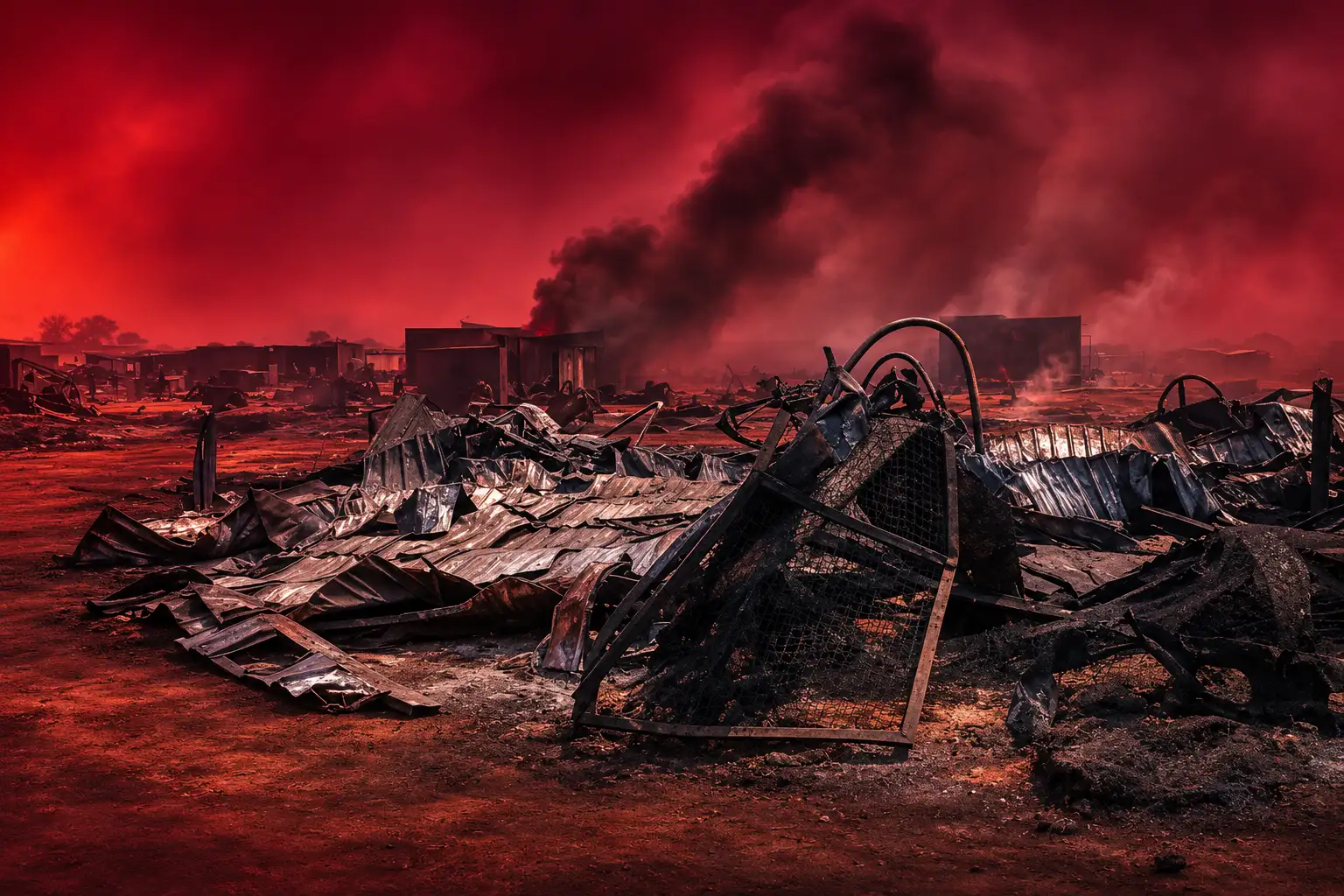
21 Drone Models, and Only One Is Sudanese
The Sudanese Armed Forces and the RSF went to war in April 2023 over who would hold the state. Early fighting leaned on jets, helicopters, tanks, artillery, and pickup trucks with guns. The Centre for Information Resilience, a London-based open-source group, first documented armed drones in July 2023. A CIR Sudan investigator said you now hear about a strike nearly every day.
CIR’s 15 October factsheet is the closest thing the war has to a census of the air. It lists 21 unique UAV models in use since April 2023. One is Sudanese. The other makers sit in Belarus, Iran, China, Russia, and Turkey. CIR counted 12 manufacturing firms, including state-linked and sanctioned names such as Iran’s Qods Aviation Industry and Russia’s Zala Group. Ten types are tied to the RSF and its allies, built in Belarus, China, and Russia. Five types are tied to the army and its allies, built in Iran, Sudan, and Turkey. The remaining six could not be assigned with the same confidence.
Ali Mahmoud Ali, a Sudan analyst at the conflict monitor Acled, has described a split in how the two sides fly. The army, he said, uses drones to hit RSF bases and cut fuel and other supply lines. The militia, he said, goes after power stations, water plants, airports, and hospitals “to send the message” that it can destabilise army-held regions. “The key weapon in peripheral warfare is the drone,” Ali said. CIR’s own targeting notes put commercial spaces such as markets, residential blocks, and military sites at the top of the strike list.
FOREIGN UAVS CIR HAS TIED TO EACH SIDE
| Model | Maker and country | First documented | Operator |
|---|---|---|---|
| Bayraktar TB2 | Baykar, Turkey | 30 November 2024 | Army |
| Mohajer-6 | Qods Aviation, Iran | 16 February 2025 | Army |
| Akinci | Baykar, Turkey | 7 October 2025 | Army |
| YIHA-III | Baykar, Turkey | 27 January 2026 | Army |
| Berkut-BM | KB Unmanned Helicopters, Belarus | 8 February 2025 | RSF |
| CH-95 | CASC, China | 31 May 2025 | RSF |
| BZK-005E | Harbin Aircraft, China | 6 May 2026 | RSF |
| Zala T-16 | Zala Group, Russia | 7 August 2026 | RSF |
Small FPV quadcopters, the cheap kamikaze kind, were common early in the war. CIR’s investigator said both parties are moving to larger, long-range aircraft that can carry guided munitions. That shift is what puts a market in Abyei or a substation on the Red Sea inside range of a launch site hundreds of kilometres away, and it is what makes a factory in Ankara, Tehran, Minsk, or a Chinese state yard a party to a Sudanese funeral.
The Army Flies Turkish Drones Against Chinese Ones
Once those larger airframes arrived, they started hunting each other. CIR logged a crashed Akinci near El Fasher. It also logged Chinese CH-95s with the RSF from 31 May 2025 and a twin-boom BZK-005E at RSF-held Nyala airport on 6 May 2026, a type promoted abroad by Norinco. Seeker footage that has circulated since August shows army Akinci drones firing on CH-95s west of El Obeid. Clip after clip treats the engagements as a scoreboard for Turkish airframes against Chinese ones, down to whether pylons still carry rounds after the pass.
That spectator habit misses the ground. The same long-range types that duel over Kordofan are the ones that can loiter, pick a market, and leave no warning. Christy Cooney, a researcher at the campaign group Avaaz, put it simply: combatants can now attack each other from far behind the front, and “there’s obviously no warning.” CIR’s investigator said drones have also “muddied the water of attribution.” A wreck in a marketplace does not wear a flag.
Nathaniel Raymond, executive director of the Humanitarian Research Lab at the Yale School of Public Health, has argued that the RSF’s mass killing in El Fasher in 2025, which the UN said had “hallmarks of genocide,” was made technically possible by drones and “the tactical integration of UAV systems into a repertoire of civilian hunter-killer targeting.” The Yale lab Sudan situation reports have kept logging UAV activity at Nyala and, in early November, drone strikes and blackouts in Blue Nile. Raymond’s warning is blunt: without a brake on how these wars are fought, Sudan is a preview, not a special case.
Where Did the Long-Range Drones Come From?
Khartoum has an answer, and Addis Ababa and Abu Dhabi reject it. Late in October Sudan’s foreign ministry said a wave of RSF drones hitting electricity sites in army-held areas were supplied by the United Arab Emirates and launched from Ethiopia. Both governments deny backing the RSF. Ethiopian officials have, in turn, accused the Sudanese army of aiding Tigray-linked rebels, a charge Khartoum rejects.
Sudan’s army-led Transitional Sovereignty Council published its own tally for 15 February to 27 October: 70 attacks, 187 one-way attack drones, 484 civilians killed, 176 soldiers killed. It named launch points at Asosa Airport in western Ethiopia, the Kurmuk-Gizen border, and Bahir Dar airbase in Amhara. Flight paths have not been independently verified. On 4 November Ali, the Acled analyst, noted that the RSF has built out camps in Ethiopia’s Benishangul-Gumuz region near Blue Nile since October 2025, and that the army has claimed 62 drone tracks or intercepts coming from that border. Blue Nile political violence, Acled recorded, topped 330 events in 2026, against 70 before those camps, with about 120,000 people displaced.
WHAT WE KNOW
- The hardware: CIR has tied RSF long-range types to Chinese and Russian plants and army long-range types to Turkish and Iranian ones, with only one Sudanese model in the set of 21.
- The grid campaign: Acled logged 17 RSF attacks on electricity sites in two weeks through early November, and Sudan has filed complaints at the UN Security Council and the African Union.
- The denials: The UAE says it does not arm the RSF. Ethiopia calls the launch-site charges baseless.
WHAT IS UNCONFIRMED
- The 187 drones: The army-led council’s count of one-way drones from Ethiopian soil has not been audited by the UN or by CIR.
- Who flew Al-Dibab: Monitors have pointed at army-held Kadugli as a likely launch area for the West Kordofan strikes; the army has not claimed the 139 dead.
- UAE supply: Sudan repeats the charge; CIR documents Chinese, Belarusian, and Russian types with the RSF, not an Emirati factory mark on those airframes.
The gap is the point. A CH-95 can be photographed on a Nyala apron. A ministry can hold up fragments and call them Ethiopian. Neither fact names the broker who moved the aircraft, the trainer who taught the payload, or the official who signed the transfer. That is the hidden stake: the war’s deadliest tool is imported, and the import trail is built to be deniable.
Power Stations Went Dark in 10 States
Killing is only one product of the same aircraft. In early November Denise Brown, the UN resident and humanitarian coordinator in Sudan, said the strikes were cutting electricity, water, and fuel and stalling aid. Hundreds of aid trucks sat idle for lack of fuel. In one hospital with no generator and no solar panels, she said, treatment stopped for 25 dialysis patients. Women were delivering in the dark. Operations could not run. “We need help passing the message to whoever needs to hear it, that this must stop,” she said.
James Elder, a Unicef spokesman, told reporters in Geneva on 10 November that in the last week of October not a single day passed without a drone hitting a power station, and that 15 stations were hit in the month. “In Sudan, power is water,” he said. When a station goes, pumps stop, treatment stops, vaccine fridges fail, and irrigation dies. Unicef expects 825,000 children under five to suffer severe acute malnutrition this year, the form that kills.
THE GRID THE DRONES HIT
- Acled’s fortnight: The monitor recorded 17 attacks on electricity infrastructure by the RSF, with outages across Khartoum, Al Jazirah, Sennar, Gedaref, Kassala, River Nile, Northern, White Nile, South Kordofan, and North Kordofan.
- October’s stations: Elder said drones can fly as far as 1,500 kilometres, and that Unicef could not say who flew the October power-grid strikes.
- The warehouse: On 20 September drones hit a Unicef store in El Obeid, North Kordofan, and fire took more than 292,000 school textbooks and 40,000 Arabic and maths review books.
- The motive Ali sees: With the RSF losing ground and commanders, the grid hits may be a way to make the army-held state own the blackout, and to force a pause.
Ali Salih, a resident of El Obeid whose name was changed for his safety, said a recent strike in the city killed three people and wounded several more. He still goes about his day, and he still listens for the next aircraft. People who live near anything that might be a target, he said, find ordinary life hard to keep.
Two in Three Child Casualties Come From the Air
Elder’s other figure is the one that will outlast any single market. This year, he said, two in three child casualties in Sudan were caused by drones. “They are bringing the war to places that were once safe,” he said. “People here talk about three things: safety, education and water. Armed drones are taking all three.”
Drones and drought are closing in on Sudan’s children from both sides. It is an assault unlike anything we have seen in Sudan’s history.
James Elder, Unicef spokesman, Palais des Nations, Geneva, 10 November 2026
On a visit to North Kordofan he met Burie, a teenager living in a tent after an explosive took both his hands. Burie told him, “I must accept this as it is.” Mornings he studies online. Afternoons he pulls grass for animals with the stumps. Friends help. Etleva Kadilli, Unicef’s regional director for Eastern and Southern Africa, said after Nyala and Abyei that a trip to the market should never cost a child their life. Unicef’s Sudan appeal, Elder added, is one-third funded, even as the agency and partners have treated hundreds of thousands of starving children, helped with health care for more than 2.5 million people, and kept water moving for close to 8 million.
This year in Sudan, armed drones have caused two out of three child casualties.
After more than three years of conflict, even the most ordinary parts of daily life have become increasingly dangerous.
Watch to see the maddening devastation with UNICEF Spokesperson @1james_elder… pic.twitter.com/TSK5ATpDER
— UNICEF (@UNICEF) November 9, 2026
WHAT UNICEF SAYS MUST HAPPEN
- The violence: End attacks on children and on the power stations, water systems, and other civilian sites they need.
- The weapons: Give aid lines safe passage, and stop the flow of weapons that are killing and injuring children.
- The money: Put flexible funds into water, malnutrition wards, clinics, schools, and protection, none of which run on goodwill.
Wider war-death estimates still sit in a brutal band, from 150,000 to more than 400,000, with millions pushed from their homes. Drones did not start that catastrophe. They have become its most efficient civilian weapon, and they have done it with airframes that Sudan, with one exception, does not build.
A Halt on Armed Drones That Has Not Arrived
Türk, in his May alert, asked for a real block on arms transfers, including advanced armed drones, to the parties in Sudan. “Drone attacks against civilians and civilian objects will only worsen if they are met with utter impunity, with this violence being increasingly normalized as a go-to tactic by both parties,” he said. He also warned that drones let the fighting run through the rainy season, when ground wars used to pause.
Armed drones have now become by far and away the leading cause of civilian deaths.
Volker Türk, UN high commissioner for human rights, 11 May 2026
No such halt has arrived. On 13 November the army said it had retaken Al-Khuwai in West Kordofan, a town the RSF had held for nearly two years, and that it had shot down a drone which had entered Sudanese airspace from Ethiopia. The RSF did not comment. The town changed hands. The import trail did not.

Airbnb Starts House Rules Reviews as Cities Rewrite Contracts

United’s Computers Failed the Day After Kirby Blamed ATC

Tyson Foods Guides Beef Losses Narrower as Chicken Cools

Saudi Arabia’s Leisure Tourism Falters as Pilgrims Still Come

Himesh Patel Confirms the X-Files Writers’ Room Is Open

AI Server Boards Put Everyday Circuit Materials on Allocation

Glacier Collapse Buried Nepal’s Hydropower Workers in Tunnels

Congo’s Bundibugyo Outbreak Outruns the Licensed Ebola Shots

Pennsylvania Measles Deaths Follow a Long Slide in Coverage

CISA’s Known Exploits Still Come From 2007-Era Bugs
-
 NEWS2 months ago
AI Server Boards Put Everyday Circuit Materials on Allocation
-
 NEWS3 months ago
Glacier Collapse Buried Nepal’s Hydropower Workers in Tunnels
-
 NEWS3 months ago
Congo’s Bundibugyo Outbreak Outruns the Licensed Ebola Shots
-
 NEWS3 months ago
Pennsylvania Measles Deaths Follow a Long Slide in Coverage
-
 NEWS3 months ago
CISA’s Known Exploits Still Come From 2007-Era Bugs
-

 NEWS3 months ago
Germany Can Miss Its 2026 Climate Cap Without Penalty
-

 NEWS3 months ago
Texas Judge Freezes the SEC Eligibility Ban for 41 Athletes
-

 GAMING2 months ago
Xbox Disc-to-Digital Turns Delisted Games Into Traveling Licenses