
NEWS
Congo’s Bundibugyo Ebola Outbreak Passes 11,042 Cases Without a Licensed Shot
Congo’s Bundibugyo Ebola outbreak has reached 11,042 cases and 5,387 deaths, while Kenya discharged its last patient and licensed shots still target a.

The Democratic Republic of the Congo has recorded 11,042 confirmed Bundibugyo Ebola cases and 5,387 deaths, according to government data released on 10 November. That is a case fatality ratio of 48.8%, and it is now the largest Ebola outbreak in Congolese history.
On 11 November, Kenya discharged its last patient from the same virus. Licensed Ebola shots still target a different species, and Bundibugyo-specific trial results are not due until early 2027.
Congo’s Count Hits 11,042 as Eight Provinces Stay Live
The 10 November tally comes almost six months after the outbreak was declared on 15 May in Ituri, and two days after the World Health Organization last posted a full national snapshot. Eight of the DRC’s 26 provinces have now logged cases. Many of the dead never reached a treatment centre.
THE DRC TALLY ON 10 NOVEMBER
- Confirmed cases: 11,042 in government figures released on 10 November.
- Deaths: 5,387, or 48.8% of confirmed infections.
- Provinces hit: 8 of 26, with 67 health zones named since May.
- Rank: Second-largest Ebola outbreak on record, behind the 2014 to 2016 West Africa epidemic of more than 28,600 cases and more than 11,000 deaths.
WHO’s Disease Outbreak News, using data to 3 November, had already counted 10,668 confirmed cases and 5,198 deaths across 67 health zones across eight provinces, with transmission still active in 51 of those zones. In the 21 days to 3 November, 1,463 new confirmed cases were added: 710 in Ituri, 640 in Nord Kivu, 77 in Haut-Uélé, 31 in Tshopo and 5 in Nord-Ubangi. Nord Kivu logged 232 cases in the seven days to 3 November, the heaviest weekly load, even though Ituri still holds most of the cumulative count.
A European Centre for Disease Prevention and Control update compiled the provincial books as of 8 November, one step behind the ministry’s 11,042. Ituri remains the most affected province, with 7,654 cases and 3,613 deaths from 28 of its 36 health zones.
CASES AND DEATHS BY PROVINCE AS OF 8 NOVEMBER
| Province | Confirmed cases | Deaths | Health zones hit |
|---|---|---|---|
| Ituri | 7,654 | 3,613 | 28 of 36 |
| Nord-Kivu | 2,720 | 1,488 | 17 of 34 |
| Haut-Uélé | 491 | 214 | 7 of 13 |
| Tshopo | 98 | 32 | 7 of 23 |
| Bas-Uélé | 13 | 4 | 4 of 11 |
| Nord Ubangi | 9 | 1 | 2 of 11 |
| Sud-Kivu | 3 | 1 | 1 of 34 |
| Sud Ubangi | 2 | 1 | 1 of 16 |
Those eight rows sum to 10,990 cases and 5,354 deaths, the ECDC running total for 8 November. Nord Kivu’s death rate on WHO’s 3 November books was 54.8%, the highest of any province. Yakoma, in Nord-Ubangi, is the newest named health zone and sits on the Central African Republic border.
Why Bundibugyo Has No Licensed Vaccine
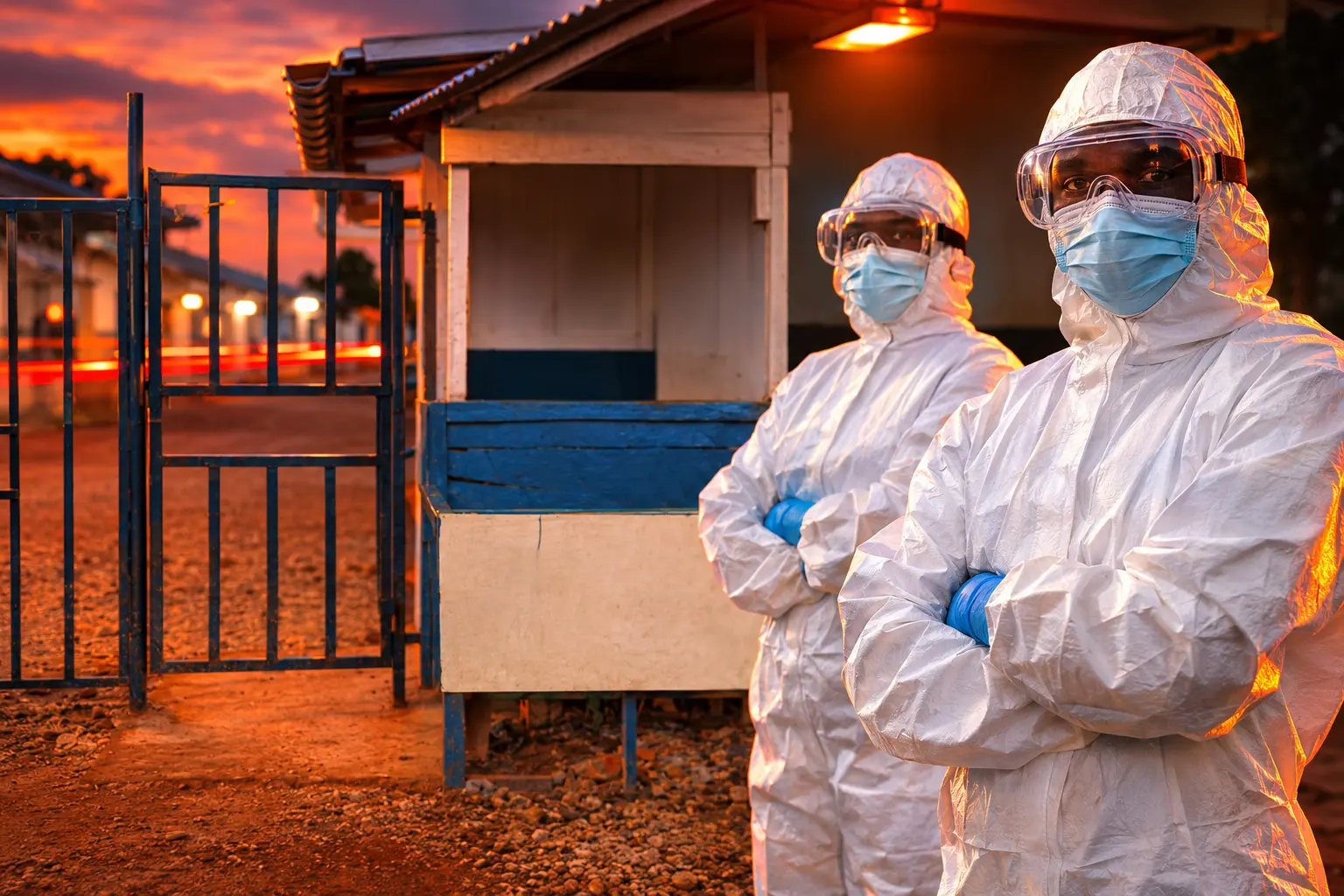
The outbreak is caused by Bundibugyo virus, one of four Ebola viruses that infect people. It was first identified in 2007 in Uganda’s Bundibugyo district. A second outbreak followed in the DRC in 2012. WHO says those two waves killed about 30% and 50% of confirmed patients. Both were small enough that product makers put their money into Zaire ebolavirus, the species behind most later epidemics, including West Africa in 2014 to 2016 and the DRC’s 2018 to 2020 North Kivu and Ituri wave of 3,470 cases.
This is the DRC’s 17th recorded Ebola outbreak and its second Bundibugyo wave. The 2025 Kasai outbreak was Zaire ebolavirus, the species covered by Ervebo. Ervebo has a licence. Bundibugyo does not. Early symptoms (fever, fatigue, muscle pain, headache, sore throat) look like malaria, which slows detection. People become infectious only after they fall ill. The incubation window is 2 to 21 days.
On 23 October the DRC’s Institut National de Recherche Biomédicale opened Tumaini, a Phase 2/3 ring-vaccination trial in Bunia, Ituri’s capital. Tumaini is Swahili for hope. It first tests whether Ervebo, built for Zaire ebolavirus, offers any protection here. On 4 November, WHO expert groups recommended adding two new vaccine candidates designed for Bundibugyo itself, subject to national approvals. Results are expected in early 2027.
THE TUMAINI TRIAL ARMS
- Ervebo: Already in the rings; licensed for Zaire ebolavirus, unproven against Bundibugyo.
- ChAdOx1 BDBV: University of Oxford with the Serum Institute of India; a chimpanzee adenovirus vector carrying Bundibugyo surface-protein instructions.
- mRNA-1469: Moderna’s messenger-RNA candidate in lipid particles, aimed at the same Bundibugyo protein.
- PARTNERS treatments: A separate WHO-sponsored study launched in July tests the antibody MBP134, remdesivir, or both; maftivimab is due to join, and obeldevisir is being studied as post-exposure prevention.
Four vaccination rings were already in place when the two Bundibugyo-specific shots were recommended, with more being prepared among contacts of people who fell ill or died. The Coalition for Epidemic Preparedness Innovations has put more than US$75 million for Bundibugyo shots into development and trial doses. Gavi has approved up to US$40 million so manufacturers can scale production before they know which candidate works. Dr Meg Doherty, WHO’s director of science for health, called outbreak-time tests of Bundibugyo-specific vaccines an important scientific milestone. Initial treatment findings are expected in the coming months, still well before the vaccine readout.
Kenya Sends Its Last Patient Home
Kenya confirmed its first Bundibugyo case on 6 October, a Kenyan citizen who had been living in the DRC, travelled by road to Kampala, and flew into Nairobi on 3 October. That patient died. Eight more infections followed, all tied to the same cluster: four family members and four health and care workers. Every secondary case was already in quarantine when symptoms began. No community chain was found. The last Kenyan case was confirmed on 19 October.
Health Cabinet Secretary Aden Duale said on 11 November that the last patient had gone home healthy and free of the virus, and that the final 11 contacts had finished 21-day monitoring the same day. Kenya now has no patient in treatment and no contact in quarantine, 37 days after the first confirmation. Nine people were infected, two died, and seven recovered, a case fatality ratio of 22.2%. All 135 identified contacts were traced. As of 5 November, 760,415 travellers had been screened at Kenyan points of entry.
Kenyatta National Hospital posted the discharge as an operational milestone, not a victory lap.
The NCDC has warned that Nigeria is not yet free of Ebola, despite recording no new cases following the confirmation of an imported Bundibugyo Virus Disease infection.
Read more on https://t.co/xrtKL67BtF pic.twitter.com/klLwr67E66
— gong-news (@gong_news) November 11, 2026
Duale said a 42-day countdown starts on 12 November, twice the longest incubation period. If no new case appears, Kenya can be declared free of Ebola on 23 December 2026. He also said citizens arriving from the DRC would face 21-day quarantine. Uganda, which recorded 20 confirmed cases and two deaths after the May declaration, closed its outbreak on 27 August after 42 clear days. Kenya is trying to copy that finish line while the DRC’s count keeps rising.
Bundibugyo Cases Have Reached Kenya and Nigeria
WHO says confirmed cases have been reported in five countries since 15 May: the DRC, Uganda, Kenya, Nigeria and France. Uganda and France have been controlled since August. Kenya and Nigeria were still in response as of early November, with no new Kenyan case after 19 October and no Nigerian secondary case identified. On 5 November the United Kingdom medically evacuated a health and care worker from the DRC to London. On 26 October Switzerland took in the Nigerian patient, who remains in isolation in Geneva; her husband, a close contact, was isolated in Zurich.
CONFIRMED CASES OUTSIDE THE DRC
| Country | Confirmed cases | Deaths | Status |
|---|---|---|---|
| Uganda | 20 | 2 | Ended 27 August |
| Kenya | 9 | 2 | Last patient discharged 11 November |
| Nigeria | 1 | 0 | Patient evacuated to Geneva |
| France | 1 | 0 | Controlled since August |
Nigeria’s case was confirmed in Abuja on 20 October in a woman who had travelled from Uganda and transited through Addis Ababa. She developed symptoms on 7 October, four days after arriving, and sought care on 11 October. Sixty-two contacts were identified. WHO still advises against travel or trade bans on countries dealing with the event, and it has told neighbours to keep screening at borders. The continental pattern is East, Central and West Africa at once, with European hospitals taking a handful of evacuees. The deaths remain overwhelmingly Congolese.
Ervebo Is the Shot on Hand Until 2027
Public posts about the 11,042 figure keep repeating that Bundibugyo has no vaccine. That is true as a licence. It is not true as a cupboard. Ervebo is already being given in the DRC under trial protocols and compassionate-use rules, and Médecins Sans Frontières wants that net widened before SAGE meets on 17 November.
In August the DRC government, with Africa CDC support, asked WHO’s International Coordinating Group on Vaccine Provision for 500,000 Ervebo doses. Only 70,000 doses were released. MSF says Ervebo is licensed for people aged one year and older, that more than 365,000 people received it in Nord Kivu and Ituri between 2018 and 2024, and that waiting for Bundibugyo-specific data leaves health workers, contacts and nearby communities open. Guyguy Manangama, an MSF epidemiologist and deputy director of operations, said expanding Ervebo access is the best immediate chance to cut severe illness and deaths while strain-specific research continues. MSF wants restrictions that tie Ervebo to research protocols lifted so stockpile doses can move.
Vaccines alone will not end this outbreak, but they could become a powerful new tool for bringing it under control.
Dr Tedros Adhanom Ghebreyesus, WHO Director-General, 4 November 2026 announcement
Tedros also thanked trial volunteers in the DRC. The scientific bet inside Tumaini is ugly either way: if Ervebo cross-protects, thousands of sitting doses become a tool; if it does not, those rings were a delay. ChAdOx1 and mRNA-1469 cannot change the next few weeks. They can change the next outbreak, and only if the DRC’s regulators let them into the study and the rings keep finding contacts.
Most Recent Deaths Happened Outside Clinics
Of 512 deaths WHO counted from 21 October to 3 November, 335 occurred in communities and 177 in treatment centres. That is 65.4% dying outside care, a share the agency said is especially high among young children and points to late detection. The share of contacts seen each day, averaged over 14 days to 3 November, was 86%, under the 95% line used as the operational target. Bas-Uélé, Nord-Ubangi and Sud-Ubangi met that line. Haut-Uélé sat at 85%, Ituri at 91%, Tshopo at 71% and Nord Kivu at 82%.
ECDC, citing Congolese authorities, said the likely index patient was a nurse who died in a Bunia health facility after fever, bleeding, vomiting and weakness. The agency also said the outbreak had probably been moving for weeks before the 15 May declaration, given how far it had already spread. Insecurity and a parallel humanitarian crisis in the east have limited how far surveillance teams can go. WHO has not given a full public account of every attack on health posts, but it has said response work is being run alongside that crisis, and that funding gaps remain.
HOW THE OUTBREAK MOVED
- 15 May 2026: DRC and Uganda declare a Bundibugyo outbreak; Africa CDC had flagged Ituri the same day.
- 17 May 2026: WHO declares a Public Health Emergency of International Concern; Africa CDC follows on 18 May with a continental security emergency.
- July 2026: The PARTNERS treatment trial opens; France later reports an imported case in a returning humanitarian doctor.
- 27 August 2026: Uganda’s outbreak is declared over after 42 days with no new case.
- 6 October 2026: Kenya confirms its first case; Nigeria confirms an imported case on 20 October.
- 23 October 2026: Tumaini enrols its first participants in Bunia.
- 4 November 2026: WHO experts recommend adding ChAdOx1 and mRNA-1469 to the trial.
- 10 to 11 November 2026: DRC government data reach 11,042 cases and 5,387 deaths; Kenya discharges its last patient.
Contact tracing that works, as Kenya showed, keeps secondary cases inside quarantine. Contact tracing that sits at 86% in a war-affected province does not. The virus has not changed its biology between Bunia and Nairobi. The follow-up rate has.
SAGE Meets on 17 November With Doses Still Tight
WHO’s Strategic Advisory Group of Experts on Immunization meets on 17 November, and MSF has put the Ervebo allocation on that agenda. A wider release would not wait for early 2027. It would also spend a Zaire stockpile on a virus that stockpile was not built to stop. National approval for the two Bundibugyo-specific candidates is a separate gate; WHO said those shots enter Tumaini only after Kinshasa signs off.
Kenya’s 42-day clock starts on 12 November. The DRC’s 11,042 figure is already a week of new transmission beyond WHO’s 3 November snapshot. If SAGE keeps Ervebo tightly bound to research rings, the only new biomedical tools on the Congolese side of the border remain a treatment trial and a vaccine study whose answer arrives next year. If it loosens the stockpile, the argument shifts from whether a shot exists to whether 70,000 doses can move faster than Nord Kivu’s weekly count.
Disclaimer: This article is news reporting and analysis of an ongoing outbreak and of vaccine and treatment studies tied to it. It is informational only and is not medical advice, a diagnosis, a vaccination recommendation, or a travel instruction. Anyone who has been in an affected area, has had contact with a suspected case, or has fever or other symptoms should speak to a qualified physician or the local public health authority before acting. Case counts, deaths, trial status, dose allocations and country outbreak declarations reflect the named sources as of the dates given above and can change.

Airbnb Starts House Rules Reviews as Cities Rewrite Contracts

United’s Computers Failed the Day After Kirby Blamed ATC

Tyson Foods Guides Beef Losses Narrower as Chicken Cools

Saudi Arabia’s Leisure Tourism Falters as Pilgrims Still Come

Himesh Patel Confirms the X-Files Writers’ Room Is Open

AI Server Boards Put Everyday Circuit Materials on Allocation

Glacier Collapse Buried Nepal’s Hydropower Workers in Tunnels

Congo’s Bundibugyo Outbreak Outruns the Licensed Ebola Shots

Pennsylvania Measles Deaths Follow a Long Slide in Coverage

CISA’s Known Exploits Still Come From 2007-Era Bugs
-
 NEWS2 months ago
AI Server Boards Put Everyday Circuit Materials on Allocation
-
 NEWS3 months ago
Glacier Collapse Buried Nepal’s Hydropower Workers in Tunnels
-
 NEWS3 months ago
Congo’s Bundibugyo Outbreak Outruns the Licensed Ebola Shots
-
 NEWS3 months ago
Pennsylvania Measles Deaths Follow a Long Slide in Coverage
-
 NEWS3 months ago
CISA’s Known Exploits Still Come From 2007-Era Bugs
-

 NEWS3 months ago
Texas Judge Freezes the SEC Eligibility Ban for 41 Athletes
-

 NEWS3 months ago
Germany Can Miss Its 2026 Climate Cap Without Penalty
-

 NEWS3 months ago
FDA Approves XFG COVID-19 Vaccines Without a CDC Vote