
ENTERTAINMENT
Christina Applegate Takes 10 Minutes to Stand After MS Reversal
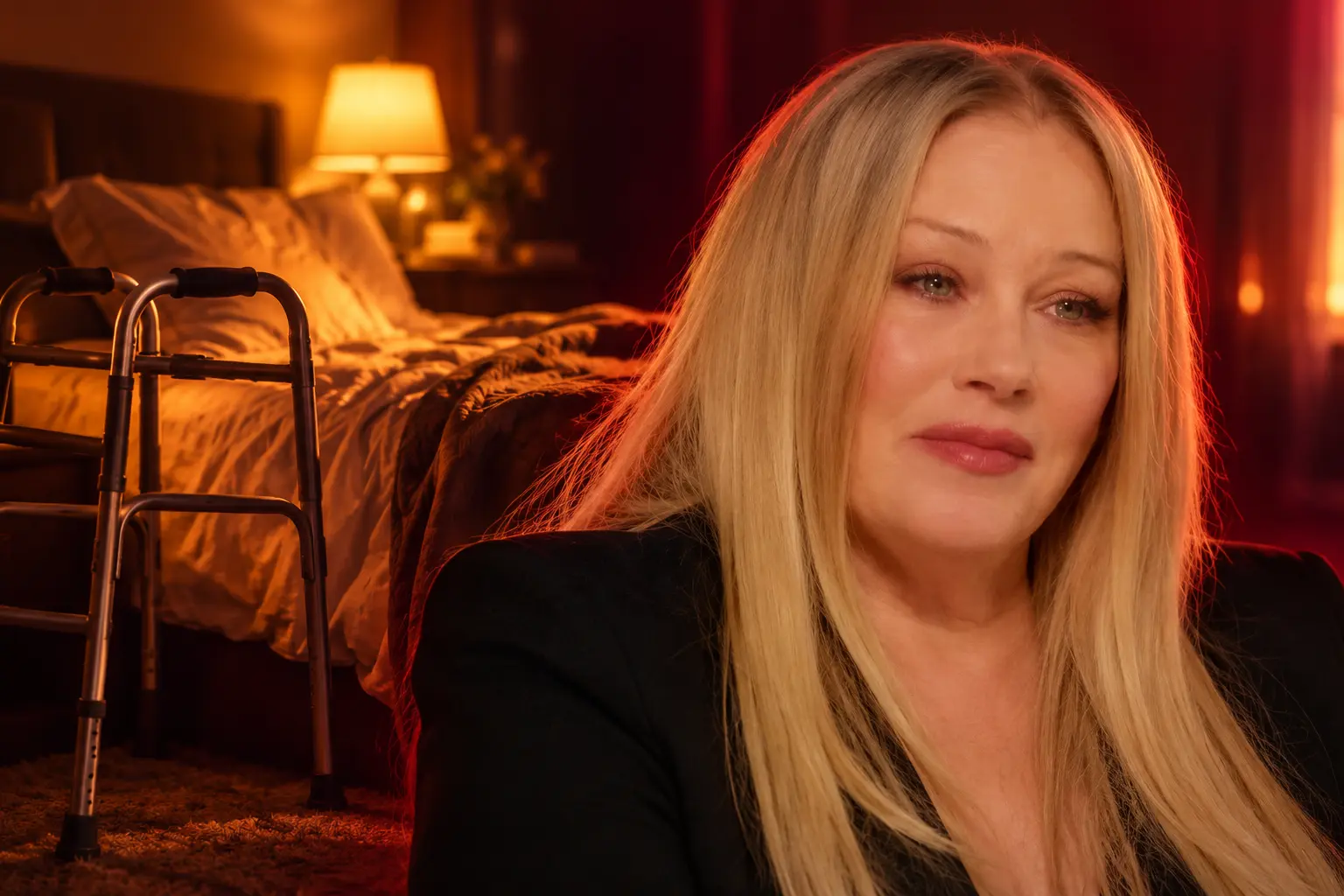
A week after doctors said Christina Applegate does not have MS, she timed 10 minutes to stand and put a walker by her bed.

Christina Applegate timed 10 minutes to move off her pillow, stand, and reach for a walker that now sits beside her bed. She said so on the Oct. 27, 2026, episode of MeSsy, the podcast she co-hosts with Jamie-Lynn Sigler, who has multiple sclerosis.
It was seven days after a doctor walked into her room and said, “Congratulations, you don’t have MS.” Applegate, 54, was not glad. The new clock on getting out of bed is what that congratulations looks like in a body that still has no name.
Ten Minutes Off the Pillow
On the episode titled “We’re All Just Living This MeSsy Life,” she described a morning she had not had before, even in the hard years after 2021. She kept a walker by the mattress because the walk to the bathroom almost did not happen.
I actually timed it today. It took me 10 minutes to be able to move off my pillow and get out of the bed and stand up, at which point I almost couldn’t walk to the bathroom, and now a walker is sitting next to my bed because of what’s going on. I don’t know what’s going on. This is what I’m still living with, and I never had that before. I was able to sit up and stuff.
Christina Applegate, co-host, MeSsy, Oct. 27, 2026
She added that it took 10 minutes just to get her head up, and that she had to move through “excruciating pain and weakness.” These limits, she said, are new, or they are worse. Either way, the cane era at home has become a walker era.
She still used wheelchairs at medical offices after the label changed, and she has said she cannot walk from the car to the exam room. The Oct. 27 tape is the first time she put a stopwatch on the first act of the day. Listeners can hear the same account on the episodes of the MeSsy podcast the show keeps on its own site.
Congratulations Was the Worst Word in the Room
Applegate returned on Oct. 20, 2026, after 6 months away, in a two-part recording. Part 1 runs 35 minutes. Part 2, with neurologist Marwa Kaisey of Cedars-Sinai, runs 44 minutes. She cried telling the room what the doctor had called good news.
“This may come as great news, but to me, I’m back at square one,” she said. “She came into my room and said, ‘Congratulations, you don’t have MS.’ I was, like, not happy at all. Everybody else was so happy.”
The people around her heard a reprieve. She heard a theft. For five years the letters MS had organized the pain, the infusions, the cane, the wheelchair on the Dead to Me set, and the public work of being a patient on the record. Pull the letters and the day still sucks, she said, only now it sucks without a reason.
“You don’t get misdiagnosed and then all of a sudden I’m better,” she told Sigler. “I haven’t gotten better, Jamie. If anything, I’ve gotten worse in some ways.” She also named the private insult that follows a withdrawn diagnosis: the thought, in her own head, that maybe she is faking it because the chart no longer says MS.
That reaction is not a quirk of celebrity. The MS Society, in a note signed by Dr. Sarah Rawlings, put typical study misdiagnosis rates of 5% to 15% and said a 2019 American hospital paper landed near 20%. A formal name, Rawlings wrote, is how people reach treatment and support. Applegate has the symptoms and has lost the name.
Almost 40 Lesions and a Life Organized Around Them
She walked listeners back to January 2021, when numbness started in her toes, climbed her legs, and turned into pain. Doctors tested “everything under the sun,” she said, and did not start with MS, because the first physician did not think the picture looked like it.
A nerve conduction test showed her nerves were intact, which at the time ruled out peripheral neuropathy and pointed the workup at MS. She had brain MRIs, spinal MRIs, and a spinal tap that showed 3 oligoclonal bands, which her doctor treated as relapsing disease on the low end of the scale. Then came the scan day. He said he was sorry, and he showed her lesions that were “almost forty.” That, she said, “was my answer to everything that was going on.”
FROM NUMBNESS TO NO NAME
- January 2021: Numbness starts in her toes, spreads through her legs, and turns into pain.
- Summer 2021: While shooting the last season of Dead to Me, she is brought to set in a wheelchair.
- August 10, 2021: She tells the public she has MS, a few months after the clinical diagnosis.
- March 19, 2024: MeSsy, co-hosted with Sigler, premieres as a show about living with the disease.
- March 2025: She says that in the three years after the diagnosis she has been in the hospital upwards of 30 times.
- March 2026: Her memoir, You With the Sad Eyes, is published while she is still living under the MS label.
- October 20, 2026: She returns from 6 months away and says a doctor has told her she does not have MS.
- October 27, 2026: She times 10 minutes to get out of bed and says a walker now sits beside it.
She leaned on Sigler, on friends, and on the audience. She took infusions for years, which she said play havoc on the body. A couple of years before the reversal, her doctor stopped the infusions to watch her B cells. The counts did not move. That non-event, plus newer scan technology, opened the file again.
By then the label had done more than sit on a chart. It had ended the shape of her acting life after Dead to Me, built a podcast, filled a memoir, and made her, in her own uneasy phrase, a poster child. “I had a reason as to why my day sucked every day,” she said. “And now I don’t have a reason, and it’s very unnerving, and it’s really confusing for me.”
How an MS Label Gets Taken Back
Doctors pulled Applegate’s MS label after her B cells did not rebound off infusions and after they re-read her brain scans with newer tools. There is no single test for MS. Marwa Kaisey, an associate professor of neurology at Cedars-Sinai, told the Oct. 20 audience that wrong MS labels are “fairly common” for that reason, and her own 2019 paper with colleagues at Cedars-Sinai and UCLA found almost 1 in 5 referred patients who arrived with an established MS diagnosis did not meet the criteria then in use.
The paper reviewed 241 new patients sent to those two Los Angeles clinics with MS already on the chart. It is a two-center snapshot, not a world rate, and it is the study the MS Society flags when it says one 2019 American paper landed near 20%.
WHAT THE 2019 CEDARS-SINAI AND UCLA REVIEW FOUND
| Measure | Finding |
|---|---|
| Patients referred with an MS diagnosis | 241 |
| Share misdiagnosed at Cedars-Sinai | 17% |
| Share misdiagnosed at UCLA | 19% |
| Most common alternate diagnosis | Migraine (16%) |
| Average time spent with the wrong label | 4 years |
| Share given MS drugs they did not need | 72% |
Other alternates in that cohort were radiologically isolated syndrome (9%), spondylopathy (7%), and neuropathy (7%). The misdiagnosed group accounted for about 110 patient-years of disease-modifying therapy they did not need, and 28% were put on drugs that carry a risk of progressive multifocal leukoencephalopathy. Applegate’s five years under the label is longer than that study’s 4-year average.
In 2024, neurologists issued updated McDonald diagnostic criteria meant to speed true cases and cut false ones. The revision adds the optic nerve as a fifth site, leans on MRI signs such as the central vein sign and paramagnetic rim lesions, and brings in a cerebrospinal fluid marker, the kappa free light chain index. Applegate has not said those named tools were the “new technology” on her scans. She has said the new look, and the quiet B cells, were enough for her team to take MS off the table without putting another disease on it.
Applegate Pledges to Stay the Community’s Warrior
The show she came back to was built as an MS show. Sigler still has the disease. Applegate does not, according to her current doctors, and she spent the Oct. 27 hour telling the same listeners she is not leaving them.
“Even though I don’t have this disease, I’ve fallen in love with everyone that we know, our listeners, our friends that have MS,” she said. “I’m still your warrior, and I’m still going to speak out on your behalf forever and ever. Despite not having MS. I still feel like part of this community. No matter what, I love you.”
That pledge is the other half of the congratulations problem. She became, with Sigler, a public face of a disease she has now been told she does not have, and she is trying to keep the face without the diagnosis. She also said she felt she had let people down. The poster-child job had given the bad days a script. The script is gone. The audience is not.
She first put the old script on the record on Aug. 10, 2021, in her own words, cane and all.
Hi friends. A few months ago I was diagnosed with MS. It’s been a strange journey. But I have been so supported by people that I know who also have this condition. It’s been a tough road. But as we all know, the road keeps going. Unless some asshole blocks it.
— christina applegate (@1capplegate) August 10, 2021
“Hi friends. A few months ago I was diagnosed with MS,” she wrote then. “It’s been a strange journey. But I have been so supported by people that I know who also have this condition. It’s been a tough road. But as we all know, the road keeps going.” Five years later the road is still there. The map she was handed is not.
A Body in No-Man’s Land
On Oct. 27 she called the in-between “living in no-man’s land.” She said it is overwhelming not to know what she has, or whether a cure for it exists. “I have every symptom of someone with MS,” she said on Oct. 20. “Every single one. Now, we both know that there are many things that mirror MS. Many different things.” Her doctors, she said, are opening “an online investigation” into what has been happening since 2021.
The blank where MS sat fills fast. When a famous patient loses a label, the first substitutes that get thrown at the case are other nerve and infectious diseases, because a body without a name becomes a public worksheet. Lyme is usually first. A rare inflammatory nerve disease treated with antibody infusions is usually next. That is not her diagnosis. It is what a vacuum attracts. A nastier strain of the same blank treats the reversal as proof the disability was a performance. She has already said that sentence lives in her own head.
Neurology papers on look-alikes are more careful, and less useful to her until someone runs the tests. NMOSD and MOGAD can mimic MS on first pass, and each has antibody tests and its own drug list. About 80% of NMOSD patients carry antibodies against the AQP4 water channel. In the United States and Europe, NMOSD accounts for about 1% to 2% of central nervous system demyelinating disease. Applegate has not said she has either condition. She has said the MS picture is gone and the replacement has not arrived.
WHAT THE WITHDRAWN LABEL DID NOT TAKE WITH IT
- The morning: Pain and weakness still hold her on the pillow until she can sit, then stand.
- The hallway: The walk to the bathroom is close to failure, so the walker stays by the bed.
- The clinic: She still needs a wheelchair from the car to the exam room.
- The days: Heat still flattens her, and she has described sleeping through entire days.
- The chart: Doctors are hunting a name for a problem that has been running since 2021.
The walker by the bed is the part of the story a congratulations cannot move. On Oct. 27 she still did not know what she has. She knew how long it took to stand.
Disclaimer: This article is news reporting on public comments Christina Applegate made about her health, and it is for information only. It is not a diagnosis, a second opinion, or medical advice for Applegate or for anyone with similar symptoms, and it does not recommend starting, stopping, or changing any treatment. Readers with neurologic symptoms, an MS diagnosis, or a change in a prior diagnosis should talk with a licensed neurologist or other qualified physician who can review their own scans, labs, and history. Figures, quotes, and clinical statuses here reflect the podcast episodes, the 2019 Kaisey study, and the cited medical pages as of the dates on those sources and may change as her doctors continue their work.

Airbnb Starts House Rules Reviews as Cities Rewrite Contracts

United’s Computers Failed the Day After Kirby Blamed ATC

Tyson Foods Guides Beef Losses Narrower as Chicken Cools

Saudi Arabia’s Leisure Tourism Falters as Pilgrims Still Come

Himesh Patel Confirms the X-Files Writers’ Room Is Open

AI Server Boards Put Everyday Circuit Materials on Allocation

Glacier Collapse Buried Nepal’s Hydropower Workers in Tunnels

Congo’s Bundibugyo Outbreak Outruns the Licensed Ebola Shots

Pennsylvania Measles Deaths Follow a Long Slide in Coverage

CISA’s Known Exploits Still Come From 2007-Era Bugs
-
 NEWS2 months ago
AI Server Boards Put Everyday Circuit Materials on Allocation
-
 NEWS3 months ago
Glacier Collapse Buried Nepal’s Hydropower Workers in Tunnels
-
 NEWS3 months ago
Congo’s Bundibugyo Outbreak Outruns the Licensed Ebola Shots
-
 NEWS3 months ago
Pennsylvania Measles Deaths Follow a Long Slide in Coverage
-
 NEWS3 months ago
CISA’s Known Exploits Still Come From 2007-Era Bugs
-

 NEWS3 months ago
Texas Judge Freezes the SEC Eligibility Ban for 41 Athletes
-

 NEWS3 months ago
Germany Can Miss Its 2026 Climate Cap Without Penalty
-

 NEWS3 months ago
FDA Approves XFG COVID-19 Vaccines Without a CDC Vote