
NEWS
A Four-Year SIV Pause Points First at Infected Newborns
One CCR5/CD3 antibody dose kept SIV undetectable for four years in an infant monkey, a result that maps onto perinatal HIV rather than an adult cure.

A single CCR5/CD3 antibody dose kept SIV undetectable for four years in one infant monkey after early antiviral drugs stopped. The University of California, Davis team published the result on 19 October 2026 in Nature Microbiology.
SIV is the simian relative of HIV. The protocol started drugs a week after infection, then gave one antibody shot. That timetable matches a newborn, not a long-treated adult.
A Single Shot After a Week of Infection
Virologist Jesse D. Deere and immunologist Dennis J. Hartigan-O’Connor led a test in newborn rhesus macaques. They did not try to tag each infected cell. They went after cells that display CCR5, the door SIV and many HIV strains use to get in.
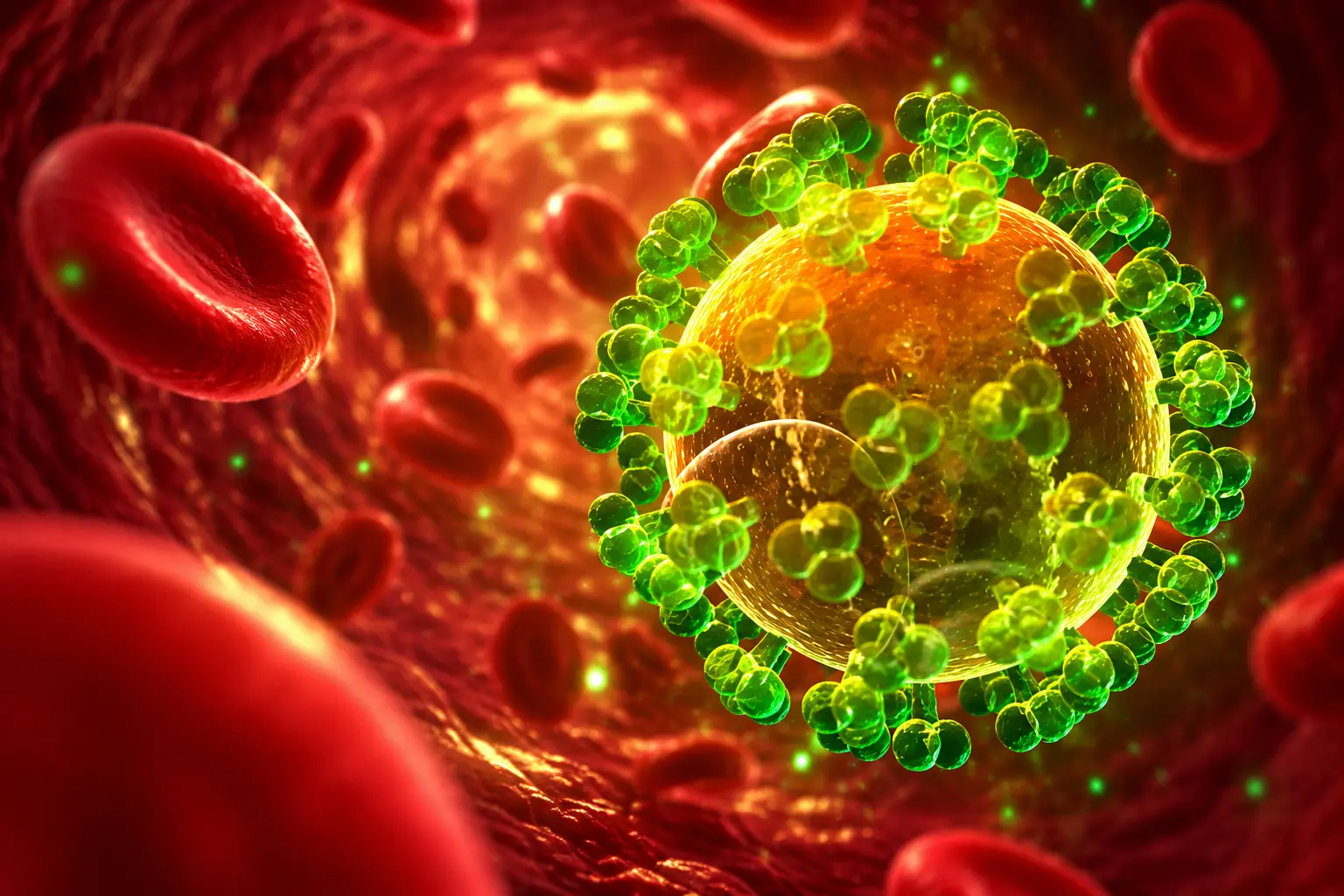
The antibody binds CCR5 on the target and CD3 on a T cell, pulling a killer cell onto anything wearing that receptor. Targets include cells that may already hold virus and cells the virus could infect later. The paper reports a single shot of CCR5/CD3 bispecific antibody after early drugs.
Twenty-five newborns were assigned to groups at birth. At about two to three weeks of age they were given SIVmac251 by mouth, twice on the same day, at 50,000 TCID50 per dose. Twenty of 25 became infected. Drugs started seven days later, a delay the authors used so a lasting, body-wide infection could take hold. The regimen was tenofovir, emtricitabine and dolutegravir.
THE INFANT MACAQUE PROTOCOL
- Group A: Antiretroviral drugs only, with no depleting antibody.
- Group B: The same drugs plus CD4R1, an antibody that strips CD4-bearing cells, given two days and 16 days after drugs began.
- Group C: The same drugs plus one intravenous CCR5/CD3 dose, infused at 3 mg per kilogram two days after drugs began.
Drugs ran for 18 weeks and were withdrawn 133 days after infection. The question was simple: would SIV come back in the blood?
Newborns Are the Patients This Protocol Fits
The authors chose infants because a young thymus still puts out new T cells, so the animals can rebuild after a depleting shot. They also wanted a small reservoir. Earlier SIV work that started drugs at day three or day seven, with no cell-killing antibody, did not produce cure.
That design is not a convenience sample. The only humans who could receive drugs a week after infection, then a reservoir-stripping antibody two days later, are babies diagnosed at or soon after birth. Adults who have carried HIV for years have a larger, older reservoir this experiment did not test.
UNICEF’s 2025 estimates, built with UNAIDS models, still put children at the short end of HIV care. About 1.26 million children under 15 were living with HIV, 87 per cent of them in sub-Saharan Africa. In 2025, 93,000 children were newly infected, mostly during pregnancy, delivery or breastfeeding, and 61,000 children died of AIDS-related causes.
THE CHILD HIV BURDEN IN 2025
- Treatment gap: Only 55 per cent of children with HIV were on antiretroviral therapy, compared with 79 per cent of adults.
- Suppression gap: 47 per cent of children had a suppressed viral load, compared with 75 per cent of adults.
- Early drugs: South Africa’s CHER study found a 76 per cent drop in deaths when treatment started in the first 12 weeks of life.
Those figures are why a monkey protocol that only works soon after infection still has a human constituency. It is a smaller group than the adult cure audience, and it is the group this paper actually modeled.
Why HIV Cure Research Keeps Returning to CCR5
The few adults who have stayed free of HIV without drugs did so after stem-cell transplants given for cancer. Several of those donors lacked a working CCR5 gene, the CCR5Δ32 mutation, so rebuilt immune systems offered the virus no common entry door. The Davis paper says meaningful wipeout of a latent reservoir had not been shown except with the harsh conditioning used for those transplants.
Gene-editing projects have tried to rewrite CCR5 in a patient’s own cells. When only a fraction of cells lose the receptor, enough targets remain for the virus to keep spreading. This antibody takes the other path. It tries to remove CCR5-bearing cells rather than convert them, and it does that for a short window while drugs hold new infection down.
People born without working CCR5 generally live with that loss. The authors treat that fact as a reason to think a brief, induced shortage might be tolerable. They also flag the other side: the shot hits infected and uninfected CCR5 cells, including some CD8 T cells that help fight other viruses.
Our study demonstrates that targeting CCR5-expressing cells using the host immune system may be a surprisingly effective route to HIV cure, at least for infants that can be treated soon after infection.
Jesse D. Deere, Dennis J. Hartigan-O’Connor and colleagues, Nature Microbiology
They add that adult SIV, with different viral dynamics and a less plastic immune system, may not respond the same way.
Four of Seven Macaques Stayed Quiet Off Treatment
Every animal that got drugs alone had SIV back in the blood within seven days of stopping. In the CD4R1 group, six of eight rebounded in that same week, and one stayed without detectable virus through the end of follow-up. The CCR5/CD3 group moved on a different clock. The first rebounds there came at 13 days. Four of seven animals then stayed without measurable virus in blood for more than three months.
Two of those four had virus return at 97 days and 173 days after drugs stopped. One had no rebound before follow-up ended at 29 weeks. In the longest-followed animal, blood tests stayed negative for four years.
HOW THE GROUPS FARED AFTER DRUGS STOPPED
| Treatment | Animals | Early rebound | Quiet more than 3 months | Longest quiet span |
|---|---|---|---|---|
| Drugs only | All controls | All within 7 days | None | 7 days |
| CD4R1 antibody | 8 | 6 of 8 within 7 days | 1 of 8 | Through follow-up in 1 animal |
| CCR5/CD3 antibody | 7 | First at 13 days | 4 of 7 | 4 years in 1 animal |
Cell-associated SIV DNA fell by an average of 1.7 log units on drugs alone, 2.7 log units with CD4R1, and 3.4 log units with the bispecific antibody (P = 0.01 versus controls). About 95 per cent of those early proviruses were intact, so the drop was not a pile of already-dead genomes.
In three animals with lasting remission, two from the CCR5 group and one from the CD4 group, the team temporarily stripped CD8 T cells. If those cells had been sitting on a hidden infection, virus should have returned. It did not. Tissue tests found no viral genetic material, and attempts to grow infectious virus from lymph-node cells failed.
One sample from the four-year animal produced a possible RNA signal at week 97: 2 copies in 91,304 cells, with no accompanying viral DNA and no return of virus in blood. The authors could not rule out contamination, though the product had the expected sequence.
The Antibody Also Strips Uninfected Immune Cells
CCR5 is not a virus-only marker. Plenty of uninfected T cells wear it, and the bispecific antibody does not pause to ask which ones hold SIV DNA. After the shot, group C first showed a short drop in CD3-bearing lymphocytes, then a lasting loss of CCR5-bearing cells. In some animals that shortage was still visible 34 weeks later. CD8 T cells as a whole were not wiped out, but CCR5-positive memory CD8 cells were.
A pilot in one infected macaque treated later, at 10 weeks after infection and after six weeks of drugs, showed 71 per cent depletion of intact proviruses in blood two weeks after the antibody. That exceeded a 10-animal control set, and it still left the authors arguing for earlier treatment, when the reservoir is smaller.
The animals generally tolerated the dose. Mild reactions cleared within hours. The open safety question is not a one-day fever. It is whether a baby whose CCR5-bearing cells have been thinned is more exposed to other infections, and whether those cells return in a pattern that still controls HIV if the reservoir is not actually gone.
The Mississippi Baby Already Tested Early Treatment
Human medicine has already learned, the hard way, that very early drugs can silence HIV in an infant for a long stretch and still not finish the job. Deborah Persaud of Johns Hopkins Children’s Center led the work on a Mississippi girl born with HIV who started combination therapy 30 hours after birth.
THE MISSISSIPPI INFANT TIMELINE
- Hours 30 of life: Combination antiretroviral therapy begins.
- About 18 months: Treatment stops after the child is lost to follow-up.
- 27 months off drugs: Blood tests stay negative, an interval far longer than the usual rebound window of weeks.
- July 2014: Virus returns in blood at about 10,000 copies per milliliter, and treatment restarts.
That rebound ended talk of a cure in that child. It also proved the infection had been real, and that starting drugs in the first two days of life can shrink the reservoir enough for a long pause. The Davis macaques add a cell-killing antibody on top of that early-drug idea. They also start later than the Mississippi case, at one week rather than 30 hours, which is a harder test.
What Four Years Without Virus Does Not Prove
The authors describe the long quiet period as remission. Absence of virus in blood, even for four years, does not by itself mean every last infected cell is gone. The study was small. Treatment began soon after a high-dose oral infection. The antibody has not been given to people.
WHAT WE KNOW
- Animal result: Four of seven infant macaques given the CCR5/CD3 shot stayed without detectable SIV in blood for more than three months after drugs stopped, including one followed for four years.
- Reservoir tests: CD8 depletion, tissue PCR and viral-outgrowth assays did not recover replicating virus in the animals that stayed quiet.
WHAT IS UNCONFIRMED
- Human safety: Effects on a child’s defenses against other infections have not been measured.
- Adult infection: The paper states that adult SIV may behave differently, and this protocol was not built for a years-old reservoir.
- Full clearance: A possible RNA blip in the four-year animal was never resolved as contamination versus residual virus.
Hartigan-O’Connor holds an NIH grant, running from 6 August 2024 through 31 July 2029, on the curative potential in infant macaques of this CD3/CCR5 antibody, including tests with larger reservoirs and combinations with broadly neutralizing antibodies. That work is still in monkeys.
If the shot ever reaches a clinic, the first candidates the protocol can honestly claim are not the millions of adults on daily pills. They are infants who can start drugs in the days after infection, the same patients who already face the widest treatment gap.
Frequently Asked Questions
What Is CCR5 and Why Does HIV Use It?
CCR5 is a chemokine receptor on some immune cells. Common HIV strains use it, together with CD4, as a second latch to enter the cell. Strains that instead use CXCR4 would not be blocked by removing CCR5-bearing cells, so tropism matters for any CCR5-directed shot. People who inherit two broken copies of the CCR5 gene resist the common R5 strains, which is why several transplant remissions used donors who lacked the receptor.
What Is an HIV Reservoir?
A reservoir is a pool of infected cells that hold viral DNA even when drugs keep blood tests negative. In SIV models cited in the Davis paper, that pool can be in place within about three days of infection. Latent cells make little or no viral protein, so antibodies that hunt virus pieces on the cell surface cannot see them, which is why this team targeted the co-receptor instead of the virus.
Why Did the Team Use Infant Monkeys Rather Than Adults?
Newborn macaques still have high thymic output, so they can rebuild T cells after a depleting antibody. The authors also wanted a limited reservoir, which is why drugs started at one week. Prior SIV studies that started antiretroviral therapy at three or seven days, without a cell-killing antibody, reported no cure (0 of 8, 0 of 11, and 0 of 10 animals in the papers they cite), so early drugs alone were not a hidden cure sitting in the control arm.
How Does the CCR5/CD3 Bispecific Antibody Kill Its Targets?
One arm binds CCR5 on the cell that should die. The other binds CD3 on a T cell, hauling a cytotoxic lymphocyte onto that target. The same molecule had already depleted CCR5-bearing cells from blood and gut in SIV-naive macaques before this infected-infant study, which is why the team expected tissue, not only blood, to lose those cells after one intravenous dose.
Did the Researchers Prove the Virus Was Completely Gone?
They did not. They report remission, meaning no detectable virus in blood after drugs stopped. Failed CD8 depletion, negative tissue PCR and negative outgrowth assays support a deep cut in the replication-competent reservoir. The possible 2-copy RNA signal at week 97 in the four-year animal, without DNA or blood virus, is why they still will not call that animal cleared.
How Is This Different From Stem-Cell Transplant HIV Remissions?
Those adult cases used donor marrow, often from people lacking CCR5, given to treat blood cancer, with chemotherapy or radiation that itself kills immune cells. This study used one antibody dose, no transplant and no cancer regimen, in infants treated a week after infection. The authors present it as a test of whether CCR5-cell depletion can shrink a reservoir without the rest of a transplant protocol.
Disclaimer: This article is news reporting on a published animal study and is for information only. It is not medical advice, a diagnosis, or a recommendation to start, stop or change HIV treatment, antibody therapy or any other care. Readers who have questions about HIV, pregnancy, infant testing or experimental treatment should speak with a qualified infectious-disease physician or pediatric HIV specialist before making any health decision. Figures, animal outcomes and trial status come from the papers, datasets and grant records named in the story and may change as further studies report.

Airbnb Starts House Rules Reviews as Cities Rewrite Contracts

United’s Computers Failed the Day After Kirby Blamed ATC

Tyson Foods Guides Beef Losses Narrower as Chicken Cools

Saudi Arabia’s Leisure Tourism Falters as Pilgrims Still Come

Himesh Patel Confirms the X-Files Writers’ Room Is Open

AI Server Boards Put Everyday Circuit Materials on Allocation

Glacier Collapse Buried Nepal’s Hydropower Workers in Tunnels

Congo’s Bundibugyo Outbreak Outruns the Licensed Ebola Shots

Pennsylvania Measles Deaths Follow a Long Slide in Coverage

CISA’s Known Exploits Still Come From 2007-Era Bugs
-
 NEWS2 months ago
AI Server Boards Put Everyday Circuit Materials on Allocation
-
 NEWS3 months ago
Glacier Collapse Buried Nepal’s Hydropower Workers in Tunnels
-
 NEWS3 months ago
Congo’s Bundibugyo Outbreak Outruns the Licensed Ebola Shots
-
 NEWS3 months ago
Pennsylvania Measles Deaths Follow a Long Slide in Coverage
-
 NEWS3 months ago
CISA’s Known Exploits Still Come From 2007-Era Bugs
-

 NEWS3 months ago
Germany Can Miss Its 2026 Climate Cap Without Penalty
-

 NEWS3 months ago
Texas Judge Freezes the SEC Eligibility Ban for 41 Athletes
-
 NEWS3 months ago
FDA Approves XFG COVID-19 Vaccines Without a CDC Vote