
NEWS
Tigers Bet Six Years on Troy Melton After Injury Year
Detroit locked Troy Melton into a six-year, $46.5 million extension after a 2.76 ERA season split by elbow and forearm trouble.

The Detroit Tigers agreed November 20 to a six-year, $46.5 million extension with right-hander Troy Melton. The 25-year-old’s only full starter season sat between two injured-list stays.
Detroit is paying for the pitcher who carried a 1.86 ERA through August, not the one who needed a forearm shutdown in September, and it is doing so after trading Tarik Skubal rather than paying him.
Detroit Just Bought Six Years of Troy Melton
The package is a six-year extension with a 2033 option and can reach $98 million if the club option and incentives all hit, a source told MLB.com’s Mark Feinsand. Jeff Passan, who first reported the agreement, flagged the modest workload behind the payday: 160 career major league innings.
The Tigers had not confirmed the deal, and it still had to clear a physical. Melton, who turns 26 on December 3, would have reached free agency after 2031. The extra seasons cover 2032 and, if Detroit exercises the option, 2033.
It is the longest pitcher contract in Detroit since Justin Verlander’s seven-year, $180 million extension that began in 2013. The guarantee works out to $7.75 million a year, a mid-rotation number on a front-of-the-rotation bet.
THE CONTRACT
- Guarantee: Six years and $46.5 million, negotiated with Paragon Sports International.
- Control: A club option for 2033, two seasons past the free-agent date he held before the deal.
- Ceiling: $98 million if the option and incentives all pay out.
- Status: Agreed November 20, still pending a physical, with the club silent in public.
Major League Baseball’s account put the news on the league feed the same night, with Melton already framed as the rotation’s long-term piece in the post-Skubal clubhouse.
Tigers, RHP Troy Melton reportedly agree to 6-year extension, per multiple reports including @MLBNetwork insider @JonHeyman. pic.twitter.com/c8eXiMHhOa
— MLB (@MLB) November 20, 2026
Scott Harris has now layered a cheap starting pitcher under the eight-year, $150 million deal Kevin McGonigle signed in April. One is a Rookie of the Year infielder. The other is a fourth-round arm Detroit is asking to eat innings Skubal used to own.
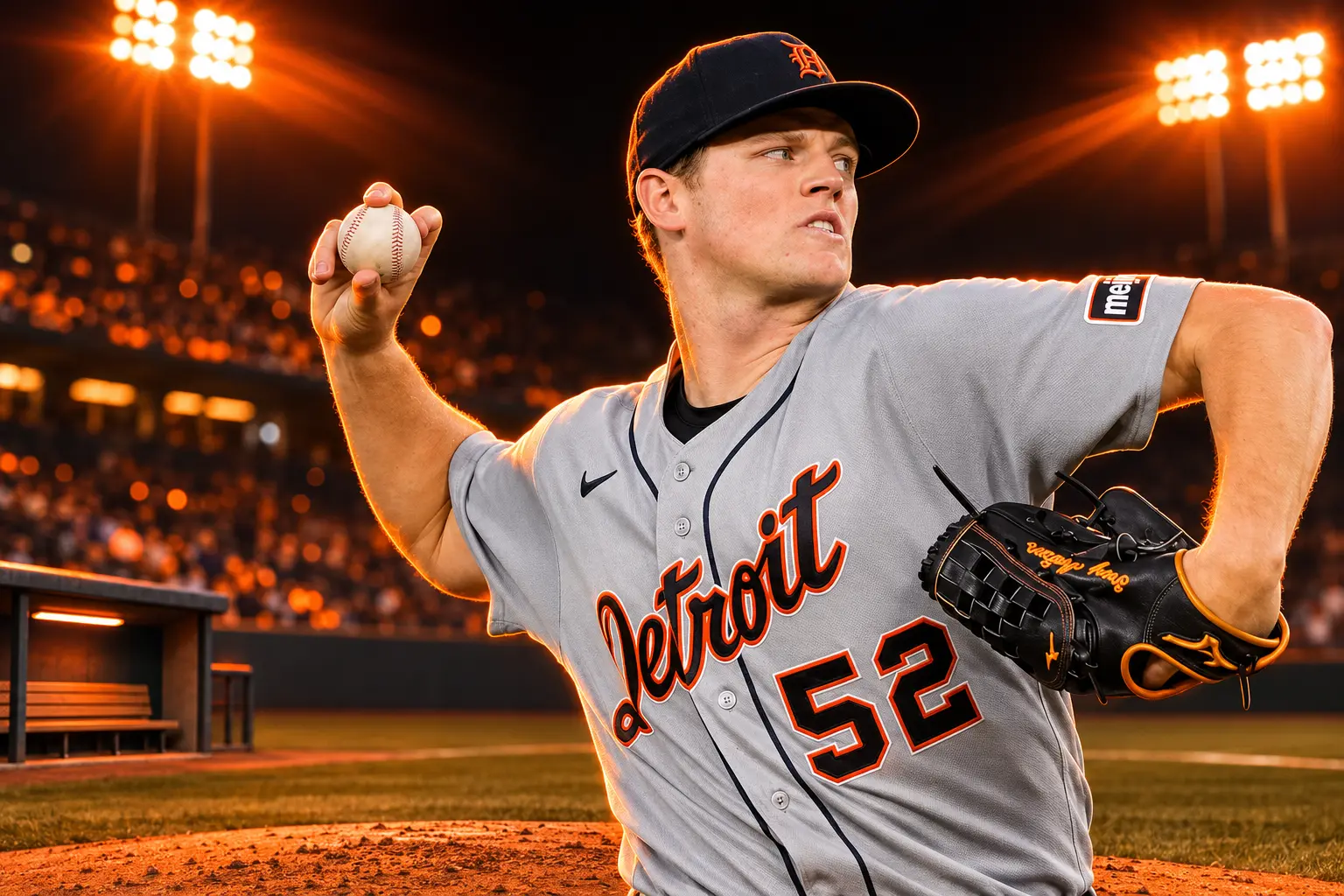
Elbow Inflammation Opened 2026 and Forearm Tightness Ended It
Melton did not pitch in a big-league game until late May. The Tigers put him on the 60-day injured list March 10 with right elbow inflammation, then ran him through rehab starts at Lakeland and Toledo before activating him May 24.
He made 20 starts after that and posted an 8-5 record with a 2.76 ERA, 114.1 innings, 94 strikeouts and 37 walks. The first 14 of those starts went 7-1 with a 1.49 ERA. July was the peak: a 0.92 ERA in 29.1 innings with 35 strikeouts.
September cut the other way. In four starts he allowed 15 earned runs, 22 hits and nine walks in 17.1 innings. He left his September 20 outing in Chicago and landed on the 15-day list the next day with right forearm tightness. The club shut him down for the rest of a season that was already over as a playoff race.
THE ARM FILE
- August 30, 2024: Lands on the seven-day injured list at Double-A Erie with a shoulder injury and does not return until September 25.
- March 10, 2026: Goes on the 60-day injured list with right elbow inflammation and misses Detroit’s first two months.
- May 24, 2026: Comes off the 60-day list and begins a 20-start run that carries the rotation through the Skubal trade.
- September 21, 2026: Hits the 15-day list with forearm tightness after exiting in Chicago, and the season is over.
- October 15, 2026: Gets a clean follow-up exam, with the club saying there was no structural damage in his forearm.
That October exam is the medical paper the extension sits on. Melton was cleared for a normal offseason program, and Detroit is now paying him as if that scan is the last word. The 2024 shoulder stay at Erie is the part of the file that does not show up in a one-year ERA.
He is 6-foot-4, 210 pounds, from Newport Beach, California, and he went to Canyon High in Anaheim before San Diego State. As a junior in 2022 he went 5-2 with a 2.07 ERA and 67 strikeouts in 65 1/3 innings. Detroit took him 117th overall in the fourth round and signed him for $517,900. The climb from Lakeland to a six-year big-league deal took four seasons, and the arm has already been on three injured lists in that span.
A 3.84 Expected ERA Behind the Shiny 2.76
The ERA is the number that sells the deal. The rest of the line is why the average annual value is $7.75 million instead of twice that.
Statcast put his 2026 expected ERA at 3.84. FanGraphs has a 4.09 FIP behind that 2.76 ERA and only 1.6 wins above replacement. He struck out 20.0 percent of batters, a 32nd-percentile rate, and his 23.4 percent whiff rate sat in the 36th percentile. Those are not ace strikeout traits. They are traits of a pitcher who kept runs off the board another way.
The fastball is the argument for paying him anyway. It averaged 96.2 mph, ranking in the 78th percentile for velocity and the 85th percentile for fastball run value, and he released it with 6.8 feet of extension, 81st percentile. He threw the four-seamer 32.8 percent of the time at 96.4 mph and the cutter 21.9 percent at 92.2 mph. Hitters batted.182 against the cutter (18-for-99). Walks stayed in check at 7.9 percent. Grounders came in at 42.9 percent, and the barrel rate of 6.0 percent ranked in the 77th percentile.
The same 2.76 ERA showed up in 2025, when he worked 45.2 innings as a swingman (3-2, 16 games, four starts) after a July 23 debut in Pittsburgh. Opponents batted.198 on balls in play that year, and an 86.0 percent strand rate helped the ERA. Both of those figures moved toward normal in 2026, which is why the second year is a sturdier sample, even if it still ran ahead of the estimators.
THE 2026 MONTHLY SPLIT
| Month | IP | ERA | SO |
|---|---|---|---|
| May | 12.2 | 1.42 | 4 |
| June | 25.0 | 2.88 | 21 |
| July | 29.1 | 0.92 | 35 |
| August | 30.0 | 2.10 | 20 |
| September | 17.1 | 7.79 | 14 |
Through August he had a 1.86 ERA in 97.0 innings. The last seven games of the year, a window that overlaps that September collapse, produced a 5.77 ERA in 34.1 innings. Career totals now sit at 11-7, a 2.76 ERA, 160 innings, 130 strikeouts and a 1.09 WHIP in 36 games (24 starts). Detroit Sports Media named him Tigers Rookie of the Year after 2025, and he gave the club eight innings of one-run ball with eight strikeouts across three of five American League Division Series games against Seattle.
How Melton’s Guarantee Compares With Other Starter Extensions
Put the guarantee next to other 2026 starting pitcher extensions and the shape of the bet is obvious. Detroit bought more years and paid a lower average salary than clubs that closed similar-aged arms on shorter pacts.
YOUNG STARTER EXTENSIONS
| Pitcher | Age | Years | Guarantee | AAV |
|---|---|---|---|---|
| Troy Melton, DET | 25 | 6 | $46.5M | $7.75M |
| Brandon Pfaadt, ARI | 26 | 5 | $45.0M | $9.00M |
| Tanner Bibee, CLE (2025) | 25 | 5 | $48.0M | $9.60M |
| Shane Baz, BAL | 26 | 5 | $68.0M | $13.60M |
Bibee and Pfaadt got about $9 million a year for five seasons. Baz got $13.60 million. Melton’s $7.75 million average is the injury-and-inning discount, and the sixth year plus the 2033 option is what Detroit extracted in return. He will earn more than the near-minimum pay of 2027 and 2028, and the Tigers buy out three arbitration seasons plus the first free-agent winter.
That math is why some of the first public reaction treated the number as small. A six-year pledge still sounds large in a Tigers clubhouse that has been careful with pitcher term since Jordan Zimmermann’s five-year free-agent contract before 2016. The dollars, stacked against a healthy year from a 25-year-old with this fastball, are the cheap part. The years are the wager.
The Skubal Trade Left Detroit Needing This Kind of Deal
On August 1, while the Tigers were in Sacramento, they sent two-time American League Cy Young winner Tarik Skubal to the Los Angeles Dodgers for right-handers River Ryan and Brady Smith and outfielder Zyhir Hope. Casey Mize went out around the same window. The staff that was built to contend in 2026 finished at home.
Skubal is a free agent now. Former Mets general manager Jim Duquette said New York’s first offer ran nine years and nearly $400 million, a figure that would set a free-agent starter record. Detroit looked at that market, declined to meet it in July, and is now writing a $46.5 million check to the in-house arm who started the game after Skubal left.
Melton’s mix is why the club thinks it can live with that swap. The slider, once an 86-87 mph hybrid, is the pitch he has talked about most.
When we talked before, I was probably throwing it 86-87 on average, and now it’s 90-91 with shorter movement. It’s more a fastball than it was.
Troy Melton, Tigers right-hander, September 2025
He has also leaned on a sinker he uses to change hitters’ eyes rather than as a beauty-contest pitch, plus a cutter he ran more often in 2026 than in his debut year. The 2025 look was four-seam heavy. The 2026 look spread usage toward the cutter and a changeup. That is a starter’s mix, which is the version Detroit just paid for through his age-32 season if the option sticks.
The health objection writes itself, and it does not need a quote to stand. Shoulder in 2024, elbow to open 2026, forearm to close it. Three stops. A clean October exam does not erase the pattern, it only lets the club sign through it. The modest average salary is how Detroit priced that pattern. If Melton gives them 180 healthy innings of a 3.50 ERA, the deal is a steal next to Skubal’s market. If the forearm is the start of a longer problem, the Tigers have bought two extra years of a pitcher they cannot keep on the mound.
Valdez, Jobe and Ryan Now Share a Younger Staff
Heading into 2027, Melton and Framber Valdez are the two names in ink. Valdez signed a three-year, $115 million deal and then put up an ERA over 4.00 in 31 starts, still getting grounders more than 55 percent of the time. There is a live case for Melton taking the Opening Day ball if that gap holds.
Keider Montero logged a 3.48 ERA in 32 games (25 starts) and sits in the next tier. Jackson Jobe, the former third overall pick, came back from Tommy John surgery in August and made nine starts. Ryan, the most advanced piece in the Skubal return, made two short starts in late September after missing 2025 following his own Tommy John operation. Reese Olson remains a depth name if he is healthy. The club already picked up Drew Anderson’s $10 million option for 2027; he worked as a swingman in 2026 and can take a turn.
THE 2027 ROTATION MIX
- Melton: Newly extended, 20 starts, 2.76 ERA, still building a full offseason after the forearm shutdown.
- Valdez: The $115 million lefty, 31 starts, ERA over 4.00, ground-ball engine still intact.
- Montero: 25 starts and a 3.48 ERA, the bridge arm if the young right-handers need time.
- Jobe: Nine starts after Tommy John, the highest-upside name who has not yet had a full healthy year.
- Ryan: Two September starts in a Tigers uniform, still on a post-surgery innings cap.
That group is cheaper than a Skubal-Valdez front, and it is thinner. Detroit has been linked to free-agent starters Shota Imanaga and Kaima Taira, and the trade board still has names such as the Angels’ Reid Detmers and the Rangers’ MacKenzie Gore. The Melton deal does not close that shopping. It sets a floor so Harris can spend on a veteran without also paying Melton’s arbitration climb later in the decade.
On the books past 2029, Melton joins McGonigle’s deal through 2034 and Colt Keith’s club options for 2030-32. Kyle Finnegan holds a $10 million mutual option for 2028. Valdez holds a $40 million mutual option the following year. Those later options are separate from the Melton bet, but they explain why Detroit wanted a starter it could carry at $7.75 million a year while the infield’s long-term money is already committed.
A 2033 Option Still Depends on a Physical
The club option is the piece that turns a standard arbitration buyout into extra control. If Melton is even an average starter in 2031, Detroit can keep him through 2033 without visiting the $400 million market it just watched Skubal enter. If the arm does not hold, the option is a walk-away, and the sunk cost is a mid-rotation average salary rather than an ace’s.
WHAT WE KNOW
- The terms: Six years, $46.5 million, with a 2033 club option and a $98 million ceiling if incentives pay.
- The 2026 line: 8-5, 2.76 ERA, 114.1 innings, 1.6 fWAR, 3.84 expected ERA.
- The October exam: No structural damage, normal offseason, cleared after the forearm shutdown.
WHAT IS UNCONFIRMED
- The physical: The agreement was still pending a physical, and the Tigers had not confirmed it in public.
- The salaries: Year-by-year pay and the exact 2033 option figure have not been published.
- The bonuses: Which incentives, Cy Young or otherwise, fill the gap from $46.5 million to $98 million.
Melton will report to spring training as the pitcher Detroit chose to pay, on a staff that no longer includes Skubal, with a fastball that grades better than his strikeout rate and a medical file that is longer than one clean scan. The next test is not the contract language. It is whether the elbow and the forearm stay quiet from February through September.

TAP Opens Porto-Dulles Flights After Lufthansa Signs On

Arla Seeks a New Home for Everswinkel Ice Cream

GTA 6’s $3.79 Billion Day One Is Mostly Pre-Sold

McMillen Missed the Suno Tracks in Isaac’s GTA Run

GTA 6 Occupied 24% of Comcast’s Network at Peak

AI Server Boards Put Everyday Circuit Materials on Allocation

Glacier Collapse Buried Nepal’s Hydropower Workers in Tunnels

Congo’s Bundibugyo Outbreak Outruns the Licensed Ebola Shots

Pennsylvania Measles Deaths Follow a Long Slide in Coverage

CISA’s Known Exploits Still Come From 2007-Era Bugs
-
 NEWS3 months ago
AI Server Boards Put Everyday Circuit Materials on Allocation
-
 NEWS3 months ago
Congo’s Bundibugyo Outbreak Outruns the Licensed Ebola Shots
-
 NEWS3 months ago
Glacier Collapse Buried Nepal’s Hydropower Workers in Tunnels
-
 NEWS3 months ago
Pennsylvania Measles Deaths Follow a Long Slide in Coverage
-
 NEWS3 months ago
CISA’s Known Exploits Still Come From 2007-Era Bugs
-

 NEWS3 months ago
Texas Judge Freezes the SEC Eligibility Ban for 41 Athletes
-

 NEWS3 months ago
Germany Can Miss Its 2026 Climate Cap Without Penalty
-

 NEWS3 months ago
FDA Approves XFG COVID-19 Vaccines Without a CDC Vote