
BUSINESS
Iran Fires More at Hormuz as Oil Income Dries
Iran’s Hormuz attacks hit a war high in October as Gulf oil recovered, prices fell, and Tehran’s last floating barrels ran out.

Reported attacks on shipping around the Strait of Hormuz exceeded 30 in October, the most since the US-Iran war began on February 28. November is already the second-busiest month of the war, with at least 22 attacks logged through November 22.
The barrage is rising as oil prices fall, Gulf exports recover, and Iran’s own cargoes at sea have run out. Tehran is shooting more often at a waterway that is making it less money.
More Than 30 Attacks in October, 22 and Counting in November
The Royal Navy-affiliated United Kingdom Maritime Trade Operations Centre only publishes incidents it can verify through primary sources, and it still had to raise the monthly line. Before October, reported attacks in the strait, the Persian Gulf and the Gulf of Oman averaged about 10 a month. October was the first month above 30. The International Maritime Organization’s confirmed list also points to October as the heaviest month of the year so far.
THE MONTHLY ATTACK COUNT
| Period | Reported attacks | What UKMTO noted |
|---|---|---|
| Before October | about 10 a month | Monthly average after the war began |
| October | more than 30 | First month above that line |
| November through November 22 | at least 22 | Second-highest month of the war |
| Week to November 18 | 6 tanker attacks | 4 in the strait, 2 in the Persian Gulf |
| Since February 28 | 106 in the strait | Verified through primary sources |
In the seven days to November 18, none of those six tankers was reported sunk. Two needed help. The outcomes for the other four were unknown. The Joint Maritime Information Center has the threat in the strait at severe, meaning an attack is highly likely.
Iran’s navy has claimed near-daily hits on commercial ships and often blames sea mines. UKMTO has kept logging unknown projectiles instead, and it has not confirmed those mine reports. The centre also said in mid-October that it was struggling to count true attacks because most vessels that get hit refuse to report.
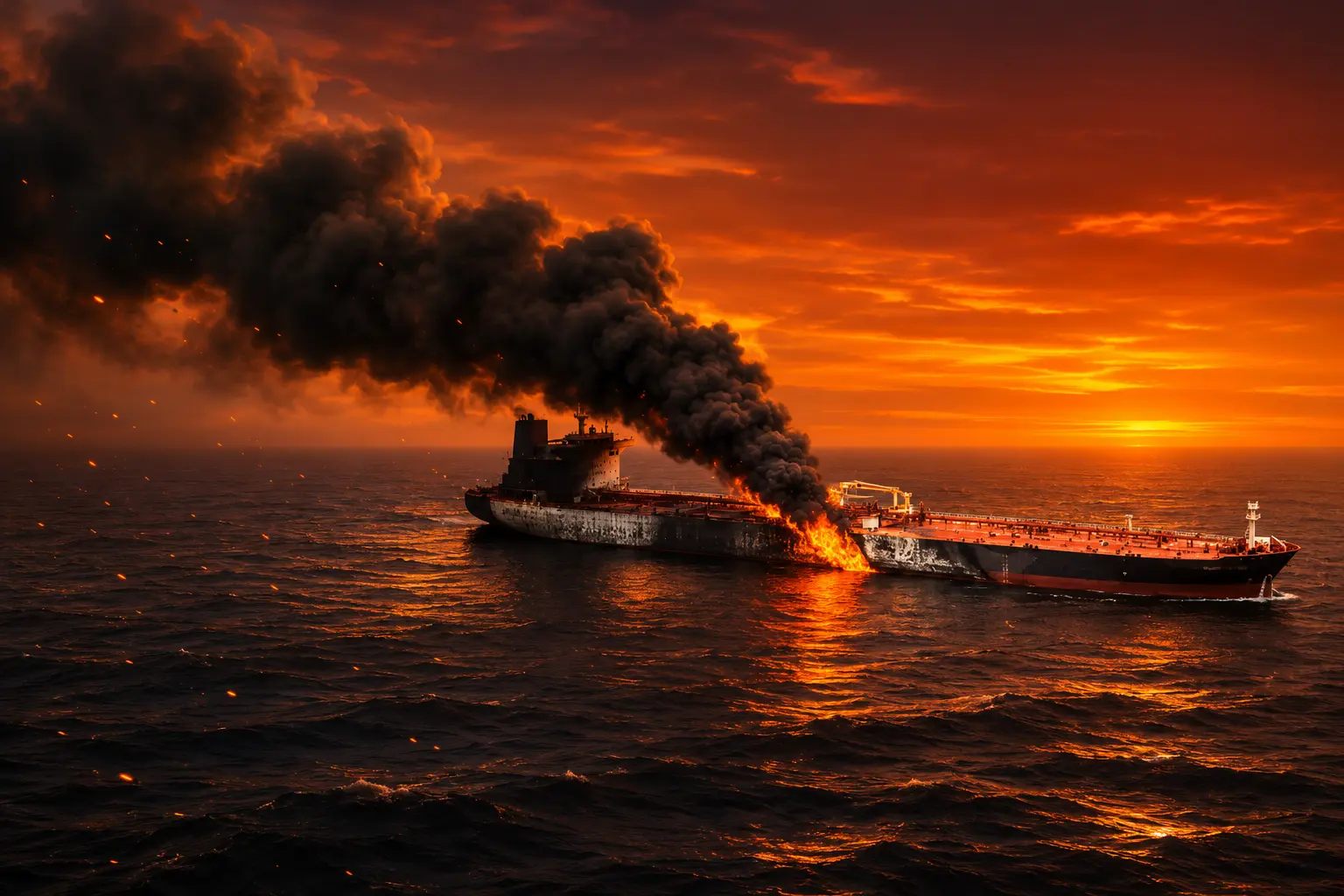
Gulf Crude Came Back as Tankers Still Burned
The International Energy Agency ties the latest drop in prices to a recovery in Gulf exports, not to a quiet strait. In October the agency put Gulf crude at 82 percent of pre-war levels, even as attacks on tankers continued. Gulf oil exports excluding Oman reached 18.4 million barrels a day that month, still 26 percent below pre-war, and they were enough to loosen the market.
North Sea Dated crude tumbled 32 percent, from $136 a barrel on October 8 to $93 when that November report came out. Global oil supply rose by 2.3 million barrels a day to 105.4 million in October. Observed inventories increased by 52 million barrels, the first rise since June, as oil on water jumped by 86 million barrels on the back of those Gulf cargoes. The agency now sees the market back in surplus in the fourth quarter.
Those export figures are not the same as tanker counts in the strait. Gulf crude includes pipelines, ship-to-ship transfers and other workarounds. Strait traffic is still thin. The U.S. Energy Information Administration’s tanker tracking put oil through Hormuz at 9.1 million barrels a day in the third quarter, up from 5.1 million in the second quarter and well below 21.6 million in the fourth quarter of 2025. LNG through the same gap was 1.4 billion cubic feet a day in the third quarter, after 0.8 in the second and 10.5 in late 2025.
OIL ON THE WATER AND IN THE GULF
| Measure | Earlier reading | Latest reading |
|---|---|---|
| Hormuz oil, EIA tanker tracking | 21.6 million barrels a day, 4Q 2025 | 9.1 million barrels a day, 3Q 2026 |
| Gulf crude exports excluding Oman, IEA | Pre-war baseline | 15 million barrels a day in October, 82 percent of pre-war |
| Gulf oil exports excluding Oman, IEA | Pre-war baseline | 18.4 million barrels a day in October, 26 percent below pre-war |
| Hormuz transits, UKMTO | Pre-conflict pace | 263 in the week to November 18, about 65 percent below |
| North Sea Dated crude | $136 on October 8 | $93 in mid-November, down 32 percent |
By mid-November the EIA said increasing flows through the Strait of Hormuz had helped push prices down, with Brent more than $30 a barrel under the October monthly average as of November 18. Diesel did not give the same relief. European diesel fell 11 percent over the same stretch as Dated crude and still sat close to $180 a barrel, 77 percent above pre-war levels. Freight for moving crude from the Middle East to Asia held near record levels in the IEA’s telling.
Hamidreza Azizi, a senior Iran analyst at the International Crisis Group, said markets appear to be assuming that a return to full-scale war is unlikely and that oil supplies will gradually recover. He added that the assumption could change quickly if Iran intensifies the confrontation. Phone videos of burning tankers keep making that warning look obvious. Dated crude has already given back the October spike, and some of those clips are days old.
Iran’s Last Floating Barrels Ran Out in China
The United States answered Iran’s attempt to halt Hormuz traffic with a blockade on Iranian ports. The squeeze is now showing up in the cargoes that used to float off Malaysia and Singapore and pay the bills in Beijing.
Kpler, the maritime data firm, found that oil on water outside the blockade hit zero in mid-October as the last cargoes discharged in China. Homayoun Falakshahi, a senior commodity analyst at Kpler, wrote that Iran has not loaded a crude or condensate cargo since August 25, and that tankers loaded since mid-July have not been able to pass the blockade line.
IRAN’S FLOATING STOCK
- The peak: 88.8 million barrels sat outside the blockade zone on July 14.
- The floor: That stock was zero by mid-October.
- Still trapped: About 43 million barrels remain inside the blockade area.
- Last loading: No crude or condensate cargo has been loaded since August 25.
At the start of the war Iran held about 136 million barrels of oil outside the region. Chinese buyers typically pay one to two months after discharge, so Kpler expects crude and condensate revenues to reach zero by mid-December, for the first time in the country’s history. Oil sales account for around 30 to 40 percent of government revenues and are Iran’s largest source of foreign currency. The IEA put Iranian output at 1.86 million barrels a day in October. U.S. Central Command has said the blockade has denied Tehran at least $25 billion in oil revenue.
The currency market moved first. On October 22 the dollar hit a record of around 272,000 tomans on the open market, up from 157,000 in mid-June, and Kpler said the toman had lost about 42 percent of its value over that stretch. Falakshahi’s October note put the short-term choice as endure, negotiate or escalate, and called escalation the least bad option while neighbours’ exports recovered. The attack log since then reads like that choice.
Why Ships Keep Switching off Their Trackers
The centre recorded 263 vessel transits in seven days to November 18, down from 308 the week before and about 65 percent below pre-conflict levels. Inbound transits were 148 and outbound 115, against 169 and 139 a week earlier. Before the war, about a fifth of the world’s oil passed through the channel.
Ships broadcasting AIS accounted for 73 of those 263 transits, down from 82 the previous week. The rest were U.S.-facilitated crossings, which UKMTO cannot independently verify and which outnumbered the AIS-tracked ships by about 2.5 to 1. Energy carriers made up half of all transits, according to U.S. Naval Cooperation and Guidance for Shipping. Most ships that still broadcast AIS used the route through Iranian waters, though more traffic shifted to the southern route during the week.
WHAT THE COUNT MISSES
- Verified only: UKMTO publishes incidents confirmed through primary sources and says it knows of more attacks it cannot independently verify.
- Silent owners: In October the centre said a majority of vessels that were attacked refused to report, which left it unable to state a true total.
- Dark crossings: Many ships now sail with AIS off, so public tracking understates both traffic and hits.
- Escorted traffic: U.S.-facilitated transits sit in a separate ledger that UKMTO cannot check.
- Mine claims: Iranian reports of mine strikes are not being matched in UKMTO’s projectile warnings.
Since the Iran-U.S. memorandum of understanding expired on August 17, about 10 percent of attacked vessels with confirmed outcomes have been lost or sunk, UKMTO said. The official attack numbers are a floor. Insurers, charterers and crews are pricing a higher one.
Oman’s Southern Corridor, and the Hits Near Khasab
Marisks, a maritime risk firm, said projectiles struck three tankers exiting the strait on November 20 and 21 and assessed Iranian involvement as likely. It did not confirm who fired. The firm called the episode a continued critical threat, especially on the southern corridor near Oman’s coastline, a route Iran opposes.
THE HITS OFF KHASAB
- November 16, 2026: An LPG tanker later named Tara Gas is struck about 7 nautical miles north of Khasab and left with an engine-room fire.
- November 17, 2026: Tara Gas is hit again, the crew abandons ship, and India’s Ministry of External Affairs says one crew member is missing and two are injured. The same day an ADNOC-managed tanker, identified by the security firm Vanguard Tech as the product tanker Navig8 Messi, is struck about 13 nautical miles north of Khasab; ADNOC says one crew member is missing and 11 are injured, and the ship goes under tow.
- November 20, 2026: The Marshall Islands-flagged chemical and oil tanker Captain Leon is struck at the bow at 3 p.m. UTC about 8 nautical miles north of Khasab. Fire breaks out. Marisks says all crew are safe.
- November 21, 2026: The Hong Kong-flagged crude tanker Torkel is hit in the stern at 5 a.m. UTC about 11 nautical miles north of Khasab and catches fire. Less than an hour later the Hong Kong-flagged Arina is struck in the engine room about 17 nautical miles east of Khasab. UKMTO reports no casualties on those two warnings.
- November 22, 2026: UKMTO logs an incident involving a tanker and military forces in the Gulf of Oman at 1425 UTC, outside the strait itself, and does not name the ship.
The November 20 and 21 trio sits outside the weekly overview that closed on November 18, so it is a fresh cluster, not a double count of that week’s six. A widely shared clip of a second giant tanker burning off the southern coast was Tara Gas from the week before, said Sal Mercogliano, a maritime historian who tracks the casualties. The pictures still travel. The price does not.
Trump Wrote That Washington Already Holds the Strait
On November 12, President Donald Trump pulled Vice President JD Vance off the Iran file and said the United States did not need an agreement with Tehran. He had tasked Vance with the talks. Then he sent him back to domestic politics.
We don’t need a deal with Iran. Those days have long since passed! We’ve got their money, Hundreds of Billions of Dollars, and we’ve got their Strait!
Donald Trump, Truth Social, November 12, 2026
He later said the United States totally controls the Gulf in terms of the Hormuz Strait, and that he would resume strikes if he saw things going the other way. On November 20 he told reporters that Iran wants a deal, but not one acceptable to him, and that he wants a real deal rather than a fake one. The waterway he says he already holds is the same stretch where Captain Leon, Torkel and Arina were burning a day later.
Kharg Island Has a Queue and No Buyers
Falakshahi said in November that about 20 tankers were near Kharg Island, Iran’s main oil export terminal, most of them already loaded and sitting still, apparently waiting for the blockade to lift. That is a parked fleet, not a working export line. UKMTO’s November 22 notice of a tanker and military forces in the Gulf of Oman is the kind of contact that follows when parked ships try to move.
Crews are still being pulled off burning decks north of Khasab. Dated crude is still well below its October high. The attack rate is the record of this war, and it is arriving as Iran’s last paid barrels clear China and Gulf neighbours put more oil into the market without asking Tehran’s permission.

TAP Opens Porto-Dulles Flights After Lufthansa Signs On

Arla Seeks a New Home for Everswinkel Ice Cream

GTA 6’s $3.79 Billion Day One Is Mostly Pre-Sold

McMillen Missed the Suno Tracks in Isaac’s GTA Run

GTA 6 Occupied 24% of Comcast’s Network at Peak

AI Server Boards Put Everyday Circuit Materials on Allocation

Glacier Collapse Buried Nepal’s Hydropower Workers in Tunnels

Congo’s Bundibugyo Outbreak Outruns the Licensed Ebola Shots

Pennsylvania Measles Deaths Follow a Long Slide in Coverage

CISA’s Known Exploits Still Come From 2007-Era Bugs
-
 NEWS3 months ago
AI Server Boards Put Everyday Circuit Materials on Allocation
-
 NEWS3 months ago
Congo’s Bundibugyo Outbreak Outruns the Licensed Ebola Shots
-
 NEWS3 months ago
Glacier Collapse Buried Nepal’s Hydropower Workers in Tunnels
-
 NEWS3 months ago
Pennsylvania Measles Deaths Follow a Long Slide in Coverage
-
 NEWS3 months ago
CISA’s Known Exploits Still Come From 2007-Era Bugs
-

 NEWS3 months ago
Texas Judge Freezes the SEC Eligibility Ban for 41 Athletes
-

 NEWS3 months ago
Germany Can Miss Its 2026 Climate Cap Without Penalty
-

 NEWS3 months ago
FDA Approves XFG COVID-19 Vaccines Without a CDC Vote