
BUSINESS
Arla Seeks a New Home for Everswinkel Ice Cream
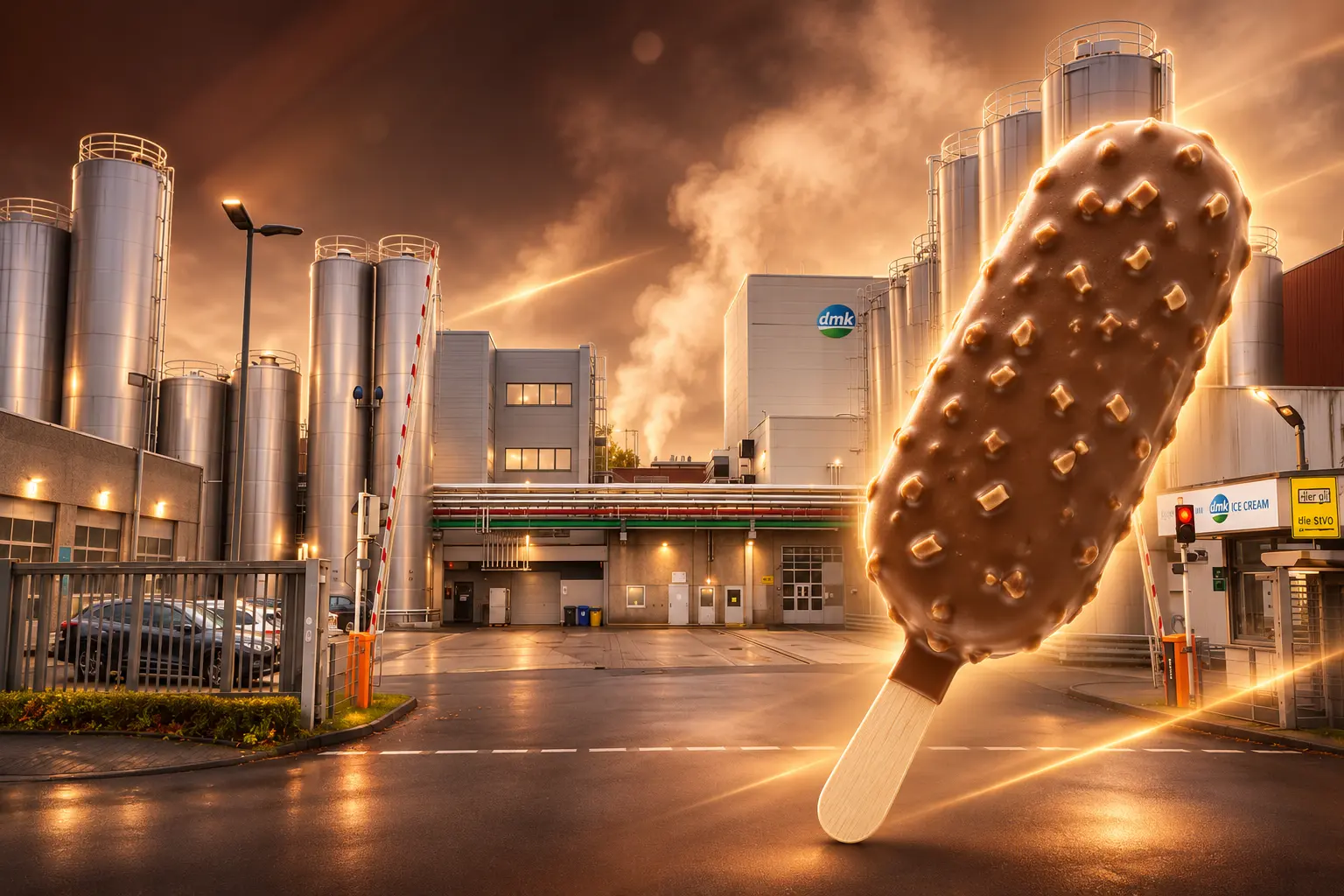
Arla is exploring a new owner for the brandless Everswinkel ice cream plant it inherited with DMK, as specialists still buy factory capacity.

Arla Foods opened a review of its German ice cream business on 19 November 2026, less than six months after absorbing DMK Group.
The farmer-owned group said it would explore options for future ownership of a single North Rhine-Westphalia factory that makes licensed and private-label ice cream. Arla put the headcount at around 380 staff, and no house brands sit in the process. Ingo Müller, chief integration officer and former DMK chief executive, called it a search for a good home.
One Factory in Everswinkel, No House Brands
The plant is in Everswinkel, in the Warendorf district, and still trades as DMK Eis GmbH, a former DMK unit that moved onto Arla’s books when the merger took effect on 1 June 2026. Arla’s own statement places it in North Rhine-Westphalia and describes a broad range of ice cream for established licensed brands and for retailers’ own labels.
That mix is the whole business. There is no Magnum, no Milram tub on the shopper-facing side of this review, and no second factory in the pack. DMK spent years building the unit after taking control of Rosen Eiskrem in 2012, when it called itself Germany’s largest ice cream maker. The asset Arla is now testing is that industrial shop, not a brand portfolio.
THE ASSET ON THE BLOCK
- The site: One factory in Everswinkel, North Rhine-Westphalia, operated by DMK Eis GmbH.
- The work: Licensed ice cream plus private-label products for retail customers, with no house brands in the review.
- The payroll: Around 380 staff, according to Arla, against a merged co-op of 28,800 colleagues.
- The process: Outcome-open, with no binding timetable and with production still running on existing contracts.
Arla said the announcement does not change employees’ tasks, roles or responsibilities now, and that customers, suppliers and partners keep their current agreements. The review, it added, is limited exclusively to ice cream and should not be read as a signal about other parts of the group.
The Co-op Is Already Cutting German Office Roles
The ice cream notice landed inside a wider German integration. End of October 2026, Arla and DMK put a voluntary severance scheme in front of office staff, aimed at overlapping admin after two headquarters cultures were stacked on top of each other. Production jobs were left out.
A company spokeswoman put the saving in administration and corporate functions at €37 million. Separate from that office programme, the group has talked of merger synergies of more than €200 million from buying, logistics and a stronger market position. The German food workers’ union NGG has estimated 500 to 600 jobs nationwide, including more than 100 of about 900 posts at the Bremen admin site. Arla has not confirmed a headcount.
Oliver Bartelt, a DMK spokesman, said the future organisation is still being designed in many areas, and that the companies want to avoid compulsory redundancies if they can. The first application window runs to 8 December 2026, with exits spread over almost two years. Focus has been on Bremen and Düsseldorf rather than the freezer hall.
FROM MERGER DAY TO THE ICE CREAM REVIEW
- 28 May 2026: Remaining merger approvals clear, with the deal set to take effect on 1 June.
- 1 June 2026: Arla and DMK unite as Europe’s leading dairy co-op, with ice cream arriving as part of DMK.
- End of October 2026: A voluntary programme for German office staff is presented, with a €37 million admin saving attached.
- 19 November 2026: Arla opens the ice cream ownership review and briefs Everswinkel staff at a works meeting.
- 8 December 2026: The first window for the office severance scheme is due to close.
Müller now sits on Arla’s executive team as the man paid to stitch the two co-ops together. He is also the voice on the ice cream statement. The person looking for a new owner ran the business that brought the plant in.
Why Farmer-Owners Do Not Need an Ice Cream Plant
A farmer co-op lives on the milk cheque. Ice cream that is packed for someone else’s brand does not set that cheque the way Lurpak, Castello, Arla, Puck or Milram can. On merger day Arla said the combined group would hold approximately 11,200 farmers and 28,800 colleagues across seven countries, a milk pool of 19.4 billion kg a year, and pro forma revenue of more than €20 billion (about $22 billion).
Those farmers own a dairy engine. Arla’s own description of itself on the ice cream statement still leads with organic dairy, whey proteins, and the brands that sit in chillers, not freezers. Licensed sticks and discounter tubs need capex, seasonal crews, and a sales story that is closer to a contract manufacturer than to a milk price.
Peder Tuborgh, Arla’s chief executive, sold the 1 June combination as a European champion that could invest at scale in food production. Less than six months later, the first product line put through an “outcome-open process” is the one product line that does not start in a member’s bulk tank in the same way cheese or butter does.
Our Ice Cream business has attractive market positions, long-standing customer relationships and, above all, highly experienced and committed employees. This is precisely why we are taking this step from a good position. We want to create a perspective in which Ice Cream receives the strategic attention and opportunities the business deserves. What matters to us is finding a good home for the business and its employees.
Ingo Müller, Chief Integration Officer, Arla Foods statement, 19 November 2026
The praise is doing work. Arla is not describing a broken factory. It is describing a factory it does not want to parent inside a milk co-op, and it wants a buyer who will.
Private-Label Specialists Are Still Spending
Wire copy has reached for Unilever and Nestlé because both have stepped back from ice cream. The comparison only holds if Everswinkel is treated as a brand. It is not. The branded end of the freezer cabinet already has a dedicated listed parent. The co-pack end still has buyers writing cheques for lines and sheds.
Unilever completed the split of The Magnum Ice Cream Company on 6 December 2025 and listed it in Amsterdam, London and New York two days later. A Unilever filing valued the ice cream business at €8.4 billion and recorded a 19.85% stake left behind, matching the Unilever voting interest of 19.85% on Magnum’s own shareholder register. Magnum, which counts Magnum, Ben & Jerry’s, Cornetto and Heartbrand in its stable, puts its global share at about 21%. That is a different object from a Westphalian co-pack hall.
Nestlé’s remaining in-house ice cream, which chief executive Philipp Navratil called “a distraction” in February 2026, is being fed toward Froneri, the 50/50 venture with PAI Partners, “in a phased way.” Froneri, which already runs plants in Osnabrück and Uelzen, said in July 2026 it would put €30 million into new lines at Osnabrück for private-label work and branded family packs, including Mövenpick, in time for the 2027 season.
FOUR DIFFERENT ICE CREAM BETS
| Holder | What sits in the freezer | Latest move |
|---|---|---|
| The Magnum Ice Cream Company | Global brands, about 21% retail share | Listed 8 December 2025; Unilever keeps 19.85% |
| Froneri (Nestlé and PAI) | Brands plus private label, two German plants | €30 million into Osnabrück for the 2027 season |
| Glacier | Private label and co-manufacturing, five European sites | €45 million into Italy and Belgium, still open to deals |
| Arla (DMK Eis, Everswinkel) | Licensed plus private label, one plant, around 380 staff | Ownership review opened 19 November 2026 |
Glacier is the cleaner comparison. The group calls itself Europe’s leading pure-play private label ice cream producer, with five plants in Belgium, France and Italy, 50 lines, 298 million litres a year, about 1,500 staff, and net sales of €582 million in 2025. On 13 July 2026 it announced a €45 million spend on two new Italian lines, extra warehousing and cooling at Langemark in Belgium, and a bites line rated at 50,000 pieces an hour, adding 220 million units of annual capacity.
Matt Frost, Glacier’s executive director, has said the company is still looking at “selective acquisitions and partnerships.” Marc Auclair was named group chief executive for November 2026, with Frost staying on the board. Davidson Kempner and Afendis back the platform. A German license-and-own-label factory with retail contracts is the sort of bolt-on that platform was built to digest.
Who Might Want a License and Own-Label Shop
Arla has not named bidders, and it has not said a sale is the only outcome. The factory’s work, though, points at a short list of owners who already live in that trade rather than in farmer milk.
WHO CAN USE A FACTORY LIKE THIS
- A private-label consolidator: Glacier has the balance sheet, the retailer habit, and a stated wish to add plants and formats outside its present map.
- Froneri’s German system: Osnabrück is already adding private-label lines for 2027, and Nestlé is still pushing leftover ice cream into that venture.
- A retailer-tied co-packer: The Everswinkel book is built on licensed brands and supermarket own labels, which is work a grocery group or its dedicated maker could keep in-house.
- A financial owner with a freezer thesis: The Magnum listing showed branded ice cream can stand alone; a cheaper, contract-led plant is a different private-equity brief, closer to Glacier than to Magnum.
Any of those homes would still have to take the people. Müller’s statement puts employees in the same sentence as the business, which is both a social promise and a sale point. A seasonal ice cream hall without its skilled crews is just a cold shed.
Rumours Reached Everswinkel Before the Statement
Staff were told on 19 November 2026, at an internal meeting the same day as the public notice. Local reporters have already heard from workers who do not fully trust the line that nothing changes. Some described talks about exits and severance. Arla and the Everswinkel works council say those talks belong to the office programme, not the ice cream review.
The nerves are older than the statement. Merger talk in 2025 had already stirred job rumours around the former DMK sites. DMK cut roles at several locations in 2016 when milk prices fell. A few years ago the Everswinkel works was supposed to be strengthened as an ice cream plant. Hearing that the same hall now needs “a good home” lands, in that town, as a broken promise rather than a strategy memo.
The 380 people on the line are not in the voluntary office scheme. They are also not in the farmer register. They sit in the thin middle of a co-op merger: close enough to be briefed, far enough from the milk price that their factory can be described as non-core without touching Lurpak.
Arla Will Not Set a Date
No buyer, no price, and no deadline were attached to the 19 November notice. Arla said it will run the process with an ongoing dialogue with the people who have a stake in it, and that stable operations are the priority while options are tested.
WHAT WE KNOW
- The scope: The review covers only the ice cream business inherited with DMK, not cheese, butter, milk or infant nutrition.
- The factory: One Everswinkel plant, licensed plus private-label work, around 380 staff, still running on current contracts.
- The German cuts beside it: A voluntary office scheme aimed at €37 million, with NGG warning of 500 to 600 roles and the company refusing a number.
WHAT IS UNCONFIRMED
- The outcome: A sale, a carve-out, a joint venture, or a decision to keep the plant have all been left open.
- The buyer: No bidder has been named, including Glacier and Froneri.
- The jobs: Arla has not said whether a new owner would keep the 380 roles, and it has not confirmed the union’s wider German tally.
The lines in Everswinkel are still filling licensed moulds and retailer tubs under the same orders they had on 18 November. The co-op that called itself Europe’s dairy champion on 1 June is now asking someone else to want that freezer.

TAP Opens Porto-Dulles Flights After Lufthansa Signs On

Arla Seeks a New Home for Everswinkel Ice Cream

GTA 6’s $3.79 Billion Day One Is Mostly Pre-Sold

McMillen Missed the Suno Tracks in Isaac’s GTA Run

GTA 6 Occupied 24% of Comcast’s Network at Peak

AI Server Boards Put Everyday Circuit Materials on Allocation

Glacier Collapse Buried Nepal’s Hydropower Workers in Tunnels

Congo’s Bundibugyo Outbreak Outruns the Licensed Ebola Shots

Pennsylvania Measles Deaths Follow a Long Slide in Coverage

CISA’s Known Exploits Still Come From 2007-Era Bugs
-
 NEWS3 months ago
AI Server Boards Put Everyday Circuit Materials on Allocation
-
 NEWS3 months ago
Congo’s Bundibugyo Outbreak Outruns the Licensed Ebola Shots
-
 NEWS3 months ago
Glacier Collapse Buried Nepal’s Hydropower Workers in Tunnels
-
 NEWS3 months ago
Pennsylvania Measles Deaths Follow a Long Slide in Coverage
-
 NEWS3 months ago
CISA’s Known Exploits Still Come From 2007-Era Bugs
-

 NEWS3 months ago
Texas Judge Freezes the SEC Eligibility Ban for 41 Athletes
-
 NEWS3 months ago
Germany Can Miss Its 2026 Climate Cap Without Penalty
-

 NEWS3 months ago
FDA Approves XFG COVID-19 Vaccines Without a CDC Vote