
AUTO
Porsche Tests a Cayenne Turbo GT Electric After 1,139 hp
Porsche is testing a Cayenne Turbo GT Electric coupe with 911-style lights and a ducktail, even though the current Turbo Electric already makes 1,139 hp.

A barely wrapped Porsche Cayenne Turbo GT Electric coupe has been photographed with 911-style lamps and a ducktail lip. The current Turbo Electric already makes 1,139 hp and is quoted at 2.4 seconds to 60 mph. In September, a V8 Cayenne Turbo GT with Weissach hardware was still lapping the Nürburgring almost undisguised.
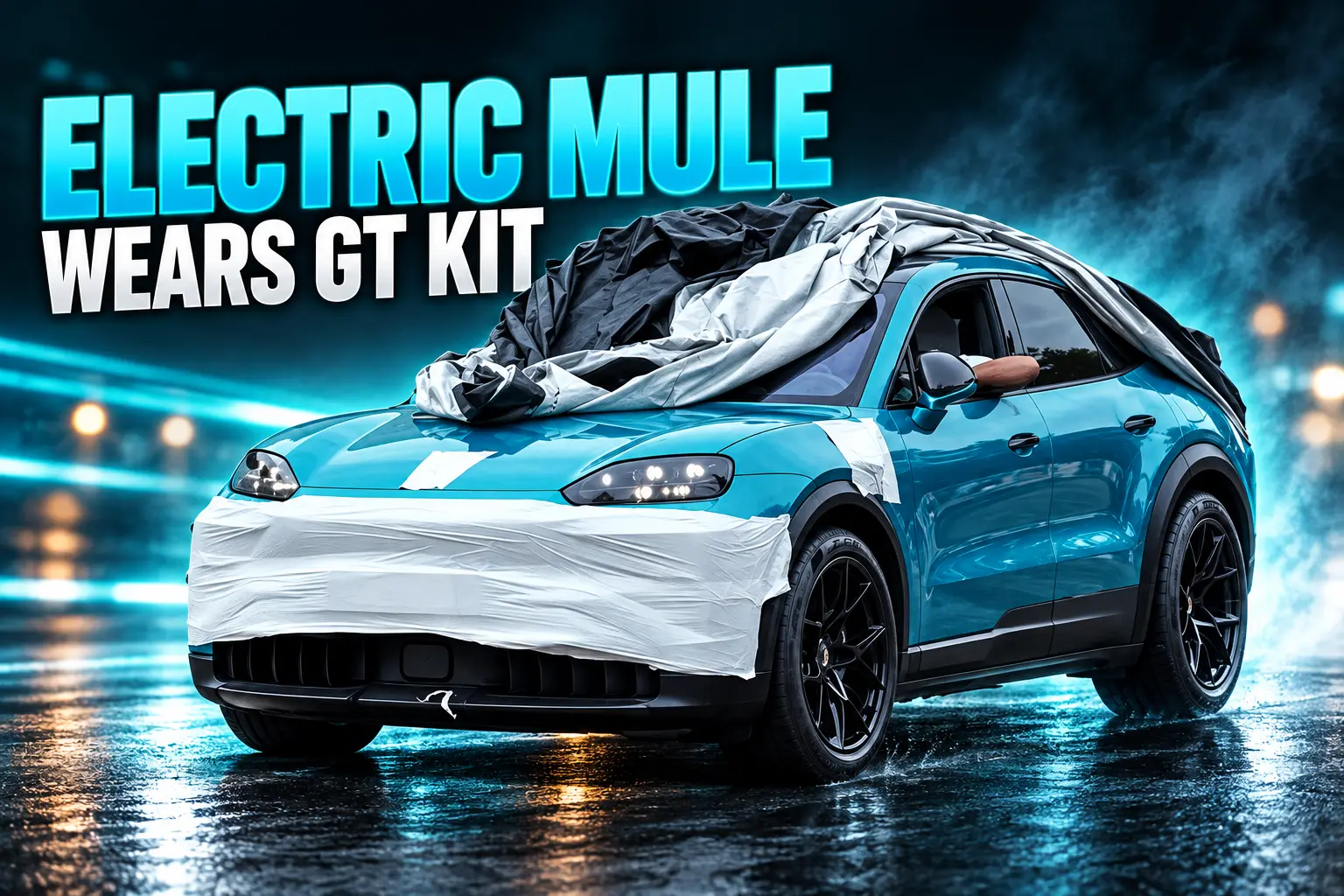
The electric mule is wearing a ducktail, fender covers, and lamps that recall a 992-generation 911, the same GT costume Porsche already put on the Taycan Turbo GT. Horsepower is the part of this job it finished first.
Quad Lights, a Ducktail, and Pirelli P Zeros
The car in the early October photographs is a Cayenne Coupe, not the upright SUV, and it is electric. Thick Pirelli P Zeros sit on light alloy wheels, and large discs fill the arches. Darkened door handles and mirrors finish a familiar Porsche GT look, the kind that usually arrives with carbon trim once the tape comes off.
This is not the V8 Turbo GT that ran the Nordschleife in September with almost no camouflage. The electric coupe still wears a cover over the tail, and a rear three-quarter view shows a ducktail lip under that tarp, a shape the standard Turbo Coupe Electric does not use. Headlamps drop the four slim light bars of the production Electric for quad rounded units that read like a 992 911.
Earlier in 2026, a black mule on winter tests wore a much taller rear wing, a deep front splitter, and black tape over the front fenders. Those taped patches were read as race-style vents, the sort Porsche uses on a 911 GT3 RS to bleed pressure from the wheel wells. The October car looks calmer. The wing has shrunk to a ducktail. The lights are closer to production. Porsche has not said whether those were two stages of one car or two different GT kits.
WHAT THE OCTOBER MULE SHOWS
- The lamps: Quad rounded lights replace the four slim bars on the current Cayenne Electric.
- The tail: A ducktail lip sits under a tarp, where the standard coupe uses a pop-out spoiler.
- The fenders: A cover sits over a vent or flare just behind the front wheels.
- The rubber: Thick Pirelli P Zeros wrap light alloy wheels with large brake discs behind them.
- The trim: Door handles and mirrors are darkened, a usual Porsche tell on a GT special.
None of that hardware confirms a power figure. It does confirm Porsche is still sculpting air around a coupe that already uses active aeroblades, an adaptive rear spoiler, and cooling flaps on the regular Turbo Electric.
What the Current Cayenne Turbo Electric Makes
Porsche unveiled the Cayenne Electric and Cayenne Turbo Electric on November 19, 2025, and called the Turbo the most powerful production Porsche it had built. Launch Control unlocks 1,139 hp with Launch Control, listed as 850 kW, with 1,106 lb-ft of torque. Porsche quotes 2.4 seconds to 60 mph, a 9.9-second quarter mile, and a 162 mph track top speed on summer tires.
Those peaks are brief. In normal driving the dual-motor setup is rated at 630 kW, or 844 hp. A steering-wheel Push-to-Pass button adds 130 kW, 173 hp, for 10 seconds, which takes the rolling total to 1,017 hp. The rear motor uses a 940 A silicon carbide inverter and direct oil cooling, a layout Porsche ties to motorsport. A front motor of 362 hp and a rear motor of 804 hp were recorded on one instrumented test car.
CAYENNE TURBO ELECTRIC, AS SOLD
- Launch output: 850 kW / 1,139 hp and 1,106 lb-ft with Launch Control.
- Maker sprint: 2.4 seconds to 60 mph, 9.9 seconds through the quarter mile.
- US price: $163,000 before a $2,350 delivery fee, $165,350 as a dest-in starter.
- Charge window: 10 to 80 percent in 16 minutes at up to 400 kW on an 800-volt pack.
The pack is a 113 kWh high-voltage battery with cooling plates above and below the cells. Porsche says the motors can recoup up to 600 kW and handle about 97 percent of everyday braking, with optional Porsche Ceramic Composite Brakes for harder use. Towing is rated at 7,716 pounds. Optional inductive charging at 11 kW is listed from the second half of 2026.
Below the Turbo, the Cayenne Electric starts at $109,000 with 435 hp and a 4.5-second run to 60 mph, limited to 143 mph. The S Electric is $126,300, 657 hp, 3.6 seconds, and 155 mph. On April 24, 2026, Porsche added the Coupe Electric at $113,800, the S Coupe Electric at $131,200, and the Turbo Coupe Electric at $168,000, again before the $2,350 fee. The coupe roof sits 24 millimeters lower and the drag figure falls from 0.25 to 0.23. Deliveries of the Electric models were scheduled to begin at the end of summer 2026.
Independent instrumented testing published in September 2026 put one Turbo Electric SUV at 5,960 pounds and recorded 2.1 seconds to 60 mph, a number that omits a one-foot rollout of 0.2 seconds. That same car ran the quarter in 9.5 seconds at 146 mph, reached 100 mph in 4.5 seconds, and was governor-limited at 166 mph. Optional 17.3-inch front and 16.1-inch rear carbon-ceramic discs, a $10,900 extra, stopped it from 70 mph in 140 feet and held 1.05 g on a 300-foot skidpad, on Pirelli P Zero R tires sized 285/40R-22 front and 325/35R-22 rear. As tested it listed at $194,600.
Porsche already gives the Turbo Electric a Sport Chrono package with Track Endurance Mode, and the Turbo’s active aeroblades extend from 34 mph and tuck away below 21 mph. The GPS coordinates of the Weissach wind tunnel are etched on those blades. The GT mule is arriving after all of that hardware is already in the showroom.
The V8 Turbo GT Gets a Weissach Pack
The combustion Cayenne Turbo GT is the other car in this picture. It is a coupe-only, four-seat V8 with no hybrid battery, built around a 4.0-litre biturbo eight. Porsche’s latest figures, circulated on September 24, 2026, put it at 485 kW, 659 PS, 19 PS more than the prior tune, with 850 Nm, 3.3 seconds to 100 km/h, and a 305 km/h top speed. Pistons, rods, crankshaft, and the timing chain drive were revised for sustained load. A titanium sports exhaust still dumps through central pipes.
That GT is the SUV Porsche used to take the official production record on the Nürburgring Nordschleife. On June 14, 2021, test driver Lars Kern lapped the 20.832 km circuit in 7:38.925. The updated car rides 15 millimeters lower than a regular Cayenne and takes ceramic brakes, active anti-roll, torque vectoring, and rear-axle steering as standard. It is not offered in Europe, Japan, Hong Kong, India, Taiwan, or Singapore, among other markets, because of emissions rules.
In May 2025 the same model set a 2:14.046 production SUV lap of the 5.281 km Yas Marina Grand Prix circuit, with racing driver Ramez Azzam driving.
The power and sound of the engine is impressive, but what sets the Cayenne Turbo GT apart is its braking and handling performance. For a car of this size to brake so late, carry so much corner speed and sit so flat is remarkable. I could push it so hard and still have confidence.
Ramez Azzam, racing driver, Yas Marina Circuit
Photographs from September 9 to 11, 2026, show a black Turbo GT on the Nordschleife with a large rear wing, a revised front bumper, and almost no wrap. A roll cage is visible through the glass. That is Weissach-pack hardware, the same extra-light, extra-aero label Porsche already sells on the Taycan Turbo GT. A show date has been guessed at late 2026 or early 2027. Porsche has not confirmed one.
The Taycan Turbo GT Already Did This Job
The electric GT playbook is not a rumor. It is a $239,400 Taycan. Porsche lists the Taycan Turbo GT with Weissach Package at 760 kW and 1,019 hp on Launch Control, 2.1 seconds to 60 mph, and 190 mph. A two-second peak of 815 kW, 1,092 hp, sits above that. The Weissach car deletes the rear seats. Lars Kern took a pre-production Turbo GT around the Nordschleife in 7:07.55 and around Laguna Seca in 1:27.87.
The Cayenne Turbo Electric already out-guns that Taycan on the launch figure, 1,139 hp against 1,019 hp, a gap of 120 hp, and 47 hp above the two-second Taycan peak. What it does not have is the Taycan GT’s fixed wing, stripped cabin, and track mass. The October Cayenne mule is borrowing the costume, not the two-seat diet.
THREE PORSCHE GTS, ON PAPER
| Model | Peak output | Maker sprint | Track top speed |
|---|---|---|---|
| Cayenne Turbo Electric | 1,139 hp | 2.4 sec to 60 mph | 162 mph |
| Cayenne Turbo GT (V8) | 659 PS | 3.3 sec to 100 km/h | 305 km/h |
| Taycan Turbo GT Weissach | 1,019 hp | 2.1 sec to 60 mph | 190 mph |
The V8 still owns top speed. The Taycan still owns the official sprint claim among these three. The electric Cayenne owns the horsepower chart and, in that September test, a quarter-mile Porsche quotes at 9.9 seconds and the test gear timed at 9.5 seconds. A GT badge on the Cayenne EV has to change how that weight uses a corner, because the motors have already done their party trick.
A 5,960-Pound SUV Wants GT Aero
The instrumented Turbo Electric SUV weighed 5,960 pounds. That is the number hanging over every ducktail in these photographs. Porsche can add inverter current, as it did when the Taycan Turbo GT received a higher-flow unit. It cannot delete a structurally integrated 113 kWh pack without building a different car. The visible work on the mule is therefore air and rubber: a lip, vents, Pirellis, and big discs.
Kyle Conner, who sets the times for the One Lap series, ran a Cayenne Turbo EV on max-performance tires and put it 0.27 seconds behind a Lucid Air Sapphire on the same day, same track. He wrote that he eased off slightly because it was a viewer’s car.
“It’s BANANAS that the 6,000lb Cayenne can even come close to matching Sapphire & and it can tow 7,713lbs,” Conner wrote. Porsche’s own tow rating is 7,716 pounds. The slip is one decimal of enthusiasm. The point stands. A family EV that tows a heavy trailer is already being asked to mimic a track sedan.
That is why a second, hotter electric Cayenne is an aero project first. Extra downforce and vented arches are how Porsche has always made a GT out of a car that already had enough power. The 911 recipe is lamps, a lip, and brakes, then a power bump if the motor will take it. Applying that recipe to a near-three-ton coupe is the expensive half of the job, and it is the half these photographs actually show.
Electric and V8 GTs Are Moving in Parallel
Porsche said at the Electric launch that combustion and plug-in hybrid Cayennes stay on sale beside the battery cars, a three-way range it called a commitment to choice. The October mule and the September Weissach V8 are that policy with GT badges on. One program is putting 911 lights on an 850 kW coupe. The other is still chasing Nordschleife time with a 4.0-litre eight and a cage in the cabin.
HOW BOTH GT PROGRAMS SHOWED UP
- November 19, 2025: Porsche unveils the Cayenne Electric and Turbo Electric, 1,139 hp on Launch Control.
- February 2026: A black electric Coupe mule is photographed with a tall wing, splitter, and taped fender vents.
- April 24, 2026: The Coupe Electric goes on sale beside the SUV, Turbo Coupe from $168,000, drag figure 0.23.
- September 9-11, 2026: A V8 Turbo GT with Weissach wing and a roll cage laps the Nordschleife almost undisguised.
- October 1, 2026: A barely wrapped electric Coupe shows 992-style lamps and a ducktail under a tarp.
The Turbo Coupe Electric has been a production car for only a few months. A full facelift is unlikely. A GT kit is exactly how Porsche adds a harder model without waiting for a new generation. What it will be called, what it will make, and when it will be shown are still open. Porsche has not confirmed a Turbo GT Electric badge, a power target, or a date.
The tarp still covers the ducktail, and the V8 still has a cage in it.

Kulbergs Leads Latvia’s Election With a Fragile Coalition

Tesla Held Deliveries While Rival EV Lines Collapsed

US Caps Jet-Part Licenses to Keep COMAC From Stockpiling

Greg Lui Routed $300 Million in GPU Servers Through Malaysia

Netflix Sends KPop Demon Hunters 2 to Theaters First

Glacier Collapse Buried Nepal’s Hydropower Workers in Tunnels

Congo’s Bundibugyo Outbreak Outruns the Licensed Ebola Shots

CISA’s Known Exploits Still Come From 2007-Era Bugs

Germany Can Miss Its 2026 Climate Cap Without Penalty

AI Server Boards Put Everyday Circuit Materials on Allocation
-
 NEWS1 month ago
Glacier Collapse Buried Nepal’s Hydropower Workers in Tunnels
-
 NEWS1 month ago
Congo’s Bundibugyo Outbreak Outruns the Licensed Ebola Shots
-
 NEWS1 month ago
CISA’s Known Exploits Still Come From 2007-Era Bugs
-
 NEWS1 month ago
Germany Can Miss Its 2026 Climate Cap Without Penalty
-
 NEWS4 weeks ago
AI Server Boards Put Everyday Circuit Materials on Allocation
-

 NEWS1 month ago
A Cow Rumen Enzyme Dissolves Superbug Biofilms on Gauze
-

 BUSINESS1 month ago
Trump’s Venezuela Oil Deal Leaves the Barrels in the Ground
-

 NEWS1 month ago
Pennsylvania Measles Deaths Follow a Long Slide in Coverage