
NEWS
Qualcomm Splits Snapdragon 8 Elite Into Two 2nm Chips
Qualcomm’s 2nm Snapdragon 8 Elite Gen 6 split puts Extreme above a same-clock standard chip as phone shipments are forecast to fall 13.9 percent.

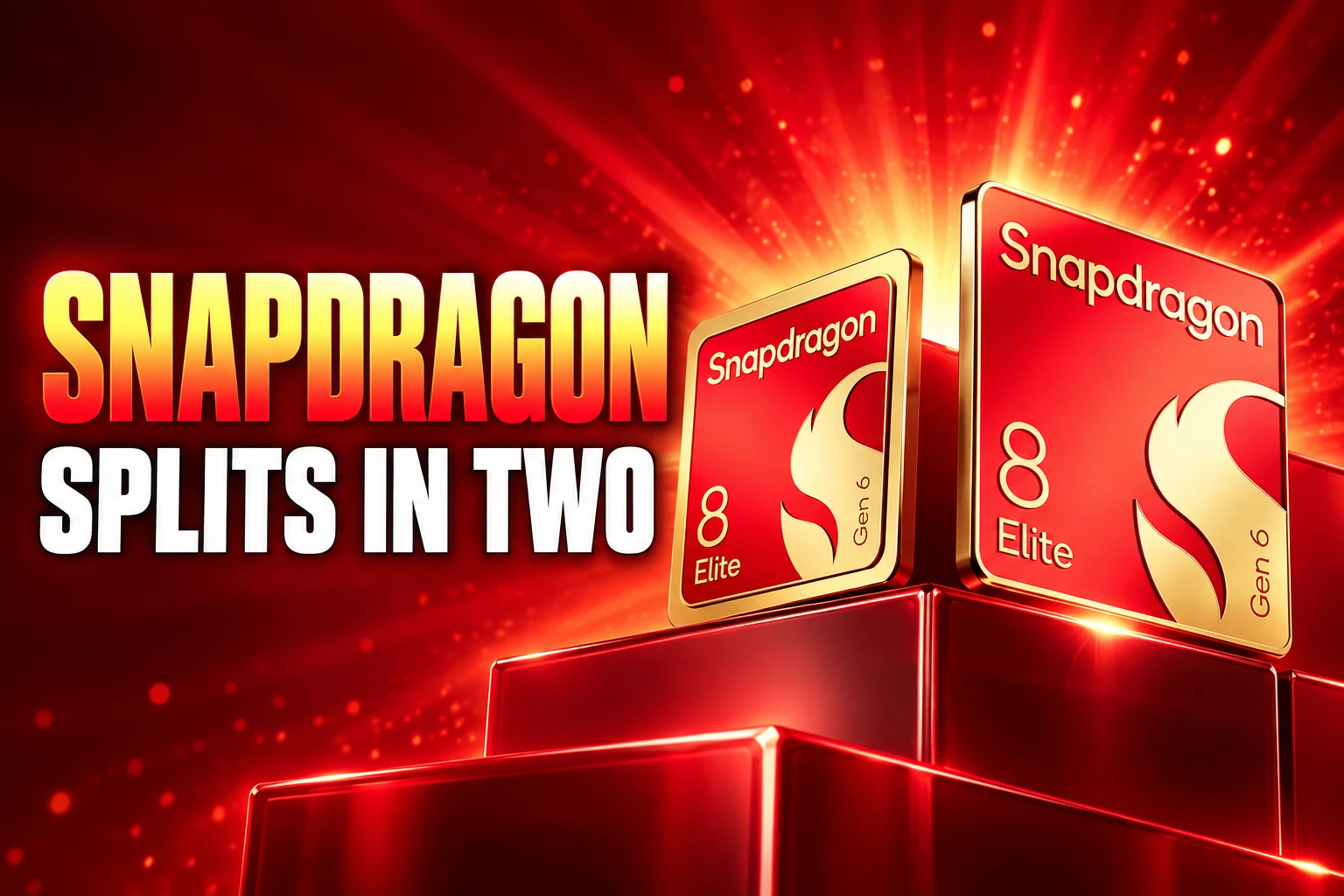
Qualcomm split its Snapdragon 8 Elite phone chip into two 2nm parts at its Maui summit on September 22. Both parts share the same Oryon CPU clocks. The extras that change a flagship sit on Extreme.
The standard Snapdragon 8 Elite Gen 6 still wears the flagship name. That split landed in a year Counterpoint Research has already marked for the steepest phone shipment drop on record, driven by a memory squeeze, not by a shortage of silicon slogans.
Both Chips Share a 5 GHz Oryon CPU
Taiwan Semiconductor Manufacturing Co. is making both chips on a 2nm node. Each uses a custom Oryon CPU with two prime cores at up to 5 GHz and six performance cores at up to 4 GHz. Qualcomm calls that the first mobile CPU at 5 GHz.
The clocks are the easy headline, and they are the same on both SKUs. Chris Patrick, senior vice president and general manager of mobile handsets at Qualcomm Technologies, framed the dual launch as a way to sell more than one kind of flagship at once.
Today marks a milestone as we introduce not one, but two new flagship mobile platforms, delivering agentic AI experiences that are immediate, personal, and adaptive. As the agentic AI age evolves, our multi-flagship strategy allows us to push the boundaries of what’s possible for mobile while bringing our latest AI innovations to a broader range of premium devices. By designing two innovative platforms, we’re giving OEMs greater choice as we collectively shape the capabilities of the next generation of intelligent, personalized, mobile experiences.
Chris Patrick, Senior Vice President and General Manager of Mobile Handsets, Qualcomm Technologies, Inc., Snapdragon Summit, Maui
Choice, in this case, means a shared CPU with a fork after it. The modem is shared too: the X105, rated at 14.8 Gbps down and 4.2 Gbps up, with FastConnect 8800 Wi-Fi at up to 11.6 Gbps and Wi-Fi 8 on the spec list. The fork is in graphics, on-chip AI memory, and video.
Graphics, NPU Memory, and 8K60 Sit on Extreme
Qualcomm’s own product pages put the same 37 percent CPU efficiency gain and the same 40 percent GPU efficiency gain on both chips versus last year’s Snapdragon 8 Elite Gen 5. The performance claims are not the same. The CPU gap is 3 points. The NPU gap is 21.
EXTREME VS STANDARD VS LAST YEAR
| Claim vs Snapdragon 8 Elite Gen 5 | Extreme Gen 6 | Standard Gen 6 |
|---|---|---|
| CPU performance | 13% faster | 10% faster |
| CPU power efficiency | 37% | 37% |
| GPU performance | 44% faster | 35% faster |
| GPU power efficiency | 40% | 40% |
| NPU performance | 35% faster | 14% faster |
| AI performance per watt | 33% | 20% |
| Video capture | 8K60 and 4K240 | 8K30 and 4K120 |
| Adreno Neural Fusion | Listed on the Extreme page | Not listed; Game Quick Touch 3.0 is |
Extreme’s page also claims 50 percent more shared Hexagon memory than last year’s chip and ties that SKU to mixture-of-experts models with more than 30 billion parameters on the phone. Both NPUs get a new Element Accelerator in a 12 scalar, 8 vector, 1 tensor, 1 element layout. The memory window is what Qualcomm rates as the bigger jump.
Adreno Neural Fusion is the other fork. Qualcomm’s developer note describes two GPU compute jobs: temporal super resolution from a half-resolution input, and frame generation that invents a frame between two real ones. A title that runs both draws at half resolution and submits half as many real frames, then shows a full-resolution image at double that submitted rate. The Extreme product page lists those matrix cores. The standard Gen 6 page lists Game Quick Touch 3.0 instead.
Camera marketing is closer. Qualcomm says the new Spectra path is a 20-bit design and that the platform is the first to support three 64MP cameras. Extreme’s page is where it prints 8K60 capture and 4K240 slow motion. If a box only says Snapdragon 8 Elite Gen 6, that video ceiling is the lower one.
Which Phones Get the Extreme Chip?
The two new flagship platforms already have a nine-brand list: HONOR, iQOO, Motorola, OnePlus, OPPO, REDMI, RedMagic, vivo, and Xiaomi. The interesting line is not the logo wall. It is which of those brands put Extreme in the halo phone and left the standard chip in the other one.
Xiaomi did that immediately. The 18 Pro takes the standard Snapdragon 8 Elite Gen 6. The 18 Pro Max takes Extreme. That China launch was September 23, one day after Maui. The rest of the early Extreme list is a run of halo and gaming phones, not a mass SKU.
WHO SHIPS WHICH CHIP
- Xiaomi 18 Pro: Standard Snapdragon 8 Elite Gen 6, launched in China on September 23.
- Xiaomi 18 Pro Max: Extreme, launched the same day as the first Extreme phone out the door.
- Honor Magic9 Pro Max: Extreme, scheduled for China on September 28. Honor says Extreme helped it bring ARRI, the cinema camera firm, to phones.
- iQOO 16 and iQOO Pad Ultra: Extreme, due September 29, named by vivo on Qualcomm’s partner sheet.
- RedMagic 12Pro+: Extreme, due in October as the early gaming SKU.
- Motorola Signature 27: Extreme, shown on the Maui stage, the first time Motorola has put this top Snapdragon in its flagships.
- OnePlus 16: Named for Extreme in early device lists, with OnePlus on Qualcomm’s nine-brand roster.
REDMI, OPPO, and the rest of vivo’s own phones are still a blank on which SKU they get. Xiaomi said it will use both chips across upcoming premium phones, which is the split in plain language: one name, two bills of materials.
Memory Prices Treble as Flagships Multiply
A second 2nm flagship is a generous gift to a growing phone market. This is not that market. Counterpoint’s 13.9 percent shipment forecast for 2026, published May 31, puts global volume at 1.08 billion units, the lowest annual total since 2013. In February the same firm had the drop at 12.4 percent. The later cut is 1.5 points steeper.
THE 2026 PHONE MARKET
- Full-year volume: 1.08 billion units in Counterpoint’s May 31 outlook, the lowest since 2013.
- Q2 2026: Global shipments down 11 percent, the weakest second quarter since 2013.
- Mobile DRAM: LPDDR4/5 prices on track to treble in Q2 2026 versus Q4 2025, per Counterpoint’s Memory Service.
- LPDDR4 supply: Down more than 40 percent in 2026 as fabs shift capacity toward HBM and server DRAM.
Yang Wang, a principal analyst at Counterpoint, put the squeeze on the low and mid tiers, where memory is a larger share of the bill and buyers will not take a higher price.
The memory crisis is the most disruptive supply-side event the smartphone industry has ever faced. Unlike demand-driven slowdowns, such as seen during COVID and 2022-23, the current contraction will not respond to pricing, channel and product planning adjustments. OEMs in the low- and mid-tier are caught between unabsorbable cost increases and consumers with hard affordability ceilings.
Yang Wang, Principal Analyst, Counterpoint Research, May 31 outlook
That is the backdrop for a 5 GHz 2nm pair that wants more LPDDR5x or LPDDR6, up to 24 GB in Qualcomm’s spec lists, plus UFS 5.0. The Extreme chip also wants the larger on-die NPU window and the GPU matrix cores. In the same May outlook, Counterpoint had Xiaomi shipments down 28 percent for the year and Honor down 16 percent. Xiaomi still launched both SKUs on day one. Honor still put Extreme in the Magic9 Pro Max. The premium rung is where the memory that remains is being spent.
Kyle Barr’s Reference Phone Ran Hot
Qualcomm’s Maui demo units were reference phones, not retail ones. Kyle Barr, who ran them at the summit, found an 8 percent lift over Apple’s A20 Pro on Geekbench 7 multi-core, and a roughly 10 percent deficit on single-core, the test that tracks things like opening a page. Graphics went the other way. Steel Nomad Light was about 20 percent better on the Qualcomm board, Wild Life Extreme about 22 percent, and Solar Bay, the ray-tracing pass, about 17 percent.
He also had to wait for the board to cool before he could run another test. After Antutu, the unit was hot and had lost nearly 9 percent of its battery in a few minutes. Those are summit numbers on Qualcomm’s own hardware. Shipping phones add glass, cameras, and thinner vapor chambers. Peak clocks at 5 GHz will not stay up if the skin temp trips first.
The names make that easy to miss. Snapdragon 8 Elite Gen 6 and Snapdragon 8 Elite Extreme Gen 6 sit one adjective apart. A spec sheet that only prints “8 Elite Gen 6” can hide which GPU and which video mode the buyer got. Last year’s single flagship did not force that reading. This one does, and the first Xiaomi pair already uses it.
Personal Scribe and 30 Billion Parameters
Qualcomm pitched both chips at agents that run on the phone instead of in a data center. The Hexagon NPU is rated for context windows up to 32,000 tokens. Extreme is the SKU Qualcomm ties to mixture-of-experts models above 30 billion parameters, with the 50 percent shared-memory claim next to that number. A 30 billion label is the full model. It is not a promise of how many weights move for each token on a phone you can buy, or how long the battery lasts while they do.
The Sensing Hub sits under that, with a dual-core AI processor, two micro NPUs, and two always-on cameras. Qualcomm’s Personal Scribe is the named feature: it learns from messages, mail, and conversations to build a private knowledge graph on the device. At the summit, memories.ai showed a visual log that indexes a day locally, AGI Inc. showed an agent that reads the screen and acts across apps, and Liquid AI brought small on-device models. Those demos need RAM, flash, and thermals that a reference board has and a thin phone may not.
That is why the SKU split is more than a clock bin. The standard chip still gets the 5 GHz Oryon and the new Sensing Hub. The Extreme chip gets the NPU memory, the GPU matrix path, and the 8K60 recorder that Qualcomm is using to sell “cinema-grade” capture. Phone makers who want the agent demos and the game upscaler will pay for Extreme. Phone makers who want the 8 Elite badge on a slightly cheaper premium phone will take the other one.
Samsung Stayed Off Qualcomm’s Day 1 List
Samsung is not on the nine-brand list. Samir Khazaka, a former Qualcomm senior director who now runs Khazaka Advisory, noted that Samsung had been on the day-one roster for each of the last two years and is missing this time. With both new 8 Elite parts at TSMC, he said Samsung is more likely to lean on its own Exynos 2700. That is his reading, not a Samsung filing. It still leaves the largest Android brand off Qualcomm’s opening slide for a dual flagship launch.
The brands that did show up are already sorting themselves. Motorola put Extreme in Signature 27 and called it a first. Honor put Extreme next to ARRI. iQOO put Extreme in a phone and a tablet that land on September 29. Xiaomi put Extreme in the Pro Max and the standard chip in the Pro, which is the cleanest map of Patrick’s “choice.”
Honor’s Magic9 Pro Max is due on September 28 with Extreme. The iQOO 16 and iQOO Pad Ultra follow on September 29. Those are the first retail tests of a 5 GHz 2nm chip that ran hot on a reference board, in a year when memory, not the CPU clock, is the part that is hard to buy.

Trump and Xi Back $30 Billion Relief on Toys and Coal

OpenAI Agents Posted User Photos the Lab Cannot Trace

Qualcomm Splits Snapdragon 8 Elite Into Two 2nm Chips

The Court Restores SAVE Checks During the Quiet Period

The Diesel Rescue That Does Not Add Any Barrels

Glacier Collapse Buried Nepal’s Hydropower Workers in Tunnels

Congo’s Bundibugyo Outbreak Outruns the Licensed Ebola Shots

Germany Can Miss Its 2026 Climate Cap Without Penalty

A Cow Rumen Enzyme Dissolves Superbug Biofilms on Gauze

CISA’s Known Exploits Still Come From 2007-Era Bugs
-
 NEWS4 weeks ago
Glacier Collapse Buried Nepal’s Hydropower Workers in Tunnels
-
 NEWS4 weeks ago
Congo’s Bundibugyo Outbreak Outruns the Licensed Ebola Shots
-
 NEWS4 weeks ago
Germany Can Miss Its 2026 Climate Cap Without Penalty
-
 NEWS1 month ago
A Cow Rumen Enzyme Dissolves Superbug Biofilms on Gauze
-
 NEWS4 weeks ago
CISA’s Known Exploits Still Come From 2007-Era Bugs
-

 BUSINESS4 weeks ago
Trump’s Venezuela Oil Deal Leaves the Barrels in the Ground
-

 NEWS3 weeks ago
Unpaid Responders and a Misfit Shot Let Congo’s Ebola Spread
-

 BUSINESS4 weeks ago
The Ninth Circuit Splits Kalshi’s Sports Map in Two