
NEWS
Ebola Eases in Ituri While North Kivu’s Cases Double
WHO hails an Ituri drop, but North Kivu’s weekly Ebola count has doubled and Bundibugyo still has no licensed vaccine in Congo.

Congo’s national public health institute counted 7,475 confirmed Ebola cases and 3,605 deaths on Friday, Sept. 18, in the country’s largest outbreak on record. The count is still rising.
Two days earlier, WHO Director-General Tedros Adhanom Ghebreyesus told reporters in Geneva that spread is falling in the worst-hit parts of Ituri province. In the same briefing he said weekly cases in North Kivu had almost doubled, from about 100 to more than 200.
North Kivu’s Weekly Count Has Doubled
The Bundibugyo virus behind this epidemic is a rare Ebola species. Congo declared the outbreak on May 15, its 17th Ebola epidemic and only the third Bundibugyo outbreak ever recorded. WHO named it a Public Health Emergency of International Concern on May 17.
Tedros said he now sees encouraging signs that we are gaining ground in Ituri, still the centre of the epidemic. South Kivu has reported no new cases since May. More than 1,700 people have recovered. A small Uganda cluster was stopped. He also said the epidemic continues to grow and continues to kill.
In the week before that briefing, Ituri still logged around 300 new cases and 160 deaths, nearly half the national total, a drop from a high base. North Kivu is on the other slope. Its weekly tally almost doubled in two weeks, and its patients are dying at a higher rate than Ituri’s.
The European Centre for Disease Prevention and Control, compiling Congolese figures, put the country at 7,404 confirmed cases and 3,577 deaths as of Sept. 15, with 930 people in hospital isolation. That cut, two days before the Friday total, is the latest public split by province.
CASES AND DEATHS BY PROVINCE, SEPT. 15
| Province | Confirmed cases | Deaths | Death rate | Health zones |
|---|---|---|---|---|
| Ituri | 5,751 | 2,622 | 45.6% | 28 of 36 |
| North Kivu | 1,323 | 821 | 62.1% | 16 of 34 |
| Haut-Uélé | 290 | 118 | 40.7% | 6 of 13 |
| Tshopo | 29 | 10 | 34.5% | 7 of 23 |
| Bas-Uélé | 7 | 4 | 57.1% | 3 of 11 |
| South Kivu | 3 | 1 | 33.3% | 1 of 34 |
| Sud-Ubangi | 1 | 1 | 100% | 1 of 16 |
| DRC total | 7,404 | 3,577 | 48.3% | 62 of 167 |
Ituri still held 77.7% of those confirmed cases. North Kivu held 17.9% of cases and a 62.1% death rate, against 45.6% in Ituri. Contact follow-up sat at 87.4% of identified contacts. Tedros called the east too vast to treat as one epidemic, with cities such as Kisangani (1.5 million people), mining zones, conflict-affected land, and sparse border country near South Sudan.
The area is so vast that it is hard to speak of a single epidemic. It is many outbreaks, in many places. We must get the response right in every one of them.
Tedros Adhanom Ghebreyesus, WHO Director-General, media briefing in Geneva, Sept. 16, 2026
A local drop in Ituri does not close those other outbreaks. It changes where the next chains have to be broken.
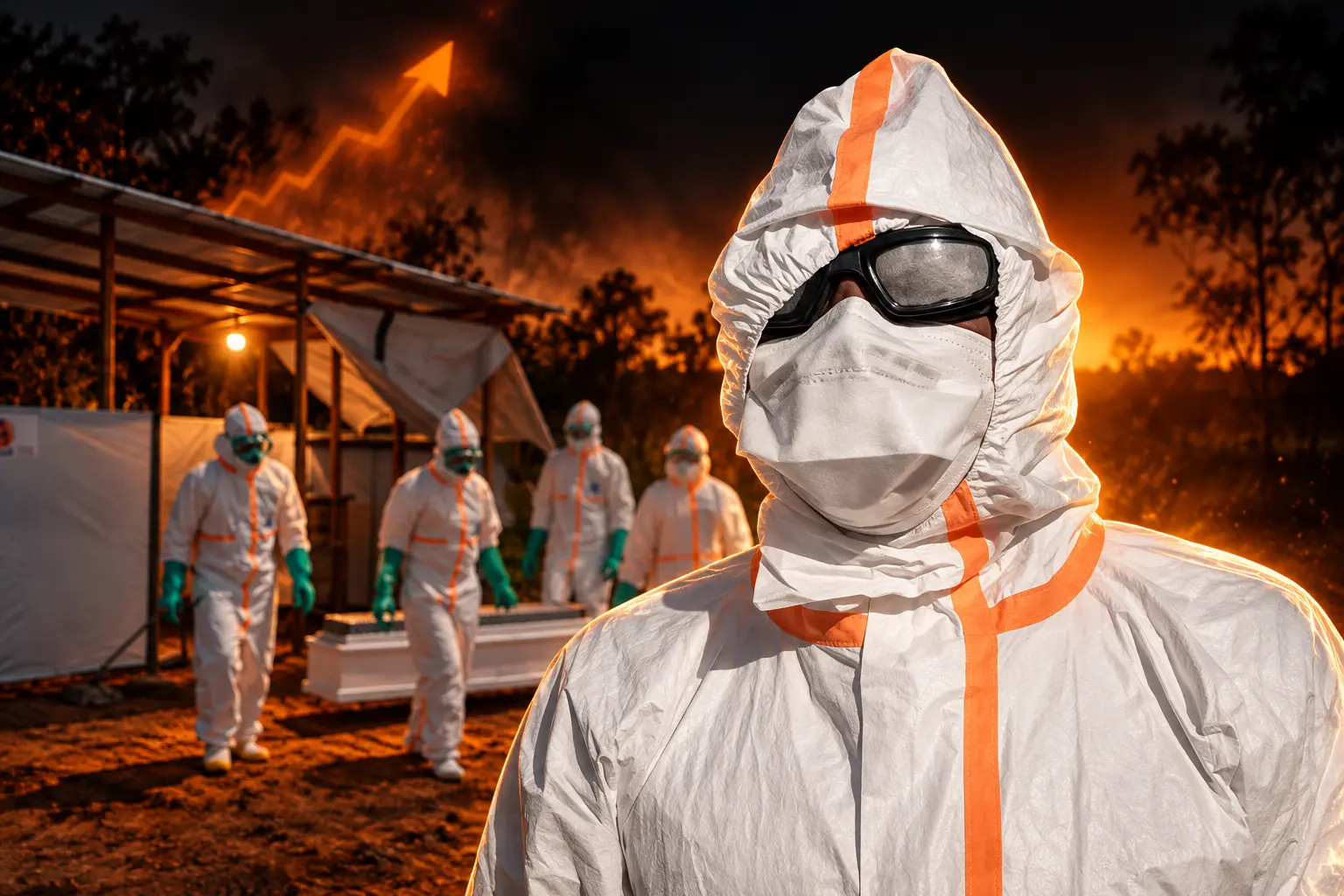
No Earlier Outbreak Grew This Fast
U.S. CDC staff compared the first 100 days of this epidemic with four earlier Ebola outbreaks. From detection on May 14 through Aug. 21, Congo recorded 5,458 confirmed cases in the first 100 days and 2,606 deaths, 48% of those patients. No previous Ebola outbreak had caused more than 800 cases by that mark.
FIRST 100 DAYS AGAINST EARLIER EPIDEMICS
| Outbreak | Early case count | Final size | Virus |
|---|---|---|---|
| 2026 DRC | 5,458 confirmed (100 days) | Still growing | Bundibugyo |
| 2014 West Africa | 759 (100 days) | 28,610 cases, 11,308 deaths | Zaire |
| 2018 DRC | 295 confirmed, 38 probable (103 days) | 3,470 cases, 2,287 deaths in 22 months | Zaire |
| 2007 Uganda | Fewer than 50 (100 days) | 131 cases, 42 deaths | Bundibugyo |
| 2012 DRC | Fewer than 50 (100 days) | 62 cases, 34 deaths | Bundibugyo |
CDC authors wrote that the 2026 count at day 100 was seven times the West Africa figure at the same point. Congo’s current total is already more than twice the final size of the 2018-2020 North Kivu epidemic, which ran 22 months. It is about a quarter the size of the West Africa epidemic, which lasted about two years.
On the day Congo declared, the ministry had eight laboratory-confirmed cases and four deaths, plus 246 suspected cases and 76 suspected deaths. That large suspected pile at the start is a sign the virus had been moving before anyone named it. The two earlier Bundibugyo outbreaks, Uganda in 2007 and Congo in 2012, each stayed inside one district or health zone and ended within six months.
This one had already reached 57 of Congo’s 519 health zones by day 100. As of Sept. 10, CDC found no community spread outside DRC. Uganda recorded 20 confirmed cases and two deaths, with limited local spread mainly among health workers, and closed its outbreak on Aug. 25 after 42 days with no new confirmed case. France identified one travel-related case.
Why the Licensed Shot Does Not Fit
Most of Congo’s past Ebola fights used tools built for Zaire ebolavirus. Ervebo, the licensed ring-vaccination shot, targets that species. Bundibugyo is a different virus. WHO’s Strategic Advisory Group of Experts on Immunization has said Ervebo’s effect against Bundibugyo disease in humans remains unknown, and has advised that the shot be used only inside a research protocol.
The International Coordinating Group on Vaccine Provision told Kinshasa in August it would release 70,000 Ervebo doses: 20,000 for a Phase 3 trial and 50,000 for frontline and health workers. Tedros said vaccine trials should begin in the coming weeks, and that WHO is already preparing to widen access if a product works. Treatment trials and post-exposure prophylaxis, he said, are picking up speed as communities engage.
WHAT IS IN THE FIELD, AND WHAT IS NOT
- Licensed Bundibugyo vaccine: None. Ervebo is licensed for Zaire ebolavirus, not this species.
- Ervebo release: 70,000 doses from the global stockpile, split between a Phase 3 trial and frontline workers.
- Purpose-built shots: CEPI is advancing three investigational Bundibugyo vaccines from IAVI, Moderna, and the University of Oxford with the Serum Institute of India.
- New research money: CEPI put $3.9 million on Sept. 16 into three projects to turn outbreak data into trial design and modelling.
- Approved Bundibugyo drug: None. Care is supportive, and treatment trials are running in parallel with the vaccine work.
That gap is why an Ituri slowdown does not travel on its own. In 2018, responders in these same eastern provinces could throw a proven Zaire vaccine around contacts. This time the ring is an experiment. Burial teams in the old epicenter have not been able to stand down, because the national curve is being rebuilt in a province where the death rate is already higher and the shot on the truck is still unproven against this virus.
Congo’s Health Minister Sees a Peak
Health Minister Samuel Kamba has said daily infections fell from around 120 toward 80 and that the epidemic has passed its peak. Jean-Jacques Muyembe, head of the National Institute of Biomedical Research, has drawn a sharper line: Ituri, he said, has passed a peak and is on a downward slope, while North Kivu’s curve has not reached a plateau.
WHO has refused to bless a national peak. Epidemiologist Olivier le Polain said it is too early to say one has been passed. Maria Van Kerkhove, WHO’s director for epidemic and pandemic management, said staff can be cautiously optimistic and still have to be realistic about the road ahead, because reading trends takes time. She also said many months of work remain.
Anthony Kergosien, emergency coordinator for Médecins Sans Frontières in Bunia, put the field objection in one line on Friday: considering the epidemic under control would be a mistake. New cases, he said, are still appearing in zones that are poorly prepared.
WHERE OFFICIALS DISAGREE ON THE PEAK
- Samuel Kamba: Daily cases have fallen from around 120 toward 80, and the epidemic has passed its peak.
- Jean-Jacques Muyembe: Ituri has peaked; North Kivu has not yet reached a plateau and is another major hotspot.
- WHO epidemiologists: Too early to call a national peak; key indicators are not yet improving as they must.
- MSF in Bunia: Calling the epidemic under control would be a mistake while new cases open in weak zones.
Tedros warned that a small minority have attacked aid workers and health facilities, on top of bad roads and aircraft that often cannot reach people. CDC’s 100-day note listed the same drag: armed groups, thin health infrastructure, attacks on health workers, and community mistrust. Those conditions are heavier in North Kivu than in the Ituri pockets now reporting fewer chains.
One Patient Opened a Seventh Province
Sud-Ubangi, in the north-west, is on the ECDC list with one confirmed case and one death, the seventh province in the outbreak. The other six are Ituri, North Kivu, South Kivu, Haut-Uélé, Tshopo, and Bas-Uélé. Sixty-two of 167 health zones had been affected by the Sept. 15 cut.
Tedros said that after four months the epidemic had been held mostly in north-eastern DRC, aside from the Uganda cluster. The Sud-Ubangi death is the exception that tests that sentence. In a region of high population movement, he said, the outbreak can still spread. The quiet in South Kivu since May shows a chain can be broken. The seventh province shows a chain can also jump a very long way.
Imported cases in Uganda and France did not seed ongoing community outbreaks. CDC said as of Sept. 10 there was no evidence of community transmission outside DRC. That is the part of the map that has held. The part that has not held is the assumption that a cooler Ituri means a cooler country.
The Response Plan Still Needs Money
Tedros asked donors to fully fund both the government’s response plan and the wider humanitarian appeal. An Ebola wave, he said, makes everything else worse: hunger rises, people stay away from clinics, maternal deaths increase, and HIV treatment is interrupted. He said the key indicators are not yet improving as they must, and that the response will need to be sustained over many demanding months.
On Friday, Unitaid said it is putting up to $3.4 million for diagnostics and medicines aimed at Bundibugyo, so tests can sit closer to the affected communities. The same day, Tedros announced that WHO, Africa CDC, and Unitaid had launched BRIDGE-Access in DRC to measure how diagnostic tests perform against this virus.
Diagnostics are essential to bring outbreaks under control. @WHO, @AfricaCDC and @UNITAID launched the BRIDGE-Access initiative (Bundibugyo Response for Improving Diagnostic Global Equitable Access) in the #DRC to generate evidence on how diagnostic tests perform against #Ebola… pic.twitter.com/FxH393PG99
— Tedros Adhanom Ghebreyesus (@DrTedros) September 18, 2026
Those tools arrive while North Kivu’s weekly count is still climbing. Ituri can post a genuine decline and still send staff, doses, and attention into a neighbouring province that is now the faster fire. Until a Bundibugyo-specific shot is proven, or Ervebo is shown to work here, the east is fighting a 2026 virus with a 2018 playbook.
Congo’s Friday tally stood at 7,475 confirmed cases and 3,605 deaths. The next sitrep will show whether North Kivu’s doubled weekly count is a spike or the new centre of the epidemic.
Disclaimer: This article is news reporting on an active Ebola outbreak and is for information only. It is not medical advice, a diagnosis, or a guide to vaccination, travel, or treatment, and it does not tell readers whether to seek care or which product to use. Anyone who may have been exposed, who has symptoms, or who is planning travel to an affected area should speak with a qualified physician or local public health authority before acting. Case counts, death totals, vaccine guidance, and outbreak status come from the cited health agencies as of the dates named above and will change as new situation reports are issued.

Nintendo Pulls SmileBASIC After the First Switch 2 Jailbreak

Arkane Lyon’s Union Holds the Clock Microsoft Cannot Skip

Airbnb Bans Guest Chores as Homes Turn Into Hotels

Riyadh Downs a Houthi Missile After Weeks of Capital Strikes

Ariana Madix’s Empty Los Angeles House Fits a Bravo Pattern

AI Server Boards Put Everyday Circuit Materials on Allocation

Glacier Collapse Buried Nepal’s Hydropower Workers in Tunnels

Congo’s Bundibugyo Outbreak Outruns the Licensed Ebola Shots

Pennsylvania Measles Deaths Follow a Long Slide in Coverage

Germany Can Miss Its 2026 Climate Cap Without Penalty
-
 NEWS2 months ago
AI Server Boards Put Everyday Circuit Materials on Allocation
-
 NEWS2 months ago
Glacier Collapse Buried Nepal’s Hydropower Workers in Tunnels
-
 NEWS2 months ago
Congo’s Bundibugyo Outbreak Outruns the Licensed Ebola Shots
-
 NEWS2 months ago
Pennsylvania Measles Deaths Follow a Long Slide in Coverage
-
 NEWS2 months ago
Germany Can Miss Its 2026 Climate Cap Without Penalty
-

 NEWS2 months ago
Texas Judge Freezes the SEC Eligibility Ban for 41 Athletes
-

 NEWS2 months ago
CISA’s Known Exploits Still Come From 2007-Era Bugs
-

 BUSINESS2 months ago
Trump’s Venezuela Oil Deal Leaves the Barrels in the Ground