
NEWS
Early Glacier Loss Day Spends the Alps Water Bank
Swiss glaciers hit Glacier Loss Day on June 29, three months early, while extra melt still padded Rhône flows that will not last.

Swiss glaciers burned through last winter’s snow by June 29, 2026, the second-earliest Glacier Loss Day on record. From that date, every litre of melt cut into ice the glaciers will not replace until the next winter. Matthias Huss, who runs Glacier Monitoring in Switzerland (GLAMOS), said the date was “three months too early, compared to a healthy state.”
The same heat that emptied the snowpack also sent extra water down some Alpine rivers in a drought year. That is the trap. The runoff looks helpful now because the ice bank is being spent.
Glacier Loss Day Landed on June 29
Glacier Loss Day is the moment a glacier has used up the snow and ice it gained the previous winter. Researchers at the University of Innsbruck framed it in 2022 as a cousin of Earth Overshoot Day. After the date, melt no longer spends this year’s snowfall. It spends the glacier.
Huss’s group at ETH Zurich and the Swiss Federal Institute for Forest, Snow and Landscape Research (WSL) put the 2026 date at June 29. Only 2022 came earlier, on June 26, after a thin winter and three heatwaves, the year Swiss glaciers lost about 6% of their remaining ice, or about 3.1 cubic kilometres. In a typical year the date sits in August. In 2024 it still did. In 2025 it had already slipped into July.
THE GLACIER LOSS DAY CLOCK
- June 26, 2022: Record Glacier Loss Day, after a poor winter and three heatwaves.
- August 2024: The date still falls in its usual late-summer window.
- July 2025: The date moves earlier after a thin snow year and hot spells in June and August.
- June 29, 2026: Second-earliest date on record, three days later than 2022.
The winter of 2025-26 never gave the ice much cover. GLAMOS surveys in April and May found 25 percent less winter snow on Swiss glaciers than in 2010 to 2020, the fourth-lowest result in two decades. Sahara dust arrived in March and darkened the surface. By late June, WSL said the ice was melting at twice the 2010 to 2020 average, and Huss’s team estimated meltwater was leaving Swiss glaciers at a rate equal to filling an Olympic pool every six seconds.
The World Meteorological Organization repeated the GLAMOS finding in early July: once the white cover is gone, darker ice takes in more sun, and melt speeds up. Huss had already watched that switch on the Great Aletsch. In two weeks, Konkordiaplatz went from snow-covered to bare ice, a change he said should have waited one to two months.
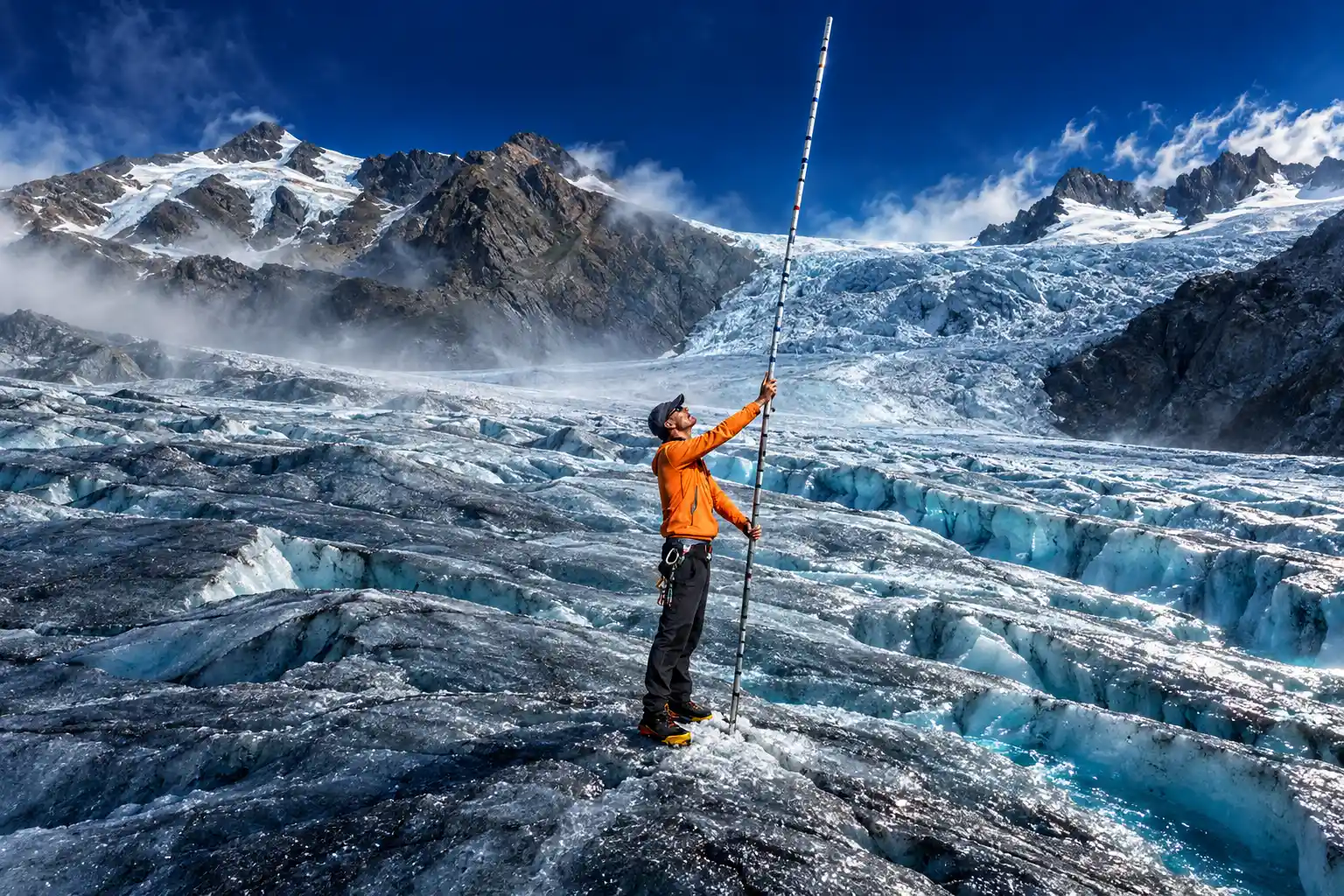
High Melt Is Still Hiding a Water Shortfall
Swiss glaciers have been shrinking for about 170 years. The pace is no longer modest. Huss said volume fell 38% between 2000 and 2024. Switzerland has lost 1,200 glaciers in 50 years and has about 1,300 left. GLAMOS counted 159 glaciers, or 11%, gone between the 2016 and 2023 inventories. The 2025 bulletin put last year’s loss at 3.0%, or 1.4 cubic kilometres, with a mean mass balance of -1.56 metres water equivalent, among the worst tenth of years since 1914.
Between the extreme summers of 2003 and 2022, 200 square kilometres of ice vanished, an area WSL compared with the canton of Zug. That missing ice already shows up in the water account. In June to August 2022, meltwater added less to runoff in most catchments WSL studied than it had in 2003, even though far more ice melted in 2022.
The melt rates, which have been extremely high every year since 2022 and have also been rising significantly in the multi-year average since 2003, are currently still masking this effect.
Matthias Huss, GLAMOS, WSL statement, June 26, 2026
Huss warned that the mask only works while there is still enough ice to over-melt. Once the remaining mass is too small, even a brutal summer cannot put the old volumes into the rivers.
Winter Snow Was Already Short
On the Rhône Glacier in June, Huss measured about 1 metre of ice gone from the tongue in 10 days. GLAMOS later put June and July loss there at more than 4 metres, and 10 centimetres a day as of July. A hole first seen on the Bossons Glacier above Chamonix in 2025 was still open more than a year later. In the 1980s that ice reached the valley floor. Melt streams now run on bare rock beside the receding tongue.
The daytime freezing level in parts of the Alps rose to 4,500 metres in June. Overnight refreezing failed even high up, which raises the odds of wet snow slides and loose slopes. Huss called the ablation “enormous” across the range as Swiss weather stations set all-time heat records.
What Peak Water Means on the Rhône
The Rhône Glacier feeds a river that runs more than 800 kilometres through Switzerland and France. About 2.5 million people drink from it, and farms and towns farther down still treat its late-summer flow as a given. In the 2026 drought, that given briefly looked intact. The Rhône held near-normal volumes because the largest Swiss glaciers were dumping ice, while many rivers on the plateau sat at lows seen once in decades.
The Swiss federal drought briefing said run-of-river plants on the plateau lost output as flows fell, while Alpine storage plants drawing extra melt made up part of the gap. Streams with a real glacier contribution were the ones that did not crash. That is peak water in plain terms: the years when dying ice still sends a lot of water downstream, just before the tap runs down.
THE 2026 WATER LEDGER
- Early-season bonus: Extra melt lifted some high Alpine flows and storage-plant output during the drought.
- Late-summer risk: Once the ice is thinner, the same catchments lose the buffer they used in July and August.
- Who drinks it: About 2.5 million people rely on the Rhône for drinking water, plus farms along the valley.
- The mask: High melt since 2022 is still hiding the drop in ice area that already cut 2022 runoff below 2003.
The late-summer problem is the one the June date announces. A river that looks healthy in a heatwave because a glacier is collapsing will not look healthy when that glacier is a patch of dirty ice. Huss has been blunt about the direction: if warming stays on its recent path, Switzerland will be left with “some little remnants of ice” by 2100.
Tignes Closed Summer Skiing on Thin Ice
The water story is easy to miss because the cameras still point at ski lifts. At Tignes, the Grande Motte Glacier is about a quarter of the resort’s terrain, with about 19 kilometres of summer trails and a summit station at 3,456 metres. The resort still sold summer skiing from 20 June to 15 July, mornings only, “subject to favourable conditions.” The window used to run longer. In 2022, summer skiing there was already over after July 1.
Clement Colin, chief executive of Altta, which runs the Tignes lifts, said people “would not be skiing on the glacier for much longer,” and that summer skiing could disappear within 10 to 15 years. Olivier Duch, Tignes’s first deputy mayor, said the glacier was losing a metre of thickness every two weeks during the 2026 summer. The resort still plans a normal winter opening at the end of November. The glacier that makes the summer product possible is the uncertain part.
SUMMER SKIING THAT STILL RAN
- The dates: Tignes listed glacier lifts from June 20 to July 15, 2026, with morning hours only.
- The share: Grande Motte is about a quarter of the resort’s overall terrain.
- The patch: Snow machines went in at the lower glacier runs in 2013 to stretch the season.
- The limit: Colin put the remaining life of summer skiing at 10 to 15 years.
Jeffrey Schlegelmilch, a Columbia Climate School professor who directs the National Center for Disaster Preparedness, calls that kind of fix maladaptation. It buys a few more seasons while a town stays tied to a product that is leaving.
buys a ski season a few more years while locking a community deeper into an economy that is going away.
Jeffrey Schlegelmilch, Columbia Climate School, interview with GlacierHub
WSL has already photographed the end state at Diavolezza, where a vanished glacier is kept ski-able only with snow farming and covers. On the Rhône, the artificial ice grotto had to close because the protected block, long detached from the glacier, had become too small.
Crevasses Forced Guides Off the Miage
In Italy, the Courmayeur Guides Society pulled clients off the Miage Glacier route up Mont Blanc after the June heat. Alex Campedelli, the society’s president, said “conditions deteriorated quickly” and it was “no longer safe enough to take clients up there.” Meltwater widens crevasses as it drains through the ice. On a glacier that changes week to week, a line that was sound in June can be a trap in July.
That is already an economic fact, not a forecast. Guiding days are cancelled. Summer ski windows shrink. A resort can still print a winter date in November. It cannot reprint a glacier.
Bella Tola Is Already Gone in Valais
The small glaciers do not wait for 2100. Above Saint-Luc in Valais, the Bella Tola Glacier, which still covered about seven football fields in the 2023 inventory, was reported gone in August 2026, reduced to a few snow patches on the 3,025-metre north face. Huss said he could not confirm the death from the photos alone, but that the glacier had not been “active nor in good health” for five years and that a full loss in those days was quite likely. The Urirotstock Glacier in Uri went the same way.
GLAMOS estimated 20 to 30 small Swiss glaciers could lose their remaining ice in 2026. Huss told Swiss radio that several dozen could disappear in the summer. Since 1970, about 1,000 Swiss glaciers have gone; 160 of those losses came between 2016 and 2023.
On September 15, Huss posted a stake photograph from Konkordiaplatz on the Great Aletsch, the largest glacier in the Alps. A layer of almost 6 metres of ice was gone in one summer, in the centre of the glacier. “It is hard to grasp even for glaciologists,” he wrote.
Ice loss on Konkordiaplatz, Great Aletsch Glacier, during summer 2026. No words…
A layer of almost 6 metres of ice is gone. In the center of the biggest glacier of the Alps. It is hard to grasp even for glaciologists.@glamos_ch @VAW_glaciology
Pic: A. Linsbauer pic.twitter.com/nUhWoZb2Rf— Matthias Huss (@matthias_huss) September 15, 2026
In mid-July he had filmed meltwater at the top measurement site on Gries Glacier at 3,000 metres and said, “This situation is incredibly wrong. We should be seeing lots of white snow there.” The stake photos do the same job Glacier Loss Day does on a calendar. They make a slow loss look like a date, or a missing wall of ice.
Researchers Dated the Last Alpine Ice
A December 2025 study in Nature Climate Change, led by Lander Van Tricht at ETH Zurich, is the first to put a year on the disappearance of each of the world’s more than 200,000 glaciers. For Central Europe’s about 3,200 glaciers, the paper’s current-policy path of 2.7 degrees Celsius above pre-industrial levels leaves 110 Central European glaciers remaining by 2100, a 97% loss. Peak glacier extinction in the region, the year when the count of disappearances hits its highest, falls around 2033. In mid-September 2026 the same team put those projections on a public map, the Global Glacier Extinction Explorer.
WARMING PATHS FOR CENTRAL EUROPE
| Warming by 2100 | Glaciers remaining | Share gone |
|---|---|---|
| +1.5 C | 426 | 87% |
| +2.0 C | 269 | 92% |
| +2.7 C | 110 | 97% |
| +4.0 C | 20 | 99% |
Van Tricht said more than half the glaciers in regions like the Alps are expected to vanish within 10 to 20 years. Daniel Farinotti, ETH professor of glaciology and a co-author, said every tenth of a degree still changes how many ice bodies survive. The paper’s point for towns is narrower than sea level. A small glacier that barely moves a tide gauge can still be the reason a valley has a summer ski lift, a guiding route, or a late-August stream.
Schlegelmilch’s question to mountain towns is the one Glacier Loss Day now poses on a calendar. Which of these changes are permanent, and what do the local economy and the pipes need to look like on the other side? June 29 did not answer that. It showed that the ice still filling the Rhône is the same ice those towns are already losing as terrain, as a route, and as a reserve.

Nintendo Pulls SmileBASIC After the First Switch 2 Jailbreak

Arkane Lyon’s Union Holds the Clock Microsoft Cannot Skip

Airbnb Bans Guest Chores as Homes Turn Into Hotels

Riyadh Downs a Houthi Missile After Weeks of Capital Strikes

Ariana Madix’s Empty Los Angeles House Fits a Bravo Pattern

AI Server Boards Put Everyday Circuit Materials on Allocation

Glacier Collapse Buried Nepal’s Hydropower Workers in Tunnels

Congo’s Bundibugyo Outbreak Outruns the Licensed Ebola Shots

Pennsylvania Measles Deaths Follow a Long Slide in Coverage

Germany Can Miss Its 2026 Climate Cap Without Penalty
-
 NEWS2 months ago
AI Server Boards Put Everyday Circuit Materials on Allocation
-
 NEWS2 months ago
Glacier Collapse Buried Nepal’s Hydropower Workers in Tunnels
-
 NEWS2 months ago
Congo’s Bundibugyo Outbreak Outruns the Licensed Ebola Shots
-
 NEWS2 months ago
Pennsylvania Measles Deaths Follow a Long Slide in Coverage
-
 NEWS2 months ago
Germany Can Miss Its 2026 Climate Cap Without Penalty
-

 NEWS2 months ago
Texas Judge Freezes the SEC Eligibility Ban for 41 Athletes
-

 NEWS2 months ago
CISA’s Known Exploits Still Come From 2007-Era Bugs
-

 BUSINESS2 months ago
Trump’s Venezuela Oil Deal Leaves the Barrels in the Ground