
NEWS
The iPhone 18 Pro Camera Puts Moving Blades Behind the Lens
iPhone 18 Pro camera adds a six-blade iris and a signed Reference Image, two admissions that software both faked blur and broke photographic proof.

Apple’s iPhone 18 Pro puts six laser-cut aperture blades in its 48MP Fusion Main camera and goes on sale September 18, 2026. The Pro starts at $1,199 in the U.S., the Pro Max at $1,299, and both add an opt-in Reference Image that signs what the sensor saw before software finishes the picture.
Those two features sit in the same lens module, and they answer two different failures of the same idea. Computed blur never fully replaced an iris. Computed photography then made a pretty frame a weak piece of evidence.
Six Hair-Thin Blades Close a Software Gap
On September 9, 2026, Apple said the new Main camera uses six laser-cut blades on a rotor, each thinner than a human hair, and that this is aperture control on an iPhone for the first time. The blades move among f/1.48, f/1.8, f/2.8 and f/4.0. Left alone, iOS opens wide in dim rooms, stays near f/1.8 for a single subject, and closes toward f/4.0 when people stand at different distances.
Greg Joswiak, Apple’s senior vice president of Worldwide Marketing, said the company built the phone so anyone can shoot with variable aperture while still giving creators more control. The stock Camera app can now show live f-stop and shutter icons in the configurable row above the viewfinder. Tap one and a controller runs along the bottom of the frame. Shutter speed goes as long as a full second. ISO still sets itself, so locking aperture or shutter makes the other value and the ISO move to compensate.
That is a real mechanism in a sealed, IP68 body rated to 6 meters for 30 minutes. It is also a reversal of a long Apple habit. For years the Pro camera stayed at a fixed opening and asked silicon to invent the look of a faster lens. The 17 Pro Main camera sat at f/1.78 and never moved. Portrait mode still draws a depth map and paints blur onto the background. The 18 Pro can finally change how much light hits the chip, and how much of a group stays sharp, before that paint starts.
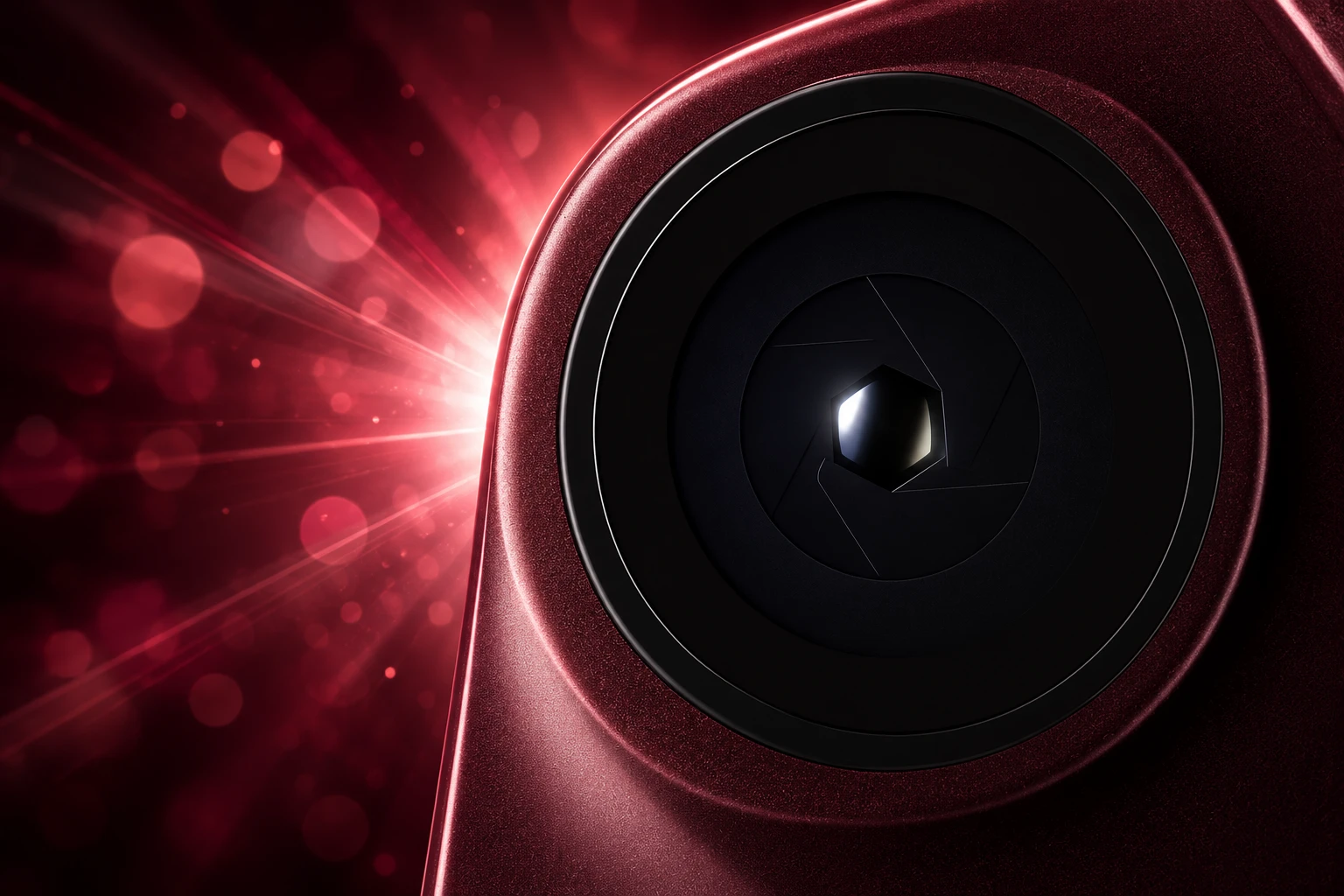
The Stops That Move
Apple’s product page ties each stop to a job. At f/1.48 it claims around 50 percent better low-light performance and faster Night mode frames. At f/1.8 it wants portraits. At f/4.0 it wants the back of a group to hold. Hands-on frames from the first week of shooting showed the iris shifting from shot to shot in the metadata, which is the auto path working as advertised.
FOUR STOPS ON THE FUSION MAIN
| Aperture | Apple’s default job | What you actually get |
|---|---|---|
| f/1.48 | Maximum light, indoor scenes, Night mode | The widest opening; about half a stop brighter than last year’s fixed f/1.78 |
| f/1.8 | Portraits | Close to the 17 Pro’s old fixed opening, with a little extra depth |
| f/2.8 | A mid stop for mixed light | Less light on the sensor, more of the scene in focus |
| f/4.0 | Groups at staggered distances | Deeper focus; streetlamps and earrings can spike into six-pointed stars |
Those stars are the tell. Light diffracting around a six-blade iris is an optical artifact a round, fixed hole cannot make, and software bokeh does not fake it cleanly. Stop down far enough and the phone starts rendering points of light the way a small camera lens does, which is the whole point of putting blades in the barrel.
The rest of the rear trio stays fixed. The 48MP Fusion Ultra Wide is 13 mm at f/2.2. The 48MP Fusion Telephoto is 100 mm at f/2.8, with an optical-quality 8x crop at 200 mm. Zoom across the set is a 16x optical-quality range. The 2x, 48 mm look is a crop of the Main sensor, so it inherits whatever the iris is doing. Apple’s spec sheet lists the 48MP Fusion Main with variable aperture and does not give the 2x its own f-number.
Why a 24mm Phone Lens Still Needs Software Blur
A 24 mm-equivalent lens on a phone sensor still has deep focus even at f/1.48, so background melt will not match an 85 mm f/1.4 on a full-frame body. Portrait mode, depth control after the shot, and the new texture and grain sliders remain the way most people will force a subject forward. The iris is an exposure and group-sharpness tool first, a bokeh toy second.
Apple is late to the mechanical part. Samsung’s Galaxy S9 and S9+ shipped in February 2018 with a dual-aperture main camera that toggled between f/1.5 and f/2.4 on overlapping blades, two positions rather than four. That phone treated the iris as a low-light switch, opening wide below about 100 lux. Apple spent the next eight years on computational portraits, then put a wider set of stops into a Pro body that still runs Smart HDR 5, Deep Fusion, and Photonic Engine on every ordinary frame.
HOW THE IRIS GOT HERE
- February 2018: Samsung puts a two-position mechanical aperture, f/1.5 and f/2.4, on the Galaxy S9 and S9+.
- September 9, 2026: Apple announces four stops on the iPhone 18 Pro Fusion Main, plus Pro controls and a developer API across the aperture range.
- September 17 to 18, 2026: Blackmagic Camera 3.5 adds iris control on the same 48MP Main camera.
- September 18, 2026: Apple begins selling the phones in more than 65 countries and regions.
Photographic Styles 3 now adds texture controls for skin, glow, and film grain, applied by subject so skin is treated differently from cloth or a wall. The grain is Apple’s own pattern. Hands-on edits showed it clumping in the midtones and thinning in highlights and shadows, the way dye clouds behave on color film. Every change stays reversible. Video from the Main camera now carries depth, so Cinematic focus can be applied later to clips shot at up to 60 fps. Time-lapse can record in 4K Dolby Vision HDR. Audio Mix can isolate music as well as voices.
A Signed Negative for a Computational Camera
Reference Image is the quieter half of the camera, and the heavier one. In Reference mode the Main sensor reboots into a locked capture path, takes one SHA-256 digest from a secure timestamp and the device manifests, and signs pixel data immediately after capture with the sensor’s private key. Private Cloud Compute then develops that signed negative into a still you can see, sitting beside the working photo in the Photos app. Apple Security Engineering and Architecture, writing with Camera & Photos, put the problem in plain terms.
In the case where the essential role of a photograph is to prove that something actually happened, an image appearing photorealistic is no longer sufficient to establish its veracity.
Apple Security Engineering and Architecture, Apple Security Research blog
The same post argues that industry systems built on the Coalition for Content Provenance and Authenticity, which is a project for certifying the source and history of media, attach provenance after the shot. Apple says that leaves a window for spoofed pixels on the sensor bus, and that tying a file to a public identity can put photographers in conflict zones at risk. Reference Image is signed at the end by Apple’s service, not by the owner’s name. An observer is not supposed to tell whether two reference frames came from the same device. Capture timestamps come from a cryptographic time service on a heartbeat that averages about 15 minutes, giving a lower and upper bound rather than a clock the operating system could fake.
HOW A REFERENCE FRAME IS BUILT
- Sensor boot: The Main camera reboots into a locked reference mode before it will sign a frame.
- In-chip signature: Digitized pixels and embedded metadata are signed together inside the sensor, not after the phone’s imaging stack.
- Cloud develop: Private Cloud Compute runs demosaic, tone map, and compression on publicly logged builds, then returns an unalterable still.
- Long-lived seal: The finished reference image carries a composite post-quantum signature of RSA-3072 and ML-DSA-87, with a revocation path if a sensor is later flagged.
The mode is opt-in and limited to the Fusion Main. Third-party apps can display reference stills through APIs in iOS 27, iPadOS 27, and macOS 27. Image Playground, Extend, and Clean Up still sit on the other side of the fence; Apple says SynthID support for many edited frames will arrive in a software update later this year. A signed negative proves what the chip recorded. It does not prove the scene in front of the lens was unstaged, and it does not travel as a default stamp on every snap from the Ultra Wide, the Telephoto, or the 18MP Center Stage front camera.
China Blocks Capture, and the EU Can Only Look
Apple’s own footnote on the September 9 press release is blunt about geography. Reference Image will not be available in China at launch because of regulatory requirements. In the European Union, capture will not be available at launch on iPhone 18 Pro models, though people on iOS 27, iPadOS 27, and macOS 27 can develop and view reference images. Siri AI is separately held out of the EU at launch on iOS, iPadOS, and watchOS, a different restriction that still lands on the same phones.
WHAT SHIPS WHERE
- United States and UK: Capture and viewing are in the launch software for the 18 Pro and 18 Pro Max.
- European Union: No capture on the new Pro phones at launch; develop and view on the 27 operating systems.
- China: The feature is absent at launch, with Apple pointing at regulatory requirements and no date attached.
- Other cameras: Ultra Wide, Telephoto, front camera, and the iPhone Duo’s rear pair are outside the signed path.
That map undercuts the launch line that the feature is “vital for photojournalists, photographers, and everyday viewers.” A newsroom in Berlin can inspect a frame that was signed in London. A newsroom in Shanghai cannot make one. The phones themselves still go on sale in China on September 18 as part of the first group of more than 65 countries, which also includes France, Germany, India, Japan, and the UK. A second group of 20 countries follows on September 25.
The App That Uses the Full Iris
Apple’s Camera app exposes four stops. The developer API is written more loosely, as control “across the aperture range,” which is how third-party tools can land intermediate values between f/1.48 and f/4.0 and, unlike the stock app, drive ISO as well. Cool Hunting’s early units showed Blackmagic Camera with that access already in place. On September 18, Blackmagic Design said version 3.5 was live, with iris control on the 48MP Fusion Main for depth of field and exposure, plus Apple ProRes recording to Pro Video Storage.
Blackmagic Camera for iOS 3.5 now available! Adds support for iPhone 18 Pro models, including variable aperture control on the 48MP fusion main camera for depth of field and exposure, plus Apple ProRes recording using pro video storage. Download now from https://t.co/cdCpQ0cCIR pic.twitter.com/Y8Ur3cCM9H
— Blackmagic Design (@Blackmagic_News) September 18, 2026
Download it from Blackmagic Camera for iOS 3.5. The stock Pro controls still read as a persistent row of icons, not a cinema panel. White balance is a set of presets. Shutter speed tops out at one second. ISO stays automatic unless another app takes the triangle. People who want a 180-degree shutter in shade, or a precise stop to hold flicker, will live in that third-party app, which is where the moving iris earns its keep on a video set.
Jimmy Chin, shooting for Apple in the Bugaboos earlier in the summer, was more interested in hold-up-at-size resolution than in f-stops. “The resolution and the sharpness on iPhone 18 Pro surprised me,” he said. “I could shoot a few inches of rock and ice, or a massive panorama, and trust that it would hold at size.” Winds there hit 70 miles per hour. That is a field test of the new cooling as much as of the lens.
What Lands in Stores on Launch Day
Finishes are black, silver, glacier, and a new burgundy. Storage starts at 256GB and runs through 2TB. The Pro is a 6.3-inch phone at 211 grams; the Pro Max is 6.9 inches at 249 grams. Face ID’s infrared camera now sits behind the screen, with some pixels removed and the rest driven brighter to hide the hole, which is how the Dynamic Island shrinks enough to show three Live Activities at once.
THE REST OF THE CHASSIS
- Chip: 2nm A20 Pro, 6-core CPU, 7-core GPU, Dual 16-core Neural Engine (32 cores, double A19 Pro), 50 percent more memory bandwidth than A19 Pro.
- Heat: Memory sits beside the die instead of on top of it, so the chip presses a vapor chamber with three times the 17 Pro’s area; Apple claims up to 40 percent better sustained performance than the 17 Pro, and a GPU up to 40 percent faster than A19 Pro.
- Battery: Up to 24 hours of typical use on the Pro and 30 on the Pro Max; up to 36 and 45 hours of video playback; about 50 percent charge in 15 minutes with a 60W-capable adapter.
- Handoff: One number can follow a person between two iPhones on iOS 27, starting with T-Mobile in the U.S. and Telekom in Germany.
Early teardowns in China already show the iris sitting in the lens barrel and the processor sitting on a large heat plate, which matches the packaging story. The GPU and sustained-performance claims are two different 40 percent figures, one against last year’s chip and one against last year’s phone under load. Long 4K takes and on-device edits are the workloads that will test the second number.
Most owners will never open Pro controls. The blades will still click, on auto, as the camera reads a room, a runner, or a family lined up on stairs. Reference Image will sit behind a switch a lot of regions cannot even throw. The phone that spent a decade simulating a camera now carries a tiny mechanical iris, and a cryptographic negative, because simulation ran out of road on both looks and proof.
Frequently Asked Questions
What aperture settings does the iPhone 18 Pro main camera use?
Four listed stops on the Fusion Main: f/1.48, f/1.8, f/2.8, and f/4.0. The native Camera app lets you pick those four by hand, while Apple’s developer API is written for the range between f/1.48 and f/4.0, so a third-party app can request in-between values the stock interface does not show.
How does Apple Reference Image prove a photo is real?
The Main sensor signs the digitized frame and its metadata before that data leaves the chip, then Private Cloud Compute develops a viewable still whose processing builds are logged in a public transparency record. The finished file is sealed with a composite RSA-3072 and ML-DSA-87 signature, and Apple can revoke a sensor later without publishing which photos came from it.
Did any smartphone have a mechanical aperture before the iPhone 18 Pro?
Yes. The Galaxy S9 and S9+ used a dual-aperture main camera in 2018 that switched between f/1.5 and f/2.4 on tiny overlapping blades, two positions rather than four, with a Pro mode toggle and an auto switch in low light. Apple’s version is the first on an iPhone and the wider of the two ranges.
Which iPhone 18 Pro cameras support Reference Image?
Only the Fusion Main. The 13 mm Ultra Wide, the 100 mm Telephoto, the Center Stage front camera, and other iPhone models in the 2026 lineup do not get the signed-sensor path, and third-party viewing APIs still cannot mint a reference frame from those lenses.
Can the 2x camera use the variable aperture?
Yes, because the 12MP optical-quality 2x look is a 48 mm crop of the same Main sensor, so it uses the iris setting already chosen for the 24 mm view. Apple’s spec list gives the 2x no separate f-number, unlike the Ultra Wide at f/2.2 and the Telephoto at f/2.8, which stay fixed.
Stores that opened on September 18 are selling a phone whose Main camera finally has moving blades, and whose proof of a real photograph is a mode you have to turn on, in countries that still allow it. The interesting work with those blades is already happening in someone else’s camera app.

Nintendo Pulls SmileBASIC After the First Switch 2 Jailbreak

Arkane Lyon’s Union Holds the Clock Microsoft Cannot Skip

Airbnb Bans Guest Chores as Homes Turn Into Hotels

Riyadh Downs a Houthi Missile After Weeks of Capital Strikes

Ariana Madix’s Empty Los Angeles House Fits a Bravo Pattern

AI Server Boards Put Everyday Circuit Materials on Allocation

Glacier Collapse Buried Nepal’s Hydropower Workers in Tunnels

Congo’s Bundibugyo Outbreak Outruns the Licensed Ebola Shots

Pennsylvania Measles Deaths Follow a Long Slide in Coverage

Germany Can Miss Its 2026 Climate Cap Without Penalty
-
 NEWS2 months ago
AI Server Boards Put Everyday Circuit Materials on Allocation
-
 NEWS2 months ago
Glacier Collapse Buried Nepal’s Hydropower Workers in Tunnels
-
 NEWS2 months ago
Congo’s Bundibugyo Outbreak Outruns the Licensed Ebola Shots
-
 NEWS2 months ago
Pennsylvania Measles Deaths Follow a Long Slide in Coverage
-
 NEWS2 months ago
Germany Can Miss Its 2026 Climate Cap Without Penalty
-

 NEWS2 months ago
Texas Judge Freezes the SEC Eligibility Ban for 41 Athletes
-

 NEWS2 months ago
CISA’s Known Exploits Still Come From 2007-Era Bugs
-

 BUSINESS2 months ago
Trump’s Venezuela Oil Deal Leaves the Barrels in the Ground