
NEWS
FDA Advisers Weigh Galleri’s Claim of Early Cancer Detection
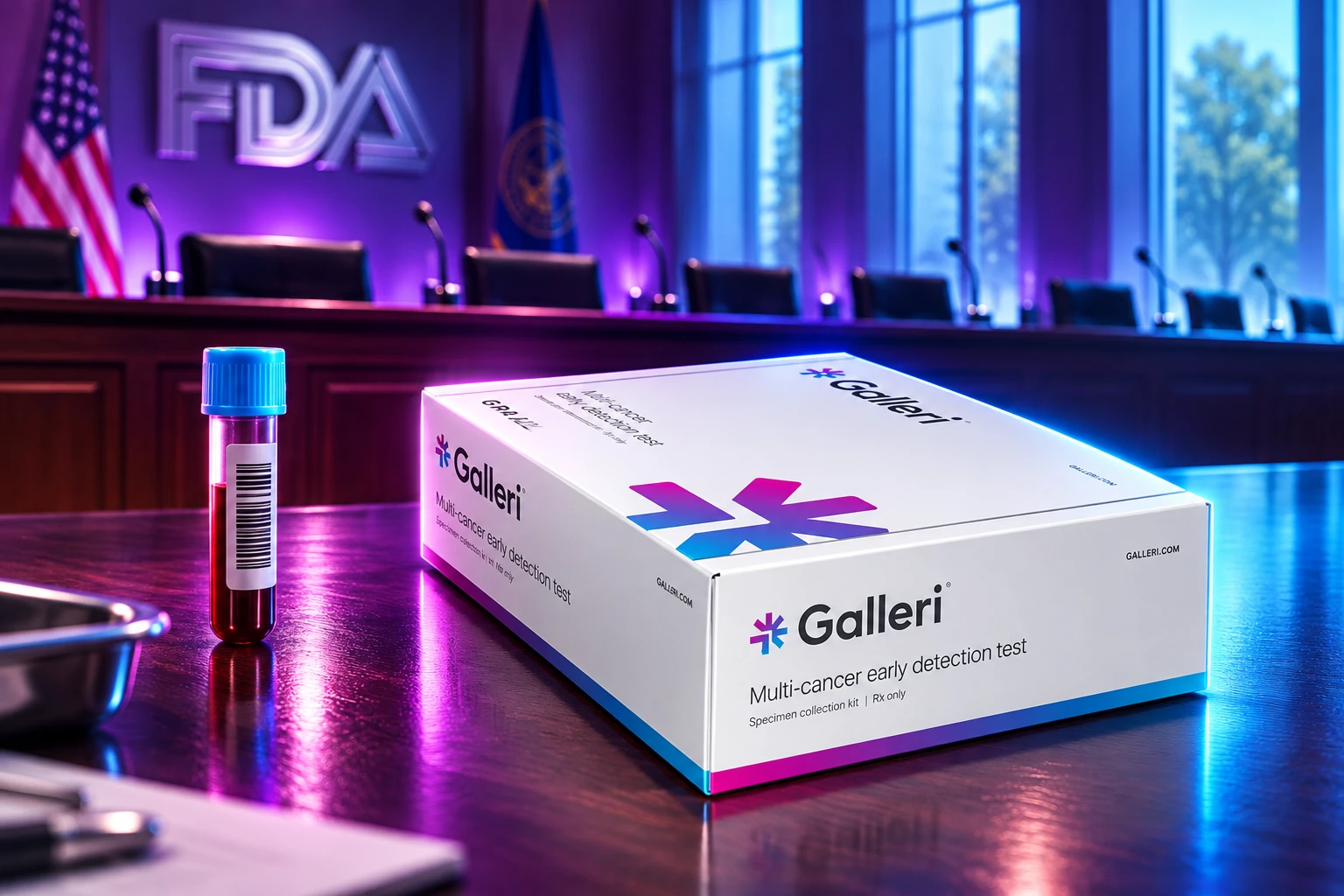
FDA advisers vote on GRAIL’s Galleri blood test as staff question whether weak Stage I detection supports an early-detection label.

FDA advisers vote September 23, 2026 on GRAIL’s Galleri test, a $949 blood screen proposed for adults 50 and older. Staff reviewers said they had no outstanding questions on the lab analysis, the study design, or the main safety numbers. They did ask whether results by stage support calling the test an early-detection screen.
The Molecular and Clinical Genetics Panel meeting runs from 9 a.m. to 6 p.m. Eastern at the agency’s White Oak campus, with a virtual option. The vote is advice. It does not approve the product.
A Prescription Blood Test That Looks for Methylation
Galleri is a next-generation sequencing test that looks for cancer-specific methylation patterns in cell-free DNA from a blood draw. It returns Cancer Signal Detected or No Cancer Signal Detected. A positive result also names a predicted Cancer Signal Origin from 18 site classifiers, meant to point doctors toward the next scan or biopsy.
GRAIL, based in Menlo Park, California, has sold the test as a prescription laboratory-developed test. It has not had FDA marketing authorization. The company filed a PMA application for the Galleri test on January 29, 2026, after a Breakthrough Device designation in August 2018. The filing uses 25,490 PATHFINDER 2 participants with one year of follow-up and first-year data from more than 70,000 people in the intervention arm of England’s NHS-Galleri study. A bridging analysis compares the trial version, called MCED-V2, with the version GRAIL wants on the label.
Josh Ofman, GRAIL’s chief executive, has argued that most cancer deaths still come from diseases that have no routine screen, and that Galleri should sit beside mammograms and colonoscopies rather than replace them. The FDA’s proposed precautions say a negative result does not rule out cancer, and a positive result is not a diagnosis.
Today, the status quo in cancer screening is simply unacceptable. Many cancers are detected too late, after symptoms appear and the disease is too advanced for effective or curative-intent treatments. In fact, 70-80% of cancer deaths occur due to cancers we are not screening for at all.
Josh Ofman, CEO, GRAIL, August 7, 2026 statement
The agency’s own cancer-burden section, drawing on Siegel and colleagues for 2026, puts the U.S. tally at more than 2.1 million new cases and nearly 630,000 deaths, with 88% of diagnoses in people 50 or older. About 58% of those deaths are expected from cancer types that lack a USPSTF grade A, B, or C screen, a lower share than Ofman’s 70-80% line because the two counts use different definitions of “unscreened.” Five-year relative survival for 2015-2021 was 92% for localized disease, 69% for regional disease, and 35% when cancer had spread farther.
Galleri Detects Stage IV Cancers More Often Than Stage I
The executive summary prepared for the panel reports PATHFINDER 2 performance on the bridged Galleri assay as 12-month episode sensitivity of 35.0%, specificity of 99.85%, positive predictive value of 77.0%, and negative predictive value of 99.07%. The false-positive rate was 0.15%. Those figures describe detection of cancers diagnosed in the following year. They are not a proof that screening changes when people die.
The same package is sharper on stage. Among PATHFINDER 2 participants with a staged new cancer in the 12-month window, sensitivity rose with later disease. Stage I sat at 21.4%. Stage IV sat at 63.2%. Of 268 people with a new primary cancer, 90 (33.6%) were flagged by Galleri. Of 177 people with Stage I or II disease, 44 (24.9%) were flagged.
GALLERI 12-MONTH SENSITIVITY BY STAGE IN PATHFINDER 2
| Stage | Detected / Total | Episode Sensitivity |
|---|---|---|
| Stage I | 27 / 126 | 21.4% |
| Stage II | 17 / 51 | 33.3% |
| Stage III | 18 / 31 | 58.1% |
| Stage IV | 24 / 38 | 63.2% |
| Stages I-II combined | 44 / 177 | 24.9% |
FDA reviewers asked the panel, in those words, whether performance by stage supports “early detection” in the proposed indication, or whether a claim such as “cancer detection” would fit the data better. Sensitivity also lagged on cancers that already have a screen. In people eligible for USPSTF-style testing, Galleri found 23.4% of breast cancers (11 of 47) and 7.7% of prostate cancers (3 of 39). Colon and rectum cancers in the same analysis were 62.5% (5 of 8), on a small count.
Cristian Tomasetti, who directs early detection and monitoring at City of Hope, has said missed trial endpoints can be a technicality when a study tries to show fewer deaths in only three years, a window that is short for mortality. He still wants longer follow-up to confirm a shift away from Stage IV. Tom Beer, chief medical officer for Abbott Cancer Diagnostics and a practicing oncologist in Oregon, has said about 70% of the cancers he sees, and the deaths from them, are diseases such as pancreatic cancer that have no screen. Abbott is developing a rival test, CancerGuard.
A 142,000-Person Trial and a Missed Endpoint
The randomized evidence is the NHS-Galleri study in England, a trial of more than 142,000 adults ages 50 to 77 with no clinical suspicion of cancer. Participants were assigned to three annual MCED tests plus usual care, or usual care alone. GRAIL’s PMA uses only the first screening round from the intervention arm. The full three-round result is now in the open.
On September 22, 2026, the New England Journal of Medicine published the trial. After three rounds and at least 12 months of follow-up after the last third visit, the intervention arm did not have a lower rate of Stage III or IV cancer across 12 prespecified types, the primary end point. GRAIL’s ASCO 2026 slides put the incidence rate ratio at 1.03 (0.92 to 1.14). Stage IV diagnoses, a secondary look, were 14% lower across all three rounds and 26% lower in the third round plus follow-up, on those 12 cancers. Stage III diagnoses ran the other way, which is why the combined late-stage goal did not move.
Detailed peer-reviewed results from the NHS-Galleri trial are now published in @NEJM and @NatureMedicine, providing clinical utility and performance data.
These results reflect GRAIL’s commitment to setting a high bar for MCED evidence—rigorously demonstrating Galleri’s… pic.twitter.com/g9bINUmwRI
— GRAIL (@GrailBio) September 22, 2026
GRAIL’s own quarterly filing warned that missing the primary end point could color how doctors, payers, and regulators read the test, and said the company is extending follow-up by 6 to 12 months. NHS England still has to decide whether to put Galleri into a national program. First-year NHS performance in the FDA briefing sat close to the U.S. study: 12-month episode sensitivity 31.6%, specificity 99.74%, positive predictive value 66.2%.
The constraint is not the false-positive rate on a lab sheet. It is how few Stage I tumors shed a readable signal. A test that is highly specific can still miss most early disease and still send a smaller group of people, including people without cancer, into scans and biopsies. That is the trade the panel is being asked to price.
What a Positive Result Can Set in Motion
PATHFINDER 2’s safety case is the workup that follows a positive MCED-V2 result, not an injury from the blood draw. FDA tabulated diagnostic procedures among 218 people who had a full evaluation and 12 months of follow-up as of December 31, 2024.
DIAGNOSTIC WORKUP AFTER A POSITIVE MCED-V2 RESULT
- Invasive procedures: 159 of 218 people (72.9%) had at least one invasive procedure, and 227 such procedures were done in that group, 89.4% of them non-surgical.
- People without cancer: 43 of 90 people who were not diagnosed with cancer (47.8%) still had an invasive procedure during the workup.
- People with cancer: 116 of 128 people who were diagnosed (90.6%) had an invasive procedure, as expected once a tumor is being confirmed.
- Adverse events: 9 of 218 people (4.1%) had an adverse event during diagnostic evaluation; FDA recorded 10 events in that slice.
A negative Galleri result is not a clean bill of health. People are told to keep guideline screens. The National Center for Health Research, in a written comment to the docket, urged the panel not to recommend approval, citing weak early-stage sensitivity, the cost and stress of false alarms, and the absence of proof that screening helps people live longer. The list price it cited is $949, before any later imaging or biopsy.
GRAIL shares jumped 35% on September 21, 2026, after the briefing documents posted. David Westenberg, an analyst at Piper Sandler, said the package looked constructive and that he expected a favorable vote, possibly with a label change. The stock move prices a yes. It does not answer the stage question.
Congress Opened a Medicare Path for 2028
The commercial stake is larger than one company’s cash price. Galleri is already sold to people who can pay. Medicare and most large commercial plans do not cover it. GRAIL has said FDA approval is the trigger it wants for payer decisions, including a federal benefit that Congress has already written.
On February 3, 2026, the Nancy Gardner Sewell Medicare Multi-Cancer Early Detection Screening Coverage Act became law as part of the Consolidated Appropriations Act, 2026. The statute creates a benefit category for tests that look for several cancer types across organs, are cleared or approved by FDA, and are found appropriate for Medicare patients by federal health officials. Medicare coverage beginning in 2028 would be limited to one such test every 11 months. In 2028 the age cap is 68, then it rises by one year each year. Until 2031, payment would match the rate already used for a multi-target stool DNA screening test.
The law’s title uses “early detection.” FDA is asking whether Galleri’s stage data support that phrase on a device label. If the panel or the agency strips “early” from the indication, the Medicare statute still names the category that way. CMS would still have to judge whether coverage is appropriate. That is the second door, and it does not open on the vote itself.
Rivals are watching the same door. Exact Sciences’ technology, now with Abbott, and other multi-cancer assays are in the queue. A first PMA, even with warnings, would give the category a template. A narrow label would too.
Three Votes Will Not Bind the Agency
Neil Vasan, a breast-cancer researcher at NYU Langone who previously served as acting chair of FDA’s oncology drug advisory committee, said Ofman’s opening at White Oak stressed cancers that have no screen, a cancer signal that is not tied to one tumor type, a favorable risk-benefit case, cancer yield, and adding Galleri to usual screening. Those are the points GRAIL needs the panel to accept as enough, without a mortality win.
THE THREE VOTING QUESTIONS
- Safety: Whether there is reasonable assurance Galleri is safe in adults 50 and older who meet the proposed indication.
- Effectiveness: Whether there is reasonable assurance the test is effective in that same group.
- Balance: Whether the benefits outweigh the risks for those patients, including the workup that follows a positive result.
The agency also wants advice on labeling, warnings, and how to describe performance and limits to doctors and patients. A false negative would not mean cancer is absent. A false positive would not mean cancer is present. Those caveats are already in the draft precautions.
THE PATH TO THIS HEARING
- August 2018: FDA grants Galleri Breakthrough Device designation.
- 2021: GRAIL begins selling Galleri as a laboratory-developed test in the United States.
- January 29, 2026: GRAIL submits the PMA, built on PATHFINDER 2 and first-year NHS-Galleri data.
- February 3, 2026: The Sewell MCED coverage law is signed, with a 2028 start if a test is FDA-approved and CMS agrees.
- February 2026: GRAIL says NHS-Galleri missed its combined Stage III and IV primary end point.
- September 22, 2026: The full randomized results appear in the New England Journal of Medicine.
- September 23, 2026: The genetics panel meets and votes.
The session is due to end at 6 p.m. Eastern. FDA can follow the panel, ignore it, demand more data, or write a narrower indication that drops the word early. Until that decision, Galleri remains a $949 lab test with a high specificity, a Stage I miss rate that is the real limit, and a Medicare calendar that already assumed someone would earn the name.
Disclaimer: This article is news reporting and analysis of an FDA advisory meeting and related trial results. It is for information only and is not medical advice, a diagnosis, or a recommendation to buy, skip, or replace any cancer screening test. Readers should talk with a qualified physician about their own screening plan, including mammography, colonoscopy, and other guideline tests, before acting on any blood-test claim. Figures, votes, and regulatory status reflect the public sources available on September 23, 2026, and may change when the panel records its votes and when FDA acts on the PMA.

Nintendo Pulls SmileBASIC After the First Switch 2 Jailbreak

Arkane Lyon’s Union Holds the Clock Microsoft Cannot Skip

Airbnb Bans Guest Chores as Homes Turn Into Hotels

Riyadh Downs a Houthi Missile After Weeks of Capital Strikes

Ariana Madix’s Empty Los Angeles House Fits a Bravo Pattern

AI Server Boards Put Everyday Circuit Materials on Allocation

Glacier Collapse Buried Nepal’s Hydropower Workers in Tunnels

Congo’s Bundibugyo Outbreak Outruns the Licensed Ebola Shots

Pennsylvania Measles Deaths Follow a Long Slide in Coverage

Germany Can Miss Its 2026 Climate Cap Without Penalty
-
 NEWS2 months ago
AI Server Boards Put Everyday Circuit Materials on Allocation
-
 NEWS2 months ago
Glacier Collapse Buried Nepal’s Hydropower Workers in Tunnels
-
 NEWS2 months ago
Congo’s Bundibugyo Outbreak Outruns the Licensed Ebola Shots
-
 NEWS2 months ago
Pennsylvania Measles Deaths Follow a Long Slide in Coverage
-
 NEWS2 months ago
Germany Can Miss Its 2026 Climate Cap Without Penalty
-

 NEWS2 months ago
Texas Judge Freezes the SEC Eligibility Ban for 41 Athletes
-
 NEWS2 months ago
CISA’s Known Exploits Still Come From 2007-Era Bugs
-

 BUSINESS2 months ago
Trump’s Venezuela Oil Deal Leaves the Barrels in the Ground