
BUSINESS
Müller Talks Put Farmer-Owned Vogtlandmilch to a Member Vote
Müller wants Saxony’s No. 2 dairy, but farmer co-ops that just rebuilt the Plauen plant must vote, and they would give up their stakes for a milk-price rise.

Unternehmensgruppe Theo Müller is in early talks to buy Vogtlandmilch, the farmer-owned dairy in Plauen, Saxony. A company spokesperson said discussions with management and the supervisory board cover the business and the plant, remain at an early stage, and would need merger clearance.
The people who actually sit on the other side of the table are milk producers, not a private equity fund. They still have to vote, and a yes would hand both of Saxony’s two largest dairies to one owner.
What Sachsenmilch Offered in Gospersgrün
Sachsenmilch Leppersdorf GmbH, the Müller plant that is already Saxony’s biggest milk processor, briefed co-op members in Gospersgrün on 15 September 2026. Mathias Hauer, Sachsenmilch’s managing director, went to the Vogtland in person to walk through the plan.
Hauer said Plauen would stay open as its own site and be enlarged, in part so volume could move west from Leppersdorf. The plant would take in about 250 million kilograms of milk a year, up from about 200 million kilograms now, with quark for the Landliebe brand and for Italy as the main job. He put a further 15 to 20 million euros on the table and promised a two-year milk offtake deal, with pay tied to the federal agency BLE’s eastern German average plus extras.
THE PLAN LAID OUT TO MEMBERS
| Item | Now | If Müller buys |
|---|---|---|
| Milk processed | About 200 million kg a year | About 250 million kg a year |
| Farm price | 33.5 cents per kg, suppliers say | BLE East average plus about 3 cents |
| Plant spend | About 46 million euros, just finished | A further 15 to 20 million euros |
| Who owns it | Two farmer cooperatives, 50/50 | Unternehmensgruppe Theo Müller |
| What the site makes | Quark, UHT milk, butter, buttermilk, school drinks | Kept, enlarged, quark for Landliebe and Italy |
Vogtlandmilch did not answer questions about the talks. Managing director Steffen Dünger had already said the dairy was looking for a strong partner. Managers have told members the books are stable, with a going-concern view for the next two years, and that this is not a distress sale.
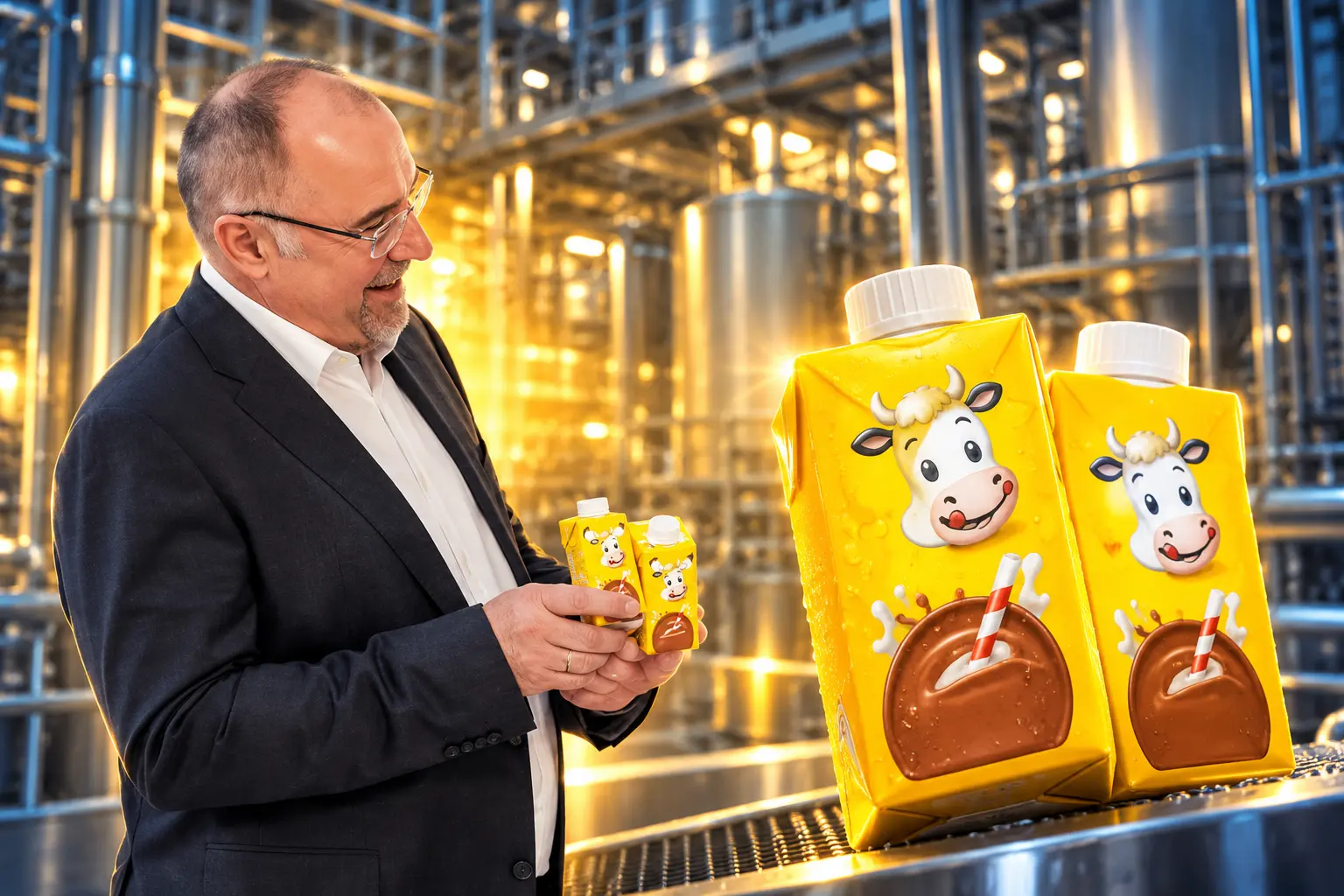
Farmer Owners Hold the Vote
The dairy is owned in equal shares by two cooperatives, Erzeugergemeinschaft Milch Plauen and Molkereigenossenschaft Glauchau. Milk comes from about 150 farms in the Vogtland, western Saxony and eastern Thuringia, all within 80 kilometres of Plauen. The brands on the shelf are Vogtlandweide and Sachsenland, plus Joe Clever school milk; the company says it is the only school-milk filler in Saxony and ships those drinks across Germany.
A sale needs 75 percent support from members. They are due to meet again in early November. Müller wants to be owner by early 2027, if they say yes and the competition authority agrees.
WHAT WE KNOW
- The talks: Müller has confirmed discussions with Vogtlandmilch’s managers and board over the business and the Plauen site.
- The owners: Two farmer co-ops hold the shares, and a 75 percent vote is required to sell.
- The catch for farms: Members were told they would lose their co-op deposits because Müller would take on the dairy’s debts rather than buy those stakes out in full.
WHAT IS UNCONFIRMED
- A signed deal: Both sides still describe an early-stage process, not a closed purchase.
- Clearance: No filing outcome exists yet, and Müller already runs Saxony’s largest dairy through Sachsenmilch.
- Advisers: Some producers have asked for a full account of possible conflicts around PricewaterhouseCoopers, which is running the sale talks and has worked for Müller in the past.
Udo Weymann sits on the Plauen producer group’s board and chairs Agrargenossenschaft Theuma-Neuensalz. He sees no real alternative, because farms are still tied to Vogtlandmilch contracts for two years, and because cows do not move.
We farmers are also bound to our soil and our barns. We cannot simply switch and produce somewhere cheaper.
Udo Weymann, board member, Erzeugergemeinschaft Milch Plauen
If the deal falls apart, he said, he expects milk prices in the basin to keep sliding.
They Built the New Plant on a Football Pitch
On 24 October 2025 the dairy marked the largest expansion in the company’s history, about 11 months before the Müller briefing. About 46 million euros went into new filling lines, extra quark kit, a high-bay warehouse and a cleaner energy setup on the north side of Plauen. Nearly 14 million euros of that was public grant money.
The old plot was too tight. The city, the dairy and Sport- und Ballspielclub 90 Plauen shifted the club off its training field so a new hall could go up on the grass. Google Maps still labelled the address as a sports field after the concrete was poured. Mayor Steffen Zenner said the city had “set the course for Vogtlandmilch to stay and grow in Plauen,” and called the plant a source of regional work, local value and a bond with home.
New kit doubled filling power to up to 100 million one-liter packs a year. The warehouse holds about 4,500 pallets. About 150 people work there. The company, founded in 1928 as Vogtländischer Milchhof AG, had said as far back as 2022 that it was putting serious money into UHT filling and storage so staff and the business would have a stable future.
THE ROAD TO THE SALE TALKS
- 1928: Vogtländischer Milchhof AG is founded in Plauen; the business later sits with the two farmer co-ops.
- 24 October 2025: The dairy celebrates the about 46 million euro rebuild on the former SpuBC pitch.
- 7 May 2026: Müller agrees to buy plant-based maker Berief Food; the deal closes on 6 July 2026.
- 15 September 2026: Sachsenmilch briefs Vogtlandmilch members in Gospersgrün on a takeover plan.
- Early 2027: Müller’s target date to own the dairy, if members vote yes and merger control clears.
Leaving Plauen had looked close three years before the hall opened. The rebuild was sold locally as the thing that kept milk, jobs and farm collections in the Vogtland. That is the asset now on the table.
The Three-Cent Offer and Lost Co-Op Stakes
Suppliers say Vogtlandmilch currently pays 33.5 cents a kilogram, below the eastern German average. Sachsenmilch told the Gospersgrün meeting that farms would get about three cents more than today, measured against the BLE East figure. Weymann said he can live with losing the deposits if that bump arrives. “If we get three cents more, we have made up the lost deposits after three months,” he said.
He also said three cents will not turn a profit for farms that recently borrowed to stay in milk. Losses on milk, he said, cannot be made up in other parts of the farm, and he expects several operations to close 2026 in the red. The sale is not a rescue of Saxony’s dairy farms. It is a price offer tied to giving up a processor the farms still own.
That is the trade. Müller gets a rebuilt quark plant and an 80-kilometre milk basin. The co-ops get a higher litre price and lose the shares that gave producers a say. Whether Müller’s stronger hand with grocery chains actually shows up in the farm cheque, Weymann said, is still an open question.
Müller Already Runs Saxony’s Largest Dairy
Sachsenmilch processes 1.7 billion kilograms of milk a year, more than eight times Vogtlandmilch’s volume, and is already the largest processor in the state. Leppersdorf, in Bautzen district, makes Müllermilch, Sachsenmilch and Weihenstephan. Adding Plauen would put the first- and second-largest Saxon dairies under the same holding company.
TWO DAIRIES, ONE BUYER
- Vogtlandmilch: About 150 staff in Plauen, about 150 farms, about 200 million kg of milk, farmer co-op owned since the successor to the 1928 milk plant.
- Sachsenmilch: Müller’s Leppersdorf site, 1.7 billion kg a year, already No. 1 in Saxony.
- The group: Family-owned since 1896, with 35,000 staff and 10.3 billion euros in 2025 sales across 21 plants, exporting to more than 80 countries.
- Recent buys: UK kefir brand Biotiful Gut Health in 2025, then Berief Food, a Beckum tofu and plant-drink maker with about 350 staff and about 113 million euros in sales, completed on 6 July 2026.
The Berief close was sold as a step into plant-based drinks. The Vogtland talks run the other way, toward more cow’s milk and more quark. Shoppers who reach for Vogtlandweide as the carton that is not Müller would lose that distinction if Landliebe quark starts flowing from the same vats. Merger control will have to look at that regional milk-collection map, which German cases have treated as a radius around each plant rather than as one national pool.
Why Brandenburg Farms Are Losing Their Contracts
The same group has been shrinking another catchment. Sachsenmilch is not renewing a run of milk contracts in northern and eastern Brandenburg that otherwise ran to the end of March 2027, mostly with mid-size herds of 400 to 800 cows. Spokesman Alexander Truhlar said collection has only business limits and, in practice, a radius around the plant. Fuel, energy and staff costs, he said, made very long raw-milk hauls a loss.
That is the other face of the Plauen pitch. Müller wants an 80-kilometre basin in the Vogtland, and even talks about shifting work from Leppersdorf toward western Saxony, while dropping farms that sit too far from the tanker route. The church-tower rule cuts both ways. Farms inside the circle get a bid. Farms outside it get a letter.
Juliane Streubel, who leads animal production at the Saxon farmers’ union, has said cow slaughter and tight forage point to a tighter raw-milk supply against still-firm demand, which is why farm prices have been edging up after a weak spring. Conventional raw milk has lately been quoted in a band from 33 to 41 cents a kilogram. Vogtlandmilch’s 33.5 cents sits at the bottom of that range, which is why a three-cent extra sounds like relief in Gospersgrün and still sounds thin in a barn with a new loan.
Members will file back in early November. Müller wants the keys in early 2027. Until both the vote and the cartel office have spoken, the rebuilt hall on the old football pitch still belongs to the farms that fill it.

Nintendo Pulls SmileBASIC After the First Switch 2 Jailbreak

Arkane Lyon’s Union Holds the Clock Microsoft Cannot Skip

Airbnb Bans Guest Chores as Homes Turn Into Hotels

Riyadh Downs a Houthi Missile After Weeks of Capital Strikes

Ariana Madix’s Empty Los Angeles House Fits a Bravo Pattern

AI Server Boards Put Everyday Circuit Materials on Allocation

Glacier Collapse Buried Nepal’s Hydropower Workers in Tunnels

Congo’s Bundibugyo Outbreak Outruns the Licensed Ebola Shots

Pennsylvania Measles Deaths Follow a Long Slide in Coverage

Germany Can Miss Its 2026 Climate Cap Without Penalty
-
 NEWS2 months ago
AI Server Boards Put Everyday Circuit Materials on Allocation
-
 NEWS2 months ago
Glacier Collapse Buried Nepal’s Hydropower Workers in Tunnels
-
 NEWS2 months ago
Congo’s Bundibugyo Outbreak Outruns the Licensed Ebola Shots
-
 NEWS2 months ago
Pennsylvania Measles Deaths Follow a Long Slide in Coverage
-
 NEWS2 months ago
Germany Can Miss Its 2026 Climate Cap Without Penalty
-

 NEWS2 months ago
Texas Judge Freezes the SEC Eligibility Ban for 41 Athletes
-

 NEWS2 months ago
CISA’s Known Exploits Still Come From 2007-Era Bugs
-

 BUSINESS2 months ago
Trump’s Venezuela Oil Deal Leaves the Barrels in the Ground