
NEWS
Connecticut Sun’s $300 Million Sale Closes a Tribal Era
The Mohegan Tribe sold the Connecticut Sun for $300 million, $25 million under Boston’s bid, and closed Uncasville with a 95-81 win before Houston 2027.

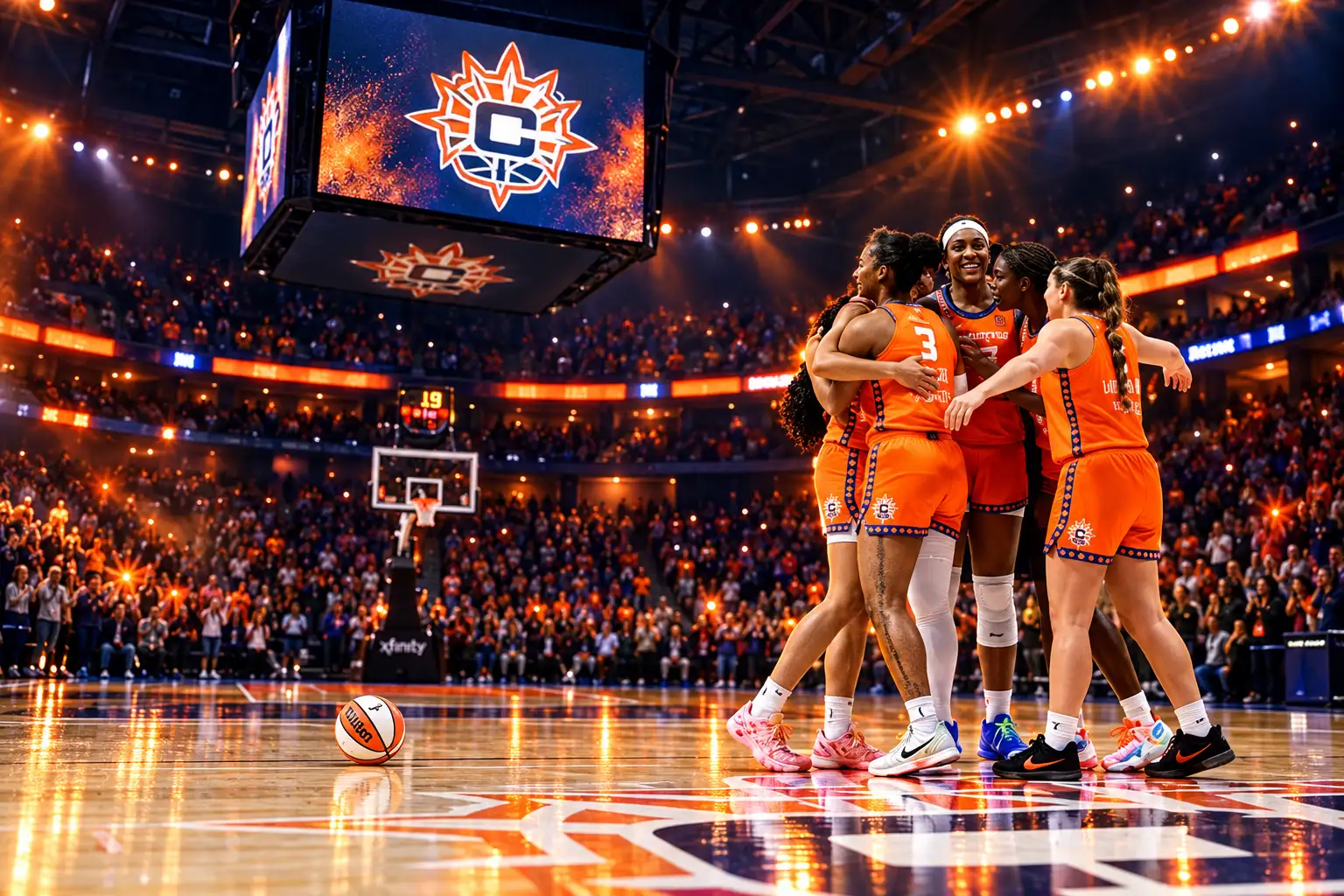
The Connecticut Sun beat the Toronto Tempo 95-81 on Thursday night at Mohegan Sun Arena, a sellout of 8,911 that closed 24 seasons in Uncasville. The win snapped a six-game skid and finished an 11-33 year, the last before a $300 million sale sends the club to Houston in 2027.
The Mohegan Tribe bought the franchise for $10 million in 2003. The same boom that minted a record price also let the WNBA block richer bids from Boston and Hartford, then clear Houston Rockets owner Tilman Fertitta to move the team with no relocation fee.
The Sun Closed Connecticut With One Last Win
Orange shirts packed the casino arena one more time. Longtime season-ticket holders were called out. Nykesha Sales, a face of the first Uncasville rosters and now a UConn assistant, was recognized. With about three and a half minutes left, fans behind the bench started chanting thank you at each player.
THE FINAL BOX
- The score: Connecticut 95, Toronto 81, after quarter totals of 23-15-31-26 against 20-16-21-24.
- The crowd: 8,911, a sellout on a night the club billed as Fan Appreciation Night, with commemorative tickets at the door.
- The record: 11-33 after the Sun entered the night 10-33 and refused a loss that would have locked up the best odds at the 2027 No. 1 pick.
- The lead scorer: Ashlon Jackson had 18 points and five threes off the bench, with Raegan Beers at 17 and Aaliyah Edwards at 16.
Edwards, a UConn product, had 14 points by halftime and told the postgame show, “This is the basketball capital of the world, baby! Don’t ever forget!” Team president Jen Rizzotti, a Connecticut native who came up at UConn and is moving with the franchise, took a microphone and let the building stay for autographs.
You’ve never disappointed. You’ve proved that Connecticut deserves a WNBA team. And I just want you all to know that no matter what happens from here, this team, as they move onto the next chapter of their careers, the success that all of them have in their future, you will always be a part of that. Always.
Jen Rizzotti, Connecticut Sun president, Mohegan Sun Arena
General manager Morgan Tuck, a former UConn and Sun player, put the night in plainer terms. “The legacy is that we had a positive impact on a lot of people,” Tuck said. “It might be an end here but it is not an end to our team.”
Boston’s $325 Million Bid Never Reached a Vote
On Aug. 2, 2025, a group led by Boston Celtics minority owner Steve Pagliuca reached a tentative deal to buy the Sun for $325 million and move it to TD Garden in 2027. Former Milwaukee Bucks owner Marc Lasry later matched that price and pointed the club at Hartford. People briefed on the talks said the league would have allowed either sale if the buyers had agreed to keep the team in Uncasville. Once those groups insisted on leaving the reservation, the path ran through Houston.
The WNBA’s public line was blunt. “Relocation decisions are made by the WNBA Board of Governors and not by individual teams,” the league said, adding that cities already in the expansion process had priority over Boston. Houston had been in that line. Commissioner Cathy Engelbert had already called Fertitta’s city “up next.”
WHAT THE BIDS PAID
| Buyer | Price | Plan | League outcome |
|---|---|---|---|
| Steve Pagliuca group | $325 million | Move to Boston in 2027 | Blocked |
| Marc Lasry group | $325 million | Move to Hartford | Blocked |
| Tilman Fertitta family | $300 million | Move to Houston in 2027 | Approved, no relocation fee |
| 2025 expansion clubs | $250 million each | Cleveland, Detroit, Philadelphia | New teams, not a sale |
Connecticut Attorney General William Tong objected in a statement to a sale “that would move the Sun out of Connecticut at a price far less than what was on the table to keep them here at home.” The gap is $25 million on the sticker, before counting the practice gym money Boston had attached. Cass Meehan, a 29-year-old Mohegan fan who grew up in the building, called the Boston block a betrayal of the tribe that had stepped in when the league needed a buyer.
Expanding into Houston would have left Connecticut a team and still put the league in Toyota Center’s market. Relocating the Sun did something else. It handed Fertitta a club without the $250 million expansion fee Cleveland, Detroit and Philadelphia paid, and it folded one of the last independent WNBA owners into the NBA-owner model the league now prefers.
A $10 Million Purchase in 2003
The tribe became the first Native American tribe to own a team when it bought the Orlando Miracle in January 2003 and moved the club to the reservation. It was also the WNBA’s first owner without an NBA sibling club. The team name tied to Mohegan Sun. The logo, a fiery orange sunburst over a basketball and a blue ribbon with four white domes, was drawn from an old Mohegan mark.
FROM MIRACLE TO LAST TIP
- January 2003: The tribe buys the Orlando Miracle for $10 million and relocates it to Uncasville as the Connecticut Sun.
- 2004 and 2005: The Sun reach the WNBA Finals in their second and third Connecticut seasons.
- 2010: The franchise becomes the first in the league to turn a profit, still playing in the smallest market.
- 2021: New Nike uniforms carry Mohegan basket motifs, wampum-collar trim, and the word Keesusk.
- Fall 2024: Ownership opens a process to explore a sale after the league’s costs jump.
- August 2, 2025: Pagliuca’s group reaches a $325 million deal the league will not let move to Boston.
- March 30, 2026: Mohegan announces a deal with the Fertitta family for aggregate proceeds of $300 million.
- May 13, 2026: The WNBA and NBA boards unanimously approve the sale and the Houston move.
- May 14, 2026: The transaction closes.
- September 24, 2026: The Sun win 95-81 in the last game on Mohegan land.
Mike Thibault, hired as coach in January 2003, later said the startup was so thin he had to order basketballs, uniforms, and sports bras. The Sun hosted a record four All-Star Games and made three trips to the Finals. By 2010 they were in the black. Mitchell Etess, the former CEO who helped bring the team north, said the sale confirmed the original business call. “If I was still CEO I’d recommend we sell it for that much profit,” Etess said.
The League Kept Relocation for Itself
Beth Regan, chairwoman of the Mohegan Tribe’s Council of Elders and a self-described Day 1 fan, said the writing had been on the wall once players won a new collective bargaining deal that requires state-of-the-art practice sites and other upgrades the tribe would have struggled to fund. Mohegan Sun Arena holds about 10,000. The 2026 club still drew nearly 8,700 a night in a rebuild. That was not the product the new CBA was written around.
People close to the talks described Uncasville, if the team stayed put, as a roughly $250 million asset, in line with the 2025 expansion fee. The $325 million checks existed to move the club. Fertitta had already missed that expansion round, coming in at least $50 million short of $250 million. Buying the Sun at $300 million, with no relocation fee, got him into the league cheaper than a clean expansion into a city the commissioner had already named.
The last WNBA club to change cities before this was San Antonio, which became the Las Vegas Aces in 2017. On the night Uncasville said goodbye, the league account posted a thank-you to the market it had just emptied.
Thank you, Connecticut 🧡
Mohegan Sun was home to unforgettable moments and a fanbase that showed up every step of the way.
A special era of WNBA basketball in Connecticut comes to a close.#WNBASeason30 pic.twitter.com/tSmKuit4hi
— WNBA (@WNBA) September 25, 2026
Joe Soper, corresponding secretary of the Mohegan Tribal Council, said the tribe owed “an enormous amount of gratitude first and foremost to our extraordinary fans.” Rizzotti, in the same March note, promised to finish the last Connecticut season with pride. The 2026 schedule still sent the club to PeoplesBank Arena in Hartford twice and to TD Garden on Aug. 18, a Boston date that now reads as a remnant of a move the board would not allow.
Sale Proceeds Went Straight at the Debt
Mohegan’s March 30 note set aggregate proceeds of $300 million, with $150 million due at close and the rest on or before Dec. 31, 2026. Chief financial officer Ari Glazer called it a step-function improvement of the capital structure, with money for debt paydown and for the resorts. The May 14 close confirmed $150 million received at closing after WNBA and regulatory approvals.
The third fiscal quarter ended June 30, 2026, booked a $279.7 million gain on the sale. In the same stretch Mohegan redeemed $140.0 million of 2029 senior unsecured notes. Cash stood at $138.0 million. Quarterly revenue was $450.6 million. Net income attributable to the authority was $296.0 million, almost entirely the Sun gain.
“The successful closing of the sale of the Connecticut Sun WNBA franchise was a remarkable step toward executing our long-term strategic priorities,” Glazer said. “While we are incredibly proud of the franchise’s legacy and the part it played in Mohegan’s history, the sale unlocks significant value and enhances our financial flexibility.” On the math that boards care about, a $10 million buy in 2003 came back at 30 times the original check.
A Mohegan Word Comes Off the Jersey
For tribal members the ledger was never the whole club. Meehan was 6, in a red jersey that hung past the knees, at some of the first Uncasville games, later copying Sales’s space buns and waiting in the tunnel for autographs. Basketball is not Meehan’s sport. The Sun was the exception, good year or bad. Ahead of Thursday, Meehan was gathering 24 years of stubs and that 2003 jersey for a shadow box the 2026 roster would sign.
WHAT LEFT WITH THE TEAM
- Youth camps: Players visited tribal youth camps and the annual Mohegan Wigwam Festival.
- The mascot: Blaze, the team’s mascot, showed up at social dances.
- The lodge: Regan laughed recalling 6-foot-6 center Jonquel Jones hugging knees to fit in the community sweat lodge, and she smudged the team with sage in losing streaks and sent injured players sweetgrass braids.
- The word: A 2021 uniform set put Keesusk, the Mohegan word for Sun, on an alternate jersey, with trail-of-life basket imagery and purple-and-white trim styled after a wampum collar.
Heather Landry bought season tickets this year so her 10-year-old, Emersyn, could meet players, including a selfie with Brittany Griner and Saniya Rivers. Landry’s favorite memory was smaller. The family walked into the Mohegan government center, found a practice in the community gym, and got waved into the bleachers. “I’m sure my daughter will cry when we walk out of the arena on Thursday,” Landry said before the finale.
Guard Charlisse Leger-Walker, who is Māori and Samoan, said that when she was drafted by an Indigenous-owned club it felt meant to be, and that elders came to practice with blessings. “It was cool for me to come to that realization, that a lot of my values that I carry with me from home are the exact same here,” she said.
Our languages were taken from us in colonization. So to see Keesusk on those uniforms is so joyous, so validating for our tribe.
Beth Regan, chairwoman, Mohegan Tribe Council of Elders
Family and community, Regan said, mean everything, and the Sun sat inside that circle. Other Native nations have since put money into soccer, lacrosse, and an NBA arena. None of that puts a WNBA club back in Uncasville.
Houston Lands the Comets Without an Expansion Fee
The Fertitta family will revive the Houston Comets name, vacant since the original club folded in 2008 after four straight titles from 1997 through 2000. Patrick Fertitta, the Rockets’ alternate governor, said the family was “thrilled for the opportunity to bring the Houston Comets back to this incredible city,” with those championship banners still in the rafters. Tilman Fertitta has owned the Rockets since 2017. Rizzotti and Tuck are staying with the operation as it shifts south.
Mohegan Sun Arena remains a casino bowl with concerts and the occasional crowd that treated Thursday like a graduation. The 2027 club will play in an NBA building, under an NBA owner, in a market the league had already chosen. The tribe that kept the franchise alive when the WNBA was trying to survive now has a cleaner balance sheet and an empty gym.
Regan fought tears talking through the last home game, then asked the question the sale does not retire. “Before all the attention, when the WNBA needed investment, who stepped up?” she said. “Mohegan did.”
Meehan’s shadow box will hold the stubs. The franchise tips off in Houston in 2027 as the Comets.
Frequently Asked Questions
How much did the Mohegan Tribe pay for the Connecticut Sun?
The tribe paid $10 million in 2003 for the Orlando Miracle, a WNBA club founded in 1999 as a sister team to the Orlando Magic. Magic owner Rich DeVos was ready to fold the franchise, and the move to Uncasville is widely credited with keeping that roster in the league.
Did Boston offer more money to buy the Sun?
Yes. Pagliuca’s group agreed to $325 million and pledged another $100 million toward a dedicated practice facility in Boston, with first games at TD Garden planned for 2027, a package the WNBA would not approve as a relocation.
When does the Houston Comets season start?
The relocated club is scheduled to begin play in the 2027 WNBA season at Toyota Center, Houston’s NBA arena, under the Comets name that won four straight titles from 1997 through 2000 and still shares the league record of four championships with the Minnesota Lynx and Seattle Storm.
Who is Tilman Fertitta in this sale?
Fertitta is the Houston Rockets owner, in that job since 2017, and the buyer of record through his family. His son Patrick Fertitta, the Rockets’ alternate governor, has been the public voice of the Comets revival, including a Toyota Center event with former Comets figures Tina Thompson and Van Chancellor.
Which other Native nations have invested in pro sports?
Wilton Rancheria is now majority owner of Major League Soccer’s Sacramento Republic FC, the Seneca Nation bought the National Lacrosse League’s Rochester Knighthawks, and the Pechanga Band of Indians’ business arm is a founding partner of the LA Clippers’ Intuit Dome, all after Mohegan’s 2003 WNBA purchase.

Nintendo Pulls SmileBASIC After the First Switch 2 Jailbreak

Arkane Lyon’s Union Holds the Clock Microsoft Cannot Skip

Airbnb Bans Guest Chores as Homes Turn Into Hotels

Riyadh Downs a Houthi Missile After Weeks of Capital Strikes

Ariana Madix’s Empty Los Angeles House Fits a Bravo Pattern

AI Server Boards Put Everyday Circuit Materials on Allocation

Glacier Collapse Buried Nepal’s Hydropower Workers in Tunnels

Congo’s Bundibugyo Outbreak Outruns the Licensed Ebola Shots

Pennsylvania Measles Deaths Follow a Long Slide in Coverage

Germany Can Miss Its 2026 Climate Cap Without Penalty
-
 NEWS2 months ago
AI Server Boards Put Everyday Circuit Materials on Allocation
-
 NEWS2 months ago
Glacier Collapse Buried Nepal’s Hydropower Workers in Tunnels
-
 NEWS2 months ago
Congo’s Bundibugyo Outbreak Outruns the Licensed Ebola Shots
-
 NEWS2 months ago
Pennsylvania Measles Deaths Follow a Long Slide in Coverage
-
 NEWS2 months ago
Germany Can Miss Its 2026 Climate Cap Without Penalty
-

 NEWS2 months ago
Texas Judge Freezes the SEC Eligibility Ban for 41 Athletes
-

 NEWS2 months ago
CISA’s Known Exploits Still Come From 2007-Era Bugs
-

 BUSINESS2 months ago
Trump’s Venezuela Oil Deal Leaves the Barrels in the Ground