
NEWS
AlphaFold’s New Viral Portal Leaves Spike Proteins Out
AlphaFold’s pandemic portal lists 8,028 viral dimers, but spike trimers, sugar coats and virus-host pairs did not clear the confidence cut.

Researchers placed 8,028 high-confidence virus protein dimers in the AlphaFold Protein Structure Database on 24 September. The pairs come from 2,812 proteomes in 23 virus families that infect people, and they sit in a new Pandemic Preparedness Portal. Most of the campaign never reached that page.
The launch was set for a United Nations meeting on pandemic prevention on 25 September. What cleared the bar are pairs of viral proteins that bind each other. Many of the surfaces that start human outbreaks did not.
The Portal Opened With 8,028 Dimers
Google DeepMind and EMBL’s European Bioinformatics Institute already offer more than 260 million predicted protein and protein-complex structures, and the database has more than three million users. Viruses were the thin patch. High-quality models were scarce for many flavivirus proteins, including those from Zika and dengue, because the genetic file does not always say where one protein ends and the next begins.
The new set is the first large public dump of intra-viral pairs for families with human members. It is collected in an open Pandemic Preparedness Portal on the AlphaFold site. Partners include NVIDIA, Seoul National University, Sungkyunkwan University, the University of Glasgow, the Swiss Institute of Bioinformatics, and the Coalition for Epidemic Preparedness Innovations. Lund University also contributed complexes computed on a separate track.
Joe Grove, professor of molecular virology at the MRC-University of Glasgow Centre for Virus Research, said the point of folding pairs is simple.
Many viral proteins do not act individually, they act in concert with partners.
Joe Grove, Professor of Molecular Virology, MRC-University of Glasgow Centre for Virus Research
A prior 2026 update had already added 1.7 million interacting pairs from 20 well-studied organisms, including humans, mice and tuberculosis bacteria. That was the first time complexes entered the public AlphaFold set. The viral campaign used the same idea on compact genomes, which are small enough for an all-versus-all search inside each proteome.
THE NEW VIRAL SET
- Dimers kept: 8,028 high-confidence pairs are in the interactive database (2,749 same-chain homodimers and 5,279 mixed heterodimers).
- Proteomes folded: 2,812 viral proteomes from 23 families chosen because they already infect people, or sit close enough to do so.
- Parent archive: the AlphaFold Database holds more than 260 million protein and complex predictions.
- Licence: entries are under CC-BY-4.0 for academic and commercial use.
Jo McEntyre, interim director of EMBL-EBI, said the open viral complex dataset release is meant to help labs that meet outbreaks first. Predicted shapes can flag surfaces for tests, drugs and shots, she said, including on lesser-studied viruses and in places with fewer wet-lab tools.
Most Predictions Never Made the Cut
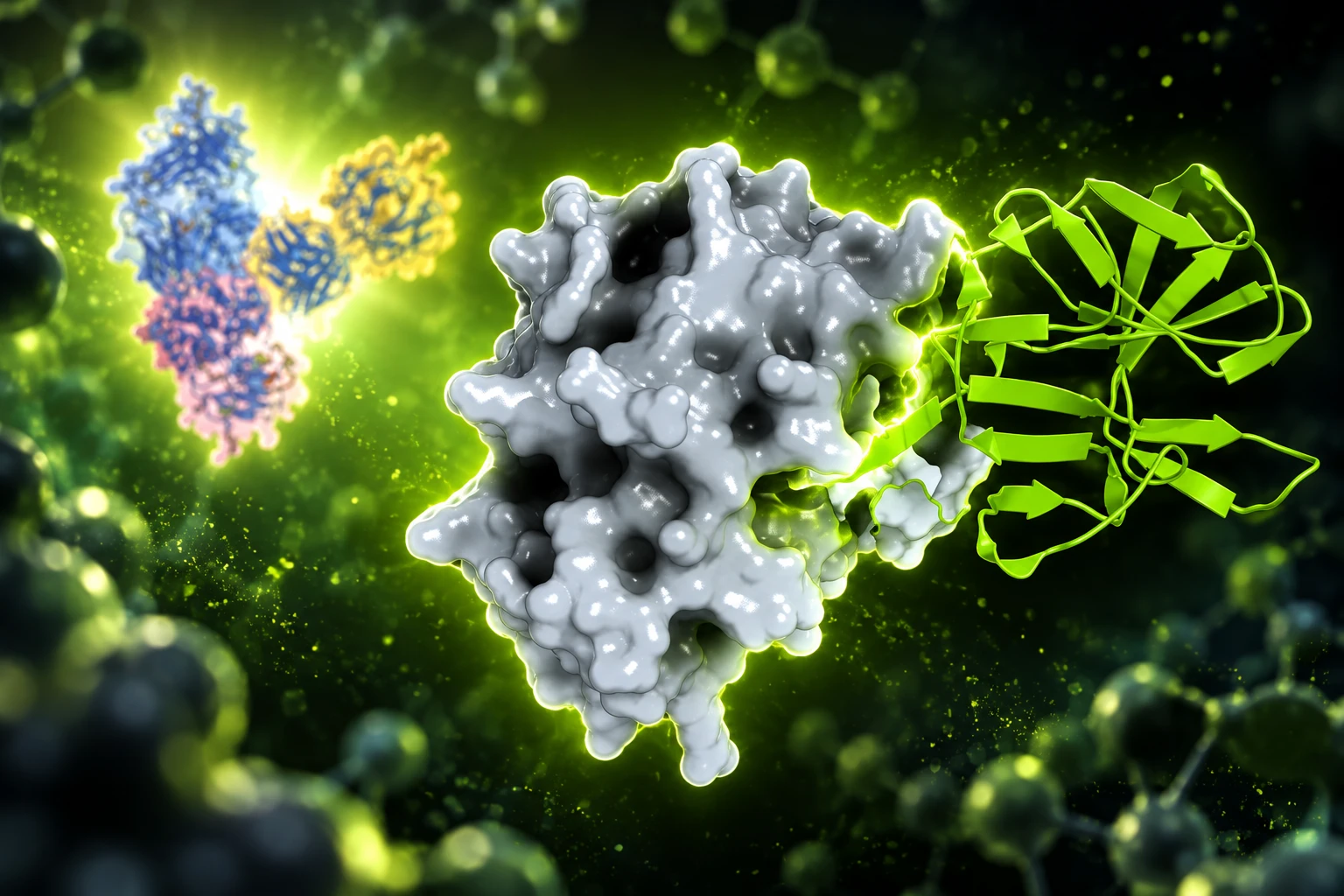
The collaboration’s manuscript, led by Yewon Han at Seoul National University and Riya Narain at NVIDIA, describes about 1.7 million mixed-pair attempts plus tens of thousands of same-chain attempts, run with AlphaFold2 and AlphaFold-Multimer on NVIDIA’s BioNeMo Inference Runtime. Only the pairs that cleared a two-score rule, ipSAEmax at or above 0.60 and pDockQ2max at or above 0.23, went onto the public pages. That rule was tuned on 215 experimental viral complexes deposited in the Protein Data Bank after the model was trained.
WHAT CLEARED THE CONFIDENCE RULE
| Pair type | Kept in the database | Share of attempts |
|---|---|---|
| Homodimers (two copies of one protein) | 2,749 | 6.75% |
| Heterodimers (two different proteins) | 5,279 | 0.32% |
| All dimers on the portal pages | 8,028 | – |
Same-protein pairs cleared the bar about 21 times as often as mixed pairs. Failed dimers were not deleted. They were parked for bulk download, so anyone can inspect a low-scoring model rather than treat silence as proof that two chains never meet.
The search itself is skewed by genome size. Poxviruses are about 2% of the proteomes and about 60% of the pair list, because large DNA genomes explode into more combinations. Picornaviruses, the common-cold group, are about 18% of the proteomes and about 2% of the pairs. RNA viruses with small genomes, the class that has driven recent human jumps, contribute fewer attempts even when they are well sampled as species.
No virus-host pairs were predicted. Every search stayed inside a single viral proteome.
Why Flavivirus Proteins Were Incomplete
When some RNA viruses copy themselves, the first protein product is a long polyprotein that is later cut into working pieces. The genome does not carry a clean “start here” mark for each cut, so older AlphaFold entries often folded the wrong stretch, or an incomplete one. That is why flavivirus pages looked thin even after the database had covered most catalogued proteins on Earth.
SIB scientists in Geneva mapped cleavage sites in viral polyproteins by mixing software, papers and ViralZone curation. The work, finished in May 2026 under the Pathogen Data Network with US National Institutes of Health support, produced the first reliable sequences for 7,783 active proteins cut from polyproteins in 699 viruses. SIB says 47% of human-infecting viruses make polyproteins, including Zika, dengue and poliovirus, and that experimental structures are still missing for 80% of viruses.
WHAT SIB ADDED BEFORE THE FOLD
- Virus list: SIB co-selected the reference proteomes with the University of Glasgow.
- Cut sites: unique polyprotein data for 699 viruses, covering 7,783 mature products.
- Sanity check: ViralZone biology was used to ask whether each predicted pair was even plausible.
Philippe Le Mercier, resource manager in SIB’s Swiss-Prot group, said many of these viruses can only be studied with computers, because they will not grow in a lab or sit under biosafety limits that block scale. The fold model has been public since 2021. The sequences that made a proteome-wide viral search honest were not.
Inside one polyprotein, mixed pairs did better. Intra-polyprotein heterodimers reached 3.56% high confidence (1,330 of 37,359). Cross-polyprotein pairs in the same virus scored 0 of 730. Pairs that were not polyprotein products sat at 0.24%. Pieces that start as one chain still remember one another in the models. Pieces from separate chains almost never do.
Spike Proteins and the Sugars Left Out
The predictions have no sugar molecules. Many viral surface proteins wear those sugars, and the coat is part of how they hide from antibodies. A drug or vaccine idea drawn from a bare protein chain can aim at a face that is not there on the live particle.
Many viral machines are also larger than a dimer. The spike that lets SARS-CoV-2 enter cells is three identical chains. HIV’s envelope-entry protein is a trimer too. Grove said dimer models of those assemblies were, in many cases, not accurate enough to put in the AlphaFold database. An mpox entry fusion complex did make the pages, so some entry proteins survived. The pandemic proteins most people can name often did not.
A protein complex structure alone doesn’t tell us what happens when a virus mutates. The new dataset provides valuable foundational knowledge that can enable fundamental research and the development of countermeasures, but it doesn’t shed light on why some viruses thrive and others don’t, and it doesn’t make it easier to engineer more dangerous pathogens.
Joe Grove, Professor of Molecular Virology, MRC-University of Glasgow Centre for Virus Research
EMBL-EBI is explicit about the same wall. The models do not show how a mutation changes deadliness or spread, and they are not a recipe for building a virus that infects people. Behaviour still has to be measured in a laboratory.
Proteases and 471 Interfaces With No PDB Match
Clustering the 8,028 dimers by interface shape shrinks the set fivefold to 1,598 groups. Of those, 471 interfaces with no PDB match make up 29.5% of the clusters. That is the part of the release that is not a reprint of known crystallography.
Two classes pulled ahead in the case studies. One is glycoprotein pairs with a vaccinology use, the other is viral proteases bound to their own cut sites. Proteases are already antiviral targets, and the models recovered substrate choice and cleavage-site shape across many families, not only in the few strains that crystallize on demand. Shared interfaces across a family are the practical prize, because a drug that fits a conserved contact has a wider net than a drug that fits one lab strain.
SIB’s early read is that some of the new contacts were not in the textbooks, with possible uses both as drug ideas and as protein tools. Those claims still need wet-lab tests. The portal is a hypothesis machine, not a finished map of how any virus lives.
UKHSA Lists Guided Which Families Got Folded
Family choice followed the UKHSA priority pathogen families tool, a 24-family reference published on 25 March 2025 and updated on 8 April 2025 after a change in clade I mpox status. The tool rates viral families for pandemic and epidemic potential and is aimed at funders of tests, drugs and vaccines in England. Coronaviridae, Paramyxoviridae (including Nipah) and Orthomyxoviridae (including avian influenza) sit among the groups UKHSA wants more work on. The AlphaFold set covers 23 viral families, a related list, not a copy of that table.
HOW THE RELEASE WAS TIMED
- 25 March 2025: UKHSA publishes the priority pathogen families tool, later edited on 8 April 2025.
- May 2026: SIB finishes reliable sequences for 7,783 polyprotein products in 699 viruses.
- 24 September 2026: the dimers go into the AlphaFold Database, and CEPI and the World Economic Forum host a roundtable on the set.
- 25 September 2026: a UN General Assembly high-level meeting in New York reviews pandemic-prevention pledges made in 2023.
EMBL-EBI, citing a Center for Global Development analysis, pointed to a nearly 50% chance of a COVID-level pandemic by 2050. The 100 Days Mission, a separate push, wants tests, drugs and vaccines in the first 100 days after a new viral threat is identified. Structural files that exist before the jump are one of the ingredients that plan assumes.
Grove’s line on the NVIDIA Healthcare account is the brief the partners want attached to the files.
"When the next pandemic happens, there may be something that comes out of the blue, and we’ll be lacking the knowledge we had for COVID. What we’re trying to do is stockpile some of that knowledge ahead of time.” – Joe Grove, @UofGlasgow
A new open dataset adds predicted… pic.twitter.com/nS0UolhHwc
— NVIDIA Healthcare (@NVIDIAHealth) September 24, 2026
The stockpile that actually shipped is a filtered set of intra-viral dimers, a protease-and-cleavage atlas, and 471 interface groups that do not match the PDB. The sugars, the failed spike and HIV envelope trimers, and every virus-host contact are still outside that pile, and any use of the files still has to be checked in a lab.
Frequently Asked Questions
Can Companies Use the AlphaFold Viral Structures Commercially?
Yes. AlphaFold Database data, including the new viral monomers and high-confidence dimers, are released under a CC-BY-4.0 licence that allows academic and commercial reuse with attribution. EMBL-EBI asks users to credit the service in papers, products and tools, and a given entry may carry extra citations in its metadata.
How Many Extra Homodimers Came From the Viral AlphaFold Database?
The portal adds 4,681 high-confidence viral homodimers from the Atkinson Lab’s Viral AlphaFold Database, on top of the 2,749 homodimers from the Han and Narain campaign. VAD is a separate monomer-and-homodimer resource covering viruses of bacteria, archaea and eukaryotes, not a duplicate of the 23-family dimer search.
How Many Entries Sit in the Pandemic Portal View?
The Pandemic Preparedness browse view lists 514,962 entries. That figure mixes the new high-confidence dimers with older viral models already in the archive, so it is much larger than the 8,028 pairs that passed this campaign’s confidence rule.
Did Other Labs Add Viral Complexes in This Release?
Yes. EMBL-EBI says the September 2026 drop also includes complexes computed independently by colleagues at Lund University in Sweden, outside the EMBL-EBI, DeepMind, NVIDIA, Glasgow, SIB and Korean-university collaboration that ran the 2,812-proteome search.

Nintendo Pulls SmileBASIC After the First Switch 2 Jailbreak

Arkane Lyon’s Union Holds the Clock Microsoft Cannot Skip

Airbnb Bans Guest Chores as Homes Turn Into Hotels

Riyadh Downs a Houthi Missile After Weeks of Capital Strikes

Ariana Madix’s Empty Los Angeles House Fits a Bravo Pattern

AI Server Boards Put Everyday Circuit Materials on Allocation

Glacier Collapse Buried Nepal’s Hydropower Workers in Tunnels

Congo’s Bundibugyo Outbreak Outruns the Licensed Ebola Shots

Pennsylvania Measles Deaths Follow a Long Slide in Coverage

Germany Can Miss Its 2026 Climate Cap Without Penalty
-
 NEWS2 months ago
AI Server Boards Put Everyday Circuit Materials on Allocation
-
 NEWS2 months ago
Glacier Collapse Buried Nepal’s Hydropower Workers in Tunnels
-
 NEWS2 months ago
Congo’s Bundibugyo Outbreak Outruns the Licensed Ebola Shots
-
 NEWS2 months ago
Pennsylvania Measles Deaths Follow a Long Slide in Coverage
-
 NEWS2 months ago
Germany Can Miss Its 2026 Climate Cap Without Penalty
-

 NEWS2 months ago
Texas Judge Freezes the SEC Eligibility Ban for 41 Athletes
-

 NEWS2 months ago
CISA’s Known Exploits Still Come From 2007-Era Bugs
-

 BUSINESS2 months ago
Trump’s Venezuela Oil Deal Leaves the Barrels in the Ground