
NEWS
Typhoon Dujuan Kills Six on Japan’s Soaked Hillsides
Typhoon Dujuan killed six in Chiba and Kanagawa after 832 mm of rain on Oshima, cutting Silver Week events on ground that had already flooded twice.

Six people died in landslides after Typhoon Dujuan dumped a record 832 millimeters of rain on Oshima and tore through hillsides east and south of Tokyo. The cyclone had already moved northeast over the Pacific by Tuesday morning, the Japan Meteorological Agency said.
More than 74,000 people remained under evacuation orders on Tuesday afternoon, largely in Chiba Prefecture. Six others were still missing as police, firefighters, and Self-Defense Forces crews worked the slopes.
Landslides Killed Six After Dujuan Moved Offshore
Chiba authorities counted five of the dead. Kanagawa counted one. The storm, Japan’s 25th named typhoon of the year, never made a clean landfall. It ran northeast offshore, passing near the Boso Peninsula on Monday night with a central pressure of 960 hectopascals, sustained winds of 40 meters per second, and gusts up to 55 meters per second.
In Yokosuka, Kanagawa, mud punched into a two-story house on Monday afternoon. Junko Yokoyama, 64, was pulled from the wreckage and pronounced dead. Her husband survived. About a kilometer away, a couple in their 70s vanished after another slide hit their home. In nearby Miura, two women, one in her 20s and one in her 30s, were unaccounted for after debris tore into apartment buildings.
A 51-year-old worker died in Sodegaura, Chiba, after the hydraulic excavator he was using to clear mud slid off a road and into a bamboo grove. Police opened an investigation. That death came during cleanup, not during the peak rain.
A house collapse in Sanmu killed a 72-year-old woman. Landslides in Kamogawa killed a man and a woman in their 80s and left two men, in their 60s and 70s, missing. In Mobara, an 80-year-old woman died when her home came down.
THE STORM CLOCK
- Sept. 21, 12:40 p.m.: The weather agency issues a Level 5 landslide emergency for Oshima Town, saying a disaster may already have begun.
- Sept. 21, afternoon: Slides hit homes in Yokosuka and a road crew in Sodegaura. Japan Airlines scraps 135 flights and All Nippon Airways scraps 140.
- Sept. 21, 7 p.m. to 11 p.m.: Prime Minister Sanae Takaichi’s government jet is held four hours at Haneda before leaving for New York.
- Sept. 21, 11 p.m.: The Oshima Level 5 warning is cut to a lower tier after the heaviest rain eases.
- Sept. 22, 8:16 a.m.: Oshima Town lifts its remaining Level 2 landslide advisory.
- Sept. 22, evening: Prefectural tallies stand at six dead and six missing. Search teams are still on the hills.
Takuya Hosomi, a senior forecaster at the weather agency, had already told a Monday briefing that disaster in slide-prone ground was extremely likely, and that the threat to life was immediate. The Cabinet Office applied the Disaster Relief Act to 25 municipalities.
Oshima’s 832-Millimeter September Record
Oshima, a volcanic island about 120 kilometers south of central Tokyo, took the rain first. In the 48 hours through 1:30 a.m. Tuesday it recorded 832 millimeters, 32.8 inches, the highest total on the books for that gauge and more than twice a normal September.
The 24 hours ending at 2 p.m. Monday had already put 600 millimeters on the same island, a September mark that triggered the Level 5 landslide warning for Oshima. Oshima Town pushed emergency safety orders to all 3,020 residents in 1,901 households at 12:46 p.m. It opened 10 shelters. Seventy-two people were in them around 1:30 p.m.
The town’s disaster account posted the all-clear on the lower advisory Tuesday morning.
*レベル2 土砂災害注意報の解除について*
発表されていた レベル2 土砂災害注意報は午前8時16分に解除となりました。
— 防災大島 (@oshimatown) September 22, 2026
The Kanto plain did not get Oshima’s totals, but it got enough to break local records and fill rivers.
WHERE THE GAUGES BROKE
| Place | Total | Window | Note |
|---|---|---|---|
| Oshima, Izu Islands | 832 mm | 48 hours to 1:30 a.m. Tuesday | Highest on record |
| Ichihara, Chiba | 487 mm | 48 hours to 2:40 a.m. Tuesday | Local record |
| Kimitsu (Sakahata), Chiba | 476.5 mm | 48 hours to 1:50 a.m. Tuesday | Local record |
| Edogawa Rinkai, Tokyo | 325 mm | 48 hours to 6:10 a.m. Tuesday | Heavy urban total |
| Haneda area, Ota Ward | 261.5 mm | 48 hours to 6 a.m. Tuesday | Highest on record there |
| Kisarazu, Chiba | 291 mm | Monday daily total | Daily record |
| Miura, Kanagawa | 244 mm | Monday daily total | Second-highest daily mark |
The weather agency told Kanto residents to stay alert for slides even after the rain stopped, because water sitting in the soil can still bring a hillside down. The Ministry of Land, Infrastructure, Transport and Tourism logged 17 slides in Chiba and 9 in Kanagawa by 9 a.m. Tuesday.
August Rain Had Already Filled the Same Streets
Chiba was not dry when Dujuan arrived. Parts of Chiba City and Oamishirasato had already flooded in August and again in early September. A convenience store in one of those districts took water for the third time in a little more than a month.
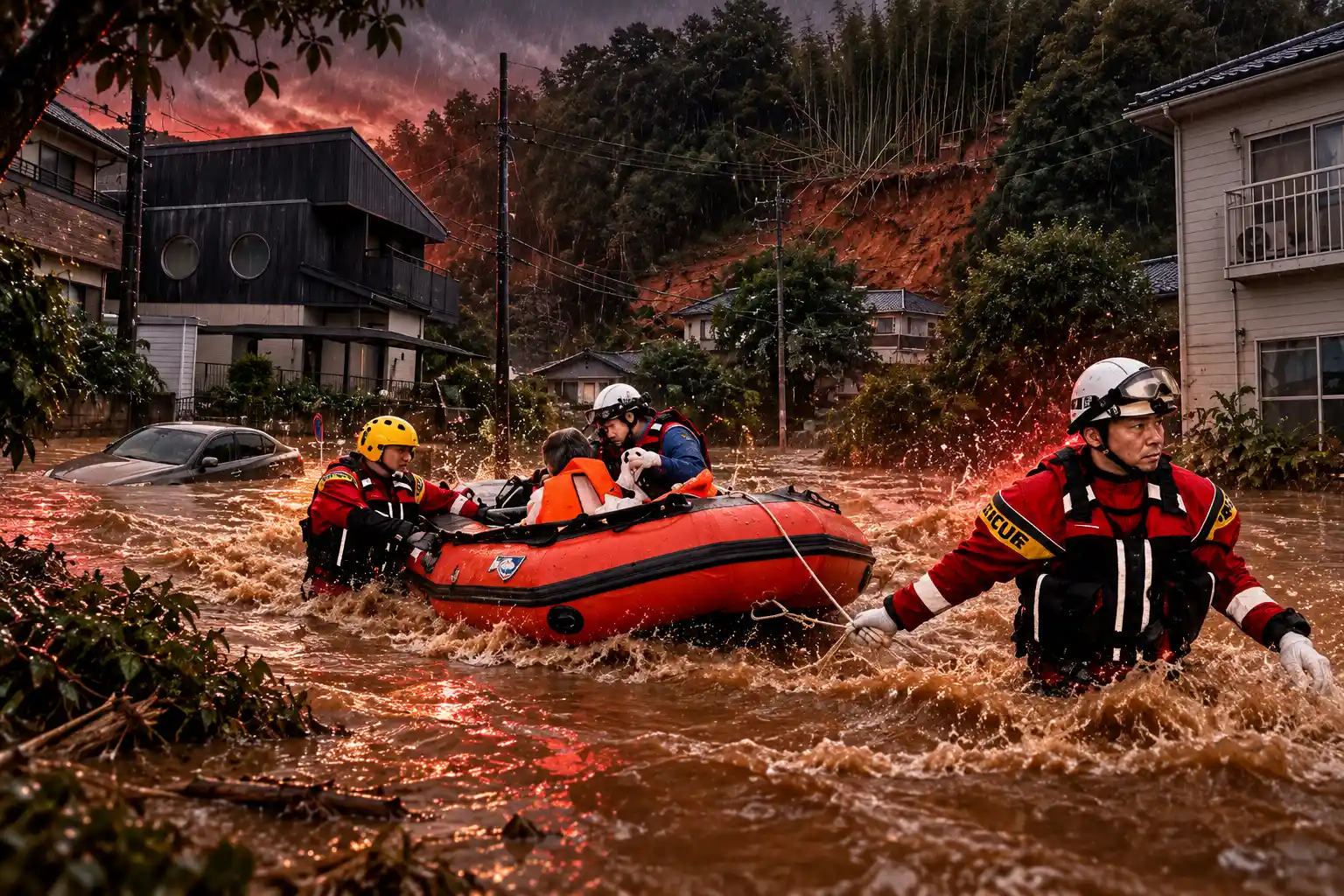
On Tuesday the Takasaki River came over its banks in Sakura. Floodwater stood nearly a meter deep near JR Sakura Station. About 300 households were cut off. Firefighters moved elderly residents in rubber boats. Trucks sat with water over the tires. Residents looked out from second-floor windows at a street that had become a channel.
The pictures that moved fastest were those Chiba streets, not the Tokyo skyline. Dujuan’s center stayed over water. The damage sat on a prefecture that had been wet for weeks, on slopes that had little left to absorb, and on a commuter river that had nowhere to put the extra volume.
THE DRAWDOWN AFTER THE WIND
- Monday night orders: About 1.91 million people in 902,000 households across Ibaraki, Saitama, Chiba, Tokyo, Kanagawa, and Shizuoka were under evacuation instructions at 8 p.m., the Fire and Disaster Management Agency said.
- Tuesday afternoon remainder: More than 74,000 people were still under orders, largely in Chiba, after most warnings were cut or downgraded once the cyclone moved east.
- Power: Tokyo Electric Power Grid counted 42,260 households without electricity at 4:30 p.m. Tuesday, the vast majority in Chiba, with smaller cuts in Kanagawa, Yamanashi, and Shizuoka.
- Houses: Damage reached over 470 buildings in Kanagawa, Chiba, and Ibaraki, including homes that took water or lost walls to slides.
The agency’s damage figures as of 12:30 p.m. on Tuesday were still being revised as prefectures added names to the death list through the evening.
The Game Show and the Festival Shared the Floodplain
Silver Week, the September holiday stretch, put Japan’s biggest consumer crowds on the same Chiba ground the rain was about to hit. Organizers spent Sunday shutting the last day rather than sending people home in a typhoon.
Tokyo Game Show was in its 30th year and, for the first time, had booked five days at Makuhari Messe in Chiba. The Computer Entertainment Supplier’s Association canceled in-person events for Monday, a public holiday, after forecasts called for stronger wind and rain from the afternoon and trouble on the trains.
Prioritizing the safety of all attendees, exhibitors, and staff, we have decided to cancel the event for the entire day.
Computer Entertainment Supplier’s Association, TGS 2026 notice
The four days that did open, Sept. 17 to 20, drew a four-day total of 257,642 visitors. That was 5,459 short of last year’s 263,101, a 2.1 percent dip that includes a lost public day, not a collapse in demand. Exhibitors numbered 1,138 from 53 countries and regions, a record. The business-matching desk logged 3,673 meetings, also a record. Monday stages moved online, including a Red Bull Street Fighter showmatch and the closing program. Next year’s dates are already on the calendar: Sept. 16 to 20, 2027, back at Makuhari Messe.
Rock in Japan Festival, an outdoor run at Soga Sports Park in Chiba City, killed its Sept. 21 bill the same day. The J Fes office said rainfall would top Sunday’s totals all day and that strong wind would arrive with the cyclone’s closest pass. Safety inside and outside the grounds could not be guaranteed, it said. About 25 acts had been booked, including Ado. Refunds for that day were promised by the end of September.
WHAT SILVER WEEK LOST ON MONDAY
- Tokyo Game Show: Final public day at Makuhari Messe canceled; tickets refunded; some stages streamed.
- Rock in Japan: Final outdoor day at Soga Sports Park canceled; 25-act bill dropped; refunds to be detailed later in September.
- Nakayama racing: The Japan Racing Association postponed Monday’s card at Funabashi, Chiba, to Tuesday.
- Pokemon Champions League: The Yokohama card-game finals at Pacifico Yokohama called off.
- Asian Games equestrian: Eventing in the Tokyo region postponed one day; swimming at the Tokyo Aquatics Centre went ahead.
Makuhari Messe sits on Tokyo Bay in Chiba. Soga Sports Park is an open field in the same prefecture. Nakayama is in Funabashi, also Chiba. The holiday calendar was not a Tokyo story that the storm happened to nick. It was booked on the floodplain.
What Closed at Haneda and on the Rails
Haneda, in Ota Ward, recorded 261.5 millimeters in 48 hours through 6 a.m. Tuesday, its highest such total. That is the airport Takaichi needed. Her government jet had been set for 7 p.m. Monday. It left at 11 p.m. and landed at John F. Kennedy International Airport later that night, New York time. A government official said her United States schedule was unchanged: a first address to the U.N. General Assembly’s general debate, talks with President Donald Trump on Tuesday, and a return on Thursday.
Before leaving Tokyo she told reporters she wanted the U.N. speech to “express Japan’s determination to exercise leadership” on energy supply chains and on technology including artificial intelligence. The four-hour hold was a weather problem at Haneda, not a rewrite of the New York book.
East Japan Railway suspended or delayed sections of the Sobu, Narita, and Sotobo lines from the first trains Tuesday. Keikyu halted service between Kanazawa-hakkei and Horinouchi, and between Miura-kaigan and Misakiguchi, the coastal pair that feeds the same Miura hills where crews were digging. Narita Airport, in Chiba, had already lost more than 100 flights on Monday. Haneda lost nearly 400, according to the FlightAware tally circulating with the cancellations.
Sunny breaks were forecast across much of Kanto on Tuesday. High waves and strong wind were still possible along the Pacific coasts of eastern and northeastern Japan as Dujuan pulled away toward the open ocean.
Search Teams Remain in Yokosuka and Kamogawa
Chiba and Kanagawa both asked for Self-Defense Forces units. Crews were still cutting into slide debris in Yokosuka, Miura, and Kamogawa on Tuesday while Sakura pumped out streets. The weather agency’s point was simple: the cyclone can leave and the hillside can still move.
WHAT WE KNOW
- The dead: Six people, five in Chiba and one in Kanagawa, including Yokoyama in Yokosuka and the 51-year-old road worker in Sodegaura.
- The rain: 832 millimeters in 48 hours on Oshima, a record, with broken marks in Ichihara, Kimitsu, Kisarazu, and the Haneda gauge.
- The orders: About 1.91 million people on Monday night; more than 74,000 still covered Tuesday afternoon, mostly in Chiba.
WHAT IS UNCONFIRMED
- The missing: Six people, including a couple in their 70s in Yokosuka, two women in Miura, and two men in Kamogawa. Search status can change by the hour.
- The worker’s fall: Police are investigating how the Sodegaura excavator left the road. No finding has been released.
- Further slides: Saturated soil can fail after rain ends. The agency has not closed that risk for Kanto.
Dujuan was east of Japan by Tuesday afternoon, weakening as it headed toward cooler water. The people still unaccounted for were last seen on hillsides that had been wet long before the cyclone’s closest pass, in a prefecture that had already taken two floods this season and then booked its busiest holiday week on the same ground.

Nintendo Pulls SmileBASIC After the First Switch 2 Jailbreak

Arkane Lyon’s Union Holds the Clock Microsoft Cannot Skip

Airbnb Bans Guest Chores as Homes Turn Into Hotels

Riyadh Downs a Houthi Missile After Weeks of Capital Strikes

Ariana Madix’s Empty Los Angeles House Fits a Bravo Pattern

AI Server Boards Put Everyday Circuit Materials on Allocation

Glacier Collapse Buried Nepal’s Hydropower Workers in Tunnels

Congo’s Bundibugyo Outbreak Outruns the Licensed Ebola Shots

Pennsylvania Measles Deaths Follow a Long Slide in Coverage

Germany Can Miss Its 2026 Climate Cap Without Penalty
-
 NEWS2 months ago
AI Server Boards Put Everyday Circuit Materials on Allocation
-
 NEWS2 months ago
Glacier Collapse Buried Nepal’s Hydropower Workers in Tunnels
-
 NEWS2 months ago
Congo’s Bundibugyo Outbreak Outruns the Licensed Ebola Shots
-
 NEWS2 months ago
Pennsylvania Measles Deaths Follow a Long Slide in Coverage
-
 NEWS2 months ago
Germany Can Miss Its 2026 Climate Cap Without Penalty
-

 NEWS2 months ago
Texas Judge Freezes the SEC Eligibility Ban for 41 Athletes
-

 NEWS2 months ago
CISA’s Known Exploits Still Come From 2007-Era Bugs
-

 BUSINESS2 months ago
Trump’s Venezuela Oil Deal Leaves the Barrels in the Ground