
NEWS
Trutakna Posts Zero Dialysis Events in Two-Year Trial
Trutakna flattened kidney decline over two years in IgA nephropathy, with zero dialysis events versus eight on placebo, as Vera prepares a full-approval filing.

Vera Therapeutics said on September 15, 2026 that Trutakna held kidney function nearly flat over two years in the ORIGIN 3 trial of IgA nephropathy. Annualized decline was -0.6 milliliters per minute versus -5.6 on placebo, a 5.0-point gap, and 0 patients on the drug reached dialysis, transplant, or death against 8 on placebo.
The Brisbane, California company already sells the weekly shot under accelerated approval to reduce proteinuria, granted July 7, 2026. It now plans a supplemental biologics license application in the fourth quarter of 2026 and is aiming for full approval in 2027.
ORIGIN 3 Flattened Kidney Decline Over Two Years
The ORIGIN 3 final efficacy analysis covered 428 adults with primary IgA nephropathy at risk of getting worse, 214 on Trutakna (atacicept-vymj) 150 mg once a week and 214 on placebo. Mean change in estimated glomerular filtration rate, the standard blood test of kidney filter function, was -0.1 at 52 weeks on Trutakna and -5.7 on placebo, a 5.6-point difference (95% CI 3.7 to 7.5, p<0.0001).
Through 104 weeks the annualized eGFR slope was -0.6 on Trutakna (95% CI -1.6 to 0.4) and -5.6 on placebo (95% CI -6.6 to -4.6). The 5.0-point treatment effect (95% CI 3.6 to 6.5) also met p<0.0001. Vera said that slope sits inside the KDIGO goal of slowing loss to the physiologic rate of less than 1 mL/min/1.73 m2 per year, the pace of normal aging.
Founder and chief executive Marshall Fordyce, M.D., told investors on September 10 at the Cantor Global Healthcare Conference that two-year kidney-function results from the earlier ORIGIN 2b study, published in 2024, had already shown patients holding a similar slope. Phase 3 has now repeated that pattern in a larger, placebo-controlled set.
ORIGIN 3 AT TWO YEARS
| Endpoint | Trutakna (n=214) | Placebo (n=214) | Effect |
|---|---|---|---|
| Mean eGFR change at 52 weeks, mL/min/1.73 m2 | -0.1 | -5.7 | 5.6 |
| Annualized eGFR slope through 104 weeks | -0.6 | -5.6 | 5.0 |
| Composite kidney progression events | 11 | 38 | HR 0.24, 76% lower risk |
| Dialysis ≥30 days, transplant, or death | 0 | 8 | 8 vs 0 |
The same analysis also met hierarchically tested cuts in proteinuria, galactose-deficient IgA1 (the abnormal antibody that drives the disease), and hematuria. Proteinuria data from the first 203 patients, published in the New England Journal of Medicine after a late-breaking talk at ASN Kidney Week 2025, showed a 46% drop from baseline at week 36 and a 42% drop versus placebo (p<0.0001). That surrogate result is what the FDA used for the July 7 license.
Zero Dialysis Events Against Eight on Placebo
Composite kidney-disease progression events accumulated in 11 patients on Trutakna and 38 on placebo through 104 weeks, a hazard ratio of 0.24 (95% CI 0.12 to 0.48), or a 76% lower risk (p<0.0001). The harder subset of dialysis for at least 30 days, kidney transplant, or death was 0 versus 8. Those are different counts: the composite is the broader progression tally, and the 0-versus-8 line is the organ-failure and death subset inside it.
Richard Lafayette, M.D., professor of medicine at Stanford University Medical Center and a principal investigator for ORIGIN 3, put the clinical claim in one line.
Prevention of kidney failure or kidney-related death is the ultimate goal. We now have evidence suggesting that TRUTAKNA may help patients avoid dialysis, transplantation, or kidney-related death over the long term.
Richard Lafayette, M.D., ORIGIN 3 principal investigator, Vera statement
IgA nephropathy is an immune disease in which an abnormal IgA antibody builds up in the kidney’s filters, leaking protein into urine and scarring the organ over years. Vera estimates about 160,000 people in the United States have the diagnosis. About 2.5 adults per 100,000 are diagnosed each year worldwide, most often between ages 30 and 40, and the company says at least 50% may progress to kidney failure or death within 10 to 20 years of diagnosis.
Fordyce said upstream blockade of BAFF and APRIL, the two B-cell signals that feed production of that antibody, “achieves results that reflect the potential for comprehensive disease modification in IgAN.” ORIGIN 3, he added, was the first reported Phase 3 IgAN trial to align with the FDA on an earlier final efficacy look, so placebo patients could move sooner onto open-label drug. That plan was set on June 2, 2026, pulling the analysis forward from 2027.
How Trutakna Compares With Voyxact
The ranking fight is not with older pills. It is with Otsuka’s Voyxact (sibeprenlimab-szsi), an APRIL-only antibody that already posted VISIONARY two-year eGFR results on August 3, 2026. In that trial the annualized slope was +0.3 on Voyxact versus -4.2 on placebo, a 4.5-point effect (95% CI 3.6 to 5.4, p<0.0001). Otsuka is running a rolling supplemental filing for traditional approval and has called Voyxact the first approved IgAN drug to show stabilization, with some evidence of improvement.
Raw drug-arm slopes favor Voyxact (+0.3 versus Trutakna’s -0.6). Placebo-adjusted effects go the other way, 5.0 versus 4.5, and the confidence intervals overlap. The placebo groups themselves were not the same: ORIGIN 3 placebo fell 5.6 mL per year, VISIONARY placebo 4.2, so a cross-trial gap of a few tenths of a point is noise. Both drug arms sit inside the KDIGO aging-rate band. What ORIGIN 3 has, and VISIONARY’s public two-year package has not matched in kind, is the 76% composite cut and the 0-versus-8 dialysis, transplant, or death count.
TWO-YEAR EGFR ACROSS IgAN DRUGS
| Drug | Company | Two-year slope, drug vs control | Adjusted effect | U.S. status |
|---|---|---|---|---|
| Trutakna (atacicept-vymj) | Vera | -0.6 vs -5.6 placebo | 5.0 | Accelerated; sBLA planned Q4 2026 |
| Voyxact (sibeprenlimab-szsi) | Otsuka | +0.3 vs -4.2 placebo | 4.5 | Accelerated; rolling sBLA |
| Fabhalta (iptacopan) | Novartis | -3.0 vs -5.7 placebo | 2.7 | Full approval July 17, 2026 |
| Filspari (sparsentan) | Travere | -3.0 vs -4.2 irbesartan | 1.2 vs active control | Full approval September 2024 |
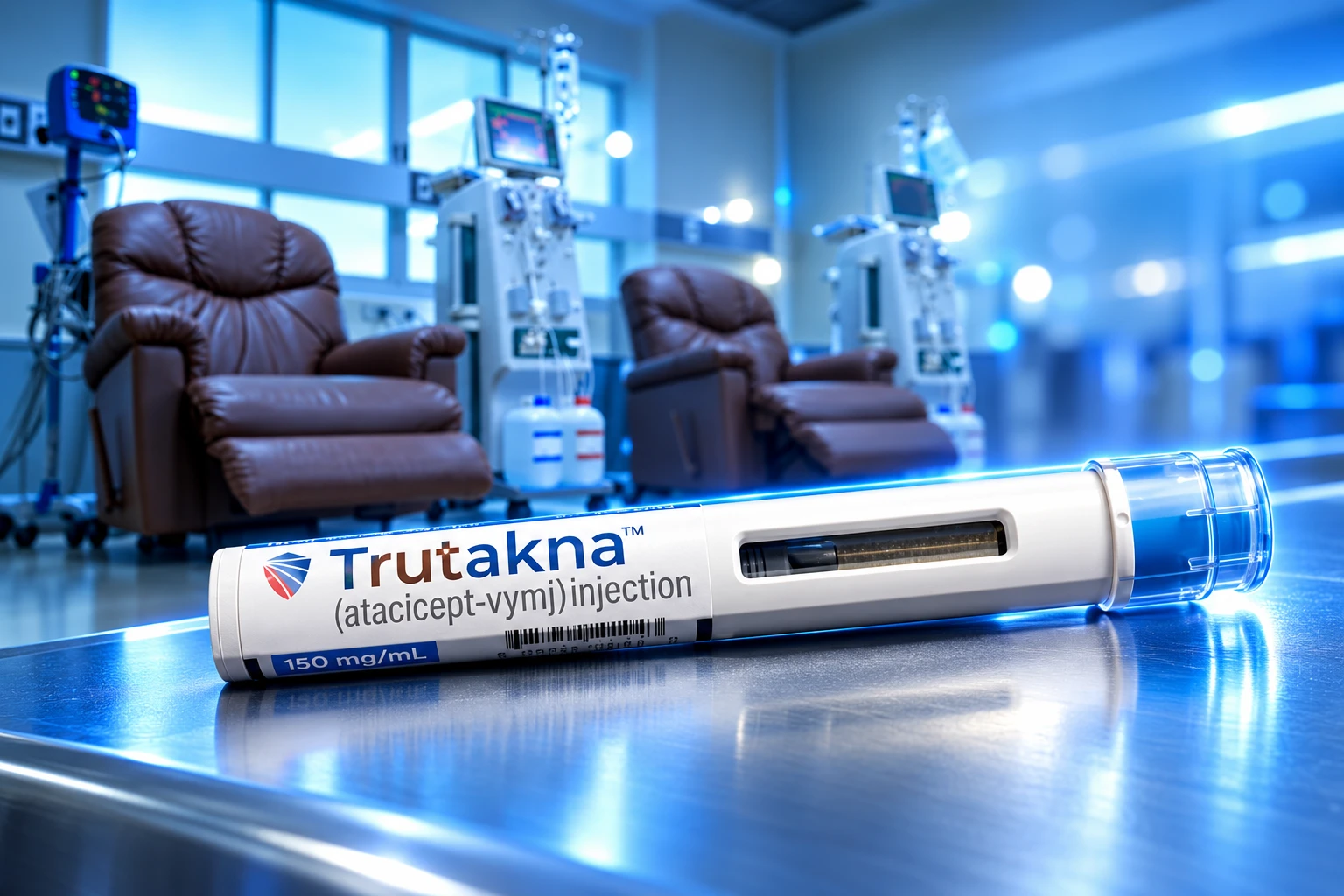
Trutakna is a 1 mL, 150 mg subcutaneous autoinjector used at home once a week. Safety in ORIGIN 3 through two years was described as similar to placebo for overall adverse events and for infections, with no opportunistic infections and no clinically relevant drop in antibodies (hypogammaglobulinemia). The approved label, built on earlier ORIGIN data, lists infections in 32% of Trutakna patients versus 28% on placebo and local administration reactions in 30% versus 5%, including injection-site reaction in 19% versus 2%.
Fabhalta Converted First, With a Smaller eGFR Gap
The FDA’s IgAN shortcut has been consistent: accelerate on proteinuria at about nine months, then convert to a full label if two-year eGFR holds up. Three drugs already completed that conversion before Vera’s readout, and they did it with smaller filter-rate gaps than the B-cell pair.
WHERE THE CLASS STANDS
- Tarpeyo (budesonide): Calliditas’s targeted-release steroid won accelerated approval in December 2021 and full approval in December 2023 after NefIgArd.
- Filspari (sparsentan): Travere’s dual endothelin and angiotensin blocker moved from accelerated approval in February 2023 to a full label in September 2024, with a 110-week slope of -3.0 versus -4.2 on irbesartan (p=0.0168).
- Fabhalta (iptacopan): Novartis’s oral complement inhibitor converted on July 17, 2026 after APPLAUSE-IgAN, with an annualized change of -3.0 versus -5.7, a 2.7-point difference.
- Vanrafia (atrasentan): Novartis’s selective endothelin blocker still sits on accelerated approval from April 2025; the company said ALIGN’s week-136 eGFR difference of 2.39 missed the pre-set significance cut (p=0.057).
- Voyxact and Trutakna: both remain on accelerated licenses while they file two-year packages for traditional approval.
Doctors now have two B-cell drugs that flattened the curve toward the aging rate and a set of downstream agents that slowed it. That split, not a single winner, is what the confirmatory era has produced. Head-to-head trials do not exist, so any ranking still has to carry the usual caveats on different placebos, different control arms, and different statistical plans.
Start Forms Reached 350 in 10 Weeks
Trutakna launched after the July 7 license as a commercial product, not a pipeline slide. Chief commercial officer Matt Skelton said the company generated more than 350 patient start forms in the first 10 weeks, is seeing paid claims, and is pleased with early payer policies. A Raymond James note the same day as the readout treated that early paper as landing in range of Voyxact’s launch pace.
List price is steep. At launch Skelton set wholesale acquisition cost at $32,700 for a 28-day carton of four doses, about $425,000 a year. Eligible commercially insured patients may pay as little as $0 out of pocket through the TRUTAKNA TRU SUPPORT copay program, Vera said. For a disease diagnosed in people in their 30s, that annual bill is the access fight that sits behind the eGFR charts.
THE PRODUCT ON THE MARKET
- Dose: 150 mg in a 1 mL once-weekly at-home autoinjector.
- Start forms: more than 350 in the first 10 weeks after July 7, 2026.
- List price: $32,700 per 28-day carton, about $425,000 per year.
- U.S. pool: about 160,000 people with IgA nephropathy, per Vera.
The shot suppresses antibody production, so the FDA warns that it can raise infection risk, should be delayed during active infection, and should not be paired with live vaccines within 30 days before the first dose or during treatment. It also received priority review and Breakthrough Therapy designation on the way to the July license.
Vera Will File for Full Approval in the Fourth Quarter
The current U.S. indication is still narrow: reduce proteinuria in adults with primary IgA nephropathy at risk of progression. The label states that it has not been established whether Trutakna slows kidney-function decline over the long term, and that continued approval may depend on the confirmatory trial. That trial is ORIGIN 3. The ORIGIN 3 trial listing describes a 104-week randomized, double-blind, placebo-controlled design in adults who still had heavy protein leak after at least 12 weeks of maximized ACE inhibitor or ARB therapy, with SGLT2 inhibitors allowed.
THE PATH TO A FULL LABEL
- November 6, 2025: Week-36 proteinuria win presented at ASN Kidney Week and published in the New England Journal of Medicine; BLA filed that month.
- January 7, 2026: FDA grants priority review, PDUFA date July 7, 2026.
- June 2, 2026: FDA agrees to pull the eGFR analysis into the third quarter of 2026 from 2027.
- July 7, 2026: Accelerated approval for proteinuria reduction; commercial launch begins.
- September 15, 2026: Two-year eGFR, composite, and 0-versus-8 dialysis, transplant, or death results reported.
- Fourth quarter of 2026: Planned supplemental BLA for full approval, with Vera pointing to 2027 for a possible full label.
Fordyce said the company plans to submit that supplemental BLA in the fourth quarter of 2026 and looks toward potential full approval in 2027. Detailed ORIGIN 3 numbers will go to a scientific congress that has not been named. Until the FDA rewrites the label, Trutakna is still a proteinuria drug with a two-year kidney-function package sitting in the wings, and Voyxact is still the other B-cell shot with a flattening slope of its own. The 0-versus-8 count is the piece of ORIGIN 3 that filing is built to put on the label.
Disclaimer: This article is news reporting and analysis of a completed clinical-trial readout and a planned FDA filing. It is informational only and is not medical advice, a treatment recommendation, or investment advice. Patients should talk with a nephrologist or other qualified physician before starting, stopping, or switching any IgA nephropathy therapy, and readers considering Vera Therapeutics securities should consult a licensed financial adviser. Trial figures, prices, start-form counts, and approval statuses reflect company, FDA, and trial sources as dated in the piece and can change as labels, filings, and further analyses are issued.

Nintendo Pulls SmileBASIC After the First Switch 2 Jailbreak

Arkane Lyon’s Union Holds the Clock Microsoft Cannot Skip

Airbnb Bans Guest Chores as Homes Turn Into Hotels

Riyadh Downs a Houthi Missile After Weeks of Capital Strikes

Ariana Madix’s Empty Los Angeles House Fits a Bravo Pattern

AI Server Boards Put Everyday Circuit Materials on Allocation

Glacier Collapse Buried Nepal’s Hydropower Workers in Tunnels

Congo’s Bundibugyo Outbreak Outruns the Licensed Ebola Shots

Pennsylvania Measles Deaths Follow a Long Slide in Coverage

Germany Can Miss Its 2026 Climate Cap Without Penalty
-
 NEWS2 months ago
AI Server Boards Put Everyday Circuit Materials on Allocation
-
 NEWS2 months ago
Glacier Collapse Buried Nepal’s Hydropower Workers in Tunnels
-
 NEWS2 months ago
Congo’s Bundibugyo Outbreak Outruns the Licensed Ebola Shots
-
 NEWS2 months ago
Pennsylvania Measles Deaths Follow a Long Slide in Coverage
-
 NEWS2 months ago
Germany Can Miss Its 2026 Climate Cap Without Penalty
-

 NEWS2 months ago
Texas Judge Freezes the SEC Eligibility Ban for 41 Athletes
-

 NEWS2 months ago
CISA’s Known Exploits Still Come From 2007-Era Bugs
-

 BUSINESS2 months ago
Trump’s Venezuela Oil Deal Leaves the Barrels in the Ground