
BUSINESS
Covid Inquiry Finds Care Homes Had No Protective Ring
Hallett’s Module 6 report records staff in scavenged PPE, families kept from the dying, and eight care-home jobs sent to the Prime Minister.

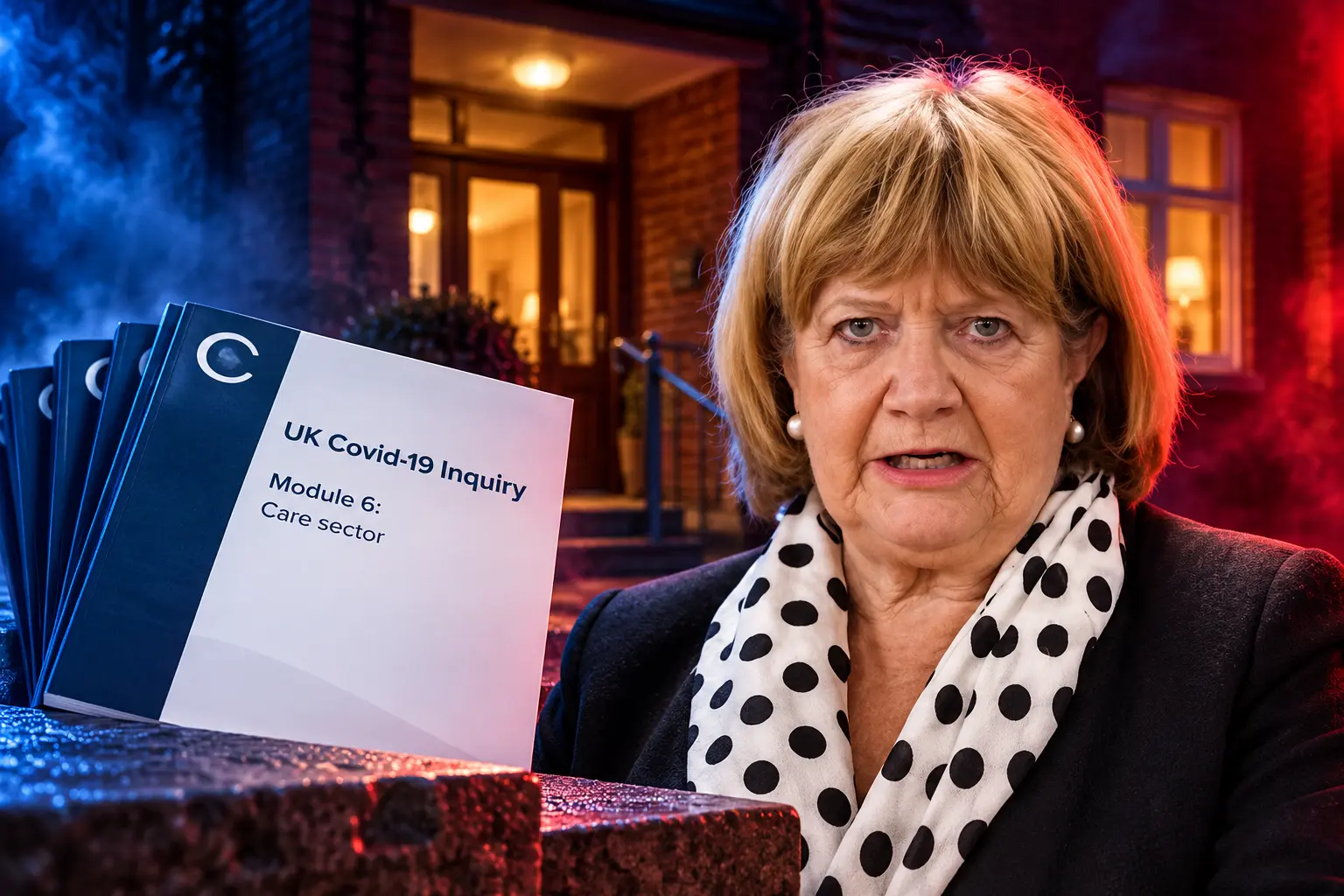
The UK Covid-19 Inquiry has found that a claimed protective ring around care homes never existed, after more than 43,000 residents died with the virus. Baroness Heather Hallett, the inquiry chair, said adult social care was treated as leftover business while ministers focused on hospitals.
Her Module 6 report, published on 20 October 2026, puts that record on the people who lived and worked inside those buildings, and on eight jobs that now sit with the Prime Minister.
No Protective Ring Around Care Homes
Matt Hancock, health secretary from July 2018 to June 2021, told a Downing Street briefing on 15 May 2020 that the government had tried, “right from the start,” to throw a “protective ring” around care homes. Hallett finds that claim unfounded. In March and the first half of April 2020, she writes, the opposite was true.
The UK government and the Scottish, Welsh and Northern Ireland governments knew before the pandemic that care home residents were extremely vulnerable to respiratory viruses. Care homes still received too little protection when they most needed it, and action to shield workers and residents came too late. In the inquiry’s words, the adult social care sector appeared to be something of an afterthought, and the mantra of protecting the NHS sometimes came at the expense of the people who used and provided care.
At the critical early stages of the pandemic, not enough was done to protect those living and working in care homes. The mantra at the time of ‘protecting the NHS’ sometimes came at the expense of the users and providers of care. The adult social care sector as a whole appeared to be something of an afterthought.
Baroness Heather Hallett, Chair, UK Covid-19 Inquiry
Covid-19 was the second leading cause of death in care homes in all four nations of the UK in 2020. Between March 2020 and July 2022 there were more than 43,000 recorded deaths involving the virus in those homes. Hallett says the failures set out in the report created settings in which the virus could spread like wildfire.
Why Isolation Was Never Written Into the Discharge Rules
In March 2020 all four UK governments sped up hospital discharges to free beds. About 25,000 people in England moved into care homes between 17 March and 15 April 2020, before routine testing. England, Wales and Northern Ireland did not at first tell homes to isolate those arrivals. Hallett calls that a significant omission.
She accepts the discharges themselves were needed to free hospital beds. Hancock told the inquiry it “was a question of what is the least worst solution to this terrible problem.” Testing capacity was too low to know patients’ Covid-19 status, there was no vaccine, and PPE was short. Isolation was one of the few remaining controls. It was not initially advised in March 2020 in England, Wales and Northern Ireland. Some homes could not isolate people safely, and no fallback was in place.
The inquiry’s own table of hospital discharges to care homes in early 2020, drawn from national audit and public health figures, is set out below. The windows differ, so the rows are not a single UK total.
HOSPITAL DISCHARGES TO CARE HOMES, EARLY 2020
| Nation | People discharged | Share without a test | Period |
|---|---|---|---|
| England | c. 25,000 | Not known | 17 March to 15 April 2020 |
| Scotland | 3,595 | 82% | 1 March to 21 April 2020 |
| Wales | 1,729 | 96% in March 2020; 65% in April before 29 April 2020 | 1 March to 31 May 2020 |
| Northern Ireland | 4,957 | Not known | First two quarters of 2020 |
England’s count is the National Audit Office figure of c. 25,000 between 17 March and 15 April 2020. Routine testing of patients sent from hospital into English care homes began on 15 April 2020. The High Court ruled in 2022 that the English discharge policies issued on 17 March, 19 March and 2 April 2020 were unlawful because they did not face up to the risk from people who carried the virus with no symptoms.
Studies later found that hospital admissions were one of several ways the virus entered care homes, and were unlikely to have been the main driver of infections in the first wave. Limited testing meant those studies could not fully measure the effect. Hallett still treats the missing isolation advice as a serious gap, because isolation was one of the few tools left when tests were not.
THE MONTHS THAT MATTERED
- October 2016: Exercise Cygnus recommends work on social care surge capacity that is still unfinished when Covid-19 arrives.
- March 2020: All four governments speed up hospital discharges. England, Wales and Northern Ireland do not at first advise isolation of new arrivals.
- 15 April 2020: England begins testing patients discharged from hospital into care homes.
- 15 May 2020: Hancock says the government has tried to throw a protective ring around care homes right from the start.
- Summer 2020: Visiting limits begin to ease after months of essential-only access.
- 27 April 2022: The High Court rules the early English discharge policies unlawful.
- 30 June to 31 July 2025: Module 6 hearings take oral evidence in London.
- 20 October 2026: Hallett publishes the care sector report and writes to the Prime Minister on the recommendations.
By the time Hancock spoke of a ring, testing of discharged patients in England had been in place for a month. The inquiry’s finding is that the weeks that counted were March and early April, when isolation was not in the guidance and homes were already taking people whose Covid-19 status was unknown.
Staff Worked in Ponchos, Bin Bags and Painters’ Overalls
A paid workforce of at least 1.5 million people, including those who care for people in their own homes, kept working through the outbreak. Many put their own lives at risk. Early infection-control guidance told staff to stay two metres from the person they were looking after. That rule could not be followed. Most social care is close work: washing, dressing, eating.
From mid-March 2020, staff were told to wear PPE. Supply collapsed. Hallett calls the result wholly unacceptable. Care workers were left without the protection they needed, even though, she finds, better planning could have improved supply from the start.
WHAT STAFF USED WHEN PPE RAN OUT
- Festival ponchos: Waterproof ponchos made for outdoor events, worn as makeshift gowns.
- Painters’ overalls: Decorating kit used as a barrier because proper coveralls were not there.
- Bin bags and bed linen: Home-made cover from fabric, refuse sacks and sheets when stock ran out.
Jacqueline Kitchen, a care worker who gave a statement to Module 6, said she and her colleagues were “experiencing burn out and constant exhaustion, as well as grief and trauma from our experiences caring for residents who had Covid-19.” Senga Walker, a care assistant, said she sat with residents who could not be moved to hospital and held their hands, because she was not a medic and there was little else she could do.
The report describes post-traumatic stress and suicidal thoughts among staff, and records that a number of care workers killed themselves. Many others left the job. Changes to sick pay arrived in England, Scotland and Northern Ireland between March and May 2020. Wales did not follow until November 2020. Hallett says money to let care staff stay home when infected, or to limit staff moving between homes, has to be ready at the start of the next pandemic, not built in the middle of it.
What Visiting Bans Did to Families
From late March 2020, care homes were told to limit visits to essential calls. Restrictions did not begin to ease until the summer. Residents likened the period to prison. Some families were kept from people who were dying. Hallett said many still carry a guilt they do not deserve.
The report finds that the severity and length of the limits caused profound and enduring effects, especially for people with dementia and other complex cognitive conditions. Relatives could not help with eating, drinking and washing. Professional visits, including by healthcare staff, dropped sharply. Oversight of care quality thinned at the same time as families were locked out. Visits at the end of life should have been allowed. That did not always happen, and people died without their families beside them.
I asked to be able to see my mum, but they refused. It had been 10 months, since I last had physical contact and now, she was gravely ill. In the last few days of her life, I was allowed to be outside the patio door to her room and the staff wheeled her bed closer to me. I stayed there for hours each day in the freezing cold, rain, and snow. This is an open-ended trauma, a wound that won’t close.
Jane Wierzbowska, witness statement to Module 6
Linda Dinsdale told the inquiry her relative Sheryl died alone from Covid, and that the virus was brought into the home by discharged hospital patients in a setting with little PPE or effective infection control. Hallett says preventing visits caused immense emotional harm and, at times, limited access to medical care. She also says that letting visitors in ran the risk of bringing a deadly virus into a vulnerable population. Future guidance, she recommends, should start from a right to in-person visitors except in the most grave or exceptional circumstances, and should be published before the next outbreak, not improvised during one.
The same chapter of harm includes Do Not Attempt Cardiopulmonary Resuscitation decisions. Some were made on the basis of age, a health condition or a learning disability, or without a proper personal assessment. Hallett found no UK-wide or nation-specific policy that encouraged blanket orders. She still wants mandatory end-of-life training, because those conversations were too often rushed or missing.
The Register the Other Three Nations Already Keep
Scotland, Wales and Northern Ireland already keep registers of care workers. Those lists made it possible, in the pandemic, to find recently retired staff and to push advice out quickly. England has no such register. One of Hallett’s eight recommendations is a voluntary English register, with a full cost-benefit review within five years of whether membership should become mandatory.
That gap sits on top of an older planning failure. Exercise Cygnus, a pandemic exercise run in October 2016, recommended ways to assess social care and surge capacity. That work had not been finished when Covid-19 arrived. Ministers were then taking decisions without the data they needed on beds, staff and deaths. Real-time figures on care home deaths in each nation were not available until mid to late April 2020. Data on people receiving care in their own homes who had died were weaker still.
Around the paid workforce sat about 5.8 million unpaid carers. They took on more complex care, for longer hours, with little or no respite. Support arrived late, and governments struggled even to identify who those carers were. A State of Caring snapshot of unpaid care, cited in the report, records the sense that this work is treated as “just what you should be doing.” Hallett’s terms of reference do not let her redesign adult social care as a whole. She points instead to the Independent Commission on Adult Social Care, chaired by Baroness Casey of Blackstock, for those wider English questions.
The people the “protective ring” language left out are the same people the unfinished Cygnus work left uncounted: staff with no register in England, unpaid carers with no list, and homes whose deaths did not show up in government dashboards until the first wave had already torn through.
Eight Recommendations Go to the Prime Minister
Hallett makes eight recommendations and says they must be acted on now, before the next pandemic. On 20 October 2026 she wrote to the Prime Minister about implementation. The inquiry will monitor progress during its lifetime. The official account posted the chair’s call as the report landed.
1/ The Chair of the UK Covid-19 Inquiry, Baroness Heather Hallett, has today published her sixth report.
Baroness Hallett is calling for the prompt and thorough implementation of eight key recommendations. pic.twitter.com/pL4fzr6Ios
— UK Covid-19 Inquiry (@covidinquiryuk) October 20, 2026
THE EIGHT FIXES IN THE MODULE 6 REPORT
| Recommendation | What it requires |
|---|---|
| Pandemic planning | Clearer structures, roles and responsibilities for adult social care in all four governments, including local and provider plans that are tested. |
| Isolation capacity | Practical steps to scale up safe isolation for care home residents, including people arriving from hospital. |
| Staff isolation pay | Financial schemes ready to roll out so care staff can self-isolate or so movement between homes can be limited. |
| Visiting rules | Published guidance on how visiting limits will be decided, based on a right to in-person visitors except in the gravest cases. |
| Inspections | Protocols so inspections continue in a pandemic, including on-site visits where possible. |
| Death data | Better collection of data on deaths in adult social care, including deaths of workers. |
| End-of-life training | Mandatory training for relevant health and social care staff on end-of-life care and DNACPR conversations. |
| English workforce register | A voluntary register for social care staff in England, matching lists that already exist in Scotland, Wales and Northern Ireland. |
Health Secretary Yvette Cooper told the Commons the government would give a full response to the recommendations “in due course.” She said she agreed with Hallett that social care has been undervalued and under-recognised for too long, and that her thoughts were with people who could not be with dying relatives because of visiting limits. She also said the sector was insufficiently prepared and too often treated as an afterthought compared with the NHS.
That is the political product of a 2026 report on a 2020 failure: a letter to the Prime Minister, eight operational jobs, and a promise of a reply in due course. The inquiry does not set out criminal charges or ministerial bans. The argument that followed the Sky clip of Hallett’s “wildfire” line was about prison and blame. The document itself is about isolation rooms, sick pay, inspection protocols and a register England still does not have.
Hallett says the next pandemic will again hit care home residents hardest. Module 7, on test, trace and isolate, is due on 19 November 2026. Cooper’s full response has no date attached.
Frequently Asked Questions
Who Took the Government to Court Over Care Home Discharges?
Dr Cathy Gardner and Fay Harris brought the 2022 High Court case after their fathers, Michael Gibson and Donald Harris, died in care homes. On 27 April 2022, Lord Justice Bean and Mr Justice Garnham held that the English discharge policies in documents issued on 17 March, 19 March and 2 April 2020 were unlawful, because they did not take account of the risk from people who had the virus with no symptoms.
What Did the Inquiry Find About DNACPR Decisions?
A DNACPR decision is a clinical choice not to attempt cardiopulmonary resuscitation; a person can also record their own wishes in advance. The orders are meant to be person-specific and must not be applied to groups. Module 6 found no UK-wide or nation-specific policy that encouraged blanket use, but it heard of decisions based on age, health condition or learning disability, and of talks that were rushed or never held. Mandatory end-of-life training is the remedy Hallett proposes.
Will the English Social Care Workforce Register Be Mandatory?
Not at first. Hallett recommends a voluntary register in England, where none exists, in line with the lists already used in Scotland, Wales and Northern Ireland. Once that register has been running for no more than five years, the UK government should run a full cost-benefit analysis and review whether membership should become mandatory.
How Much Evidence Did Module 6 Collect?
Public hearings ran from 30 June to 31 July 2025. Fifty-seven witnesses gave oral evidence, among them residents, families, unpaid carers, care workers, regulators, clinicians, and serving and former ministers and officials. The inquiry gathered more than 170 written statements and more than 100,000 pages of evidence, and listed 27 Core Participants for the module.
When Do the Remaining Covid Inquiry Reports Appear?
Module 7, on test, trace and isolate, is due on 19 November 2026. The last three reports, Module 8 on children and young people, Module 9 on the economic response, and Module 10 on the impact on society, are due in the first half of 2027. The inquiry says it will monitor implementation of recommendations, including the eight in Module 6, for the rest of its life.

Nintendo Pulls SmileBASIC After the First Switch 2 Jailbreak

Arkane Lyon’s Union Holds the Clock Microsoft Cannot Skip

Airbnb Bans Guest Chores as Homes Turn Into Hotels

Riyadh Downs a Houthi Missile After Weeks of Capital Strikes

Ariana Madix’s Empty Los Angeles House Fits a Bravo Pattern

AI Server Boards Put Everyday Circuit Materials on Allocation

Glacier Collapse Buried Nepal’s Hydropower Workers in Tunnels

Congo’s Bundibugyo Outbreak Outruns the Licensed Ebola Shots

Pennsylvania Measles Deaths Follow a Long Slide in Coverage

Germany Can Miss Its 2026 Climate Cap Without Penalty
-
 NEWS2 months ago
AI Server Boards Put Everyday Circuit Materials on Allocation
-
 NEWS2 months ago
Glacier Collapse Buried Nepal’s Hydropower Workers in Tunnels
-
 NEWS2 months ago
Congo’s Bundibugyo Outbreak Outruns the Licensed Ebola Shots
-
 NEWS2 months ago
Pennsylvania Measles Deaths Follow a Long Slide in Coverage
-
 NEWS2 months ago
Germany Can Miss Its 2026 Climate Cap Without Penalty
-

 NEWS2 months ago
Texas Judge Freezes the SEC Eligibility Ban for 41 Athletes
-

 NEWS2 months ago
CISA’s Known Exploits Still Come From 2007-Era Bugs
-

 BUSINESS2 months ago
Trump’s Venezuela Oil Deal Leaves the Barrels in the Ground