
BUSINESS
CoreWeave’s Bond Crash Reprices Who Builds AI Data Centers
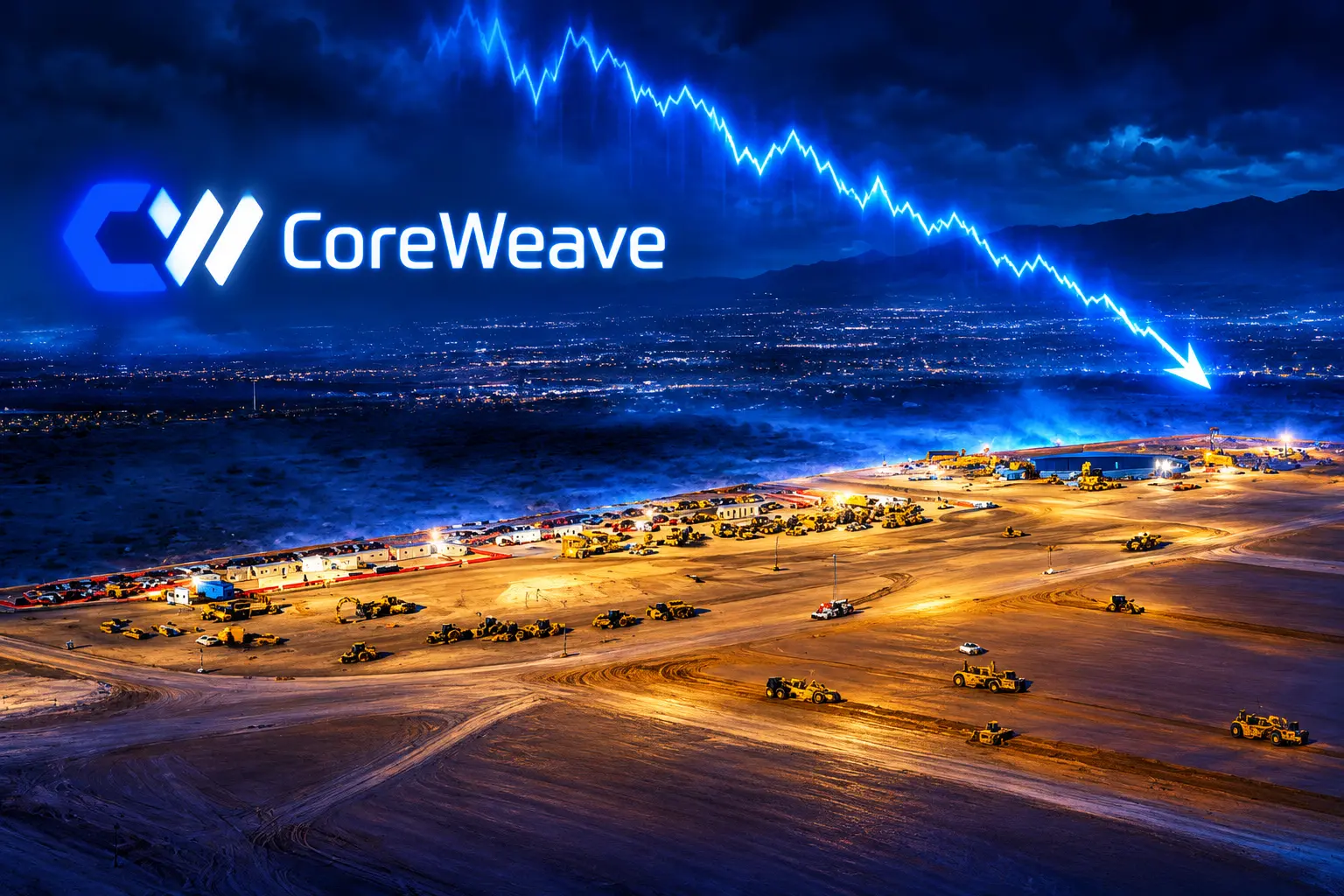
CoreWeave’s mid-October bond crash is a funding-cost shock that pushes the next AI data centers toward cash-rich builders, even without a default.

CoreWeave’s unsecured bonds fell to about 79 cents on the dollar in mid-October, and five-year default insurance jumped to a record 1,194.5 basis points. Credit markets now price more than a 60% chance the Nvidia-backed AI cloud misses its debts within five years.
No coupon has been skipped. The change that will last is the cost of the next dollar. At yields as high as 16%, a specialist that still has to borrow to turn a contracted backlog into live racks cannot fund the next campus at last year’s price, so the work moves toward names that can still pay cash or borrow like investment-grade credits.
Credit Markets Just Repriced CoreWeave
CoreWeave rents Nvidia-powered computing to labs and companies that do not want to own the boxes. It went public in March 2025 at $40 a share, raising about $1.4 billion, and now runs 51 data centers. The equity story has been growth. The credit story in October was the coupon on the 9.75% notes due October 2031, a $2.75 billion issue that traded around 79 cents on Tradeweb after the yield spiked as high as 16%.
Kathleen Brooks, research director at XTB, called the company “the AI trade’s canary in the coal mine.” Gavan Nolan, executive director of fixed income pricing at S&P Global Market Intelligence, said a spread of 1,000 basis points or more is generally a sign of credit distress. CoreWeave’s five-year contracts, per ICE Data Services, went through that line and kept going, to 1,194.5 basis points on October 15. A year earlier the implied five-year default odds sat near 30%.
The Evercore ISI trading desk put the mood in four words: the market is saying “no mas” to AI debt that does not have operating cash behind it. Default swaps on a name this size can also gap when a few hedges hit a thin book, so that 60% figure is a price, not a court filing. It is still the price at which CoreWeave would have to refinance.
THE CREDIT BREAK IN MID-OCTOBER
- October 14, 2026: Gartner warns that more than $3.5 trillion of AI infrastructure spending could face impairment by 2030, and CoreWeave shares drop about 15%.
- October 15, 2026: Five-year CoreWeave default swaps hit 1,194.5 basis points on ICE data, and the 2031 notes yield as much as 16% before easing.
- October 16, 2026: Bonds tied to other U.S. AI data-center projects, including campuses leased to large cloud tenants, are quoted below par, showing the move is not confined to one issuer.
Oracle and SoftBank were pulled into the same tape. They are not the same credit.
HOW DEFAULT INSURANCE PRICED THE NAMES
| Company | Five-year CDS | Market reading on October 15 |
|---|---|---|
| CoreWeave | 1,194.5 bps (ICE) | More than 60% odds of default within five years |
| Oracle | 288 bps (S&P Global) | A record for the company |
| SoftBank | 424 bps | Widened 24 bps in the move |
Amazon, Alphabet, and Meta also printed record-wide swaps on S&P Global and LSEG data, but the spreads stayed a fraction of Oracle’s, let alone CoreWeave’s. That gap is the story the default headlines bury.
$72 Billion of Liabilities, $5 Billion of Equity
CoreWeave’s June quarter filing listed $72 billion of total liabilities against $5.0 billion of stockholders’ equity, about 14 times. Total assets were $77.1 billion. Those liabilities are not all bonds. Debt principal due over time is $35.6 billion. Operating-lease liabilities are $16.3 billion. The rest is payables, deferred revenue, and other items that still have to be met in cash.
THE JUNE 30 BALANCE SHEET IN FOUR LINES
- Cash on hand: $5.5 billion, against $46.7 billion of property and equipment already on the books.
- Near-term principal: $4.4 billion still due in the rest of 2026 and $6.2 billion in 2027.
- Interest bill: $640 million in the second quarter, up from $267 million a year earlier, and $1.18 billion in the first half, a 121% increase.
- The backlog: about $104 billion of contracted revenue not yet recognized as of June 30, per the company’s earnings release.
Second-quarter revenue was $2.58 billion, up 112% from $1.21 billion a year earlier. The same quarter produced a $49 million operating loss and a $626 million net loss, versus a $290 million net loss a year before. Interest ate about a quarter of quarterly sales. Chief executive Michael Intrator told staff after the slide that the backlog can cover the obligations. A backlog is a claim on future rent, not cash in the account, and the chips and buildings have to be paid for first.
The company also signed $35.5 billion of leases that had not yet started as of June 30. Those payments sit off the balance sheet until the sites open, and they still need funding at whatever rate lenders will take.
Why Specialist Clouds Hit Credit First
CoreWeave is what the trade calls a neocloud: a specialist that buys Nvidia GPUs, fills halls, and sells the hours. Microsoft, OpenAI, and a short list of other large customers have been the demand. The model works when the rent on those contracts covers the loan on the boxes. It buckles when the loan reprices and the boxes are not yet plugged in.
WHY THE COUPON HITS THIS MODEL FIRST
- Cash timing: The company borrows to buy chips and build halls before the contracted rent shows up, so a higher coupon lands on empty floor space.
- Thin coverage: Second-quarter operating results did not cover the $640 million interest bill, so new borrowing has to roll the old borrowing.
- Customer mix: A handful of huge counterparties make the book look solid and make a pause by any one of them a credit event.
- Chip life: Lenders are underwriting six-year metal in a market where a new Nvidia generation can reprice last year’s cluster long before the note matures.
Private credit filled a lot of that gap on the way up, including delayed-draw term loans and a Magnetar facility still on the June 30 schedule. Those loans are often tied to specific contracts and pledged gear. They look safe until the borrower needs a new slug of money at 15% to finish the job the last loan started. That is the Darwin filter Michael Hartnett at Bank of America pointed at: the formula of borrow heavy, build fast, now costs more than the rent.
Oracle and SoftBank Carry Different Stress
Oracle’s five-year default swaps set a company record at 288 basis points, about $2.88 a year to insure $100 of bonds. That is ugly for a software giant and nowhere near CoreWeave’s print. Oracle is funding a vast cloud build, including work for OpenAI, with a mix of cash, leases, and bonds, and it still has a long book of contracted cloud revenue. The market is charging it a penalty for stretching, not pricing a 60% default.
SoftBank is a holding company that has borrowed to keep writing OpenAI checks. It sold $11.1 billion of high-yield bonds on September 24, the largest junk deal on record, with coupons as high as 9.75%, to cover the last $10 billion of a $30 billion follow-on. Five-year swaps widened 24 basis points to 424. That is a leveraged bet on an equity stake, not a GPU landlord rolling construction paper. If OpenAI’s next funding round or listing slips, SoftBank’s cost of debt moves. The metal in the racks does not change hands.
Lumping the three names into one “AI debt” pile flattens that difference. CoreWeave’s problem is the spread between a 16% unsecured coupon and the rent on a cluster that is still being wired. Oracle’s problem is how long it can run capital spending ahead of cash without losing the rating. SoftBank’s problem is the price of holding a giant private stake with junk bonds. Only one of those three has to refinance GPU halls in the open market this year.
Junk Bonds Behind Other Junk Bonds
The uglier loop is not CoreWeave’s own notes. It is the paper issued by landlords whose main tenant is CoreWeave. Distressed unsecured bonds at the tenant sit behind other junk-rated data-center bonds that depend on that tenant’s lease checks. If the tenant’s coupon spikes, the landlord’s project bonds trade down even when the campus is leased, because the market starts asking who pays if the tenant stumbles. That stacked structure, not a missing GPU, is how a specialist’s credit print leaks into “safe” project debt.
Bonds tied to Meta’s Hyperion campus, Hut 8 projects, and QTS’s Project Excalibur were quoted below par in an October 15 comparison, with CoreWeave paper the deepest discount in the set. None of those reports described a missed payment, a bankruptcy, or a cancelled site. Repricing is not default. It is how default gets closer: the next construction draw costs more, so less gets built, so the tenant’s backlog converts more slowly, so the landlord’s coverage thins.
Nvidia is supposed to break that loop. A September 9, 2025 order form under a 2023 master services agreement has an initial value of $6.3 billion. When CoreWeave’s halls are not full, Nvidia is obligated to purchase the residual unsold capacity through April 13, 2032, if delivery and service tests are met. Nvidia also sells CoreWeave the GPUs and owns stock in the company. Either side may end the master agreement if the other files for bankruptcy and the case is not dismissed within 90 days, so the backstop is not a promise that survives a filing. It is a utilization hedge for a going concern.
Gartner’s $3.5 Trillion Impairment Call
Gartner’s October 14 note is what turned a CoreWeave tape into a sector argument. The firm said more than $3.5 trillion of AI infrastructure spending could be exposed to impairment by the end of 2030 if providers keep the current pace. It also said more than 80% of neocloud providers will cease independent operations by 2030.
In 2026, AI providers are expected to spend nearly $1 trillion on AI infrastructure, and are forecast to invest an additional $6 trillion between 2027 and 2030. However, our research indicates that enterprise and consumer AI revenue will be insufficient to support profitable returns on all planned AI capital expenditures during this period.
Will Sommer, senior director analyst, Gartner press release, October 14, 2026
Sommer’s arithmetic is blunt. Data-center owners would need a cumulative $8.5 trillion of revenue through 2030 to cover announced spending, financing costs, and a 12% return. Gartner forecasts no more than $3.6 trillion of enterprise and consumer AI revenue that can be tied to those centers in the same window. Most AI-native firms run asset-light, so less than half of AI revenue, in Gartner’s telling, lands with the companies that own the halls. “All of them want to be the full-stack. They can’t all be,” Sommer said.
Cease independent operations is not the same as the chips going dark. Sommer has said it can mean a sale, a partnership, or a failure. The compute still has a buyer. The equity in the specialist often does not.
Who Still Gets to Fund the Next Campus
Microsoft, Amazon, Alphabet, and Meta can still issue investment-grade bonds and spend operating cash. They are not immune. Epoch AI, reading the group’s filings, had capex on track to overtake operating cash flow around the third quarter of 2026, with cash spending rising about 70% a year against operating cash growth of about 23%. Debt’s share of hyperscaler capital spending had already climbed from 9% in fiscal 2024 to 32% on a trailing basis by mid-2026, per that same research line. The four largest are still funding a large share of the build from cash and from coupons a CoreWeave cannot touch.
That is the reallocation. A 16% unsecured yield on a GPU landlord does not stop AI demand. It stops that landlord from being the marginal builder. Campuses already under contract still get finished if the backlog counterparties pay. Campuses that need a new loan at last week’s price get delayed, shrunk, or sold to a balance sheet that can print at 5% instead of 16%. Project vehicles leased to Meta or Microsoft can live with a wider spread. Vehicles that depend on one specialist tenant cannot.
Railroads and fiber lines changed the economy and still wiped out the people who overpaid for the last mile. The useful kit survived under new owners. Gartner’s 80% line is that process with a date on it. CoreWeave’s 1,194.5 basis points are the auction that starts it, whether or not a payment is missed in 2026.
Disclaimer: This article is news reporting and analysis of public market prices, company filings, and research notes. It is for information only and is not investment, legal, or tax advice, and it does not recommend buying, selling, or holding CoreWeave, Oracle, SoftBank, Nvidia, or any related stock, bond, loan, or credit-default swap. Readers should consult a licensed financial adviser or credit specialist who can review their own holdings, covenants, and risk limits before acting. Bond prices, swap spreads, backlogs, and other figures reflect the filings and market data named in the piece as of mid-October 2026 and can change quickly.

Nintendo Pulls SmileBASIC After the First Switch 2 Jailbreak

Arkane Lyon’s Union Holds the Clock Microsoft Cannot Skip

Airbnb Bans Guest Chores as Homes Turn Into Hotels

Riyadh Downs a Houthi Missile After Weeks of Capital Strikes

Ariana Madix’s Empty Los Angeles House Fits a Bravo Pattern

AI Server Boards Put Everyday Circuit Materials on Allocation

Glacier Collapse Buried Nepal’s Hydropower Workers in Tunnels

Congo’s Bundibugyo Outbreak Outruns the Licensed Ebola Shots

Pennsylvania Measles Deaths Follow a Long Slide in Coverage

Germany Can Miss Its 2026 Climate Cap Without Penalty
-
 NEWS2 months ago
AI Server Boards Put Everyday Circuit Materials on Allocation
-
 NEWS2 months ago
Glacier Collapse Buried Nepal’s Hydropower Workers in Tunnels
-
 NEWS2 months ago
Congo’s Bundibugyo Outbreak Outruns the Licensed Ebola Shots
-
 NEWS2 months ago
Pennsylvania Measles Deaths Follow a Long Slide in Coverage
-
 NEWS2 months ago
Germany Can Miss Its 2026 Climate Cap Without Penalty
-

 NEWS2 months ago
Texas Judge Freezes the SEC Eligibility Ban for 41 Athletes
-

 NEWS2 months ago
CISA’s Known Exploits Still Come From 2007-Era Bugs
-

 BUSINESS2 months ago
Trump’s Venezuela Oil Deal Leaves the Barrels in the Ground