
NEWS
A 222-Meter Moon Crater Left a 7-Kilometer Cold Halo
McGetchin crater is 222 meters wide, but Diviner mapped a 7-kilometer cold halo of fluffed lunar soil that may matter more for future rovers.

A 222-meter crater opened on the Moon in spring 2024, and the soil around it now runs 8 to 9 kelvin colder across 7 kilometers each night. NASA’s Lunar Reconnaissance Orbiter caught the scar in October 2025. Two Science Advances papers on September 16, 2026, measured the hole and the halo.
Robert Wagner, an image-processing specialist at Intuitive Machines who works Lunar Reconnaissance Orbiter Camera data, stopped on a change map and pulled the feature apart. NASA posted the find the day the papers landed.
The Moon’s got a big new crater! 🕳️
Spotted by NASA’s Lunar Reconnaissance Orbiter, the McGetchin crater formed when a rock as big as a six-story building crashed into the Moon. It’s 141 feet deep and wider than the length of two football fields.🪨💥🌕https://t.co/I2fX7bPts1 pic.twitter.com/Zft4mKUv1Z
— NASA Solar System (@NASASolarSystem) September 16, 2026
McGetchin Is 222 Meters Across and Still Sharp
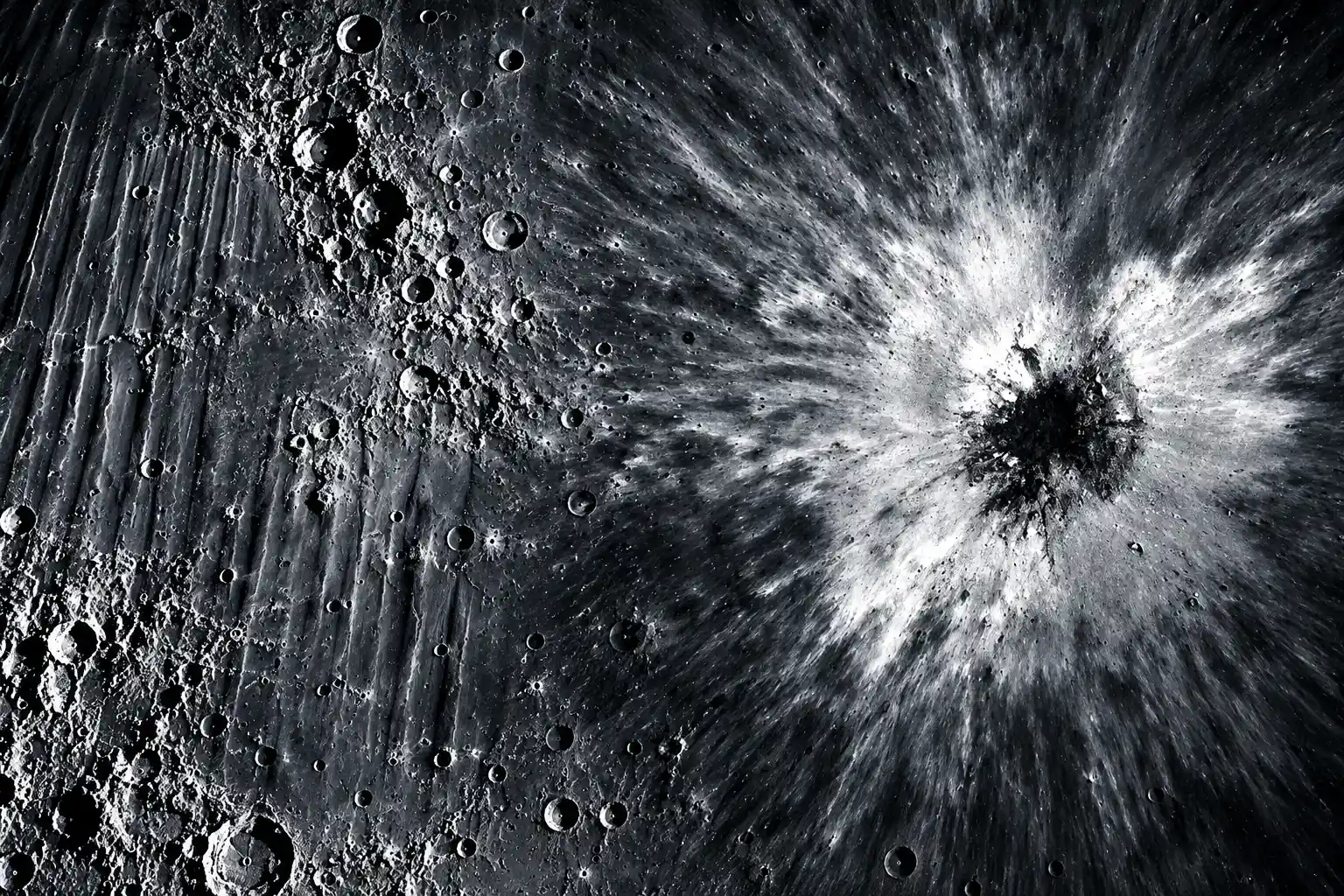
The bowl sits at 1.3536°N, 67.1765°E, on the eastern near side, right on a contact between mare basalt and highlands ejecta from Dubyago N. Mark S. Robinson, LROC principal investigator at Intuitive Machines, and colleagues report an average rim-to-rim width of 222 meters, stretching from 213 meters east-southeast to 231 meters north-northeast. NASA’s public writeup calls that a 728-foot crater on the eastern edge, 141 feet deep, carved by a comet or asteroid fragment about the size of a three- to six-story building sometime between April 11 and May 22, 2024.
Depth is 43 meters, a depth-to-diameter ratio of 0.19, typical of the freshest pits of this size. The LROC team’s image release gives wall slopes averaging 24 degrees, reaching nearly 40 degrees in places, and a rim that stands about 8 meters above the old surface. Narrow-Angle Camera frames from December 5, 2025, resolve the floor at about 3 feet per pixel. No Earth telescope logged the strike as it happened. The dates are the last image without the crater and the first that shows it.
Crater-rate models in the papers put a hole this size on the Moon about once every 132 years. Until this one, the largest new crater found during the LRO mission, which began in 2009, was 70 meters across, formed in Mare Humorum in October 2012. McGetchin is about three times that width.
MCGETCHIN AGAINST THE LAST LRO HIGH
| Crater | Diameter | Peak night cooling |
|---|---|---|
| McGetchin (spring 2024) | 222 m | 8.61 K |
| NC-B, Mare Humorum (October 2012) | 70 m | 5.14 K |
Higher-reflectance ejecta stays mostly within two crater radii of the rim. Robinson’s group measured a median reach of 258 meters from the center, with the outer edge running from 126 to 360 meters. That bright blanket is the classic splash. The thermal and photometric scars go much farther.
Nighttime Temperatures Drop Across 7 Kilometers
After Wagner’s find, the Diviner Lunar Radiometer started targeting the site. The first useful pass came on November 1, 2025, about a year and a half after the impact, too late to catch leftover heat from the strike itself. By February 18, 2026, the team had 43 orbits across nine campaigns, 20 of them at night.
Tyler Powell’s group reports a 7-kilometer-wide cold spot that is 8 to 9 kelvin cooler at local midnight than the ground around it, a drop NASA also rendered as about 16 degrees Fahrenheit. The center of the crater and the nearest ejecta stay rockier and warmer at night. Outside that, the impact loosened the upper centimeters to decimeters of soil, cutting its density so it cannot hold heat after sunset. A thermal model that fits the cooling curve needs a fluff layer about 39 centimeters thick, against about 6 centimeters in the untouched terrain nearby.
Powell’s team also pulled every newly formed crater larger than 20 meters that LROC has timed so far, a set of 21 pits, and found that every crater larger than about 30 meters makes a detectable cold spot. Bigger holes drive deeper, colder halos. The authors argue that the sum of these events can loosen shallow soil at a rate comparable to the gardening done by the primary craters themselves, a first-order process on any airless body with a dust cover.
A crater of this size is expected to form on the moon only once per century, so we’re extremely lucky it formed during the lifetime of the LRO mission and that we are able to observe the region both before and after impact.
Tyler Powell, lead author of the Diviner study, Science Advances
Apollo 16 Already Walked on Fluffed Ground
Cold spots are not a 2024 novelty. Diviner first mapped them around young craters tens of meters to a couple of kilometers wide, often stretching tens to hundreds of crater radii. They fade on timescales of about 100,000 years to 2 million years, which is why they mark some of the Moon’s youngest hits. Apollo 16 landed on a faint cold spot tied to South Ray crater, and the crew’s footprints sank deeper there than at other stations, a field check that the soil really is looser. McGetchin gives the same process a dated start, with before-and-after temperatures instead of a faded fossil.
The new halo is roughly symmetrical even though the crater sits on a mare-highlands line, which fits a picture in which only the top few centimeters control the night temperature, and those centimeters look similar across both terrains. Several cold rays run out from the rim. The strongest points north-northeast, matching a dark tongue in the near ejecta and a ray in the farther dark zone.
The Impact Disturbed Ground 100 Kilometers Out
Visible change does not stop at the cold ring. Robinson’s crater paper and the LROC image notes both track surface disturbance more than 100 kilometers from the rim, a distal low-reflectance zone about 30 times the radial reach of the night-time chill. Grain-scale roughening can shift how the ground reflects light without moving enough mass to change midnight temperatures. Diviner’s daytime emission-phase data add a third scale: a roughness anomaly about 14 kilometers across, twice the cold spot, because millimeter-scale facets still change the heat you see when the spacecraft looks toward the Sun or away from it.
NESTED SCARS FROM ONE HIT
- Bright ejecta: Higher-reflectance debris stays mostly within two crater radii, median 258 meters from the center.
- Night cold ring: About 7 kilometers of loosened soil that sheds heat after sunset.
- Daytime roughness: An emission-phase anomaly about 14 kilometers across, sensitive to millimeter-scale facets.
- Distal dark zone: Photometric change out to about 100 kilometers, including faint rays that will fade much faster than the crater.
The LROC team also says the high-speed jetting looks steeper than the usual textbook splash, above 10 degrees rather than about 2 degrees, and that the continuous blanket arrived in at least two waves, with some flows running across the surface for long distances. Repeat images of the 70-meter 2012 crater already show its distal dark zone fading, with a rough extrapolation that it may be gone in on the order of 50 years. McGetchin’s gleam will not last. The bowl will.
How LRO Caught a Century-Scale Hit
LRO has flown pole to pole for more than 17 years with seven instruments, shooting from about 60 miles up. The camera suite uses two narrow-angle bodies for sharp black-and-white frames and a wide-angle camera whose pixels are about the size of football fields. Teams usually comb the close-ups for changes smaller than 30 feet. Every few years they build global maps and hunt features wider than 150 feet. That was Wagner’s job on October 24, 2025.
He stacked hundreds of wide-angle frames from different years. Unchanged ground went gray. Anything new flared bright or dark. The software also flags every shift in shadow, so he spends his time hunting tiny fuzzy halos around single bright pixels. McGetchin was not tiny. The debris pattern ran across hundreds of pixels on a composite about 900 miles wide.
It was by far the most obvious impact debris pattern I’ve ever seen in one of these images.
Robert Wagner, LROC image-processing specialist, NASA
He had already said, of the first glance, “I just stopped, dropped everything, and started looking into what that spot was.” Later Narrow-Angle Camera passes, including the December 5, 2025, strip about three-quarters of a mile wide, fixed the shape and the local wreckage. Impactor mass and energy are still promised for a later paper.
THE DISCOVERY CLOCK
- April 11 to May 22, 2024: Image bounds on the impact, with no flash recorded from Earth.
- October 24, 2025: Wagner flags the debris pattern on a wide-angle change map.
- November 1, 2025: Diviner begins targeted thermal passes.
- December 5, 2025: Narrow-Angle Camera shoots the close-up used to measure the bowl.
- February 18, 2026: The published Diviner set reaches 43 orbits.
- May 4, 2026: The IAU working group adopts the name.
- September 16, 2026: Both Science Advances papers appear.
The analogical units in the first public posts, football fields, school buses, stories of a building, did the job of making a 222-meter pit famous. They also buried the 7-kilometer thermal scar, which is the measurement that actually moves a traverse plan.
The Name Fits the Physics of Ejecta
The IAU working group approved the name McGetchin on May 4, 2026, as Feature 16447, centering it at 1.35°N, 67.18°E. The gazetteer honors Thomas R. McGetchin, an American geologist and planetary scientist who lived from 1936 to 1979. In 1977 he became director of the Lunar and Planetary Institute in Houston, after pushing the old Lunar Science Institute to look beyond the Moon. A 1973 ejecta-thickness rule that carries his name is still the classroom frame for how debris thins with distance from a rim. Julie Stopar of the same institute is a co-author on the new crater paper.
That is an awkward compliment. McGetchin’s formula describes a blanket that dies out fast. The 2024 strike threw a bright sheet only a few hundred meters, then kept roughening and fluffing ground out to 7, 14, and 100 kilometers. The name now sits on a crater that is already testing how far “ejecta” really goes when you can watch the dirt before and after.
Fluffed Soil Changes How Wheels Will Bite
NASA’s own writeup flags the practical point. Differences in texture and density can change how rover wheels meet the ground. Apollo 16 already showed deeper prints on a cold spot. A crew or a commercial lander that treats a “smooth” mare patch as uniform is reading a map that an impact can rewrite in a night, even if the nearest rim is kilometers away. The Moon has no air to burn incoming rock, so the small stuff never stops. LRO’s catalog is the live count of that rain.
LRO’S CHANGE TALLY
- New craters: At least 1,000 dated impacts during the mission.
- Other scars: About 100,000 extra surface changes from strikes or thrown debris.
- Small annual crop: About 140 new pits a year at the 30-foot scale, from rocks about 43 inches wide.
- This class of hole: About once every 132 years, per the papers’ crater-rate models.
Most of those 1,000 pits are nuisances. McGetchin is the calibration shot: a dated bowl, a measured fluff depth, and a cold ring still in its first years. Diviner is still flying over it. The fade clock on a feature that lasts 100,000 years or more has barely started, and the next stereo and night-temperature passes will show how fast the halo relaxes. For anyone stacking habitats or driving off a landing pad, that relaxation rate is the number that belongs next to the postcard of the hole.
Frequently Asked Questions
Where Is McGetchin Crater on the Moon?
It sits on the eastern near side at 1.3536°N, 67.1765°E, on the contact between an unnamed mare patch and the proximal ejecta of highlands crater Dubyago N, in lunar atlas quad LAC-62. The IAU listing rounds the center to 1.35°N, 67.18°E and logs the feature as a crater 0.20 kilometers across, a gazetteer rounding of the 222-meter science diameter.
Who Was Thomas McGetchin?
Thomas R. McGetchin was born in La Jolla, California, on July 31, 1936, taught at MIT from 1969 to 1974, and directed the Lunar and Planetary Institute from 1977 until illness forced him out. He died in Hawaii on October 22, 1979. NASA gave him its Public Service Award that September for moving lunar work toward a wider planetary program, and asteroid (2891) McGetchin also carries his name.
How Often Do 222-Meter Craters Form on the Moon?
The Science Advances papers use crater-rate models that average about one such impact every 132 years, a statistical wait, not a clock. The 70-meter Mare Humorum crater of October 2012 had been the largest new pit LRO had timed in more than 17 years of mapping, which is why a 222-meter bowl inside the same mission is treated as a century-scale catch rather than a routine add to the 1,000-crater list.
Do All New Lunar Craters Create Cold Spots?
In Powell’s Diviner sample of 21 new craters larger than 20 meters, every pit above about 30 meters has a detectable night-time cold halo, and the temperature drop grows with crater size. McGetchin’s peak cooling is 8.61 kelvin; the 70-meter 2012 crater shows 5.14 kelvin; a smaller new crater in the same set, labeled NC-D, shows 3.20 kelvin. Below that size the signal falls into the noise of the night-time maps.
How Long Does a Fresh Cold Spot Last?
Published cold spots fade on the order of 100,000 years to 2 million years, far longer than the bright rays and distal dark zones that optical cameras see. Repeat LROC images of the 70-meter 2012 crater already show its distal low-reflectance zone dimming, with a rough line that it may vanish in about 50 years, while South Ray’s cold spot was still walkable, and still loose underfoot, when Apollo 16 landed. McGetchin now gives those clocks a start date measured in weeks.

Nintendo Pulls SmileBASIC After the First Switch 2 Jailbreak

Arkane Lyon’s Union Holds the Clock Microsoft Cannot Skip

Airbnb Bans Guest Chores as Homes Turn Into Hotels

Riyadh Downs a Houthi Missile After Weeks of Capital Strikes

Ariana Madix’s Empty Los Angeles House Fits a Bravo Pattern

AI Server Boards Put Everyday Circuit Materials on Allocation

Glacier Collapse Buried Nepal’s Hydropower Workers in Tunnels

Congo’s Bundibugyo Outbreak Outruns the Licensed Ebola Shots

Pennsylvania Measles Deaths Follow a Long Slide in Coverage

Germany Can Miss Its 2026 Climate Cap Without Penalty
-
 NEWS2 months ago
AI Server Boards Put Everyday Circuit Materials on Allocation
-
 NEWS2 months ago
Glacier Collapse Buried Nepal’s Hydropower Workers in Tunnels
-
 NEWS2 months ago
Congo’s Bundibugyo Outbreak Outruns the Licensed Ebola Shots
-
 NEWS2 months ago
Pennsylvania Measles Deaths Follow a Long Slide in Coverage
-
 NEWS2 months ago
Germany Can Miss Its 2026 Climate Cap Without Penalty
-

 NEWS2 months ago
Texas Judge Freezes the SEC Eligibility Ban for 41 Athletes
-

 NEWS2 months ago
CISA’s Known Exploits Still Come From 2007-Era Bugs
-

 BUSINESS2 months ago
Trump’s Venezuela Oil Deal Leaves the Barrels in the Ground