
NEWS
Bolivia’s Tilcayo Tiger Cat Arrives as Five Species, Not One
Leopardus tilcayo is a new Bolivian wildcat, and the same paper splits tiger cats into five species that now need separate threat listings.

Researchers named a new wild cat, Leopardus tilcayo, from two live animals in Bolivia’s Yungas on September 17, 2026. The same genomes split South America’s tiger cats into five species. Each of those species now has to be judged on its own for extinction risk.
The paper’s own highlight calls it the first novel cat species in more than a century. The harder result sits in the table of effective population sizes. For the tilcayo, that number fell 63 percent from the Pleistocene to the Holocene, and the species itself has not yet been assessed.
A Shelter Cat From Arapata Gets a Latin Name
The holotype is CBF-11990, an adult male held in captivity. Collectors Enzo Aliaga-Rossel and Paola Nogales-Ascarrunz sampled him in September 2021 near Arapata in Nor Yungas, at 1,570 meters. His genome is in the public archive as SRX30196846.
Nogales-Ascarrunz, a biologist at Universidad Mayor de San Andrés and a National Geographic Explorer, first saw the animal in 2016. Senda Verde Animal Refuge, on the North Yungas Road in Coroico, had called about a “weird cat.” A local man had found it as a kitten on a road by the forest and taken it home, sure it was a house cat. After about a year he brought it in.
I took a hundred pictures of it. I was so fascinated.
Paola Nogales-Ascarrunz, co-lead author, Current Biology
She assumed it was a northern tiger cat, Leopardus tigrinus, the small spotted felid described in 1775 from a drawing made in French Guiana. In 2019, while she was making a booklet of Bolivia’s cats, the rosettes looked too large next to Brazilian reference photos. Whole-genome work with Jonas Lescroart of the University of Antwerp and Eduardo Eizirik of the Pontifical Catholic University of Rio Grande do Sul placed the lineage on its own branch.
The phylogenomic study of 38 cat genomes appeared in Current Biology, dated October 5, 2026, after acceptance on August 25. The new species authors are Nogales-Ascarrunz, Aliaga-Rossel, Lescroart, and Eizirik. They kept the local word as both the scientific epithet and the English name.
“We asked the local people, ‘Why do you call it tilcayo?’” Nogales-Ascarrunz said. “And they said, ‘I don’t know! My grandpa called it tilcayo, so I call it tilcayo.’”
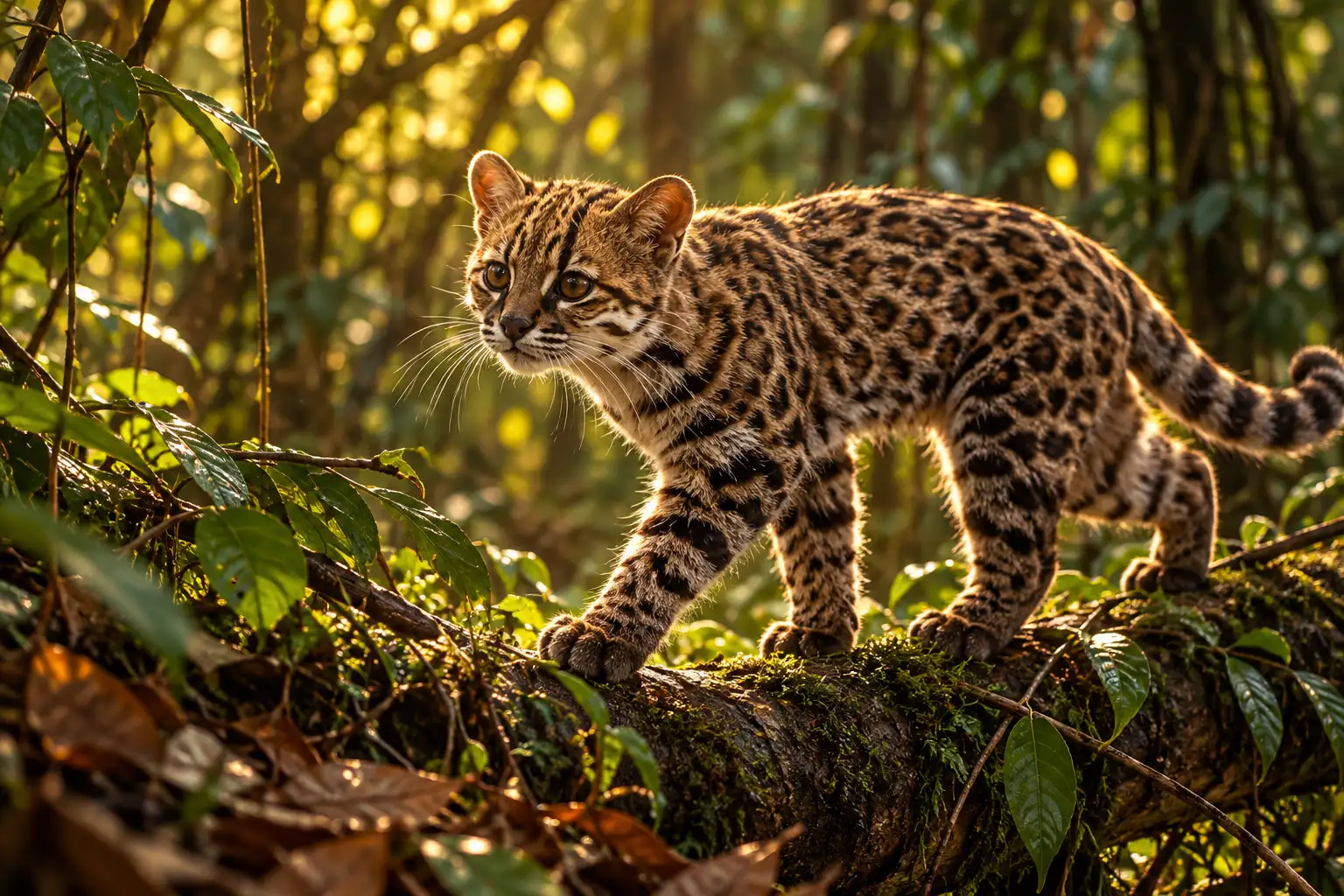
Five Species Where Conservationists Counted One
Tiger cats were long treated as one widespread animal, then as two after a 2013 genetic split, then as a growing pile of proposed species. Lescroart and colleagues now treat five as full species. A sixth unit, from the Peruvian Yungas, is named as a new subspecies, Leopardus tigrinus antisuyo, after Antisuyu in the old Inca map of the eastern Andes.
Lescroart, an evolutionary biologist, said no one had proposed the Bolivian animal as a separate species, subspecies, or anything else. “The five tiger cat species are all cryptic species. They’re morphologically very similar,” he said.
THE FIVE TIGER CAT SPECIES
| Species | Where it lives | Year set apart | IUCN as listed now | Holocene Ne change |
|---|---|---|---|---|
| L. tigrinus | Guiana Shield; Peru as antisuyo | 1775, narrowed in 2026 | Vulnerable (2016, lumped) | -8% (t. tigrinus) |
| L. guttulus | Atlantic Forest | 2013 | Vulnerable | -61% |
| L. emiliae | Caatinga and Cerrado, Brazil | 2017 | Not evaluated on its own | -61% |
| L. pardinoides | Northern Andes cloud forest | 2024 | Not evaluated on its own | -80% |
| L. tilcayo | Bolivian Yungas | 2026 | Not evaluated | -63% |
The 2016 Red List still listed the northern tiger cat as Vulnerable under criterion A2c, with a range-wide population put at under 10,000 to 11,000 animals. That grade covered the Guianas, the Andes, Central America, and Bolivia as one species. The new paper’s footnote is blunt: assessed apart, each of those units is not evaluated.
What the Two Known Tilcayos Have Already Survived
Lescroart said the team’s information is limited to the two live individuals they examined and a small number of camera-trap records. One is the 10-year-old male at Senda Verde. He weighs 1.4 kilograms (3 pounds). The other is a female that was rescued and released after locals attacked her, Nogales-Ascarrunz said.
WHAT THE TEAM CAN SAY SO FAR
- Size: Head-body length is 42.5 to 50.5 centimeters, with a tail of 25 to 26.5 centimeters.
- Coat: Light brown to beige, darker on the mid-back, with large irregular open rosettes that do not run together.
- Diet and hours: Rodent remains in scat, and camera traps that point to night activity.
- Range: Genetically confirmed only in the Bolivian Yungas, on the eastern slope of the Andes.
The paper distinguishes the cat from the clouded tiger cat by shorter fur, lower contrast, more open rosettes, a less bushy tail, and the lack of broad complete tail bands. From L. tigrinus it differs by larger, more irregular flank marks and a longer, fuller tail. From L. guttulus it differs by more mixed markings and a relatively longer tail. In the nuclear genome, about 1.39 million transversion sites separate it from L. t. antisuyo and about 1.49 million from L. pardinoides.
That diagnosis still leaves a field problem. Tiger cats are often logged as margays on cameras, and one Bolivian museum skin long filed as the country’s first tiger cat was later re-identified as a margay because of the direction of its nape hair. The full map of L. tilcayo is not known.
The Lineage Split Off 1.43 Million Years Ago
The team built 26 new whole genomes, 18 from fresh blood or muscle and 8 from museum bone or skin, then reused 12 published Leopardus genomes. Eight of those historic samples gave the first genetic look at the true L. tigrinus type region in the Guiana Shield.
THE GENOME NUMBERS
- Split date: The tilcayo branch diverged about 1.43 million years ago (2.05 to 0.80 million).
- Older node: The earliest split among tiger-cat units is 2.34 million years ago, after the Great American Biotic Interchange.
- Mixing: About 15 percent of the nuclear genome shows old introgression from L. t. antisuyo.
- Diversity: Autosomal heterozygosity is 0.21 percent in the two tilcayo genomes, with no long runs of homozygosity.
Effective population size, inferred from those genomes, dropped from about 22,000 in the Pleistocene to about 8,000 in the Holocene. Other units show the same direction. L. pardinoides in the northern Andes is down 80 percent on the same measure. L. emiliae in eastern Brazil sits at 0.08 percent heterozygosity, the lowest among the tiger cats in the table.
Eizirik, who has worked on the genus for about 25 years, said the group that looked like one species is a species complex. The Bolivian samples did not cluster with northern Andean clouded tiger cats, which is where Yungas animals were expected to sit. Peruvian Yungas cats grouped, instead, with the Guiana Shield lineage, a geographic puzzle the paper leaves open.
Bolivia’s Red List Does Not Yet Bind Policy
Threat lists and trade rules still run on species names. The Red List guidelines treat species as the default unit. All wild cats sit on CITES Appendix II, but the stricter Appendix I listing for the oncilla and for the southern tiger cat is a species-rank step. The paper notes six Leopardus species now on Appendix I, including L. tigrinus and L. guttulus.
If you think the tiger cat is a single thing from southern Brazil all the way to Costa Rica, you’re going to find it’s not endangered. But if we find that it’s not a single thing, but actually five things, each of them must be assessed separately.
Eduardo Eizirik, geneticist, Pontifical Catholic University of Rio Grande do Sul
James Sanderson, founder of the Small Wild Cat Conservation Foundation and a member of the IUCN Cat Specialist Group, who was not an author, put the arithmetic in one line. Once three species become five, each population is reduced, he said, and conservation work has to rise with that, depending on the counts. Those counts do not exist yet for the tilcayo.
The paper flags a legal gap in the cat’s only confirmed country. Bolivia has a Red List, but that list is not embedded in national policy. Costa Rica and Panama lack documented national lists for the clouded tiger cat. Suriname and Guyana lack them for L. tigrinus. Species-level revisions, the authors write, will change conservation assessments for these cats.
Tadeu Gomes de Oliveira, an ecologist at Maranhão State University and a co-author, said the habitats are vanishing fast. In the Yungas that means clearing for crops and the illegal pet trade, the same path that delivered a kitten to a family house in 2016. Clips of that year in a living room spread on September 17 and 18 as a charming accident. The accident is the conservation problem. A cat that looks like a pet is the cat people keep, and the cat they attack when it takes chickens.
How a House Cat Became a Holotype
Schreber named Felis tigrina in 1775. For most of the time since, every small spotted Leopardus from Costa Rica to Argentina could be filed under that name. The southern tiger cat, L. guttulus, was pulled out in 2013. L. emiliae was argued as distinct in 2017. The clouded tiger cat, L. pardinoides, was elevated in 2024. This paper is the first in that sequence that names a cat no one had proposed before.
THE DATES THAT SHRANK THE MAP
- 1775: Schreber describes the tiger cat from a Cayenne illustration.
- 1923: The last novel living cat species commonly cited before this paper, the Uruguayan pampas cat, appears in print.
- 2013: L. guttulus is accepted as a species separate from L. tigrinus.
- 2016: A Yungas family hands a “house cat” to Senda Verde; Nogales-Ascarrunz photographs it.
- 2017: L. emiliae is proposed for the dry forests of eastern Brazil.
- 2021: The Arapata male is sampled as holotype CBF-11990.
- 2024: L. pardinoides is set apart as the clouded tiger cat of the northern Andes.
- September 17, 2026: L. tilcayo is named, and the complex is treated as five species.
The paper’s own test for a new cat is time. Nogales-Ascarrunz said that if a cat lineage split more than a million years ago, it is another species. At 1.43 million years, the tilcayo cleared that line. The male that started the work is still at Senda Verde. The female is back in the forest. Between them they are the entire live sample of a species that now has a Latin name, a holotype, and no Red List of its own.
Frequently Asked Questions
What Is the Scientific Name of the Tilcayo Tiger Cat?
The valid name is Leopardus tilcayo Nogales-Ascarrunz, Aliaga-Rossel, Lescroart and Eizirik, 2026. The act is registered as Life Science Identifier urn:lsid:zoobank.org:act:E91EB0AF-416E-4B27-97D2-643BE62DD936, and the authors treat “tilcayo” as a noun in apposition, so the local word does not change with Latin grammar.
How Does a Tilcayo Differ From a Margay?
A margay is larger on average, with longer canines, big eyes, a longer tail relative to the body, and nape hair that slants forward. It can also rotate its hind ankles, a climbing trait tiger cats lack. Those marks are hard to see on a camera-trap still, which is why field surveys in the Andes and the Guianas mix the two unless someone sequences the animal or has the skin in hand.
Is Leopardus Tilcayo on the IUCN Red List?
Not as its own species. Newly described taxa are added case by case, and an assessment of the full species is required before any lower rank can be listed. Until that review happens, the only published grade that covered Bolivian tiger cats is the 2016 Vulnerable listing for the old, broad L. tigrinus.
What Does the New Peruvian Name Antisuyo Refer To?
Leopardus tigrinus antisuyo is a subspecies, not a sixth species in the 2026 revision. The name refers to Antisuyu, the eastern quarter of the Inca realm that included the Peruvian Yungas. The authors kept it inside L. tigrinus because its split from the Guiana Shield lineage, about 0.49 million years ago, still falls inside distances seen within other living cat species.

Nintendo Pulls SmileBASIC After the First Switch 2 Jailbreak

Arkane Lyon’s Union Holds the Clock Microsoft Cannot Skip

Airbnb Bans Guest Chores as Homes Turn Into Hotels

Riyadh Downs a Houthi Missile After Weeks of Capital Strikes

Ariana Madix’s Empty Los Angeles House Fits a Bravo Pattern

AI Server Boards Put Everyday Circuit Materials on Allocation

Glacier Collapse Buried Nepal’s Hydropower Workers in Tunnels

Congo’s Bundibugyo Outbreak Outruns the Licensed Ebola Shots

Pennsylvania Measles Deaths Follow a Long Slide in Coverage

Germany Can Miss Its 2026 Climate Cap Without Penalty
-
 NEWS2 months ago
AI Server Boards Put Everyday Circuit Materials on Allocation
-
 NEWS2 months ago
Glacier Collapse Buried Nepal’s Hydropower Workers in Tunnels
-
 NEWS2 months ago
Congo’s Bundibugyo Outbreak Outruns the Licensed Ebola Shots
-
 NEWS2 months ago
Pennsylvania Measles Deaths Follow a Long Slide in Coverage
-
 NEWS2 months ago
Germany Can Miss Its 2026 Climate Cap Without Penalty
-

 NEWS2 months ago
Texas Judge Freezes the SEC Eligibility Ban for 41 Athletes
-

 NEWS2 months ago
CISA’s Known Exploits Still Come From 2007-Era Bugs
-

 BUSINESS2 months ago
Trump’s Venezuela Oil Deal Leaves the Barrels in the Ground