
BUSINESS
China’s Export Surge Widens the Surplus Partners Aim to Cap
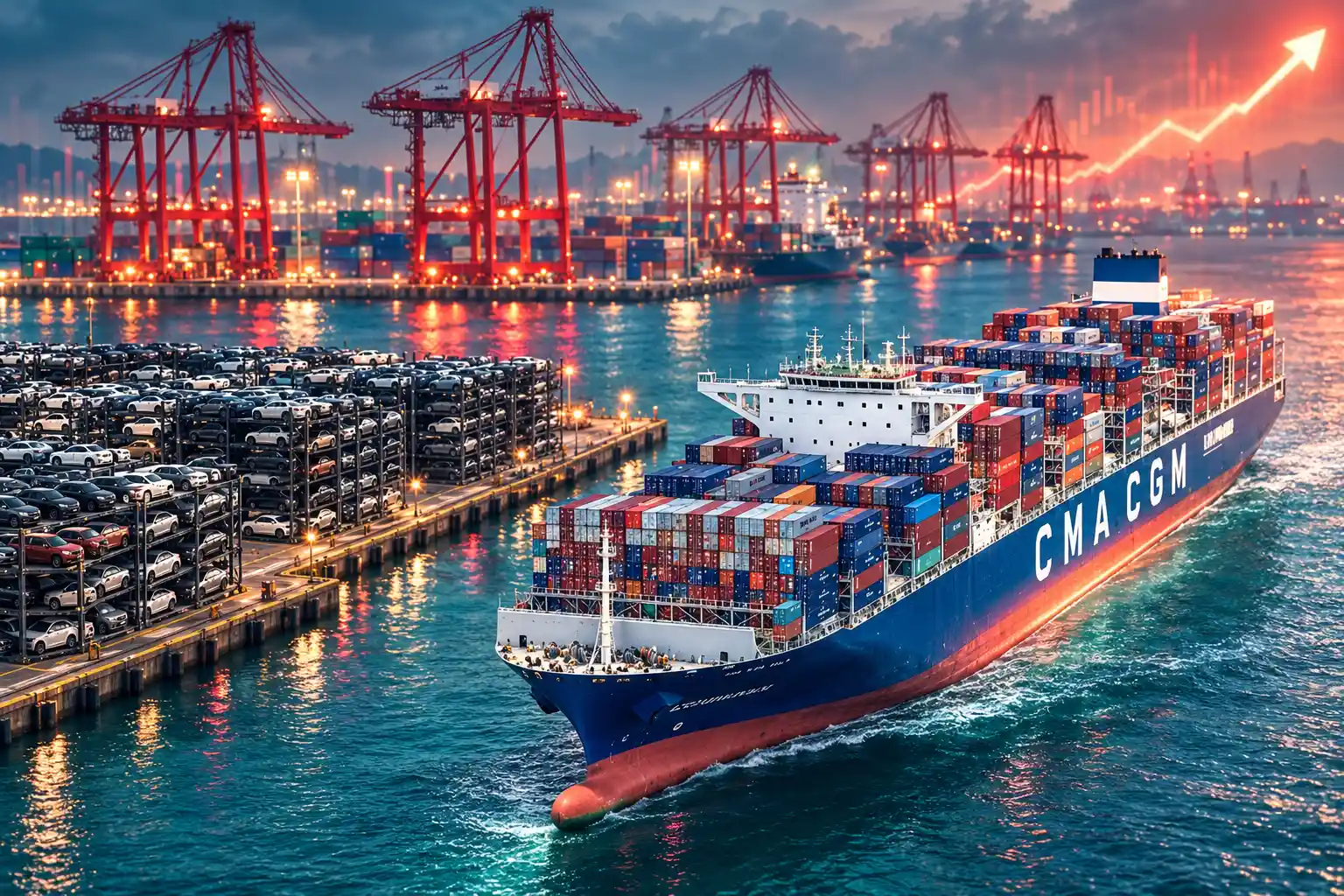
China’s September exports jumped 36.3% in dollars as AI hardware and cars widened a surplus that Europe is now capping.

China’s September exports rose 36.3% from a year earlier in dollar terms, beating a 25.5% median forecast, as the General Administration of Customs posted the first month of goods trade above 5 trillion yuan.
The same release put the monthly surplus at $133.53 billion. That is the print partners in Europe and Washington had already started to fence in with a hybrid-car quota and a narrow tariff truce.
September Trade Cleared 5 Trillion Yuan
Customs said goods trade in September reached 5.16 trillion yuan, up 27.5% from a year earlier and the first time a single month has crossed 5 trillion yuan. Exports in yuan rose 29.6%. Imports rose 24.6%. Wang Jun, a customs vice minister and the agency’s spokesman, said foreign trade in the first three quarters had coped with outside shocks and that further growth still had a foundation and support.
In dollar terms the beat was wider than the yuan rates imply. Exports rose 36.3%, some 10.8 points above the 25.5% forecast. Imports rose 31.0%, against a 24.5% forecast. The surplus of $133.53 billion compared with a $118.10 billion forecast and with $119.09 billion in August.
SEPTEMBER AGAINST AUGUST AND THE FORECAST
| Measure | September 2026 | August 2026 | Forecast |
|---|---|---|---|
| Exports, USD, year on year | 36.3% | 25.0% | 25.5% |
| Imports, USD, year on year | 31.0% | 28.2% | 24.5% |
| Trade surplus, USD | $133.53 billion | $119.09 billion | $118.10 billion |
| Total goods trade, yuan | 5.16 trillion | 4.65 trillion | – |
For January through September, customs put goods trade at 39.94 trillion yuan, about $5.97 trillion, up 18.8%. Exports were 23.2 trillion yuan, up 16.4%. Imports were 16.74 trillion yuan, up 22.3%. Official August goods trade in yuan had already shown exports at 20.17 trillion yuan through eight months, up 14.6%, with imports at 14.61 trillion yuan, up 22%.
China's total goods imports and exports reached 39.94 trillion yuan (about $5.97 trillion) in the first three quarters of 2026, up 18.8% YoY. In September alone, total goods imports and exports hit 5.16 trillion yuan, surpassing the 5-trillion-yuan mark for the first time, the… pic.twitter.com/5SPTNLAWXc
— People's Daily, China (@PDChina) October 14, 2026
How Large Was the September Surplus?
The September surplus of $133.53 billion, or 905.97 billion yuan, was $15.43 billion above the forecast and $14.44 billion above August. Adding it to the $805.51 billion surplus for January through August puts the nine-month dollar surplus at $939.04 billion. That is the figure Brussels and Washington have been arguing about, not the year-on-year growth rate on the customs sheet.
Imports are still growing faster than exports on a year-to-date yuan basis, 22.3% against 16.4%. The gap narrowed in September, when export growth outran imports. A large share of the import rise is prices for fuel, metals and AI-related parts rather than households restocking shelves. That mix leaves the surplus fat even when inbound shipments look firm.
Showrooms Emptied as Export Lots Filled
The split is sharpest in cars. The China Passenger Car Association said passenger-car retail in September fell 28.0% from a year earlier, to 1.618 million vehicles. New-energy retail fell 16.7% to 1.084 million, yet took a record 67.0% of the month’s retail. The same plants shipped 917,000 passenger cars abroad, up 73.7%. New-energy exports were 558,000.
PASSENGER CARS IN SEPTEMBER
| Flow | September 2026 | Change from a year earlier |
|---|---|---|
| Retail, all powertrains | 1.618 million | -28.0% |
| Retail, new-energy | 1.084 million | -16.7% |
| Exports, all powertrains | 917,000 | +73.7% |
| Share of wholesale sent abroad | 36% | 19% a year earlier |
Makers in China shipped 2.549 million passenger cars at wholesale in September, and 36% of those units left the country, up from 19% a year earlier. That is why wholesale held up while retail collapsed. BYD’s wholesale rose 15.8% to 455,000, while its China retail fell 28.9% to about 247,000.
The China Association of Automobile Manufacturers, which counts factory sales of all vehicle types, put September sales at 2.956 million, down 8.4%, and auto exports at 1.053 million, up 61.4%, including 571,000 new-energy vehicles, up 160%. Chen Shihua, the group’s deputy secretary-general, said the year-on-year drops were pronounced and that weak domestic sales were likely to last. For January through September the group counted 8.205 million vehicle exports, up 65.8%.
AI Servers and Chips Are Doing the Heavy Lifting
The other engine is hardware for data centers. In the first eight months of goods trade, customs said exports of mechanical and electrical products rose 21.9% to 12.91 trillion yuan. Exports of integrated circuits rose 95.4% to 1.77 trillion yuan. Labor-intensive goods edged down 0.6%. High-tech exports were up 42.9% in dollar value through August. Semiconductor export values more than doubled even as volumes rose only 4.1%, a price story as much as a shipment story.
Zhaopeng Xing, senior China strategist at ANZ, pointed to demand for AI products, electric vehicles, solar cells and lithium-ion batteries as the offset for weak home orders. China is selling the racks, cooling, batteries, boards and optical gear that foreign data-center builders need. It still buys the advanced processors it cannot yet make at scale. IDC figures for the first half put Nvidia’s share of China’s data-center AI accelerators at 34% on 678,000 units, down 44% from a year earlier under U.S. export rules, with Huawei at 28% on 572,000 units.
That split matters for the surplus. Outbound AI infrastructure fattens exports. Inbound chips and memory keep imports elevated. The net is still a wider goods gap, and it is now tied to how long foreign cloud companies keep building.
Brussels Caps Chinese Hybrids at 350,000
The European Union spent October 8 and 9 in Beijing locking in a hybrid-car arrangement that treats this export wave as the problem. Maros Sefcovic, the EU trade commissioner, said the two sides had a shared understanding to moderate shipments of hybrids and plug-in hybrids.
We have reached a shared understanding to moderate China’s export of hybrids and plug-in hybrids to the European Union. This opens the prospect of cutting China’s exports by more than a half.
Maros Sefcovic, EU trade commissioner, in Beijing
Officials briefed on the terms described an annual cap of 350,000 Chinese hybrid and plug-in hybrid imports, due as early as December, running four years, with a 6% rise from the second year. Chinese-brand cars built inside the EU would sit outside the cap. Eurostat counted 107,000 hybrid imports from China in 2024 and 302,000 in 2025. This year’s pace has been near 800,000. Against 2025, 350,000 is a small step up. Against this year’s run-rate, it is a cut of more than half, which is the comparison Sefcovic used.
WHAT THE HYBRID DEAL SETS
- The cap: 350,000 hybrid and plug-in hybrid imports a year from China, with a 6% rise from year two.
- The exemption: Chinese-brand vehicles assembled inside the EU do not count against the quota.
- The 2025 base: Eurostat’s 302,000 imports, which China’s commerce ministry cites as the starting point for “steady growth.”
- The swap: China eases duties on about 4 billion euros of EU goods, including car parts, olive oil, footwear and ice cream, and smooths licences for rare earths and magnets.
China’s commerce ministry said the quota for China would be no lower than that for any other source and that measures would not single out Chinese firms. It also reserved the right to seek WTO dispute settlement. Hybrid exports to the EU tripled to 6.7 billion euros in the first half from 2.2 billion a year earlier. Sefcovic called the deal a first step, not the last, with chemicals, furniture and renewable gear still on the table.
Washington’s Cut Leaves Chips and EVs Out
The U.S. track is a pause, not a reopening. After a late-September leaders’ meeting in Washington, the two sides published “30-for-30” lists covering about $30 billion of goods each way, based on 2024 values. The White House and the U.S. Trade Representative described the lists as Board of Trade recommendations. About 90% of the named lines could return to most-favored-nation rates. No start date and no full rate schedule were attached.
The U.S. list leans on household goods, toys, holiday decorations and children’s car seats. China’s list runs to about 1,619 tariff lines of American farm goods, seafood, logs, cosmetics and medical devices, which USTR said could improve access for about 30% of U.S. exports to China. Chips, electric vehicles and batteries are not on the lists. The broader tariff truce, which had been due to lapse on November 10, now runs to January 10, 2027.
Customs figures showed August exports bound for the United States at $42.475 billion. The August surplus with the U.S. was $29.18 billion, with those exports up 34.4% from a year earlier. For September, customs figures showed a $34.01 billion surplus with the U.S. A $30 billion cut in duties on toys and car seats does not touch that flow. The next scheduled meetings are at APEC in Shenzhen in November and at the G20 in Miami in December.
Producer Prices Hit a Four-Year High
The National Bureau of Statistics said the producer price index rose 5.0% in September from a year earlier, up from 3.8% in August and above a 4.5% forecast. It is the strongest reading since June 2022. Prices rose 1.2% from August. Input prices were up 6.9% from a year earlier. For the first nine months, factory-gate prices were up 2.3% on average.
PRICES IN SEPTEMBER
- Factory gate: PPI up 5.0% year on year, 1.2% month on month.
- Store prices: CPI up 0.9%, against a forecast near 1%, with core CPI up 1.0%.
- Fuel in the CPI: gasoline up 16.6%, adding about 0.47 percentage points, according to Dong Lijuan, chief statistician in the bureau’s urban division.
- The split inside PPI: production materials up 6.5%; consumer goods down 0.1%.
Coal mining prices were up 35.3%. Oil and gas extraction was up 24.5%. Computers, communications and electronics were up 5.8%. Auto manufacturing prices were down 2.0%. Factories feeding the export boom are raising tags. Factories that still sell into Chinese showrooms are not. That is the same pattern as the car lots.
Households have not closed the gap. Total retail sales of consumer goods rose 1.1% in the first eight months. August retail sales including vehicles were up 0.4%, and vehicle retail in that month was down 18.5%. Wang Jun said the fourth-quarter export outlook is unchanged. The EU quota is due in December. The U.S. truce runs to January 10. The docks had a record month. The argument about who absorbs it is just getting a date.
Frequently Asked Questions
How Fast Did China’s Exports Grow in September 2026?
Customs reported September exports up 29.6% in yuan and 36.3% in dollars from a year earlier. The dollar rate followed 25.0% in August and 23.9% in July, so the acceleration is three months long, not a one-month spike, and it sits well above the 25.5% forecast that economists had penciled in for September.
What Is the EU Quota on Chinese Hybrid Cars?
The operational cap described by officials is 350,000 hybrid and plug-in hybrid imports a year from China for four years, with a 6% increase from the second year, and with Chinese-brand cars built at plants inside the EU kept outside the quota, a design that pushes assembly into Europe rather than only blocking the dock.
Which Goods Sit on the U.S.-China $30 Billion Tariff Lists?
The U.S. side names household goods, toys, holiday decorations and children’s car seats. China’s side names farm goods, seafood, logs, cosmetics and medical devices. USTR said about 90% of the listed lines could revert to most-favored-nation rates and that the Chinese list covers about 30% of U.S. exports to China, while chips, electric vehicles and batteries are left off.
Why Did China’s Producer Prices Rise in September 2026?
The National Bureau of Statistics tied the 5.0% PPI increase to fuel and commodities, including coal-mining prices up 35.3% on winter-heating demand, tight supply in major coal regions, and expectations of higher international coal prices, with oil and gas extraction up 24.5% and chemicals up 12.1%.
How Much of China’s Auto Output Is Going Abroad?
The China Association of Automobile Manufacturers counted 8.205 million vehicle exports in the first nine months, up 65.8%, including 4.006 million new-energy vehicles, up 130%, which means more than half of those export shipments were new-energy models for four straight months.

Nintendo Pulls SmileBASIC After the First Switch 2 Jailbreak

Arkane Lyon’s Union Holds the Clock Microsoft Cannot Skip

Airbnb Bans Guest Chores as Homes Turn Into Hotels

Riyadh Downs a Houthi Missile After Weeks of Capital Strikes

Ariana Madix’s Empty Los Angeles House Fits a Bravo Pattern

AI Server Boards Put Everyday Circuit Materials on Allocation

Glacier Collapse Buried Nepal’s Hydropower Workers in Tunnels

Congo’s Bundibugyo Outbreak Outruns the Licensed Ebola Shots

Pennsylvania Measles Deaths Follow a Long Slide in Coverage

Germany Can Miss Its 2026 Climate Cap Without Penalty
-
 NEWS2 months ago
AI Server Boards Put Everyday Circuit Materials on Allocation
-
 NEWS2 months ago
Glacier Collapse Buried Nepal’s Hydropower Workers in Tunnels
-
 NEWS2 months ago
Congo’s Bundibugyo Outbreak Outruns the Licensed Ebola Shots
-
 NEWS2 months ago
Pennsylvania Measles Deaths Follow a Long Slide in Coverage
-
 NEWS2 months ago
Germany Can Miss Its 2026 Climate Cap Without Penalty
-

 NEWS2 months ago
Texas Judge Freezes the SEC Eligibility Ban for 41 Athletes
-

 NEWS2 months ago
CISA’s Known Exploits Still Come From 2007-Era Bugs
-

 BUSINESS2 months ago
Trump’s Venezuela Oil Deal Leaves the Barrels in the Ground