
BUSINESS
Four Fashion Giants Fund a Ghana Test for Global EPR
H&M, Inditex, BESTSELLER and adidas will fund a Ghana pilot testing whether producer waste fees can follow used clothes after they leave the EU.

Four European fashion groups launched a Ghana-based coalition on September 29 to test whether waste fees can follow exported clothes. adidas, BESTSELLER, H&M Group and Inditex, parent of Zara, joined The Or Foundation at Kantamanto Market in Accra to open the Apparel Recovery Coalition, with Amsterdam nonprofit Circle Economy as secretariat.
The companies will make voluntary contributions in 2026 and 2027 through an independent foundation registered in the Netherlands. The money is a stand-in for extended producer responsibility fees that EU rules still keep inside the countries where garments are first sold, even after the clothes leave.
The Gap EU Law Still Leaves at the Border
Producer-responsibility systems charge brands for collection, sorting, reuse and disposal in the market of first sale. Used clothing does not stay there. Circle Economy, speaking for the new coalition, points to European Environment Agency figures that put EU exports of used textiles at around 1.4 million tonnes a year, mostly to Africa and Asia.
The Agency’s own series, updated in 2026, is sharper. Exports from EU countries reached 1.44 million tonnes of used textiles in 2025, or 3.2 kg per person, more than double the 2005 volume. Asia took 48 percent of those shipments that year and Africa 43 percent. Most of the trade is worn clothes, not declared rags, and there is still little public data on quality because used clothing that is not labelled as waste has almost no reporting duty.
THE EU EXPORT CLOCK
- 2025 volume: EU used-textile exports reached 1.44 million tonnes, or 3.2 kg per person.
- Where it went: Asia accounted for 48 percent of 2025 shipments and Africa 43 percent.
- The legal bind: Fees raised under national textile EPR schemes are built for the country of first sale, not the country of last use.
- The 2028 mark: A June 2026 Eunomia study for the European Environmental Bureau says member states must have textile EPR schemes in place from 2028 under the revised Waste Framework Directive.
Liz Ricketts, co-founder and executive director of The Or Foundation, has been saying the missing piece is geographic. Policymakers do not let EPR fees travel with the garments, so Accra’s cleanup crews and Kantamanto’s traders carry costs that the original sellers never see. The coalition is her organisation’s attempt to run that money movement as a live trial instead of another white paper.
Kantamanto Already Recirculates 25 Million Garments a Month
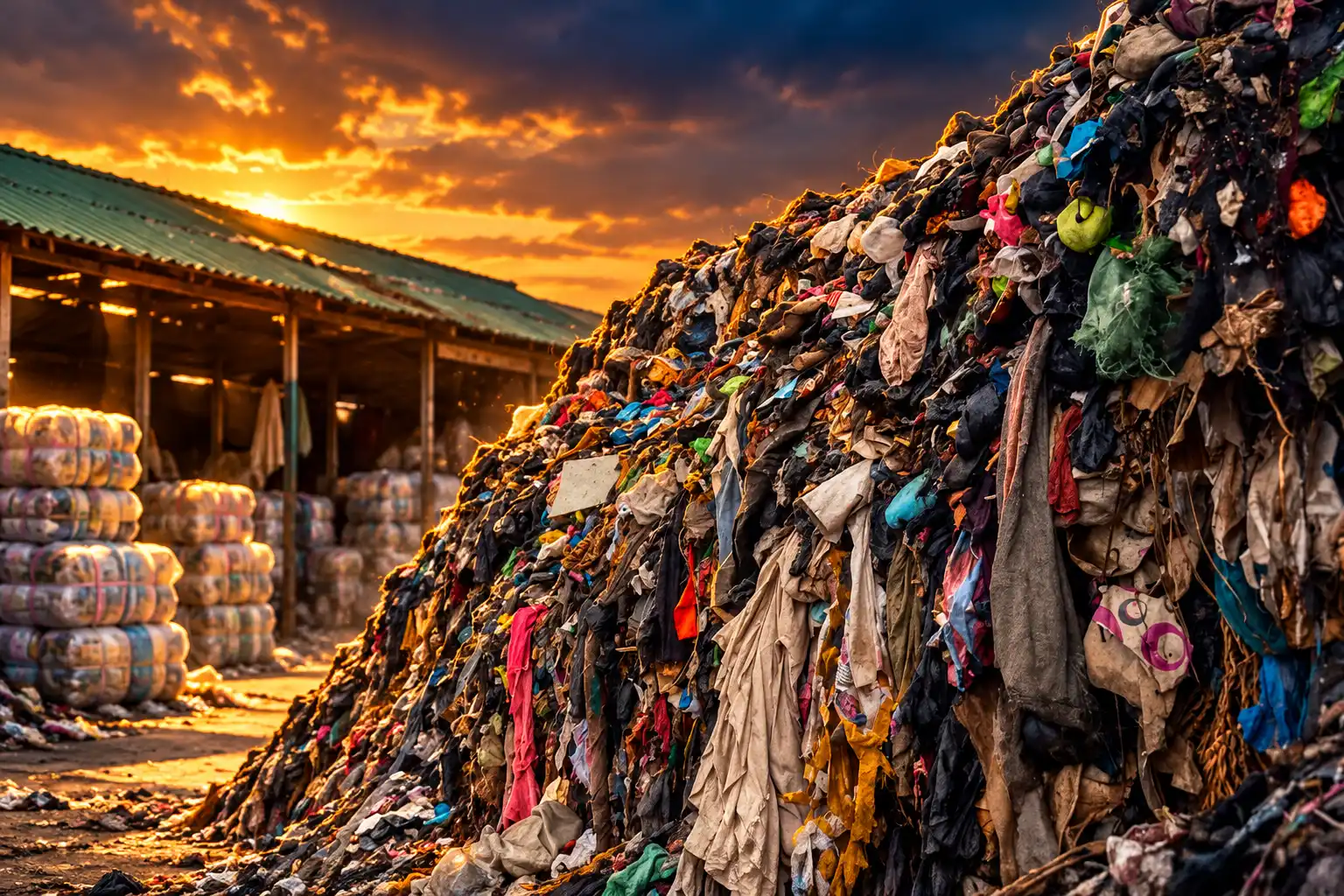
Kantamanto is not a landfill with a market attached. The Or Foundation describes it as the largest secondhand clothing market in the world, a 20-acre maze of stalls, tailors, dyers, cobblers and porters in central Accra that has been taking in Global North castoffs since the 1950s. The Accra Metropolitan Assembly estimates that about 30,000 people earn a living there.
The same organisation says traders and upcyclers already recirculate over 25 million garments a month. That is the figure the coalition itself used at the launch. It also says about 40 percent of what arrives still leaves as waste, often within a week or two of landing at port, and ends up in burn piles, informal dumps or the sea. Those two numbers describe different stages of the same trade: clothes that get a second life, and clothes that do not.
Importers and retailers have long argued that the waste share inside a freshly opened bale is much lower, on the order of a few percent. The 40 percent figure is the share that cannot be sold, repaired or remade once the market has done its work, which is a different quantity. Both can be true in the same week.
KANTAMANTO IN FIGURES
| Measure | Figure | Who published it |
|---|---|---|
| Garments recirculated | 25 million a month | The Or Foundation, cited at the ARC launch |
| People earning a living | About 30,000 | Accra Metropolitan Assembly / The Or Foundation |
| Share leaving as waste | 40 percent | The Or Foundation |
| Ghana secondhand imports, 2023 | Over 147,000 metric tons | UN Comtrade, cited by Textile Exchange |
| January 2025 fire | 60 percent of the market destroyed | Textile Exchange, drawing on market reporting |
Maame Rosina, a retailer who has worked in the market for nearly 30 years, told Textile Exchange the contents of the bales have collapsed. “When we opened the bales back then, the items were good quality. We could sell out of our stock completely. But now, out of every 100 items, 60 or 70 are unusable,” she said. Retailers buy sight unseen, cannot return a bad bale, and often take loans to do it. “These brands owe us. We work for them.”
A fire in January 2025 destroyed 60 percent of the market and slowed trade. The coalition is arriving in a rebuilt, still-strained version of that place, and it is selling the launch as a signal that circular-fashion plans have to start from a market that already sorts, mends and remakes at this scale, not from a European sorting hall.
What the Coalition Will Fund in Accra
Apparel Recovery Coalition is co-founded by the four companies and The Or Foundation. Circle Economy, whose CEO Hilde van Duijn is the coalition’s spokesperson, will run the secretariat. The first demonstration is Ghana. A second is promised in another recipient country within two years. Other brands and producer-responsibility organisations are invited to join.
The public site is blunt about the hole it wants to fill. Producer systems still pay in the first-sale market while impacts pile up elsewhere, so ARC says it will test funding linked to post-consumer textile flows, plus more inclusive governance that brings affected communities into how priorities are set.
ARC’S STATED OBJECTIVES
- Money that moves: Explore how funding and practical support tied to used-textile flows can strengthen collection, sorting, reuse and recycling in recipient countries, starting in Ghana.
- Who decides: Test more inclusive governance by putting affected community views into how work is designed and judged.
- A file for Brussels: Produce practical learnings for brands, producer-responsibility organisations, policymakers and other actors writing post-consumer textile rules.
On the ground, The Or Foundation will keep running Accra projects the coalition says it wants to fortify: market infrastructure, environmental cleanup, and training. The launch text is careful. Kantamanto is the first lab, not a finished circular economy, and the work is upstream, aimed at keeping clothes in the market rather than fishing them off the sand.
WHO SITS ON THE VEHICLE
| Organisation | Role in ARC | What it is putting in through 2027 |
|---|---|---|
| adidas | Co-founder | Voluntary funding, amount unpublished |
| BESTSELLER | Co-founder | Voluntary funding, amount unpublished |
| H&M Group | Co-founder | Voluntary funding, amount unpublished |
| Inditex | Co-founder | Voluntary funding, amount unpublished |
| The Or Foundation | Co-founder; Accra implementer | Fifteen years of Kantamanto programmes, now the on-site operator |
| Circle Economy | Secretariat | Runs the Dutch foundation’s day-to-day work |
No dollar figure has been published for the four companies. That is the loudest silence in the launch. The legal form is a Dutch foundation, which can take money and issue a case study. It cannot, by itself, rewrite EU law.
Thirty Tonnes Still Leave Accra’s Beaches Each Week
The Or Foundation’s Tide Turners cooperative has been pulling clothing off Accra’s shoreline for years. On September 24, five days before the coalition launch, the foundation marked a separate milestone at Kinshasha Beach in Jamestown: more than 3 million kg of textile waste, plastics and other refuse removed from the coast since 2024, with European Union Ambassador to Ghana Rune Skinnebach in attendance.
A truck the foundation operates under Accra Metropolitan Assembly authorisation now takes about 30 tonnes of waste off the coastline every week. Tide Turners has 65 paid participants and about 100 regular volunteers. A wider Community Ecological Care Network, which also includes Kanta Keepers inside the market and the June 4 Task Force on drains, employs more than 150 people. Citizen-science monitoring of textile “tentacles” on the sand has run weekly since 2021.
Fideis Issah, who works with Tide Turners, has described the Tuesday shifts in simpler terms. “We deserve to have clean beaches as a place to relax and spend time with our friends. But with the state of the water now, no one wants to spend time there,” she said. Her crew cuts labels from the clothes they pull, and she has said she knows the names.
Kantamanto isn’t a dumpsite and it isn’t a perfectly functioning circular economy, but it is a place of action, ingrained knowledge, skill and possibility. Launching here sends a signal that ambitious plans for circularity must be grounded in reality.
Liz Ricketts, co-founder and executive director, The Or Foundation
Hilde van Duijn said studies show that a majority of post-consumer textiles collected and sorted in the EU are exported, and that even reused or upcycled garments eventually become waste in the countries that receive them. “We will explore how producer responsibility contributions could follow textiles until the end of life, wherever this happens. We hope, through ARC, we can show that this is possible.”
Ordinary Accra life around Kantamanto did not pause for the launch. In September the market still showed up in local posts as a place to buy thrift, a site for health screenings, and a source of upcycled stage props. The coalition is a policy instrument landing on a trade that already functions as a city, not a vacant lot waiting for European design.
Shein Wrote the First Check in 2022
European brands have paid into domestic EPR pots for years, especially in France, in ways The Or Foundation says mainly subsidise collection and export rather than the last-mile work in Accra. Named, extra-territorial cash from a major seller was slower.
In June 2022, Shein announced a voluntary EPR-style fund and an initial grant to The Or Foundation of $5 million a year for three years, drawn from a $50 million five-year commitment. Or staff were clear it was not an endorsement of Shein’s model. Sammy Oteng, then senior community engagement manager, called it an admission that the company was part of the problem. Ricketts called it a bill coming due. No other marquee seller matched that structure in public until this Accra launch.
The Or Foundation’s own policy paper, Stop Waste Colonialism, published on February 14, 2023, asked for more than a pilot. It wanted fees that follow global material flows, community seats in governance, money for reuse and repair as well as capital works, and cleanup of waste already on the beaches. Separate campaign material set a floor of $0.50 per newly made garment and a 40 percent cut in production over five years. ARC, as launched, does not publish a per-garment fee, a production cap, or a total from the four companies.
THE ROAD TO A VOLUNTARY CROSS-BORDER POT
- June 2022: Shein announces a $50 million five-year waste fund and $5 million a year for three years to The Or Foundation.
- February 14, 2023: The Or Foundation publishes Stop Waste Colonialism, arguing that textile EPR must be globally accountable.
- January 2025: A fire destroys 60 percent of Kantamanto Market.
- September 24, 2026: The Or Foundation says more than 3 million kg have been taken off Accra’s coast since 2024; an extra 22,450 kg comes off on World Cleanup Day.
- September 29, 2026: adidas, BESTSELLER, H&M Group, Inditex and The Or Foundation launch ARC in Kantamanto.
The sequence is the point of leverage, and the limit. Shein paid a published sum into Ghanaian work without a seat on an EU rule-writing exercise. The four European groups have taken the seat and left the sum blank.
A Ghana Case File for Brussels by 2028
EU member states are building textile EPR schemes under the revised Waste Framework Directive. Eunomia’s June 2026 report for the European Environmental Bureau, on EPR fee transfer between exporting and importing countries, treats 2028 as the year those schemes must exist, and it treats the export of about 1.4 million tonnes of used textiles as the reason a purely national fee will miss the last owner of the waste.
ARC’s two-year clock, 2026 to 2027, sits just in front of that deadline. The coalition says it will talk to brands, producer-responsibility organisations, sorters, recyclers, policymakers and affected communities, then offer a blueprint it hopes will be written into EU EPR policy. Ghana is named. The second country is not. The payments are voluntary, time-limited, and unpublished.
WHAT WE KNOW
- The vehicle: An independent Dutch foundation, with Circle Economy as secretariat, will hold brand money for Accra work and a later second country.
- The operator: The Or Foundation will keep running market upgrades, cleanup and training as the first demonstration.
- The legal status: The funds are voluntary. They are not an EU fee, and they do not yet travel under statute.
WHAT IS UNCONFIRMED
- The total: No public figure for what adidas, BESTSELLER, H&M Group and Inditex will pay in 2026 and 2027.
- The second site: No country has been named for the follow-on demonstration.
- The statute: No EU text yet requires EPR fees to follow exported clothes; embedding the blueprint remains a hope the coalition itself states.
On September 24, The Or Foundation handed Skinnebach an EU flag sewn from upcycled windbreakers taken out of Kantamanto. On September 29, the four companies stood in that market and offered a case file for Brussels. The beaches are still being cleared by paid locals on a truck that moves 30 tonnes a week, and the fee that would make that work a line item in European law has not been written.

Nintendo Pulls SmileBASIC After the First Switch 2 Jailbreak

Arkane Lyon’s Union Holds the Clock Microsoft Cannot Skip

Airbnb Bans Guest Chores as Homes Turn Into Hotels

Riyadh Downs a Houthi Missile After Weeks of Capital Strikes

Ariana Madix’s Empty Los Angeles House Fits a Bravo Pattern

AI Server Boards Put Everyday Circuit Materials on Allocation

Glacier Collapse Buried Nepal’s Hydropower Workers in Tunnels

Congo’s Bundibugyo Outbreak Outruns the Licensed Ebola Shots

Pennsylvania Measles Deaths Follow a Long Slide in Coverage

Germany Can Miss Its 2026 Climate Cap Without Penalty
-
 NEWS2 months ago
AI Server Boards Put Everyday Circuit Materials on Allocation
-
 NEWS2 months ago
Glacier Collapse Buried Nepal’s Hydropower Workers in Tunnels
-
 NEWS2 months ago
Congo’s Bundibugyo Outbreak Outruns the Licensed Ebola Shots
-
 NEWS2 months ago
Pennsylvania Measles Deaths Follow a Long Slide in Coverage
-
 NEWS2 months ago
Germany Can Miss Its 2026 Climate Cap Without Penalty
-

 NEWS2 months ago
Texas Judge Freezes the SEC Eligibility Ban for 41 Athletes
-
 NEWS2 months ago
CISA’s Known Exploits Still Come From 2007-Era Bugs
-

 BUSINESS2 months ago
Trump’s Venezuela Oil Deal Leaves the Barrels in the Ground