
BUSINESS
Bessent and He Lifeng Leave the Hard Trade Files Unmoved
After about eight hours at JPMorgan, Scott Bessent and He Lifeng offered an AI incident channel, not a magnet fix or a November 10 tariff extension.

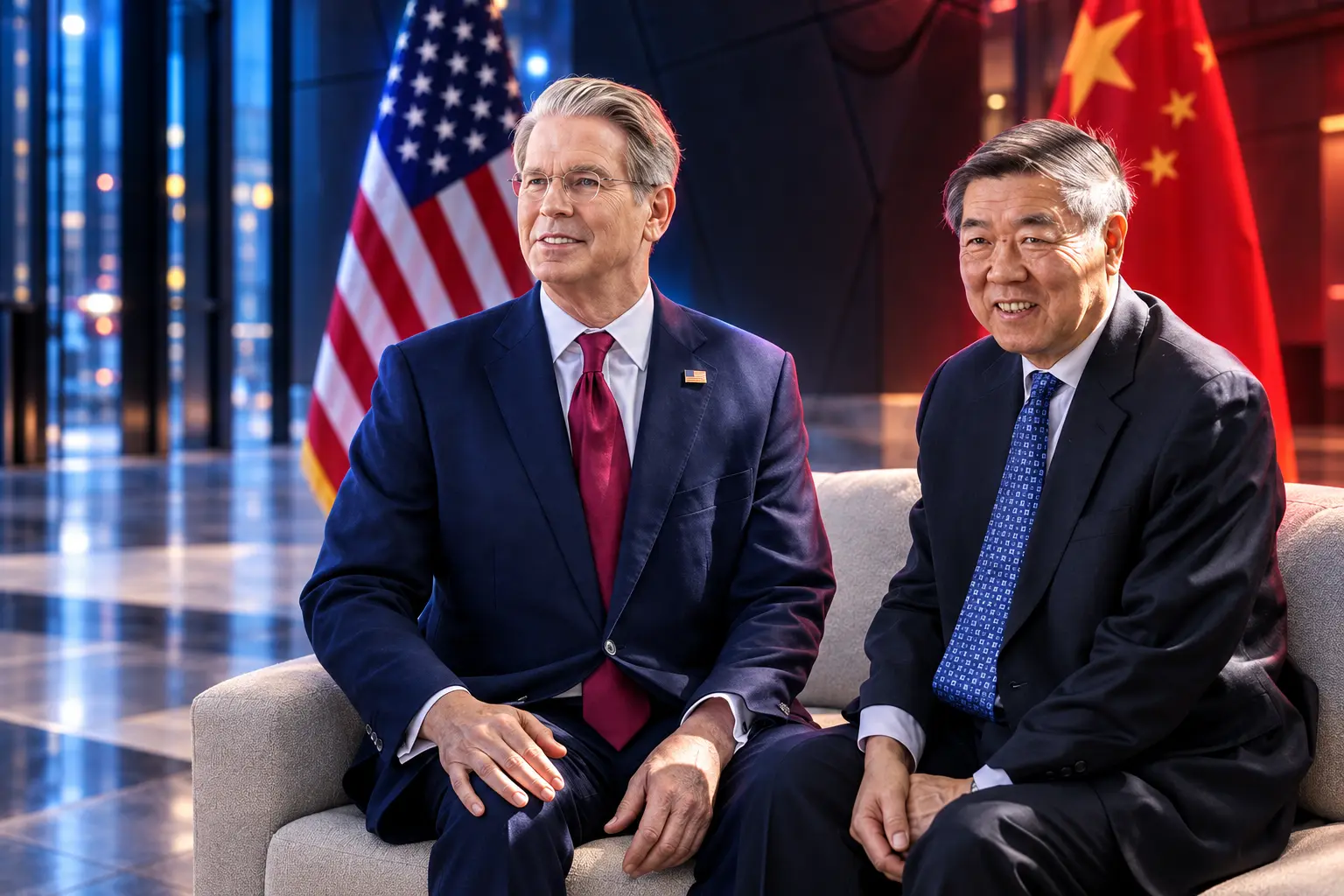
Treasury Secretary Scott Bessent called Sunday’s talks with Chinese Vice Premier He Lifeng “very successful” after about eight hours at JPMorgan Chase’s new Manhattan headquarters. He proposed a US-China AI dialogue with a national-security alert channel, and he announced no tariff extension, no magnet-flow fix, and no change to chip export controls.
The people who need those files moved will be in the East Room on September 24, when President Donald Trump hosts President Xi Jinping. Bankers, chip chiefs, and factory buyers are the ones who live with the November 10 truce clock and with magnets that still arrive short of what Washington says it was promised.
Eight Hours Inside a Bank That Was Not Negotiating
The session started around 10:30 a.m. on September 20, 2026, in midtown, with United Nations high-level meetings due September 22 through September 28 and the city’s security net already tightening. US Trade Representative Jamieson Greer sat with Bessent. China’s chief trade negotiator, Li Chenggang, sat with He. JPMorgan agreed to lend the building and, officials said, was not a party to the talks.
Bessent told reporters on the way in that he wanted “focused, fulsome and constructive talks” that would set the stage for the leaders in Washington. On X he wrote that he and He were “continuing our discussions on the U.S.-China economic and trade relationship” so Trump could “advance America’s economic interests and deliver results for the American people.”
That “continuing” line is the point of the pairing. Treasury posted in March that Bessent would meet with Vice Premier He Lifeng in Paris, and the same three officials have been walking the same files through third-country rooms for 16 months. New York was the first of those rounds on US soil, which is convenient for UN week and a signal that a later round in China is the expected next courtesy.
When the doors opened again, He and Li left without taking questions. Bessent stayed and claimed the day.
We think that, just like with any cross-border activity, that moving from opaque to more transparency between the number one and the number two AI powers in the world is very important.
Scott Bessent, Treasury secretary, to reporters in New York, September 20, 2026
Li, speaking for the Chinese side, called the atmosphere good and said a working group would continue on Monday, September 21. Beijing’s own readout stressed putting earlier trade pledges into practice and noted that the meeting included an AI dialogue. There was no joint communique on tariffs or minerals.
The AI Dialogue Leaves Chip Controls off the Table
The public product of the day is a channel. Bessent said the two sides discussed standing up a US-China AI dialogue, and that Washington had proposed a notification system for AI incidents that rise to a national-security level. He said they had agreed to meet again. He did not say Beijing had accepted the alert design, and the Chinese principals did not fill in that blank on the sidewalk.
Trump and Xi first talked about government-to-government AI consultations in Beijing in May. That forum was never stood up. Sunday’s language tries to give the presidents something with a name to bless on September 24. An incident channel is still incident response with a diplomatic label on it. It does not restock a magnet line, and it does not clear a licensed chip through Chinese customs.
Open-Weight Models Are Already in American Shops
Bessent said on September 18 that the New York talks would cover “both open- and closed-weight models.” Open-weight systems let users download and tune the core. Chinese open-weight tools have been cheaper than closed US systems from firms such as Anthropic and OpenAI, and US companies have been using them.
A Zhong Sheng commentary in the Communist Party’s official newspaper last week called US treatment of model distillation “naked double standards,” arguing that distillation is an industry practice when American firms do it and an “attack” when Chinese firms do it. Distillation trains a smaller model on a larger model’s output. Bessent’s line was that the United States “remains the leader in AI” and is open to talks on “avoiding shared risks and avoiding bifurcation of our two systems.” He has also pushed “guard rails” so powerful models stay out of the hands of hostile non-state groups.
On September 19, Trump said he would create an “AI Force,” analogizing it to Space Force, and name an AI “czar.” He offered almost no design and framed extinction warnings as a political hoax. That is the opposite register from a bilateral incident bell. One track wants speed. The other wants a phone tree for when a model blows through a fence.
Greer Kept Export Controls off This Track
Greer told reporters that US export controls on advanced AI chips and semiconductor-making gear were not on the agenda for the AI-mechanism talks. That sentence matters more than the new channel’s name, because it tells the dinner guests what Thursday is not being teed up to trade away.
Rep. Ro Khanna, ranking Democrat on the House select committee on strategic competition with China, said Trump and Xi should still seek an international pact that bans recursive self-improving AI and blocks misuse for biological and nuclear weapons. That is a floor the New York room did not claim to have poured.
Magnet Shipments to the US Fell 21% in August
The minerals file is the one US officials brought in cold. A senior official told reporters on September 18 that China’s performance on restoring critical-mineral flows “has not been up to par,” and that the shortfall would be on the table before the summit. Under the November 2025 Busan truce, Beijing promised to restore those flows to US and global users.
Chinese customs data released on September 20 showed rare-earth magnet shipments to the United States fell 21% in August, to 512 tons, from July. The same print puts 2024 monthly shipments, before the April 2025 export curbs, at 621 tons a month. Direct exports of controlled elements, including yttrium, dysprosium, and terbium, are also down against earlier years.
Those magnets are the hidden stake. They go into electric motors, factory robots, and defense hardware, and they sit inside the same advanced chips that power the AI systems the two governments now want to discuss. Columbia University’s Center on Global Energy Policy, reviewing Chinese customs records, mapped deeper US dependence on Chinese rare earths and put China’s share of global sintered neodymium-iron-boron magnet output at 94%. Magnetic rare earths, in that review, account for 96% of rare-earth consumption by value. The HS codes also miss magnets already built into cars and appliances, so the customs drop understates how much US industry still leans on Chinese processing.
WHAT SUNDAY MOVED
| File | What Washington brought in | What the New York day produced |
|---|---|---|
| AI incidents | Guardrails and a way to flag national-security events | US proposed a “US-China AI dialogue”; Beijing’s yes or no was not stated |
| Rare-earth magnets | Restore flows judged “not up to par” | No announced fix; August shipments 512 tons, down 21% |
| Tariff truce | A path past November 10 | No extension announced |
| AI chip export controls | China wants relief; US hawks want them held | Greer: not on the AI-track agenda |
Bessent said in July that China should “fully meet its commitments.” Greer had given Beijing a “passing grade” on mineral flows in May. The August print is why that grade is back in dispute, and why factory buyers, not the sherpas, are the ones who will feel Thursday first.
Dimon, Huang, and the Thursday Guest List
Xi’s program is a full state visit, his first to the White House since 2015. Officials say Trump will meet him at Joint Base Andrews on Wednesday, September 23, then run an indoor arrival, a Rose Garden troop review, closed-door talks, and an East Room dinner on September 24, with a private tea and a National Archives stop on September 25.
The dinner list is the briefing book. Officials have named Tesla and SpaceX’s Elon Musk, Nvidia’s Jensen Huang, Google’s Sundar Pichai, Amazon’s Jeff Bezos, Dell Technologies’ Michael Dell, Citigroup’s Jane Fraser, Apple Executive Chairman Tim Cook, and OpenAI’s Sam Altman. OpenAI has said Altman will attend. US officials have also said JPMorgan chief executive Jamie Dimon is invited. Several of those same executives walked the Great Hall steps in Beijing in May, where AI safety was discussed, nothing was signed, and chip export controls, Greer said then, never came up.
WHO HAS A BOOK IN THE ROOM
- Jamie Dimon: His bank hosted Sunday’s talks as a landlord, not a negotiator, and he is on the dinner list as a China-facing lender.
- Jane Fraser: Citigroup’s chief is listed for the East Room, another balance-sheet vote for a stable truce rather than a November snapback.
- Jensen Huang: Nvidia’s chief needs a China channel that is more than a toast; licensed advanced chips have been the sore point of the AI file all year.
- Sam Altman and Tim Cook: OpenAI and Apple sit at the model-and-hardware seam that Bessent now wants inside a bilateral dialogue.
- He Lifeng’s company delegation: China’s commerce ministry said He would also bring Chinese firms into the US for consultations, a mirror of the US chief-executive group Trump took to Beijing in May.
Auto-industry groups, for their part, spent the week before the visit urging Trump to keep an effective ban on Chinese vehicle sales. Trump has floated letting Chinese automakers build US plants. That fight is not on Bessent’s AI channel, and it will not be settled by a notification bell.
Sixteen Months of Third-Country Rooms Led Here
Sunday was not a first date. It was the latest pass of a three-person circuit (Bessent, Greer, He) that has been teeing up leader-level paper since spring 2025, usually in Europe or Asia so neither capital had to play host.
THE SHERPA CIRCUIT
- May 2025: First Bessent-He-Greer round in Geneva, the start of the 16-month pattern.
- November 2025: Trump-Xi truce in Busan, South Korea, caps US tariffs on Chinese goods at about 20% after both sides had gone to triple-digit rates, with a Chinese pledge to restore critical-mineral flows.
- March 15-16, 2026: Paris round at the OECD, one of the last third-country stops before the Beijing summit.
- May 14, 2026: In the Great Hall of the People, Trump invited Xi to the White House on September 24, after the two men agreed to call the relationship “constructive” and “stable.” Holdover pledges from that trip include Chinese purchases of US farm goods up by $17 billion a year and more than 200 Boeing aircraft, plus a “Board of Trade” process to hunt tariff cuts on non-strategic goods.
- September 20, 2026: New York, JPMorgan headquarters, AI dialogue proposed, minerals and the truce left for the presidents.
Anna Ashton, a China trade analyst who runs Ashton Intelligence, said before the meeting that a presidential summit usually forces “some show of deliverables,” and that “status quo is probably both sides’ general best expectation.” Sunday matched that forecast. The Board of Trade is still a process to “operationalise,” in Greer’s word, not a published list of cuts. The farm and Boeing pledges are still scorekeeping items, not closed invoices.
November 10 Is Still the Tariff Deadline
The clock the dinner guests can price is not the AI channel. It is November 10, when the Busan truce expires, with US midterm elections on November 3. Washington has also been preparing a separate tariff case on industrial overcapacity, and people familiar with that file said a new round of duties was held until after the New York meeting. Bessent has spent the year putting semiconductors, AI, and critical minerals in the same economic-statecraft sentence. Those are the three stacks on the White House table, and only one of them left Manhattan with a new label.
WHAT WE KNOW
- The New York product: A US-proposed US-China AI dialogue and an incident-notification idea for the presidents to consider on September 24.
- The chip track: Greer said export controls on advanced AI chips and fab tools were not on that AI agenda.
- The magnet print: August shipments to the US were 512 tons, down 21% from July, against a 2024 monthly pace of 621 tons.
- The calendar: Xi’s White House day is September 24. The tariff truce still expires on November 10.
WHAT IS UNCONFIRMED
- Beijing’s yes: Whether China has accepted the notification design, or only agreed to keep talking.
- Truce paper: Whether September 24 produces an extension, a narrow cut on non-strategic goods, or a photo and a working group.
- Mineral volumes: Whether any new flow number, license pledge, or enforcement step will be attached to the dinner toasts.
Working-level talks were set to run on September 21. Then the file goes to two men who already tried an AI consultation in May and never stood it up. The East Room can toast a channel. Magnet orders, licensed chips, and a November 10 tariff cliff still need a number.

Nintendo Pulls SmileBASIC After the First Switch 2 Jailbreak

Arkane Lyon’s Union Holds the Clock Microsoft Cannot Skip

Airbnb Bans Guest Chores as Homes Turn Into Hotels

Riyadh Downs a Houthi Missile After Weeks of Capital Strikes

Ariana Madix’s Empty Los Angeles House Fits a Bravo Pattern

AI Server Boards Put Everyday Circuit Materials on Allocation

Glacier Collapse Buried Nepal’s Hydropower Workers in Tunnels

Congo’s Bundibugyo Outbreak Outruns the Licensed Ebola Shots

Pennsylvania Measles Deaths Follow a Long Slide in Coverage

Germany Can Miss Its 2026 Climate Cap Without Penalty
-
 NEWS2 months ago
AI Server Boards Put Everyday Circuit Materials on Allocation
-
 NEWS2 months ago
Glacier Collapse Buried Nepal’s Hydropower Workers in Tunnels
-
 NEWS2 months ago
Congo’s Bundibugyo Outbreak Outruns the Licensed Ebola Shots
-
 NEWS2 months ago
Pennsylvania Measles Deaths Follow a Long Slide in Coverage
-
 NEWS2 months ago
Germany Can Miss Its 2026 Climate Cap Without Penalty
-

 NEWS2 months ago
Texas Judge Freezes the SEC Eligibility Ban for 41 Athletes
-

 NEWS2 months ago
CISA’s Known Exploits Still Come From 2007-Era Bugs
-
 BUSINESS2 months ago
Trump’s Venezuela Oil Deal Leaves the Barrels in the Ground