
NEWS
Galápagos Corals Give Climate Models a Hard El Niño Test
Galápagos coral chemistry shows eastern Pacific El Niño swings 36.5% stronger than the preindustrial millennium.

Eastern Pacific El Niño swings measured in Galápagos corals have run 36.5% stronger than they were across the preindustrial millennium. The finding was published in Science on August 27, 2026, by Julia Cole, chair of Earth and Environmental Sciences at the University of Michigan, and colleagues.
It lands on a live event. NOAA’s Climate Prediction Center already has an El Niño Advisory in force, and a 69% chance that October-December will beat every event in the instrumental record back to 1950. The same eastern water that grew the cores is the water now running hottest.
The 2026 Event Is Heating the Galápagos First
Forecasters El Niño Advisory in June after equatorial Pacific temperatures stayed at least 0.5 C above average for several months. The event has kept building. In its August ENSO diagnostic discussion, the Climate Prediction Center said El Niño was strengthening, with a greater than 90% chance of a very strong event during Northern Hemisphere fall and winter 2026-27.
July monthly relative departures were +1.4 C in Niño-3.4, +1.7 C in Niño-3, and +2.9 C in Niño-1+2, the far-eastern box that includes the islands. Subsurface anomalies reached +10.0 C at depth. The Southern Oscillation index sat near 2 standard deviations below normal, a coupled ocean-air mark, not a surface blip.
A later weekly briefing dated August 31, 2026, showed the heat still piled in the east while the west stayed near normal.
EASTERN PACIFIC HEAT IN LATE AUGUST
| Niño box | Weekly SST departure | What the box covers |
|---|---|---|
| Niño-4 | +0.1 C | West-central equatorial Pacific |
| Niño-3.4 | +1.8 C | Central belt used for the main index |
| Niño-3 | +2.6 C | East-central equatorial Pacific |
| Niño-1+2 | +3.5 C | Far east, including Galápagos waters |
That pattern is an eastern Pacific event, the flavor Cole’s team went to the islands to recover. The May-July Relative Oceanic Niño Index, NOAA’s three-month yardstick, was +1.0 C. For October-December, the center put a 69% chance on a historic event of +2.5 C or more, which would exceed previous El Niños dating to 1950. It expects the episode to last through spring 2027. The next monthly discussion is due September 10, 2026.
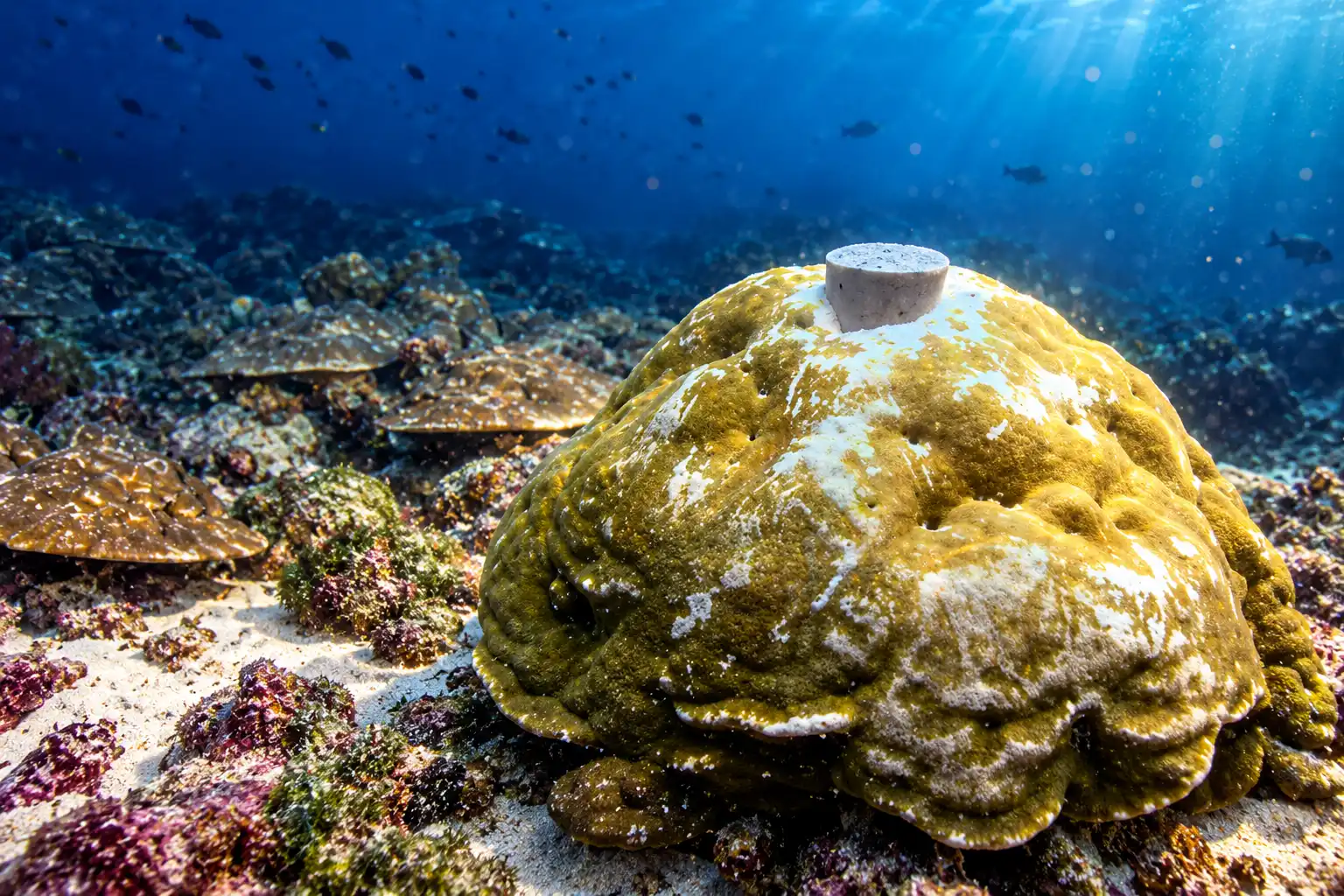
Thirteen Cores Catch a 36.5% Jump
Cole and colleagues sampled cores from 13 corals, living colonies and ancient boulders, around the Galápagos, then read monthly chemistry along each slab. The eastern Pacific ENSO paleorecord shows a large recent rise in year-to-year sea-surface temperature swings compared with older paleorecords, a rise that exceeds simulated natural variability and tracks global temperature. The paper says the extra swing comes from stronger El Niño events. Central Pacific coral data also show more variability, though less sharply.
Figures released with the journal put modern eastern Pacific ENSO variability 36.5% above the preindustrial millennium from 1000 to 1850. Cole said the team does not see a time in the past when El Niños were as strong as they are now, and that El Niño strength changes in parallel with global temperature. In a University of Michigan account of work that found recent events stronger than the prior millennium, she is quoted saying strong events cluster in the last 40 to 50 years, after a long stretch of lower intensity.
That’s the thing that has changed over that time. So if I get pushback on that, I would like to know what the alternative is.
Julia Cole, paleoclimatologist and department chair, University of Michigan
She has also described a shift in skewness. The record turned positive, she said, which means the warm events got stronger. Events that once ran a degree or two above normal in the Galápagos now run three or four. She called it a new style of El Niño, not a one-off spike. The U.S. National Science Foundation and the United Kingdom’s Natural Environment Research Council funded the work.
Which Climate Models Survive This Test?
Climate models have not agreed on what warming should do to El Niño. Some runs grow the swings. Others shrink them. Across older model generations, the ensemble-mean change in amplitude sits near zero, with published spreads from about +0.6 C to -0.4 C by late century. Many simulations also start the eastern tropical Pacific too cold, an error that can scramble the feedbacks that make El Niño in the first place.
Cole’s group compared the coral jump with preindustrial runs from 12 climate models. Almost none of those natural-only runs produced a shift as large as the one in the skeletons. The authors report that result at above 95% confidence. The paper does not claim the chemistry proves a human cause by itself. It does argue that industrial-era warming is the leading explanation, because the jump lines up with that warming and sits outside the natural range the models can make.
WHERE EXPERTS DISAGREE
- Cole’s case: The late-century rise exceeds simulated natural variability and tracks global heat, so warming is the best account on offer.
- The last IPCC report: The 2023 assessment declined to state how warming would change El Niño, a silence Kim Cobb, a Brown University climate scientist who was not on the study, says the 2029 report is likely to drop.
- The modeling split: Agus Santoso, a climate scientist at Laoshan Laboratory, notes that newer models used in IPCC work tend to produce stronger, more frequent events, even while many still run the eastern Pacific too cold.
Cobb’s own 2019 fossil-coral work from Kiritimati in the central Pacific found a 25% rise in El Niño variability. The Galápagos signal is larger, which fits a place where El Niño heat is at its most extreme. Santoso said it is encouraging that models, paleorecords, and modern observations are starting to line up. Cobb, who helped draft an earlier IPCC chapter, put the next report’s likely line in plain words: researchers are edging close to saying climate change has already had a considerable impact on El Niño’s strength.
That is the second job of the new cores. They are not only a history. They are a filter. A model that cannot grow a 36.5% eastern Pacific jump once the planet has already warmed is a weak guide to floods, droughts, and fisheries in a hotter climate. The 2026 event is the first live run of that filter.
Sixteen of Seventeen Galápagos Reefs Did Not Come Back
The archive almost did not exist. Cole first went to the islands in 1989, seven years after the 1982-83 El Niño, hoping to read old colonies that other scientists had described. The large, old corals were gone. Every living core her team later drilled still carries a death horizon from that event, a dense layer laid down by algae, snails, and barnacles that interrupts the coral lattice.
Reef scientist Peter Glynn and colleagues, a group that included Cole, later put numbers on the wreckage. Their 2018 review of Galápagos reefs reports 95% coral tissue loss across the archipelago in 1982-83. Of 17 structural reefs mapped in the mid-1970s, one still stands in a positive growth mode: Wellington Reef at Darwin Island. The rest degraded to scattered colonies or vanished into sediment after urchins bored the dead frameworks faster than new coral could grow.
WHAT THE 1982-83 HEAT DID TO THE REEFS
- Tissue kill: About 95% of coral tissue was lost archipelago-wide, with one survey at 14 sites logging 97% mortality.
- Framework collapse: All structural reefs in the central and southern islands disappeared after bioerosion and weak recruitment.
- The last reef: Wellington Reef at Darwin remains the only mapped structural reef still adding framework.
- Northern holdouts: Living giants used in the new study grow at Wolf and Darwin, 6 to 15 meters down and 2.4 to 3 meters tall, the same northern waters that recovered better after 1983.
Age work on corals killed in 1983 points to robust populations for at least 500 years before that El Niño. The 1982-83 event shut down the cool, nutrient-rich upwelling that usually feeds the islands’ food chain. Warm surface water sat on top of the thermocline, and fish, birds, marine mammals, and fishing towns took the hit with the reefs. A shrug that wildlife should simply move or adapt runs into that ledger. Most of the Galápagos reef structures did not move. They came apart.
How a Coral Skeleton Stores Monthly Heat
A Galápagos coral adds a calcium-carbonate layer each year, like a tree ring, with denser and lighter bands that keep time. Temperature is stored in the chemistry of those layers. Cole’s team cut the cores into slabs and drilled powders along a path from youngest to oldest, each sample about a month of growth.
They tracked two ratios. Strontium versus calcium falls when the water warms, because the skeleton takes up fewer of the large strontium atoms. The ratio of heavy oxygen, O-18, to ordinary O-16 also falls in warmer water, which favors the lighter isotope. Together the two clocks reconstruct El Niño heat and the colder La Niña years, when upwelling is stronger.
Living colonies came from dives on the northern islands. Fossil boulders came off shorelines around the archipelago and were dated with radiometric methods, including uranium-thorium. Some fossils are as old as 4,500 years, though the El Niño comparison that drives the new paper is the last millennium. Judson Partin, a geophysicist at the University of Texas at Austin who reads El Niño in Vanuatu corals and was not on this study, has called corals one of the best tools available for the job. In the Galápagos, because the islands sit where the El Niño signal is loud, the same tool also records the death of the instrument.
A Stronger El Niño Rearranges Weather Worldwide
El Niño events return every 2 to 7 years, when trade winds slacken and warm western Pacific water slides east and piles up near the islands. The ocean heat then shoves the atmosphere. Storm tracks bend. Rain falls in the wrong places. Drought sets up in others. The 1982-83 event sent floods through Kenya and Peru and drought through Indonesia and Brazil. A similarly strong event in 1997-98 again scrambled those patterns. Cole’s paper warns that a stronger eastern Pacific ENSO has troubling implications for climate extremes. Cobb called the system the planet’s largest source of those extremes, and said a more extreme version is information societies should act on.
FROM THE 1982 KILL TO THE 2026 EVENT
- 1982-83: A strong El Niño kills about 95% of Galápagos coral tissue and leaves only Wellington Reef standing as a structural reef.
- 1989: Cole arrives to read old colonies and finds the large southern corals already gone.
- 1997-98: Another major El Niño hits; Galápagos reefs take a second blow, lighter than 1982-83 but still severe in parts of the eastern Pacific.
- August 27, 2026: The Science paper reports eastern Pacific ENSO variability 36.5% above the preindustrial millennium.
- June-August 2026: NOAA issues an El Niño Advisory, then raises a greater than 90% chance of a very strong 2026-27 event and a 69% chance of a historic October-December peak.
Forecasts already reach about a year ahead, but they depend on satellites and buoys across the remote tropical Pacific, and on models that, until this coral series, had no thousand-year eastern Pacific ruler. The 2026 heat is already an eastern event, with Niño-1+2 at +3.5°C in the late-August weekly figures, the same neighborhood as the cores. If the October-December season clears +2.5 C on the relative index, it will not only top the instrumental catalog. It will be the first major El Niño judged against a skeleton record that says the last four decades already left the prior millennium behind.
We are edging close to saying climate change has already had a considerable impact on the strength of El Niño.
Kim Cobb, climate scientist, Brown University
The Climate Prediction Center’s next diagnostic is due September 10, 2026. Cobb expects the following IPCC report, in 2029, to say out loud what the Galápagos slabs already measure.
Frequently Asked Questions
How Often Do El Niño Events Typically Occur?
They develop about every 2 to 7 years, when weaker trade winds let warm western Pacific water flow east and stack up near the Galápagos, then rewrite rainfall and storm tracks far from the equator through the atmosphere.
Why Did the Team Sample Wolf and Darwin Islands?
The largest living Galápagos corals still grow in those northern waters, 6 to 15 meters deep, after central and southern structural reefs collapsed; recovery after 1983 has been much stronger at Darwin and Wolf than in the south, where urchin grazing kept frameworks from rebuilding.
How Old Are the Oldest Galápagos Corals in the Study?
Radiometric dates on fossil boulders run as far as 4,500 years, and poritid stacks on Wellington Reef at Darwin have returned modern ages up to 690 years, even though the El Niño trend test itself uses the last millennium.
What Is the Relative Oceanic Niño Index NOAA Is Using?
RONI is the Niño-3.4 sea-surface temperature departure minus the tropical-mean departure between 20 N and 20 S, then rescaled to match ordinary Niño-3.4 variance, with a three-month running mean; NOAA now classifies El Niño when RONI stays at or above +0.5 C with matching atmospheric features.
Who Funded the Galápagos Coral ENSO Paper?
The U.S. National Science Foundation and the United Kingdom Natural Environment Research Council supported the University of Michigan-led work published in Science on August 27, 2026.

Nintendo Pulls SmileBASIC After the First Switch 2 Jailbreak

Arkane Lyon’s Union Holds the Clock Microsoft Cannot Skip

Airbnb Bans Guest Chores as Homes Turn Into Hotels

Riyadh Downs a Houthi Missile After Weeks of Capital Strikes

Ariana Madix’s Empty Los Angeles House Fits a Bravo Pattern

AI Server Boards Put Everyday Circuit Materials on Allocation

Glacier Collapse Buried Nepal’s Hydropower Workers in Tunnels

Congo’s Bundibugyo Outbreak Outruns the Licensed Ebola Shots

Pennsylvania Measles Deaths Follow a Long Slide in Coverage

Germany Can Miss Its 2026 Climate Cap Without Penalty
-
 NEWS2 months ago
AI Server Boards Put Everyday Circuit Materials on Allocation
-
 NEWS2 months ago
Glacier Collapse Buried Nepal’s Hydropower Workers in Tunnels
-
 NEWS2 months ago
Congo’s Bundibugyo Outbreak Outruns the Licensed Ebola Shots
-
 NEWS2 months ago
Pennsylvania Measles Deaths Follow a Long Slide in Coverage
-
 NEWS2 months ago
Germany Can Miss Its 2026 Climate Cap Without Penalty
-

 NEWS2 months ago
Texas Judge Freezes the SEC Eligibility Ban for 41 Athletes
-

 NEWS2 months ago
CISA’s Known Exploits Still Come From 2007-Era Bugs
-

 BUSINESS2 months ago
Trump’s Venezuela Oil Deal Leaves the Barrels in the Ground