
NEWS
Xylitol’s Heart Risk Follows a Path Regulators Never Rechecked
A Munich xylitol study extends three years of clotting papers, while a 1977 FDA rule and WHO advice still skip polyol heart data.

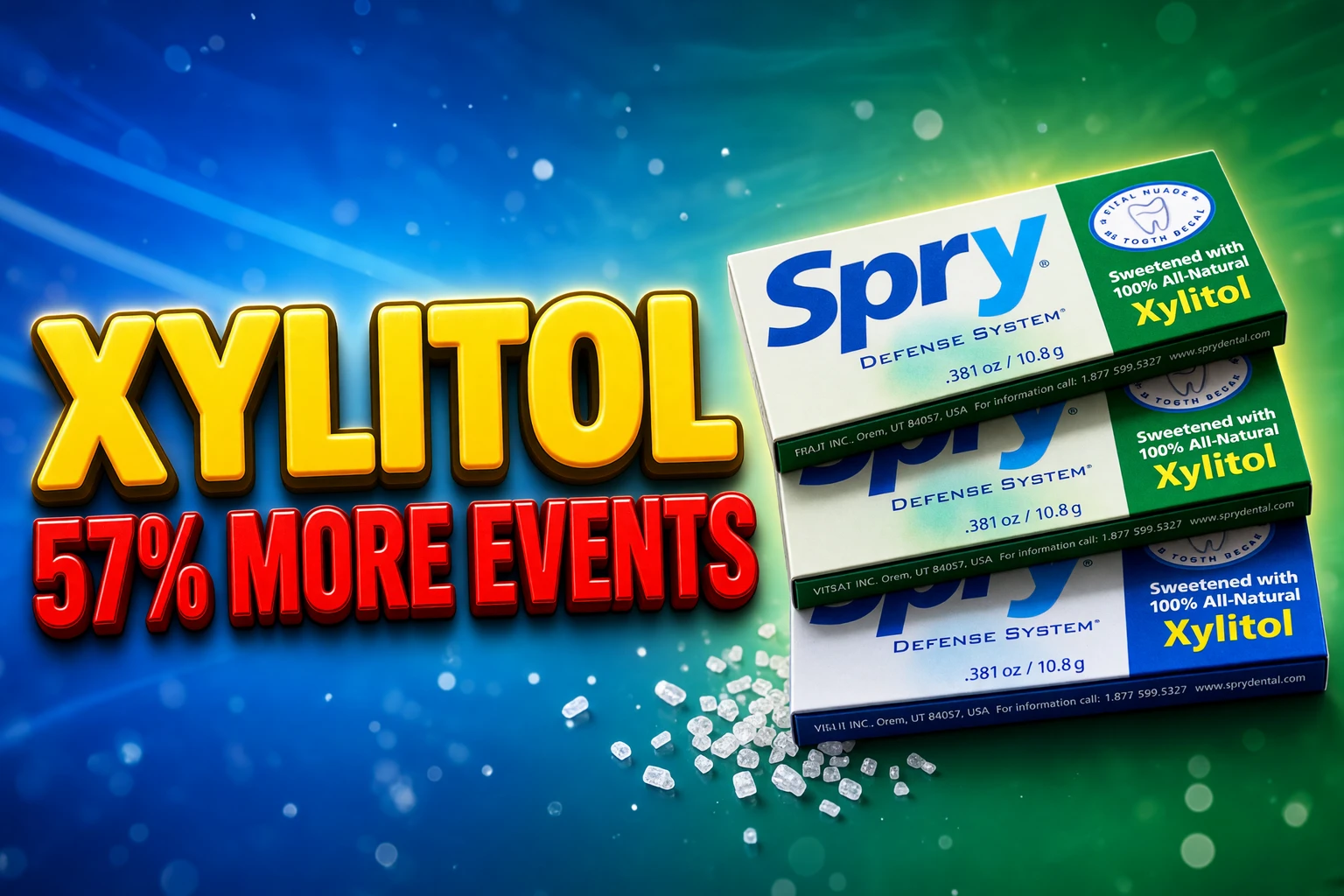
High blood xylitol tracked a 57% rise in heart attacks, strokes and death over six years in a large Canadian aging study. A British cohort followed for 30 years showed an 18% gap between the top and bottom quarters of blood xylitol. Both figures come from an analysis due at the European Society of Cardiology congress in Munich, and both rest on blood tests, not shopping lists.
Doctor Marco Witkowski of Charité University Hospital in Berlin is presenting the work. His team used stored samples from 17,710 people in two long-running cohorts, the Canadian Longitudinal Study on Aging and EPIC-Norfolk. The European Society of Cardiology released the numbers on 26 August 2026. The talk is listed for Saturday, 29 August, and the findings have not yet appeared in a peer-reviewed journal.
Two Cohorts, 17,710 People, Two Different Timelines
Xylitol is a sugar alcohol the body makes in small amounts while it handles glucose. Food makers add it, often at more than 1,000 times the level found in fruit, to gum, toothpaste, jam, yogurt and ice cream. Witkowski’s group asked whether people with more of it in their blood later had more major heart events, defined as death, heart attack or stroke.
In the Canadian aging study, the top quarter of xylitol levels had a 57% higher event rate than the bottom quarter over six years, after the team accounted for age, sex, smoking, blood fats, diabetes and high blood pressure. In EPIC-Norfolk, the extra rate was 18% across 30 years. Middle groups sat in between, which the authors read as a step-up with higher blood levels. The pattern held across age and sex, and it was not explained by body mass index, blood pressure, diabetes or lipids, the traits that often push people toward low-calorie products.
| Cohort | Follow-up | Comparison | Extra MACE rate |
|---|---|---|---|
| CLSA (Canada) | 6 years | Top vs bottom quarter of blood xylitol | 57% higher after standard heart-risk adjustments |
| EPIC-Norfolk (UK) | 30 years | Top vs bottom quarter of blood xylitol | 18% higher |
Professor Dan Atar, a member of the ESC communication committee who was not part of the study, said safety ratings for these sweeteners “had been good and granted by regulatory authorities,” while adding that observational work cannot settle cause. He said further studies are “mandated.” Meeting reports are treated as preliminary until a journal reviews them.
The Blood Tests Did Not Count Chewing Gum
The scare in the headlines is gum, jam and toothpaste. The measurement in Munich is xylitol already in blood. The ESC note does not say anyone filled out a xylitol food diary, and it does not say whether the samples were taken after an overnight fast. That gap is the hole in the abstract. It is also the first question people asked when the write-ups hit X: how many milligrams of the -ol did these people actually eat?
Witkowski’s own 2024 paper in the European Heart Journal, done with Stanley Hazen’s Cleveland Clinic lab, supplies the reason that question matters. Ten healthy adults drank a xylitol-sweetened beverage. Blood levels soared, then fell back to the starting range within four to six hours. Physician Peter Attia, writing about that paper in June 2024, quoted the authors’ own conclusion that this rapid drop “suggests that the plasma levels observed in our observational (validation) cohort represent variations in endogenous production/levels and not food intake.” In plain terms, a fasting blood test can record what the liver and the glucuronate pathway made overnight, not what a person chewed at lunch.
The body makes xylitol while it metabolizes glucose. Pathway activity rises with diabetes, liver disease and other metabolic strain, the same states that already raise heart risk. Attia’s point was that circulating xylitol can be a read-out of that strain, a third variable, rather than a poison poured from a gum pack. The 2026 analysis looks like the same blood-level design, scaled to the general population and stretched over six and 30 years. If the Canadian and Norfolk samples behave like the 2024 fasting set, the 57% and 18% figures describe people whose bodies run more xylitol, not people who bought more Orbit.
That reading does not make the poster harmless. It does mean a consumer who quits gum on Saturday may be reacting to a number that never counted the gum.
A 30-Gram Drink Spiked Plasma 1,000-Fold
The part of this research program that actually tests eating xylitol is small, short and still the most direct evidence on diet. In 2024 the same group gave 10 healthy volunteers a drink with 30 grams of xylitol, about a scoop of keto-style ice cream, and compared it with a glucose drink. NIH’s summary of the trial said blood xylitol increased 1,000-fold within 30 minutes and returned to baseline after four to six hours. Platelets became more sensitive to clotting signals while the level was high. Glucose did not do that.
THE 2024 DRINK TEST
- The dose: 30 grams of xylitol in a beverage, described as a typical portion in a sweetened food.
- The spike: Plasma xylitol rose about 1,000-fold by 30 minutes in all 10 volunteers.
- The window: Levels were back near baseline in four to six hours.
- The platelets: Every clotting measure the team tracked rose after xylitol and not after glucose.
Lab dishes and a mouse artery-injury model pointed the same way: xylitol made platelets easier to activate at concentrations seen in human plasma. The European Heart Journal paper reported that a xylitol-sweetened drink enhanced platelet responsiveness in all subjects. In the larger 2024 patient set, people in the top third of blood xylitol had an adjusted hazard ratio of 1.57 for a major event over three years versus the bottom third, 1.57 (1.12 to 2.21). That 57% sits next to this year’s Canadian 57% by coincidence of rounding, in a sicker, shorter, tertile study, not because the two analyses are the same.
Hazen said at the time that the work “does not mean throw out your toothpaste if it has xylitol in it,” while warning that a product with high levels could raise clot-related risk. A few hours of a 1,000-fold plasma jump is a different exposure from a fasting metabolomics peak. The Munich cohorts never measured that jump.
Why Dentists Still Recommend Xylitol Gum
Dentists spent 50 years putting xylitol into daily routines because mouth bacteria cannot ferment it the way they ferment sucrose, so plaque acid stays lower. Harvard Health still cites reviews in which 5 to 10 grams a day from gum, lozenges or toothpaste cut cavities. Finnish current-care guidance from 2023 still names 5 to 6 grams a day. The Canadian Dental Association has called xylitol gum helpful for plaque and caries. McGill’s Office for Science and Society has long translated that dose as about three to five pieces of xylitol gum a day, with gut upset more likely above about 15 grams.
U.S. food law did more than tolerate that habit. It wrote a label claim for it. Under may reduce the risk of dental caries rules in 21 CFR 101.80, xylitol is listed with other sugar alcohols that may carry claims such as “does not promote tooth decay” or “may reduce the risk of dental caries,” as long as the product also meets sugar and plaque-pH tests. The model language dates to 1996 and still names xylitol.
WHERE XYLITOL STILL HAS A DENTAL MANDATE
- U.S. labels: FDA health-claim rules let qualifying sugar-alcohol foods say they do not promote tooth decay.
- Finland: 2023 caries guidance still points to 5 to 6 grams of xylitol a day.
- Canada: The national dental association still flags xylitol gum as useful against plaque and cavities.
- Clinic caution from 2024: Hazen’s group said toothpaste with xylitol is not the same exposure as a 30-gram food serving.
That dental machine is why xylitol is in the cupboard of people who think they are choosing the careful option. It is also why a blood-level poster in Munich lands on a product category regulators already blessed for teeth, not for arteries.
The FDA Still Allows a Cavity Claim
The additive rule is older than the claim. 21 CFR 172.395, on the books from a 1977 food-additive package, says xylitol may be safely used in foods for special dietary uses if the amount is no greater than needed for the intended effect. The Environmental Working Group has noted that several sugar alcohols, xylitol among them, have not had a fresh FDA safety review since that era. JECFA, the FAO/WHO additive committee, gave xylitol an acceptable daily intake of “not specified” in 1983, the phrase used when a numerical cap was not set.
World Health Organization advice from 2023 against non-sugar sweeteners for weight control does not cover this ingredient. PAHO’s summary of that guideline lists aspartame, sucralose, stevia and similar non-nutritive sweeteners, and it states the recommendation does not apply to sugar alcohols, which contain calories and are not classed as NSS. Anyone treating Saturday’s poster as a WHO ban on xylitol is mixing two files.
XYLITOL’S PAPER TRAIL
- 1977: FDA 21 CFR 172.395 allows xylitol in special-diet foods at the amount needed for its effect.
- 1983: JECFA assigns xylitol an ADI of “not specified.”
- 1996: 21 CFR 101.80 lets qualifying xylitol foods carry a tooth-decay health claim.
- June 6, 2024: European Heart Journal paper links blood xylitol to three-year MACE and shows a platelet rise after a xylitol drink.
- August 26, 2026: ESC releases the 17,710-person CLSA and EPIC-Norfolk analysis for the Munich congress.
None of those rules asked for a heart-outcome trial. The 2026 poster is the first long look in ordinary adults, and it is still a conference report.
A Dietitian Warns Against Swapping Back to Sugar
Dell Stanford, a senior dietitian at the British Heart Foundation, said people often treat sweeteners as the healthier choice and eat more of them than they notice. She stressed that the new work is observational, so it can show a link between higher xylitol levels and heart events without proving that xylitol caused them. She also said it is “not a green light to have more sugar instead,” because free sugar still needs to come down. Her practical line was to cut back on processed foods and drinks that run high in sugar, salt or sweeteners, and to keep a balanced diet.
Artificial sweeteners are consumed by people who think they are healthier than sugar and they are generally regarded as safe by regulatory agencies. Our long-term findings in the general population highlight how little we know about the cardiovascular safety of xylitol and indicate that further studies are warranted, especially as the amount of xylitol in products continues to increase.
Dr Marco Witkowski, Charité University Hospital, ESC Congress 2026 news release
That quote is the authors’ ceiling, not a recall notice. The dental dose and the 30-gram food serving are different exposures. Toothpaste was already carved out by Hazen in 2024. The open cardiac question is repeated large food servings that hold plasma in the 1,000-fold zone, and that question is exactly what CLSA and EPIC-Norfolk did not record.
Munich Hears the Finding Before a Journal Does
ESC Congress 2026 runs 28 to 31 August in Munich. Witkowski’s session sits on Saturday, 29 August, on the same campus where the society is also walking back the idea that “generally regarded as safe” closes the file. The Canadian six-year 57% and the Norfolk 30-year 18% will be the figures that travel. The missing diet diary will travel more slowly, if it travels at all.
Until a journal paper lists how the blood was drawn and whether anyone’s gum, jam or ice cream was counted, the honest reading is narrow. High circulating xylitol marked more heart attacks, strokes and deaths in two general-population cohorts. The same laboratory has shown that a 30-gram xylitol drink can push platelets for a few hours. It has also written that fasting blood xylitol can be the body’s own output. Those three facts can sit in one paragraph. They do not yet tell a shopper to throw out the gum.
Disclaimer: This article is news reporting and analysis of a conference study and earlier published research. It is informational only and is not medical advice, a diagnosis, or a recommendation to start, stop or change any food, sweetener, toothpaste or medicine. Readers should talk with a physician or a registered dietitian before changing a diet, especially anyone with heart disease, diabetes, clotting risk or a prescribed eating plan. Figures, quotes and study status reflect the European Society of Cardiology release and the other sources named here as of 28 August 2026 and may change when the Munich work is peer-reviewed or when regulators update their files.

Netflix Turned the GTA 6 Look Into a Film Chart

Glacier Collapse Buried Nepal’s Hydropower Workers in Tunnels

Trump’s Venezuela Oil Deal Leaves the Barrels in the Ground

Germany Can Miss Its 2026 Climate Cap Without Penalty

CISA’s Known Exploits Still Come From 2007-Era Bugs
Glacier Collapse Buried Nepal’s Hydropower Workers in Tunnels

Congo’s Bundibugyo Outbreak Outruns the Licensed Ebola Shots
Germany Can Miss Its 2026 Climate Cap Without Penalty

The Ninth Circuit Splits Kalshi’s Sports Map in Two
CISA’s Known Exploits Still Come From 2007-Era Bugs
-
 NEWS1 week ago
Glacier Collapse Buried Nepal’s Hydropower Workers in Tunnels
-
 NEWS1 week ago
Congo’s Bundibugyo Outbreak Outruns the Licensed Ebola Shots
-
 NEWS1 week ago
Germany Can Miss Its 2026 Climate Cap Without Penalty
-
 BUSINESS1 week ago
The Ninth Circuit Splits Kalshi’s Sports Map in Two
-
 NEWS1 week ago
CISA’s Known Exploits Still Come From 2007-Era Bugs
-

 NEWS2 weeks ago
A Cow Rumen Enzyme Dissolves Superbug Biofilms on Gauze
-
 BUSINESS1 week ago
Trump’s Venezuela Oil Deal Leaves the Barrels in the Ground
-

 NEWS1 week ago
Marvin Bracy-Williams Faces DUI After a Career-Ending Ban