
NEWS
Texas Judge Freezes the SEC Eligibility Ban for 41 Athletes
A Dallas judge paused the SEC eligibility rule for 41 athletes, while LSU and the NFL still decide who actually plays.

Dallas County Judge Martin Hoffman froze the SEC’s new ban on former pro athletes on Aug. 27, covering 41 players for 14 days. The order also names the NCAA and commissioner Greg Sankey, and it tells the NCAA to open the transfer portal for a week.
The people who still have to say yes are the schools. LSU abstained from the league’s 15-0 penalty vote, already has at least one former NFL tight end practicing, and must file a 105-man roster on Friday. Anyone who walks away from an NFL camp is done with the league for 2026.
A Dallas Order Freezes the SEC Ban for 41 Athletes
Hoffman signed the temporary restraining order two days after SEC presidents voted 16-0 to keep athletes who had gone pro off conference rosters. It is the first order in this fight to bind a single conference, not only the NCAA. A hearing is set for Sept. 11.
The plaintiffs include three players still on NFL rosters: Dallas Cowboys receiver Jordan Hudson, Kansas City Chiefs linebacker Wesley Bissainthe, and Chiefs receiver Omari Evans. Hudson, 22, signed with Dallas as an undrafted free agent after four college seasons at TCU and SMU, where he was third-team All-ACC. In two preseason games he had 3 catches for 23 yards. Bissainthe played at Miami. Neither man ever played in the SEC.
Bailey Maupin, who signed a training-camp deal with the WNBA’s Golden State Valkyries, and Christeen Iwuala, who signed a rookie-scale contract with the Washington Mystics, are on the same list. Neither has played in a WNBA regular-season game. Attorney Ryan Downton, who has already won extra seasons for Vanderbilt quarterback Diego Pavia and others, represents Hudson’s group.
THE DALLAS ORDER
- The docket: 41 athletes across several sports who began college in 2022-23 and finished four seasons last spring.
- The window: a 14-day hold, with the next Dallas hearing on Sept. 11.
- The bylaw: NCAA Bylaw 12.6 and any SEC rule used to block a fifth season in 2026-27 because a player already used four.
- The portal: the NCAA must open the transfer portal for this group for one week.
The order does not force any campus to offer a scholarship or a snap. It stops the NCAA and the SEC from using the four-season cutoff, a closed portal, or time spent on a pro roster to keep these 41 out. Legal analyst Michael McCann wrote that it also restrains the NCAA’s restitution rule, the tool the association uses later to vacate wins if an injunction falls.
As long as they would have been eligible to continue playing college sports in the following semester if they had a fifth year of eligibility, they are eligible today.
Martin Hoffman, Dallas County district judge, temporary restraining order
Hoffman said his aim was to put the plaintiffs “in the position they were in at the end of their last college sports season.” If the NCAA or the SEC wants to bar any of them for some other reason, they have to come back to his courtroom and argue it.
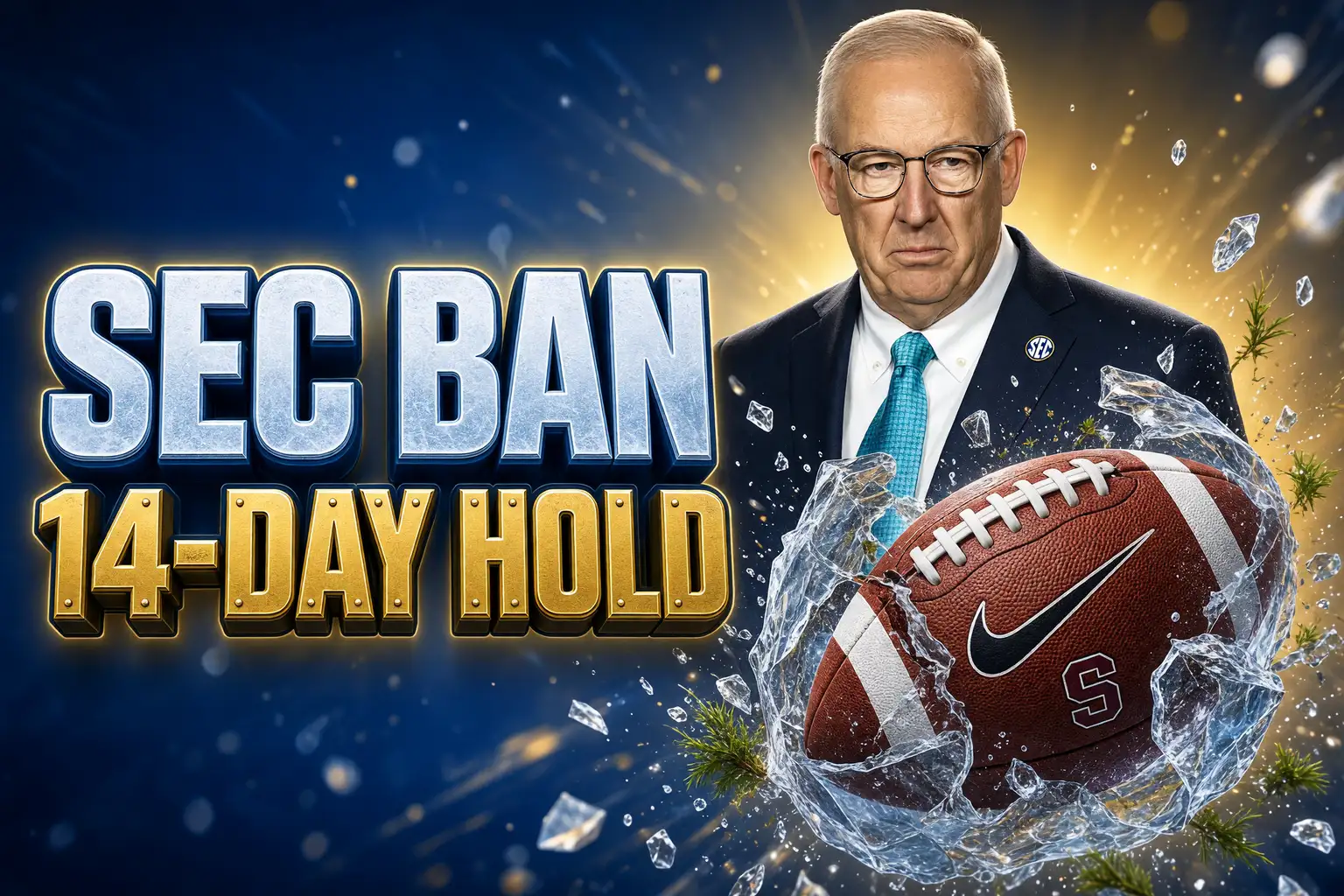
The Fine Is Half a Football Budget
The SEC’s Tuesday policy, posted after meetings of presidents, chancellors, and athletic directors in Birmingham, bars member schools from rostering anyone who declared for the NFL, NBA, or WNBA draft and did not withdraw as required, signed a contract in those leagues or the G League, or appeared on one of those rosters. Sankey was given authority to punish schools that do it anyway.
Following meetings with the Presidents, Chancellors, and Athletics Directors of the Southeastern Conference, the SEC will enforce the following policy: pic.twitter.com/LohWnb7G1J
— Southeastern Conference (@SEC) August 25, 2026
Wednesday’s penalty vote filled in the numbers. A coach who puts a covered player on the roster is suspended for half the season. The school is fined 50 percent of that sport’s operating budget for the fiscal year and loses its vote on conference business. The vote was 15-0. LSU sat out.
HOW THE POWER CONFERENCES DREW THE LINE
| Conference | Sports named | What is barred | Stated penalty |
|---|---|---|---|
| SEC | Football, men’s and women’s basketball | Draft without a proper withdraw, pro contract, or pro roster | Half-season coach ban, 50% of that sport’s budget, loss of league votes |
| Big Ten | Football first | Pro contract, pro roster, or underclassman draft without a withdraw | Half-season coach ban, fine not specified |
| ACC | Football, men’s and women’s basketball | Same three triggers as the SEC | Not stated in Thursday’s resolution |
The Big Ten moved first on Tuesday and stayed with football. The SEC added basketball the same afternoon. The ACC became the last of the four power leagues to pass a version on Thursday, hours before the Mountain West, a Group of Six league, adopted its own ban.
N.C. State football coach Dave Doeren put the coaches’ case in one line after Thursday’s practice, before the ACC voted. “Just to me, that’s kind of a cutoff, when a guy goes pro,” he said. “And we say ‘Goodbye, good luck,’ and we move on. And there shouldn’t be the ability to come back. If it’s the Big Ten, SEC, it doesn’t matter to me: it’s an amateurism rule.”
Rick Karcher, faculty athletics representative at Eastern Michigan and a former sports lawyer, had argued before Hoffman ruled that conferences can write their own rules if they are not colluding. He also said an injunction still does not require any school to play anyone, and that he doubted campuses would break their own league’s code. The Dallas order tests that second point. It bars the SEC from punishing a school or coach for which these plaintiffs “choose to compete during the 2026-2027 season.”
LSU Sat Out the Penalty Vote
LSU is the campus the rule was written to stop. On Tuesday, president Wade Rousse and athletic director Verge Ausberry voted with the other 15 schools to enforce the ban. On Wednesday, Rousse abstained from the penalty vote. Coach Lane Kiffin had already been recruiting players a Louisiana court had put back in the extra-year pool, including men he coached last season at Ole Miss.
The conference rule does not stop those players from practicing. It stops them from landing on the 105-man roster LSU must file on Friday, Sept. 4, the day before a scheduled opener against Clemson. Kiffin has said he is in daily contact with the SEC and that he would follow the league’s rules if a court order is reversed.
THE NAMES BATON ROUGE IS WEIGHING
- Dae’Quan Wright: Tight end from Ole Miss, undrafted by Philadelphia, waived Aug. 10, claimed by Cleveland, waived Aug. 24 without an exhibition snap, then cleared waivers and began practicing at LSU.
- Zxavian Harris: Defensive tackle from Ole Miss, signed with New Orleans in May, placed on the non-football injury list at the start of camp, waived Aug. 8 and unclaimed.
- Junior Tuihalamaka: Former Notre Dame defensive end who committed to LSU under a Louisiana order and never signed an NFL contract, so the SEC’s pro-contract ban did not reach him.
- Jack Pyburn: Linebacker who played at LSU in 2025, was waived by Tampa Bay, then claimed by Kansas City, which complicates any return to Baton Rouge.
Kiffin’s public line is that injunctions mean these players will suit up somewhere, so LSU might as well recruit them. “At the end of the day, through these injunctions, they’re going to play for you or play somewhere else around the country,” he said before the SEC vote. “So we made the decision to recruit them, like most people probably are.”
The sequence on campus was not a player revolt that the staff then followed. LSU had already been in contact with NFL players and their representatives about lawsuits and a path back to school. On Monday he said he had “struggled” with keeping that pursuit going against the league, then said listening to current players made him “feel a little better.” That quote arrived after the outreach, which is why it reads as cover for a staff-driven roster raid.
Men’s basketball coach Will Wade has been in the same current, recruiting former St. John’s forward RJ Luis Jr., who signed professional contracts and appeared in NBA preseason games. Louisiana Gov. Jeff Landry sided with the campus against Birmingham. “This whole thing is ridiculous. Don’t hate the player, hate the game,” Landry said, adding that the SEC was “creating a legal mess over athletes it told were out of eligibility, only to change the rules afterward.”
College Now Costs the Whole NFL Season
A day after the SEC and Big Ten votes, NFL executive vice president Troy Vincent restated league policy at meetings in Atlanta. Players who leave an NFL roster to return to college are ineligible to play in 2026. Vincent said they would become free agents for 2027 instead. They do not go back into a future draft. A club that signs such a player can lose draft picks, and the memo warns staff against any side deal about a return after the college season.
That is the other door on the same hallway. Hoffman can restore a college year. He cannot restore an NFL snap in 2026. For Hudson, who was not expected to make Dallas’s 53-man cut and had a practice-squad path if he stayed, the choice is a fifth college season with NIL money against a year on the NFL’s outside. Wright and Harris already used up four college seasons, entered the draft, and are now betting the extra campus year is worth burning this NFL season.
Cal general manager Ron Rivera, a former NFL player and coach, wanted the ACC to join the wall. “I think when somebody makes a decision, goes in a certain direction, I think they’ve made their decision,” Rivera said. “I’m disappointed that people are looking for ways to cheat the system or beat the system.”
Why the Class of 2022 Was Cut Out
The NCAA’s Division I Cabinet approved a new age-based eligibility model on June 23. Athletes who enroll no later than the academic year after their 19th birthday generally get a continuous five-year window. Redshirts, seasons-of-competition counts, and most hardship waivers go away. The association’s own transition chart is blunt about the group now in court: student-athletes who used their final season under the old rules in 2025-26 get no additional eligibility.
That cutoff is the entire lawsuit. Hudson and the others started college in 2022-23, played four seasons, and were told the new five-year clock was not retroactive. The NCAA’s stated fear, later cited in the Colorado class litigation, was that applying the model to that class would destabilize college sports and create “roster chaos.” U.S. District Judge Charlotte Sweeney in Denver still certified a nationwide class and issued an injunction. The 10th Circuit then stayed that order. Texas and Louisiana are not bound by that circuit, which is how Hoffman and a Baton Rouge judge could reach the opposite result on the same facts.
THE TWO-MONTH CLOCK
- June 23, 2026: The Division I Cabinet approves the age-based model and excludes athletes who finished their fourth season in 2025-26.
- July 31, 2026: Judge Sweeney in Denver certifies the Class of 2022 and enjoins the NCAA, a ruling later stayed on appeal.
- Aug. 25, 2026: The Big Ten and the SEC pass conference bans on former pros; Sankey gets enforcement power.
- Aug. 26, 2026: SEC presidents approve the half-season and 50 percent penalties, 15-0 with LSU abstaining; Vincent closes the 2026 NFL door.
- Aug. 27, 2026: Hoffman signs the Dallas order; the ACC and then the Mountain West pass matching bans.
- Aug. 28, 2026: A Louisiana judge adds the SEC and Sankey to an existing restraining order covering players already in NFL camps.
The docket is no longer one case. A running log of college athlete eligibility cases now sits beside Pavia’s junior-college clock fight, putative class actions such as Campbell v. NCAA, and the NCAA’s bid to park the scatter of suits in a single federal court. McCann’s reading of NCAA v. Alston is that Justice Neil Gorsuch left conferences room to write their own rules even as he stripped the NCAA of a special antitrust shield. That is the bet Birmingham made last week. Hoffman just made it more expensive.
One Week in the Portal Does Not Fill a Roster
Hoffman’s portal week is a recruiting window, not a job. Hudson or Bissainthe can enter and wait for a call. A school still has to take them, and every power conference now has a written ban and a coach-suspension clause waiting if the school is not covered by an order. Karcher’s warning still holds for anyone outside these captions: the court can restore eligibility and still leave a player without a locker.
Younger players already on those rosters are the quiet party. A 22- or 23-year-old who just left an NFL camp does not add a scholarship so much as he takes snaps from a freshman who enrolled on a different promise. Hoffman’s order is silent on that trade. So are the conference bans. The only roster math in writing is LSU’s 105 and the Friday deadline.
Other campuses are already in the same current. Texas has had Cole Hutson, a player with NFL minicamp time and a state injunction, at practice. Kentucky has been linked to Mark Mitchell, who played in an NBA summer league. Two LSU soccer players already appeared against Arizona under the Louisiana order. Kiffin is the loudest, not the only one.
Thursday in Baton Rouge, Then Sept. 11 in Dallas
As of Wednesday, Sept. 2, Hoffman’s order is still in force. The next argument that can put a former pro on a Saturday depth chart is Thursday morning in Baton Rouge, where the SEC has said it will appear. The conference called the Louisiana order “a temporary restraining order, not a final ruling on the merits,” and said Sankey is “prepared to contest the allegations” and to “defend the SEC’s rights as a voluntary association to fulfill its mission to its member institutions.”
WHAT WE KNOW
- Dallas hold: The 41 named athletes cannot be blocked by the NCAA or the SEC on the four-season cutoff, portal timing, or pro-roster time through Sept. 10.
- LSU vote: The school backed the ban on Tuesday and abstained from the penalty vote on Wednesday.
- NFL cost: A player who returns to college cannot sign with an NFL club again in 2026 and does not reenter a future draft.
- Practice versus roster: SEC rules as written do not bar practice; they bar a name on the Friday 105-man list.
WHAT IS UNCONFIRMED
- Friday’s list: Whether Wright, Harris, or anyone else from the Louisiana docket actually appears on LSU’s 105-man roster.
- The injunction: Whether Thursday’s Baton Rouge hearing, or the Sept. 11 Dallas hearing, extends relief past the 14-day window.
- League discipline: Whether other power conferences’ bans are pulled into these captions, and how far SEC officials will press penalties if a school rosters a covered player.
Hoffman’s order runs through Sept. 10. LSU’s roster is due the morning after Thursday’s hearing in Baton Rouge, and Dallas is back on the calendar on Sept. 11. The extra year is in the paperwork. A helmet on Saturday is still a school’s to give, and an NFL job this fall is already gone.

Netflix Turned the GTA 6 Look Into a Film Chart

Glacier Collapse Buried Nepal’s Hydropower Workers in Tunnels

Trump’s Venezuela Oil Deal Leaves the Barrels in the Ground

Germany Can Miss Its 2026 Climate Cap Without Penalty

CISA’s Known Exploits Still Come From 2007-Era Bugs
Glacier Collapse Buried Nepal’s Hydropower Workers in Tunnels

Congo’s Bundibugyo Outbreak Outruns the Licensed Ebola Shots
Germany Can Miss Its 2026 Climate Cap Without Penalty

The Ninth Circuit Splits Kalshi’s Sports Map in Two
CISA’s Known Exploits Still Come From 2007-Era Bugs
-
 NEWS1 week ago
Glacier Collapse Buried Nepal’s Hydropower Workers in Tunnels
-
 NEWS1 week ago
Congo’s Bundibugyo Outbreak Outruns the Licensed Ebola Shots
-
 NEWS1 week ago
Germany Can Miss Its 2026 Climate Cap Without Penalty
-
 BUSINESS1 week ago
The Ninth Circuit Splits Kalshi’s Sports Map in Two
-
 NEWS1 week ago
CISA’s Known Exploits Still Come From 2007-Era Bugs
-

 NEWS2 weeks ago
A Cow Rumen Enzyme Dissolves Superbug Biofilms on Gauze
-
 BUSINESS1 week ago
Trump’s Venezuela Oil Deal Leaves the Barrels in the Ground
-
 NEWS1 week ago
Marvin Bracy-Williams Faces DUI After a Career-Ending Ban