
BUSINESS
Lockheed Bets $7 Billion on a 10-Year F-35 Floor
The Pentagon and Lockheed set an 850-jet F-35 floor for 10 years, with $7 billion of Lockheed cash, but Congress and Lot 20 still sit in the way.

The Pentagon and Lockheed Martin set a 10-year floor of 850 F-35 jets on Oct. 22, with Lockheed putting up $7 billion of its own cash. The paper is a planning deal, not a signed buy, and it still needs a vote in Congress before anyone can lock prices or delivery dates.
That is a wager on a fifth-generation fighter remaining the mass jet of the U.S. force while Boeing builds the next ones. Lockheed lost both of those sixth-generation contests. It is now paying to keep the Fort Worth line full.
We signed a new agreement with the DOW to build a multiyear contract for the F-35, designed to reinforce our longstanding partnership and save billions in taxpayer dollars. pic.twitter.com/cK1Sdo2PjY
— Lockheed Martin (@LockheedMartin) October 22, 2026
The 850-Jet Floor Is an 85-a-Year Plan
The Department of War, the Pentagon’s current name, said the framework creates a stable buy signal for the F-35 Lightning II and guarantees a minimum floor of 850 U.S. aircraft over 10 years. Those jets sit in production Lots 21 through 30. They come with first spare parts, 10 years of modification kits, and upkeep for the global fleet.
Divide 850 by 10 and the U.S. rate is 85 jets a year. That matches the Pentagon’s fiscal 2027 request of 85 F-35s across the Air Force, Navy, and Marine Corps, a mix of 38 F-35As, 37 F-35Cs, and 10 F-35Bs. In fiscal 2026, Congress funded 47. The new floor is the request stretched across a decade, not a surprise surge past the factory’s current pace.
THE U.S. BUY RATE AGAINST THE FACTORY LINE
| Period | U.S. F-35s | What that number is |
|---|---|---|
| Fiscal 2026 funded | 47 | The last completed yearly buy |
| Fiscal 2027 requested | 85 | 38 A, 37 C, and 10 B models |
| Framework average | 85 a year | 850 U.S. jets over 10 years |
| Factory target | 156 a year | U.S. jets plus foreign orders |
Lockheed said it will hold a production rate of 156 aircraft per year for U.S. and international customers. Ten years at that rate would be 1,560 jets if the line holds. The U.S. floor of 850 would leave about 710 tails for partners and foreign sales. The 156 figure is the current rate, not a new higher one. Unlike the Pentagon’s recent munitions frameworks, this deal does not raise output.
The United States still plans to buy 2,456 F-35s for the three services. Lockheed says more than 1,375 jets are already flying, the fleet has passed 1 million flight hours, and the type operates from 42 bases, including 13 nations on home soil. Twenty allied countries have chosen the jet. The 850-jet floor is the U.S. slice of the next 10 lots, not the whole remaining program.
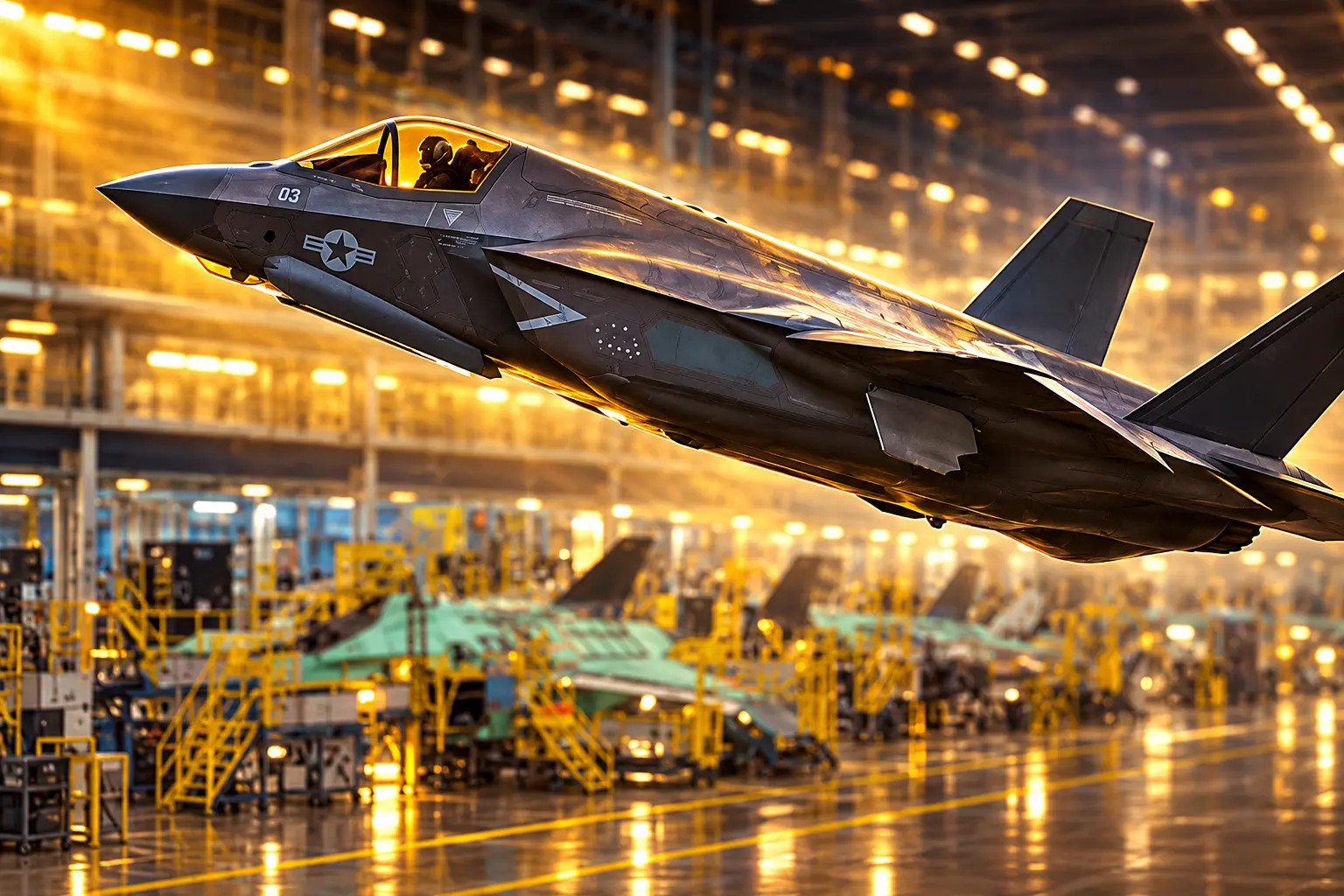
Lockheed Is Paying $7 Billion to Keep the Line Full
In exchange for that decade of demand, Lockheed will self-fund at least $7 billion in work that supports the F-35, the Pentagon said. The release does not list the projects. Under Secretary of War Michael P. Duffey, the department’s acquisition chief, tied the cash to a wider shift toward long-term buys and private money in the industrial base.
We have fundamentally changed how we stabilize the American defense industrial base to produce at speed and scale. This agreement with Lockheed Martin proves it. By aligning financial incentives with actual performance, we are ensuring our warfighters are equipped with the lethal capabilities they need to fight and win.
Michael P. Duffey, Under Secretary of War, Department of War statement, Oct. 22, 2026
Chairman, President and CEO Jim Taiclet said the extra certainty lets Lockheed spend now on capacity, efficiency, and suppliers. On the company’s earnings call the same morning, he said suppliers could hire and fix software with less fear of a later price cut, and that F-35 parts would be pooled between the production line and the repair network. Companies that hit performance marks would get a fixed-price escalation model that lets them keep more profit.
The timing is not a coincidence. Boeing holds the Air Force F-47, with a first-flight target of 2028, and the Navy’s F/A-XX carrier fighter, a development award of more than $20 billion. Lockheed was dropped from both races. Taiclet has said the F-35 can take on some sixth-generation work at a lower cost if the production and test base is stable. The $7 billion is the chip Lockheed puts on that claim.
The company also used Oct. 22 to raise its 2026 sales outlook to about $80 billion to $82 billion after a third quarter of $20.7 billion in sales, up 11% from $18.6 billion a year earlier. Net earnings were $1.8 billion, or $7.97 a share, against $1.6 billion, or $6.95. Backlog hit a record $292.0 billion. Aeronautics sales were $8.214 billion in the quarter, with F-35 volume up $710 million. The fighter is still the cash engine. The framework is how Lockheed tries to keep it that way through Lots 21 through 30.
What the Framework Covers, and What It Does Not
Lockheed is careful with the language. If Congress grants multiyear authority and the money that goes with it in the coming months, the F-35 Joint Program Office and the company will then set terms, prices, and schedules in a formal award. Until that vote, the Oct. 22 paper is a map, not an order. Neither side published a total price or a savings figure, even as both said long-term buys and volume discounts should save billions over the jet’s life.
INSIDE THE 10-YEAR FRAMEWORK
- U.S. jets: A floor of 850 aircraft in Lots 21 through 30, with first spare parts in the same plan.
- The factory line: A held rate of 156 jets a year that folds in partner and foreign sales, not 156 U.S. jets.
- Kits and upkeep: Ten years of modification kits plus sustainment for the global fleet, items that used to be bought on separate tickets.
- Lockheed cash: At least $7 billion of company money into program work the Pentagon has not itemized.
- Jobs claim: Lockheed says the program will support 317,000 U.S. jobs and about $79 billion a year in economic activity over the decade.
- Still open: Unit prices, the mix of A, B, and C models, Lot 20, and a binding contract.
A Lockheed spokesperson said the Joint Program Office keeps ownership of production slots for every customer and that the deal does not change how those slots are shared. Foreign buyers, the company argues, should see lower costs if U.S. volume is locked. That is a promise with no published discount attached.
Lots 18 and 19 Already Show the Cost of Annual Deals
Until now the F-35 has been bought lot by lot, and those talks often ran past a year. The most recent completed package, Lots 18 and 19, was finished on Sept. 29, 2025, after a handshake the previous December. It covers 296 jets for U.S. forces, partners, and foreign military sales, and it is worth about $24.3 billion. Long-lead money for parts on Lot 20 and Lot 21 has already been awarded. Lot 21 is the first lot inside the new 10-year map. Lot 20 is not.
FROM ANNUAL LOTS TO A DECADE PLAN
- Sept. 29, 2025: Lots 18 and 19 are signed for 296 jets worth about $24.3 billion, after talks that began with a handshake in December 2024.
- Fiscal 2026: Congress funds 47 F-35s, a low mark against the 85-jet request that follows.
- Late September 2026: The Congressional Budget Office estimates the department plans to buy 425 F-35s from fiscal 2027 through 2031, or about 85 a year.
- Oct. 16, 2026: An Air Force force-structure report to Congress calls for 1,509 combat-coded fighters by 2035, with F-35As about 40% of that fleet.
- Oct. 22, 2026: The Pentagon and Lockheed unveil the 10-year framework and Lockheed reports third-quarter results the same morning.
A 10-year planning horizon lets suppliers sign longer contracts for metal, electronics, and engines, and hire before the next lot fight. That is the industrial case. The political case is harder, because a floor of 85 U.S. jets a year is easier to defend in plant states than a 47-jet year, and harder to cut once the tooling and hiring are in place.
Congress Still Holds the Kill Switch
Federal law already says a multiyear buy of more than $500 million needs specific language in both an authorization act and an appropriations act. The Senate Armed Services Committee’s fiscal 2027 defense policy bill includes authority for multiyear F-35 contracts. The House version has a similar grant with extra tests. It would wait for the defense secretary to certify that each jet comes with a full set of first spare parts and alternate mission gear, and that the contract saves at least 5%. Neither chamber’s text clearly covers a multiyear sustainment deal, which is a large piece of what Lockheed and the Pentagon sketched on Oct. 22.
That gap has history. The program once chased a five-year performance-based logistics contract and could not show Congress the required cut in cost or the required rise in readiness, so the talks stalled. A decade of modification kits and fleet upkeep will hit the same proof problem unless the two sides put numbers on the table that the Oct. 22 releases omitted.
WHAT WE KNOW
- The paper: A 10-year framework for 850 U.S. F-35s, spares, kits, upkeep, and foreign orders at 156 jets a year.
- The cash: Lockheed has pledged at least $7 billion of its own money; the Pentagon has not listed the projects.
- The next gate: Multiyear authority and funding must pass Congress before prices and dates are set.
WHAT IS UNCONFIRMED
- A total price: Neither side published a contract value or a scored savings figure.
- The variant split: How many A, B, and C models sit inside the 850 is not in the releases.
- Sustainment authority: House and Senate drafts do not clearly bless a 10-year repair deal.
An Air Force report sent to Congress on Oct. 16 said the service needs 1,509 combat-coded fighters by 2035, with F-35As about 40% of that mix, beside F-15EXs, remaining F-22s, and the F-47. The 850-jet floor is how the F-35 stays the bulk fighter in that chart. It is also how a jet that already flies from 42 bases keeps eating budget share while the sixth-generation aircraft are still on the drawing board.
Deliveries This Year Are Already Behind the Cadence
The 156-a-year target sits on a line that had a record year in 2025, when Lockheed delivered 191 F-35s. The 2026 pace is slower. Company figures issued with the third-quarter results show 43 deliveries in the quarter and 94 in the first nine months, down from 143 in the same stretch of 2025. That is the immediate test of a decade plan: the factory is being asked to hold 156 a year after a nine-month stretch that is not on that path.
LOCKHEED’S 2026 DELIVERY PACE
- Third quarter: 43 F-35s handed over, against 46 a year earlier.
- Nine months: 94 jets, against 143 in the first nine months of 2025.
- Last full year: 191 deliveries in 2025, the program’s record.
- The target: 156 a year for U.S. and foreign customers if the framework holds.
The nearer contract problem is Lot 20, which sits outside the 10-year map. Lockheed said it is still in talks with the U.S. government on production contracts for lots 20 and higher. During the third quarter, costs on the Lot 20 advance acquisition contract began to exceed the authorization and funding then in place. Without more money, the company warned, results and cash flow will take a hit. Executives said a Lot 20 agreement is not expected until next year. A 10-year floor that starts at Lot 21 does not pay the bill that is already past its advance funds.
Spare Parts and Repair Speed Are the Real Wager
OJ Sanchez, president of Lockheed Martin Aeronautics, put the industrial case in readiness language. Predictable orders, he said, let suppliers invest, and that should raise mission-capable rates. The company already points to money it has put into the global spares pool. The framework, in its telling, adds factory and logistics capacity on top of that.
Our new multiyear framework gives suppliers stability to plan for the future and invest with confidence, improving readiness across the F-35 fleet. This, in addition to the investments Lockheed Martin is making to the global spares pool, will directly translate into higher mission capable rates and a more resilient supply chain.
OJ Sanchez, president, Lockheed Martin Aeronautics, company release, Oct. 22, 2026
Readiness is the part of the F-35 story that has never matched the production story. A 2025 Congressional Budget Office study found that as the jets aged, F-35 availability has lagged other fighters of the same age, even after operating costs per hour leveled off. Watchdog work has pointed to depot bottlenecks, spare-part shortages, and limits on what military maintainers can see in the jet’s technical data. Folding spares and modification kits into the same long plan as new tails is the Pentagon’s attempt to buy its way out of that gap. The $7 billion is supposed to help. The releases still do not say how.
The Pentagon is placing more than one bet at once. Collaborative combat aircraft are in production, with at least 150 of the first increment due by the end of the decade at a cost goal of under $30 million a tail, about one-third the price of an F-35. Small one-way attack drones are being ordered in the tens of thousands. The F-35 floor is the crewed, stealthy mass of the force. The cheaper aircraft are the expandable mass. A 10-year F-35 map does not settle which mix Congress will actually fund when the F-47 is flying and the first drone wingmen are on the ramp.
Lockheed’s own post called the paper a way to build a multiyear contract and save billions. The savings are the claim that still has no score. The 850-jet floor is the claim that has a number, and it is the same 85-a-year rate the Pentagon already put in its fiscal 2027 request. What changed on Oct. 22 is the $7 billion of Lockheed cash and the attempt to stop fighting the F-35 one lot at a time. Lot 20 is already over its advance funds, and the House wants a 5% savings test before it blesses the rest. The decade starts only after those two bills are paid.

Nintendo Pulls SmileBASIC After the First Switch 2 Jailbreak

Arkane Lyon’s Union Holds the Clock Microsoft Cannot Skip

Airbnb Bans Guest Chores as Homes Turn Into Hotels

Riyadh Downs a Houthi Missile After Weeks of Capital Strikes

Ariana Madix’s Empty Los Angeles House Fits a Bravo Pattern

AI Server Boards Put Everyday Circuit Materials on Allocation

Glacier Collapse Buried Nepal’s Hydropower Workers in Tunnels

Congo’s Bundibugyo Outbreak Outruns the Licensed Ebola Shots

Pennsylvania Measles Deaths Follow a Long Slide in Coverage

Germany Can Miss Its 2026 Climate Cap Without Penalty
-
 NEWS2 months ago
AI Server Boards Put Everyday Circuit Materials on Allocation
-
 NEWS2 months ago
Glacier Collapse Buried Nepal’s Hydropower Workers in Tunnels
-
 NEWS2 months ago
Congo’s Bundibugyo Outbreak Outruns the Licensed Ebola Shots
-
 NEWS2 months ago
Pennsylvania Measles Deaths Follow a Long Slide in Coverage
-
 NEWS2 months ago
Germany Can Miss Its 2026 Climate Cap Without Penalty
-

 NEWS2 months ago
Texas Judge Freezes the SEC Eligibility Ban for 41 Athletes
-

 NEWS2 months ago
CISA’s Known Exploits Still Come From 2007-Era Bugs
-

 BUSINESS2 months ago
Trump’s Venezuela Oil Deal Leaves the Barrels in the Ground