
NEWS
Kitchen Swaps Miss the Nanoplastics Already Inside Radishes
Plymouth radishes stored nanoplastics in edible flesh after a root rinse, so glass boxes and bamboo boards do not close the farm pathway into vegetables.

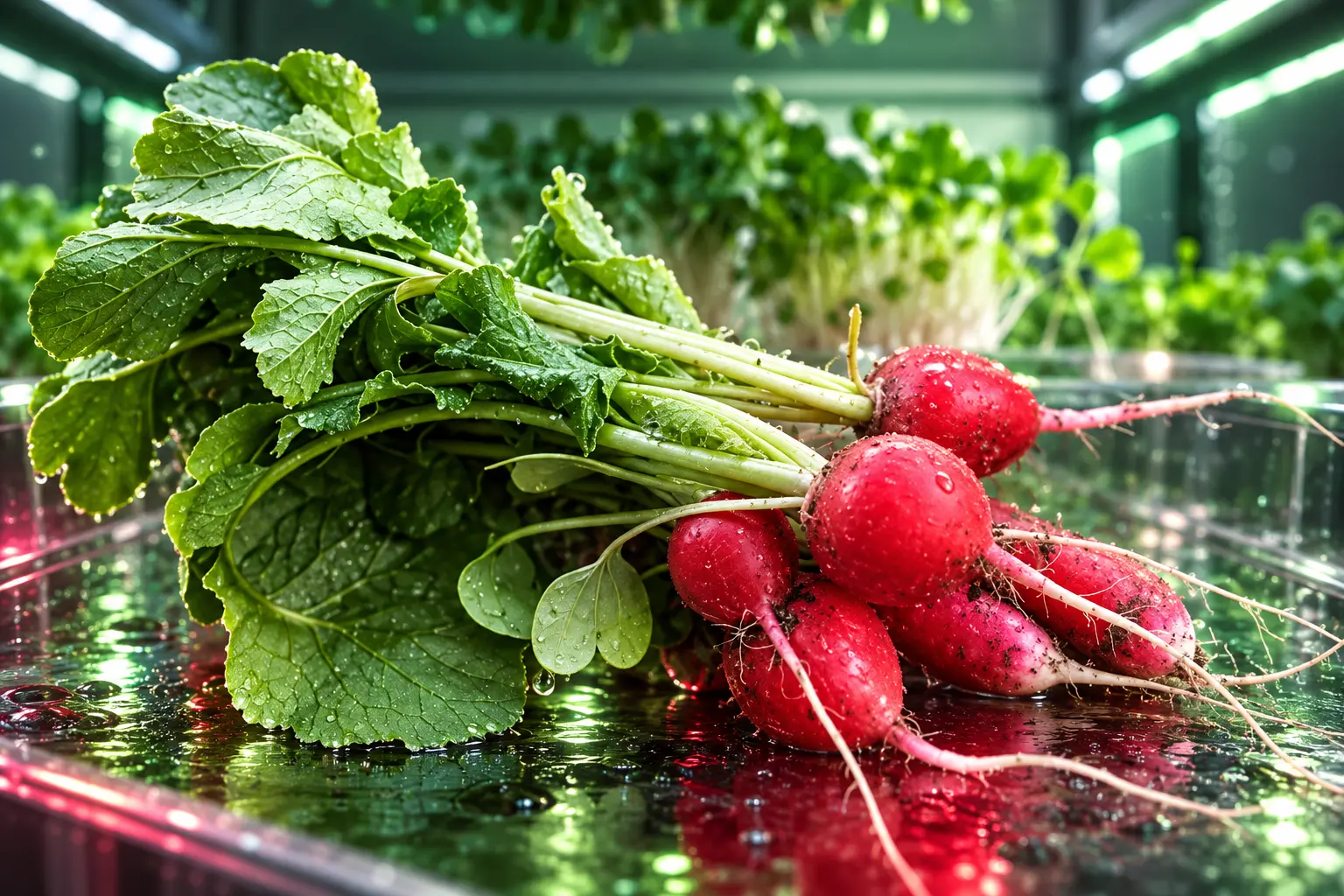
A University of Plymouth team traced 4.4 percent of labelled polystyrene nanoplastics from a five-day hydroponic bath into radish tissue, and 1.1 percent of that original dose sat in the edible flesh. The feeder roots had already been rinsed. Glass tubs, mesh bags and bamboo boards do not reach particles that have crossed into the crop.
The finding, posted 23 August 2025 in Environmental Research, is being sold as a reason to restock the kitchen. It is a reason to look at irrigation water, sewage sludge and farm plastic first.
Radish Roots Let Nanoplastics Past the Filter
Lead author Nathaniel Clark, a lecturer in physiology, grew radishes so that only the thin, non-fleshy roots touched a solution of carbon-14 labelled polystyrene particles. Shoots and the round red bulb never sat in the bath. After five days the team freeze-dried the tissues and counted radioactivity, a method that can follow particles too small for ordinary lab imaging.
The particles had a mean diameter of 138 nanometres and spanned 10 to 500 nanometres. The smallest end matches the press description of one millionth of a centimetre. Plants keep a waxy band in the root, the Casparian strip, that is supposed to block much of what the soil water carries. Clark’s group showed nanoplastics can enter radish roots and move past that band into flesh and leaves.
This is the first time a study has demonstrated nanoplastic particles could get beyond that barrier, with the potential for them to accumulate within plants and be passed on to anything that consumes them. There is no reason to believe this is unique to this vegetable, with the clear possibility that nanoplastics are being absorbed into various types of produce being grown all over the world.
Nathaniel Clark, lecturer in physiology, University of Plymouth
Five plants carried the dose. Across the whole radish, 4.4 percent of the labelled particles added to the water were recovered in tissue. Most of that load stayed in the feeder roots. A quarter of the plant’s burden, 25.5 percent, was in the part people eat. Shoots held 9.6 percent.
WHERE THE PARTICLES SAT IN THE RADISH
| Tissue | Share of plastic in the plant | Share of the original dose |
|---|---|---|
| Non-fleshy feeder roots | 64.9% | 2.9% |
| Edible fleshy root | 25.5% | 1.1% |
| Shoots and leaves | 9.6% | 0.4% |
| Whole plant | 100% | 4.4% |
Concentration followed the same gradient. Feeder roots held 216 kBq per gram, about 23 times the fleshy root and 63 times the shoots. Because only the thin roots met the particles, any signal in the bulb or the leaves had to travel through the plant. The paper notes that hydroponics will not copy every soil, given pH and organic matter change how particles move, and that nanoplastic levels in real fields are still poorly measured.
Does Washing Vegetables Remove Nanoplastics?
No, not the ones already inside the flesh. Clark’s group rinsed the feeder roots in clean medium specifically to strip particles stuck on the surface, a wash they had already validated on these nanoplastics. The edible bulb still held 1.1 percent of the starting dose. A salad spinner can throw off grit and surface film. It cannot empty a root that has taken particles into its tissue.
Even the easier job, clearing plastic that is only sitting on a leaf, is incomplete under a tap. A 2023 lettuce test found that rinsing with water alone left particles on the leaf. Ultrasonic cleaning lifted about four times as many. A detergent wash raised efficiency 6.9 times, and 100-nanometre particles clung harder than 500-nanometre ones. Those were surface grains on a leaf, not particles locked in a radish bulb.
Reusable mesh bags and a steel colander still cut a different load, the fragments that cling to wet produce in a plastic aisle bag. That is prep hygiene. It is not a reply to a root-uptake study.
Apples Carried the Highest Shop Counts
The Plymouth test showed a path. Shop food had already been counted. In 2020 Gea Oliveri Conti and Margherita Ferrante at the University of Catania, working with Mohamed Banni in Sousse, Tunisia, ran SEM-EDX on particles smaller than 10 micrometres in 36 fruit and vegetable samples. Fruit carried a median 223,000 particles per gram. Vegetables carried 97,800 per gram. Apples sat at the top of the fruit list. Carrots led the vegetables. Lettuce was the lowest vegetable in the set, at 52,050 per gram.
CATANIA 2020 SHOP COUNTS
| Food group | Median particles per gram | Interquartile range |
|---|---|---|
| Fruit | 223,000 | 52,600 to 307,750 |
| Vegetables | 97,800 | 72,175 to 130,500 |
| Lettuce | 52,050 | 26,375 to 75,425 |
Particle size in that set ran from 1.51 micrometres in carrot to 2.52 micrometres in lettuce, far larger than Plymouth’s 138-nanometre mean, so the two papers are not counting the same objects. The Catania figures are also high next to later food surveys, and they come from one patented method. A 2026 comparison of 193 food papers still put fruit and vegetables, with grains, at the top of estimated daily intake, because people eat far more of them than fish even when the biggest published counts are treated as outliers.
Other lab work has now put nanoplastics in more than radish bulbs. A 2024 Plant, Cell & Environment study reported fluorescent PMMA and polystyrene particles, 100 to 500 nanometres, moving into pak choi, tomato, radish and asparagus, including tomato fruit grown in soil. The Plymouth radiolabel is the cleanest proof that the edible flesh is not just dirty on the outside.
Most British Sludge Still Goes on Fields
If the particles are in the plant before the knife comes out, the dose starts in the growing medium. Agricultural soils take fragments from plastic mulch, greenhouse film, compost, irrigation and treated sewage sludge sold as biosolids. Fidra, the Scottish pollution charity, noted on 9 April 2025 that England, Scotland and Wales send 87 percent of sewage sludge to farmland. Heavy metals in that sludge are checked. Microplastics, PFAS and many drug residues are not.
A Swedish plant captured more than 99 percent of incoming microplastics in the sludge, which means a well-run works does not destroy the particles. It concentrates them for the field. In Lanarkshire plots that received sludge for four years, soil microplastic levels were still largely unchanged 22 years after the last spreading. The James Hutton Institute told Fidra that soil-health risk can appear after as few as two applications.
HOW PLASTIC REACHES A CROP
- Biosolids: Treated sludge carries fibres from clothes and fragments from homes and roads, then goes out as fertiliser.
- Mulch and film: Sheets laid to hold moisture crack into fragments that stay in the tilled layer.
- Irrigation: Treated wastewater and some groundwater already hold micro- and nanoplastics.
- Compost and manure: Packaging and other debris ride in with organic amendments.
Around 10 percent of microplastics released to soils are tied to farm work, and a 2016 estimate still cited by Fidra held that agricultural land can receive more plastic than the ocean. That is not moved by a $6 produce brush.
A Plastic Board Adds a Second Load
Kitchen plastic is a real source. It is a different source. In 2023 Hridoy Roy’s group at the University of Toronto, writing in Environmental Science & Technology, measured particles released by chopping on polyethylene boards and polypropylene boards. They estimated 14.5 to 71.9 million polyethylene particles per person per year, or 7.4 to 50.7 grams, and 79.4 million polypropylene particles, about 49.5 grams. Polypropylene shed more mass than polyethylene by 5 to 60 percent. Wooden boards threw off 4 to 22 times more microparticles than plastic in some tests, but those fragments are wood, not polymer.
A 72-hour check on mouse fibroblast cells found no clear drop in survival from the polyethylene or wood particles. That is not a human safety study. It is a reminder that a board swap cuts one input and leaves the field input untouched.
The European Food Safety Authority, in a 21 October 2025 review of food-contact materials, said it still had no sufficient basis to estimate micro- and nanoplastic exposure from packaging and tools in normal use. The release it could document was mostly mechanical, abrasion and friction, not plastic dissolving into food. A steel spinner with a plastic basket, or a plant-based board sold as a plastic lookalike, can change that mechanical load. Neither changes what the radish already stored.
Health Agencies Have Set No Limit
Clark and senior author Richard Thompson, who leads Plymouth’s International Marine Litter Research Unit, call the radish result an emerging food-safety issue and a pathway that sits beside seafood. Thompson has said the group has found plastic wherever it has looked. The paper itself asks for more work on other polymers, because the Casparian strip is hydrophobic and polystyrene may not stand in for every plastic in soil.
Food agencies have not turned that pathway into a legal limit.
WHERE EXPERTS DISAGREE
- Plymouth authors: Nanoplastics can cross a root filter, reach edible tissue in five days, and should be treated as a food-chain exposure that needs study.
- WHO, 2022: Data are not sufficient to say whether swallowed or inhaled micro- and nanoplastics cause a defined human disease, with methods still too uneven to compare.
- U.S. food regulators, 2024: Detected levels in food have not been shown to pose a health risk, a position that sits beside EFSA’s 2025 finding that food-contact release cannot yet be quantified.
FAO’s 2022 dietary exposure through food commodities review, by Esther Garrido Gamarro and Vittorio Costanzo, gathered counts in seafood, salt, water, sugar and produce and mapped the holes that still block a formal risk assessment. Later FAO work on the gut microbiome reached the same stall: too few studies, too little alignment on size and dose.
Public talk has drifted toward kitchen gear and, in 2026, toward a kimchi strain said to bind nanoplastics in mice. Those are after-the-fact moves. The Plymouth radishes took their dose from the water around the roots. The paper flags hydroponic growing in the Netherlands, the United Kingdom, the United States, Israel and Canada, so a water-only path is not a bench trick. The tap that is still open is the growing medium.
Frequently Asked Questions
Can You Wash Nanoplastics Out of Vegetables?
Particles already inside flesh stay there through a rinse. Plymouth’s feeder-root wash still left 1.1 percent of the dose in the edible bulb. On lettuce leaves, where plastic is only stuck to the surface, water alone also failed to clear it, and 100-nanometre grains were harder to shift than 500-nanometre ones, so a home tap is a weak tool even before the tissue question.
What Did the Plymouth Radish Study Measure?
Five radishes were held for five days with only non-fleshy roots in water dosed at 500 Bq per millilitre of carbon-14 polystyrene. Water activity fell 13 percent over the run, some of it onto glassware and some into the plants. Controls stayed below 1 Bq per sample. The work was received 13 June 2025, accepted 23 August 2025, and issued as article 122687 in volume 284.
Which Shop Produce Has Shown Plastic Particles?
Catania’s 36-item set included apples, pears, carrots, lettuce, broccoli and potatoes. The highest site median was 124,900 particles per gram from one fruiter; supermarket samples sat at 87,600 per gram. Adult estimated intake was 4.62×10⁵ particles a day from apples and 2.96×10⁴ from carrots; children’s apple figure was 1.41×10⁶. Those EDIs are specific to that SEM-EDX method and that diet sheet, not a global official intake.
Do Plastic Cutting Boards Add Microplastics to Food?
Yes, as a prep source separate from farm uptake. Polypropylene boards shed more particles than polyethylene by 14 to 71 percent in number. Yearly mass estimates were 7.4 to 50.7 grams from polyethylene and 49.5 grams from polypropylene, with chopping style, force and how fine the cut is all moving the total. Wood threw off more microparticles than plastic in some tests, so the swap is about polymer, not about a particle-free board.
Is Eating These Particles Proven to Harm Health?
No agency has set a tolerable daily intake for plastic particles in produce. WHO’s 2022 review stopped at a data gap. EFSA’s 21 October 2025 food-contact review said exposure from tools and packaging cannot yet be estimated. The Plymouth authors still flag possible harm and ask for crop-wide tests, which is a research claim, not a clinical finding in people who eat radishes.
Disclaimer: This article is news reporting and analysis of published laboratory studies and agency reviews. It is for information only and is not medical, dietary or food-safety advice. It does not tell anyone to stop eating vegetables, to buy a given kitchen tool, or to treat a health condition. Speak with a physician or a registered dietitian before changing what you eat or how you cook because of microplastic concerns. Particle counts, percentages and agency positions come from the papers and statements named above and will change as methods and reviews are updated.

Amazon’s Apple Prime Deals Mostly Undo the June Hikes

The Atlantic’s First Hurricane Is Aimed at Soaked Gulf Soil

Iran’s Hormuz Attacks Target the Route That Restored Crude

S&P 500 Clears 7,800 as AI Chips Outrun Yields

Russia’s No-Plague Finding Leaves a Siberian Death Unexplained

AI Server Boards Put Everyday Circuit Materials on Allocation

Glacier Collapse Buried Nepal’s Hydropower Workers in Tunnels

Congo’s Bundibugyo Outbreak Outruns the Licensed Ebola Shots

Pennsylvania Measles Deaths Follow a Long Slide in Coverage

Germany Can Miss Its 2026 Climate Cap Without Penalty
-
 NEWS2 months ago
AI Server Boards Put Everyday Circuit Materials on Allocation
-
 NEWS2 months ago
Glacier Collapse Buried Nepal’s Hydropower Workers in Tunnels
-
 NEWS2 months ago
Congo’s Bundibugyo Outbreak Outruns the Licensed Ebola Shots
-
 NEWS2 months ago
Pennsylvania Measles Deaths Follow a Long Slide in Coverage
-
 NEWS2 months ago
Germany Can Miss Its 2026 Climate Cap Without Penalty
-

 NEWS2 months ago
CISA’s Known Exploits Still Come From 2007-Era Bugs
-

 NEWS2 months ago
Texas Judge Freezes the SEC Eligibility Ban for 41 Athletes
-

 BUSINESS2 months ago
Trump’s Venezuela Oil Deal Leaves the Barrels in the Ground