
AUTO
The Third Row Decides Which Family SUV Works
Three-row family SUVs are sold as personality matches, yet cargo behind row three and 2026 crash awards decide who they serve.

A 2026 Honda Pilot at $45,990 including destination leaves 18.6 cubic feet behind the third row; a Honda Odyssey holds 32.8. That gap is the part most three-row SUV shortlists still skip.
The usual pitch matches a parent to a brand mood: buttons, dirt roads, hush, adventure, a plug, a hitch, a deal. The people who sit in the last row, and the bags that have to go somewhere once that row is up, are the ones who decide whether the truck works.
The Third Row Is the Real Customer
A three-row SUV is sold as a family tool and shopped as a self-portrait. Honda gets the parent who wants knobs. Subaru gets the parent who wants mud flaps. Cadillac gets the parent who wants a quiet electric waft. Land Rover gets the parent who wants height. Volvo gets the parent who wants a plug and a sprint. Infiniti gets the parent who wants a hitch. Volkswagen gets the parent who wants leather without a luxury badge.
Those are driver identities. They are not a packing plan. Families who try to put three or four child seats in a midsize three-row keep hitting the same wall: a high floor, hinged rear doors, a narrow center seat, and a third row that is legal for people but hostile to a rear-facing seat plus luggage. Sliding doors and a low step still settle that job, which is why a used Odyssey remains the boring answer when the kids are all in seats.
The Insurance Institute for Highway Safety changed the other half of that argument in 2026. Its awards list includes no minivan. The plus-tier rules now put a dummy in the back and ask how that passenger is protected. The cargo math did not move. The trophy did.
How Much Cargo Survives a Full Cabin?
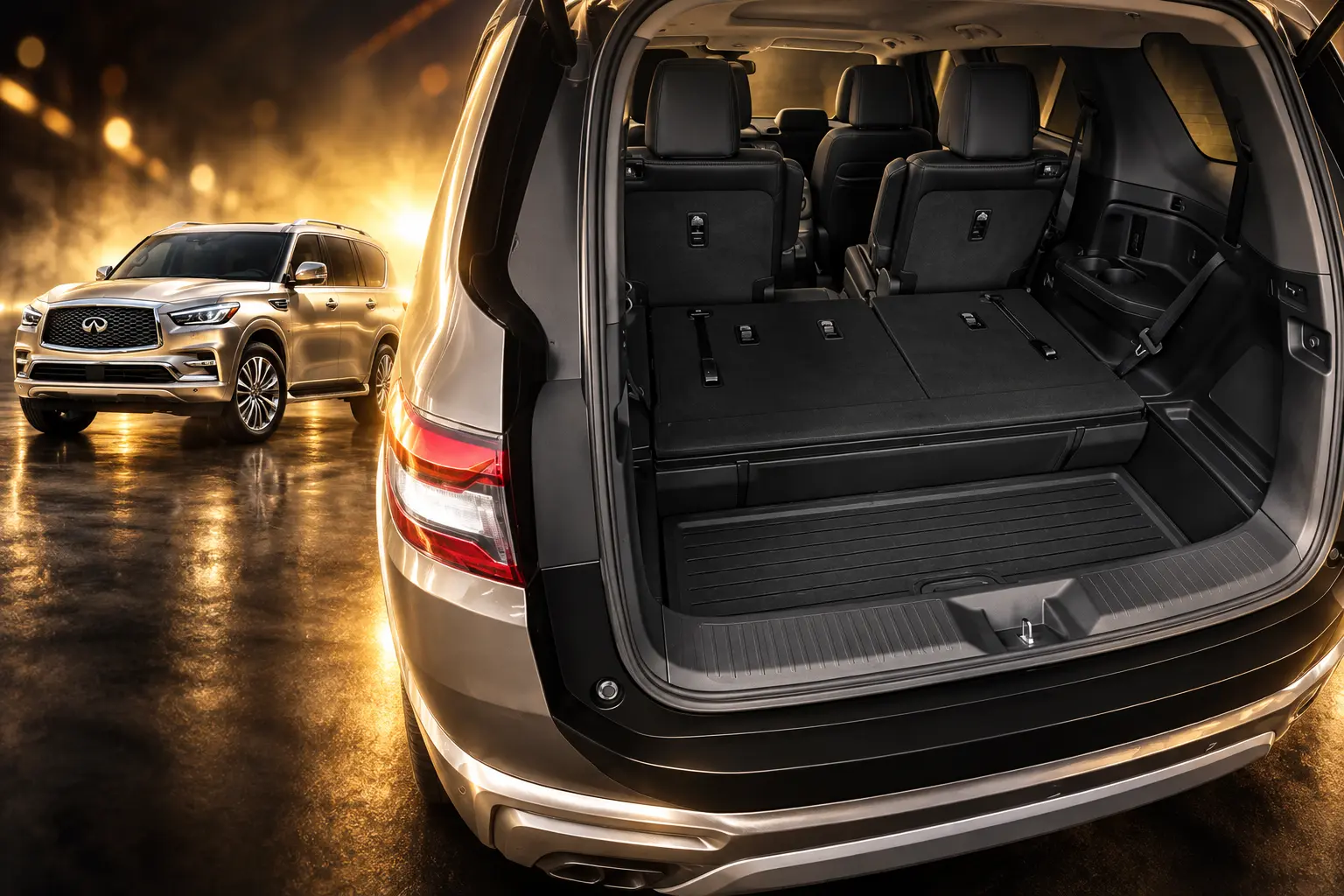
Maker ratings are the only set that can be lined up across brands, and they are kind to the brochure. They still show a cliff. Honda publishes 18.6 cubic feet behind the third row on the Pilot, with several trims reaching 22.4. That is the honest family number, because it is the space left when nobody has been asked to fold a seat.
CARGO WITH ALL SEATS IN USE
| Vehicle | Behind third row | 2026 IIHS award | |
|---|---|---|---|
| Honda Odyssey (minivan benchmark) | 32.8 cu ft | Not listed | |
| Volkswagen Atlas | 20.6 cu ft | Top Safety Pick | |
| Infiniti QX80 | 20.4 cu ft | Top Safety Pick | |
| Honda Pilot | 18.6 cu ft | Not listed | |
| Subaru Ascent | 17.6 cu ft | Top Safety Pick+ | |
| Cadillac Vistiq | 15.2 cu ft | Not listed | |
| Volvo XC90 | 13 cu ft | Top Safety Pick | |
| Land Rover Discovery | 9.1 cu ft | Not listed |
A Toyota Sienna lists 33.5 cubic feet behind its third row, so the vans are not a rounding error. They are a different shape. Five carry-on bags already want about 13 to 16 cubic feet. The Discovery, at 9.1 cubic feet, fails that trip with the family aboard. The XC90 is on the edge. The Atlas and the QX80 are the only SUVs in this set that still feel like a weekly shop plus a stroller once seven people are buckled in.
Honda, Subaru and Volkswagen Still Fill Driveways
Sales make the same split visible. The personality list treats seven nameplates as peers. Driveways do not.
U.S. SALES, 2026
- Honda Pilot: 83,486 sales from January through August, down 2.8 percent from the same stretch of 2025.
- Subaru Ascent: 28,925 in that same eight-month window, up 2.4 percent.
- Volkswagen Atlas: 37,910 through June, the latest month Volkswagen has posted.
- Infiniti QX80: 6,287 through July, in a much smaller luxury class.
Kia’s Telluride had 98,111 sales in the January-through-August window, and Hyundai’s Palisade had 88,355. Both outsold the Pilot. The family three-row Americans are actually buying is often a Korean one that never made this mood board.
The Pilot Still Sells on Buttons
Clambering into the Pilot still feels like 2016 in the best way. Climate uses knobs. The wheel switches click. The 12.3-inch screen is there, with Google built-in and wireless phone mirroring, and it does not swallow the dash. Third-row access is a big lever, not a hidden menu. Underfloor bins catch the grocery overflow the cube behind row three cannot.
Honda’s published Sport MSRP is $42,395. The AWD example that makes sense as a family truck lands at $45,990 including $1,495 destination. The 3.5-liter V6 and 10-speed send 285 horsepower and 262 lb-ft to all four wheels on most trims, and mixed driving returned 20 mpg. It is adequate. It is never eager. For a lot of school-run miles, adequate is the point.
The Ascent Has the Award the Pilot Lacks
Subaru’s three-row starts at a $40,795 MSRP starting price, or $42,245 including $1,450 destination, in an eight-seat layout with standard all-wheel drive. Ground clearance is 8.7 inches. StarTex vinyl wipes clean. The 2.4-liter turbo four makes 260 horsepower and will pull 5,000 pounds. Mixed driving returned 23 mpg, a tick above the 21 to 22 mpg combined EPA window.
The plastics are tough rather than plush, which is honest if the plan includes dirt roads. The infotainment still looks busy next to the newer Outback system. Families who want the Ascent for the woods should still run the cargo test, because 17.6 cubic feet behind the third row is tighter than the Atlas and the Pilot.
The Atlas Is the Cheap Cargo Box
Volkswagen’s three-row, not the two-row Atlas Cross Sport, starts under $40,000 before destination. A loaded SEL Premium R-Line is about $56,000 all-in, which is where heated, ventilated, and massaging leather shows up. The 2.0-liter turbo four makes 269 horsepower and 273 lb-ft, pairs with an eight-speed and all-wheel drive, and tows 5,000 pounds. It met its 21 mpg EPA combined figure in mixed driving.
The Atlas also leads this seven-SUV set behind the last row, at 20.6 cubic feet, with 55.5 behind the second row and 96.6 with the rears folded. It seats seven, not eight. If the job is adults in all three rows plus a week of bags, this is the volume truck that behaves like a box instead of a wedge.
Luxury Three-Rows Are Selling a Different Job
The other four nameplates cost as much as a loaded Pilot plus a used minivan, and they are not chasing the same weekday. Cadillac will sell you hush and thrust. Land Rover will sell you height. Volvo will sell you a plug and a 5.0-second run to 60 mph. Infiniti will sell you a frame and a hitch.
The 2026 Vistiq starts at $77,395, or $79,090 including $1,695 destination, which is the comparison Cadillac wants against an Escalade IQ north of $130,000 with destination. Dual motors are standard. Cadillac quotes 615 horsepower and 650 lb-ft in Velocity Max, a 3.7-second 0-60, and a 6,326-pound curb weight. Super Cruise is standard. The 102 kWh pack is rated at 300 to 305 miles. Mixed driving at 2.8 miles per kWh suggests that number is reachable if you treat the throttle kindly.
Cadillac also publishes 15.2 cubic feet behind the third row, 43 behind the second, and 80.2 behind the first, with 30.63 inches of third-row legroom. Seven seats, 7.24 inches of ground clearance, 5,000 pounds of towing. It is a fast lounge. It is not a cargo van with a Cadillac badge.
Land Rover’s Discovery opens at $64,900 plus $1,850 destination. The standard 3.0-liter six makes 355 horsepower and 369 lb-ft, with an official 6.2-second 0-60, and air springs that can raise the truck to 10.62 inches. All-wheel drive is standard. The EPA combined figure is 19 mpg; mixed driving landed a couple of points higher. Physical drive-mode and volume controls remain, which the Range Rover family has been stripping out. Power-folding rear seats are a $700 extra. The Advanced Off-Road Capability Pack is $2,400. And then the luggage well, at 9.1 cubic feet, tells you what “adventure with the whole family” actually holds once the family is inside.
The XC90 T8 plug-in starts at $77,595 before destination, with the Ultra and air springs pushing toward $87,000. Combined output is 455 horsepower and 523 lb-ft. Volvo quotes up to 32 miles of electric running and a 5.0-second 0-60 in Power. Towing is 5,000 pounds. Cargo behind the third row is 13 cubic feet. Driven gently, it is a quiet, efficient hauler. Driven on purpose, it is a sleeper. Either way, the last row is still the penalty box, and the bags still want a van.
Infiniti’s QX80 is the luxury truck that still does truck work. It sits on a body-on-frame chassis with a 3.5-liter twin-turbo V6 rated at 450 horsepower and 516 lb-ft. The brochure’s 8,500-pound maximum tow rating is the number that justifies the six-figure Autograph, with its wood, semi-aniline leather, massaging front and second-row seats, and 24-speaker Klipsch system. Cargo is 20.4 cubic feet behind the third row, 56.3 behind the second, and 97.1 with both rear rows down. Four-wheel-drive EPA figures are 16 mpg city, 19 highway, 17 combined. The ride is less syrupy than a true luxury rival. If a boat or a side-by-side is coming too, that trade is the job.
IIHS Left Three of These Names Off
The 2026 Top Safety Pick awards list is the other hidden scorecard. Subaru’s Ascent is a Top Safety Pick+. The Atlas is a Top Safety Pick. The XC90 and the XC90 plug-in hybrid are Top Safety Picks. The QX80, in the large-SUV class, is a Top Safety Pick. The Pilot, the Vistiq, and the Discovery do not appear.
Absence is not a crash-test fail. The Pilot shows as untested on the midsize-SUV class sheet. It still means a shopper who wants the Institute’s 2026 sticker will walk past Honda’s volume three-row and toward the cheaper Ascent. Plus-tier rules now require a good moderate-overlap score with a rear-seat dummy, good or acceptable headlights, good pedestrian automatic braking, and a decent vehicle-to-vehicle automatic braking score, all as standard kit.
Earning IIHS TOP SAFETY PICK+ awards for 2026 considering the enhanced testing criteria is a defining achievement for Subaru.
Jeff Walters, President and Chief Operating Officer, Subaru of America, March 24, 2026 statement
Walters was talking about the Forester, Outback, and Ascent, a haul that took Subaru to 78 Top Safety Pick+ awards since 2013. The sentence that matters for this class is the one about the dummy in the back. The Institute finally named the passenger the brochures treat as optional.
A Minivan’s 32.8 Cubic Feet of Reality
The Odyssey’s 32.8 cubic feet behind the third row, 86.6 behind the second, and 140.7 with the second row pulled out is still the family-haul layout. The Sienna’s 33.5 cubic feet behind the last row is the same idea with a hybrid. Sliding doors in a tight lot, a low floor for an infant seat, and a second row that can be moved or removed are the reasons testers keep sending car-seat families to vans.
Sawyer Merritt, the EV-industry commentator, put the market split in one line after 2025’s totals circulated: “Minivans are no doubt the most practical family vehicle you can buy, but most people want SUVs.” That is the whole category. The want is the badge and the ride height. The practical vehicle is still the one that swallows the week’s bags with seven belts clicked.
IIHS president David Harkey’s 2026 awards round left minivans off the board after the rear-seat test got harder, which is a real mark against the van as a default safety pick. It does not add a cubic foot behind the SUV’s last row. A family that fills three rows more than a couple of times a year is still buying a shape, not a trophy.
What a Family Test Drive Should Check
A shortlist built on brand mood will put you in seven different showrooms. A shortlist built on the hidden passenger puts you in the third row with the actual seats and the actual bags. Do this before anyone talks residual value.
A FAMILY TEST DRIVE CHECKLIST
- The last row: Sit a teenager there for 20 minutes, because brochure legroom is not a road-trip spine.
- The cargo well: Load the stroller, the week’s bags, and a cooler with all seats up; if it does not shut, the SUV is a two-row with jump seats.
- The doors: Open the rears in a marked parking space and install a rear-facing seat the way you do on a Tuesday.
- The award sheet: If the 2026 IIHS sticker is a must, the Ascent, Atlas, XC90, and QX80 are in; the Pilot, Vistiq, and Discovery are not on the list.
- The hitch: If the trailer is real, the QX80’s 8,500 pounds is in a different class from the 5,000-pound ratings on the Ascent, Atlas, Vistiq, and XC90.
Buttons on a Pilot, hush in a Vistiq, and a Land Rover badge on a school run are all fine wants. They are wants. The third row and the well behind it are the job, and they are the part of the truck that does not care which family you had in mind.

Amazon’s Apple Prime Deals Mostly Undo the June Hikes

The Atlantic’s First Hurricane Is Aimed at Soaked Gulf Soil

Iran’s Hormuz Attacks Target the Route That Restored Crude

S&P 500 Clears 7,800 as AI Chips Outrun Yields

Russia’s No-Plague Finding Leaves a Siberian Death Unexplained

AI Server Boards Put Everyday Circuit Materials on Allocation

Glacier Collapse Buried Nepal’s Hydropower Workers in Tunnels

Congo’s Bundibugyo Outbreak Outruns the Licensed Ebola Shots

Pennsylvania Measles Deaths Follow a Long Slide in Coverage

CISA’s Known Exploits Still Come From 2007-Era Bugs
-
 NEWS2 months ago
AI Server Boards Put Everyday Circuit Materials on Allocation
-
 NEWS2 months ago
Glacier Collapse Buried Nepal’s Hydropower Workers in Tunnels
-
 NEWS2 months ago
Congo’s Bundibugyo Outbreak Outruns the Licensed Ebola Shots
-
 NEWS2 months ago
Pennsylvania Measles Deaths Follow a Long Slide in Coverage
-
 NEWS2 months ago
CISA’s Known Exploits Still Come From 2007-Era Bugs
-

 NEWS2 months ago
Germany Can Miss Its 2026 Climate Cap Without Penalty
-

 NEWS2 months ago
Texas Judge Freezes the SEC Eligibility Ban for 41 Athletes
-

 BUSINESS2 months ago
Trump’s Venezuela Oil Deal Leaves the Barrels in the Ground